
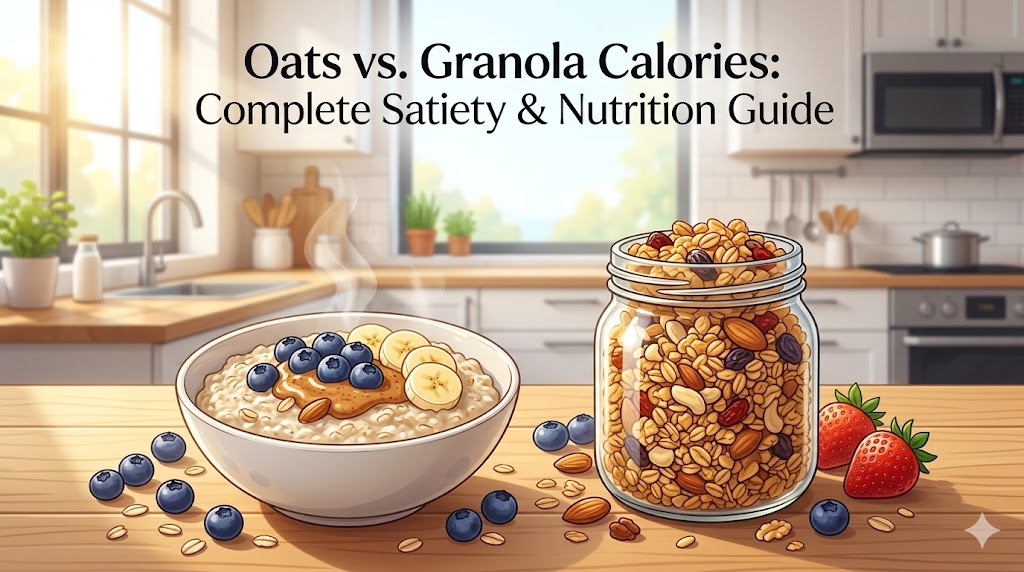
Picture this: It's a crisp morning, and you’re standing in your kitchen staring at two breakfast champions—a steaming bowl of cozy oatmeal and a jar of crunchy, golden granola. Both look incredibly healthy, and both share a botanical family tree rooted in the humble whole oat groat (Avena sativa).
But when it comes to your fitness and weight loss goals, these two breakfast favorites are actually worlds apart. While one is a low-calorie volume superstar, the other is an energy-dense powerhouse that can sneakily add extra calories to your day if you aren't careful.
To help you choose the best option for your morning routine, let's dive into a friendly oats vs granola calories comparison to see how they stack up under the microscope. And if you've ever struggled to eyeball the right serving size, voice-activated calorie trackers like VoCal can take the guesswork out of logging your breakfast with a simple spoken sentence.
Key Takeaways
Calorie Density: Cooked oatmeal is mostly water, meaning you get a huge, filling portion for very few calories. Granola is dry and baked with fats and sugars, packing a high caloric punch into a tiny handful.
Sugar Traps: Commercially baked granola often hides as much sugar as a dessert, whereas plain oats have almost zero sugar.
Satiety Superpowers: Pure oats contain high amounts of beta-glucan, a soluble fiber that turns into a thick gel in your gut to keep you full for hours. Baking granola can break down these fibers, reducing their filling effect.
Portion Control: Granola is incredibly easy to over-pour. Using an app like VoCal lets you track your morning bowl using just your voice to prevent accidental calorie surpluses.
The Calorie Breakdown: Serving Size Comparison
At their core, rolled oats are simply oat groats that have been steamed and flattened into flat flakes, keeping the fiber-rich bran and nutrient-dense germ fully intact. Granola, on the other hand, starts with these same oat flakes but coats them in oil and liquid sweeteners before baking them into crispy, clustered goodness.
This baking process completely transforms their weight, volume, and caloric impact. A standard raw serving of rolled oats (1/2 cup or 40 g) sits at about 150 calories. Once cooked in water, those oats absorb the liquid, swelling into a hearty, hot 1-cup bowl of oatmeal while staying at that light 150-calorie mark.
Granola, however, has had its water baked out of it, leaving a dry, dense food matrix. A tiny 1/2-cup scoop of homemade granola (60 g) clocks in at 283 calories. If you casually pour a full 1-cup bowl (120 g to 122 g) without measuring, you are looking at an easy 565 to 597 calories before even adding milk or yogurt.
To see how they compare, here is the nutritional breakdown per 100 g of raw rolled oats versus baked homemade granola, using verified data from the United States Department of Agriculture (USDA) FoodData Central.
Nutritional Component | Whole-Grain Rolled Oats (100 g) | Homemade Baked Granola (100 g) | Cooked Plain Oatmeal (100 g) |
Energy (Atwater) | 382 kcal | 471 kcal | 71 kcal |
Protein | 13.5 g | 10.3 g | 2.5 g |
Total Lipid (Fat) | 5.89 g | 20.3 g | 1.4 g |
Carbohydrate | 68.7 g | 64.4 g | 12.0 g |
Total Dietary Fiber | 10.4 g | 5.0 g | 1.7 g |
Total Sugars | 0.8 g | 24.5 g | 0.2 g |
Saturated Fat | 1.21 g | 4.81 g | 0.24 g |
Sodium | 1.0 mg | 7.4 mg | 0.0 mg |
Thiamin (B1) | 0.406 mg | 0.300 mg | 0.075 mg |
Magnesium | 126.0 mg | 110.0 mg | 23.0 mg |
Phosphorus | 387.0 mg | 260.0 mg | 65.0 mg |
Iron | 4.34 mg | 3.50 mg | 0.80 mg |
If we look at this mathematically, we can calculate the calorie density (D) of our breakfast using a simple formula:
D = E / M
where E is the total calories and M is the weight of the food in grams. Cooked oatmeal has an incredibly low calorie density (D approx 0.71 kcal/g), while granola sits at a high calorie density (D approx 4.71 kcal/g). That is a staggering tenfold difference in concentration! It explains why cooked oatmeal keeps you satisfied on fewer calories, while granola makes it easy to accidentally overeat.
Why Granola Packs More Calories: The Hidden Culprits
How does a wholesome oat flake turn into a caloric heavyweight? It all comes down to what happens in the kitchen. To make granola golden and crunchy, recipes require a mix of fats and liquid sugars to act as binders.
Fats and Sweeteners
Added Oils: Coconut oil, canola oil, or butter are folded into the mix to make the grains crisp up beautifully during baking. Because fats carry 9 calories per gram—more than double the calories of carbs or protein—they raise granola's fat profile to over 20.3 g per 100 g.
Liquid Gold (And Sugar): Maple syrup, honey, brown sugar, or agave are drizzled on to bind the clusters. This raises the sugar content of granola to a high 24.5 g per 100 g.
To make matters more dense, granolas are often mixed with dried fruits (like raisins or cranberries), seeds, and nuts. While nuts and seeds provide fantastic heart-healthy fats, they are also highly caloric.
Dried fruit, too, is a concentrated source of sugar. Since the water has been pulled out of it, dried fruit has a much higher calorie density than fresh fruit. For example, a single cup of raisins delivers about 480 calories, whereas a cup of fresh, juicy grapes is only 104 calories!
All those added syrups mean that a single 100-gram serving of granola can meet or exceed the American Heart Association’s recommended daily limit for added sugars (24 g for women and 36 g for men) in one go. Consuming too much added sugar over time is linked to increased visceral (belly) fat, insulin resistance, and cardiovascular strain.
Which Helps You Lose Weight Faster: Oatmeal or Granola?
If your goal is shedding body fat, you need to maintain a consistent daily calorie deficit. Generally, aiming for a deficit of 500 to 750 calories per day helps you lose a steady, healthy 1.0 to 1.5 pounds a week. But the secret to sticking to a deficit is choosing foods that keep your stomach happy so you aren't fighting constant hunger pangs.
The Science of "Stomach Stretching"
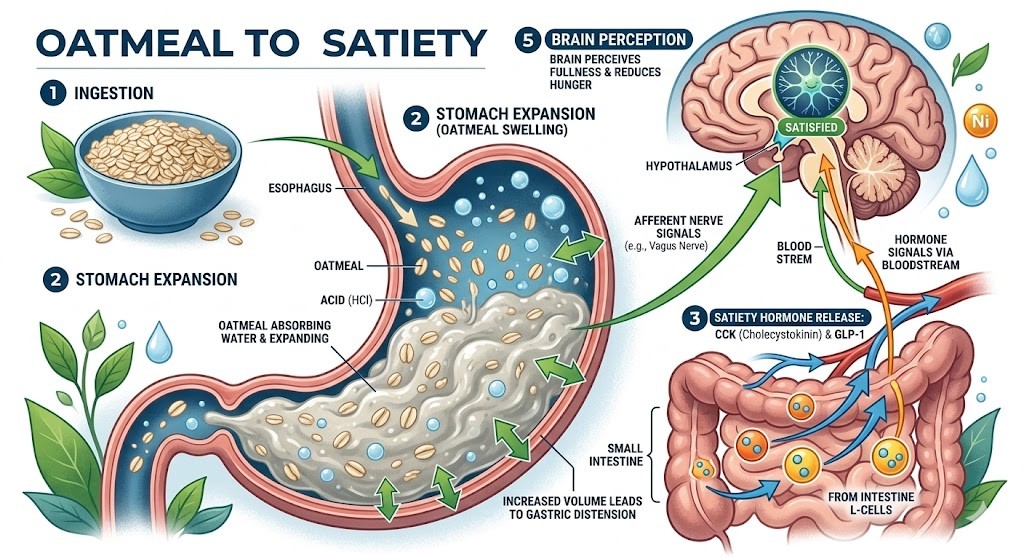
Your stomach has physical stretch receptors that monitor how much volume you've eaten. When a high-volume food fills your stomach, these receptors tell your brain to release satiety hormones like peptide YY and suppress hunger hormones like ghrelin.
Because cooked oatmeal absorbs water, it takes up a lot of physical space in your tummy, signaling that you are full on very few calories. Granola is so compact that you need to eat a much larger, highly caloric portion to trigger those same fullness stretch receptors.
The "Food Reward" Trap
Ever notice how it's hard to stop eating granola? That is due to the "food reward" effect. Foods that combine crispy lipids (fats) and sweet sugars are highly rewarding to our brains, activating pleasure pathways that make us want to keep munching even if we aren't physically hungry.
Plain oatmeal has a much lower food reward value, which naturally keeps us from overeating. Plus, the complex starches in oats digest slowly, keeping your blood sugar and insulin levels on a steady, smooth ride rather than a roller-coaster spike and crash.
Overnight Oats vs. Crunchy Granola: Satiety and Protein Compared
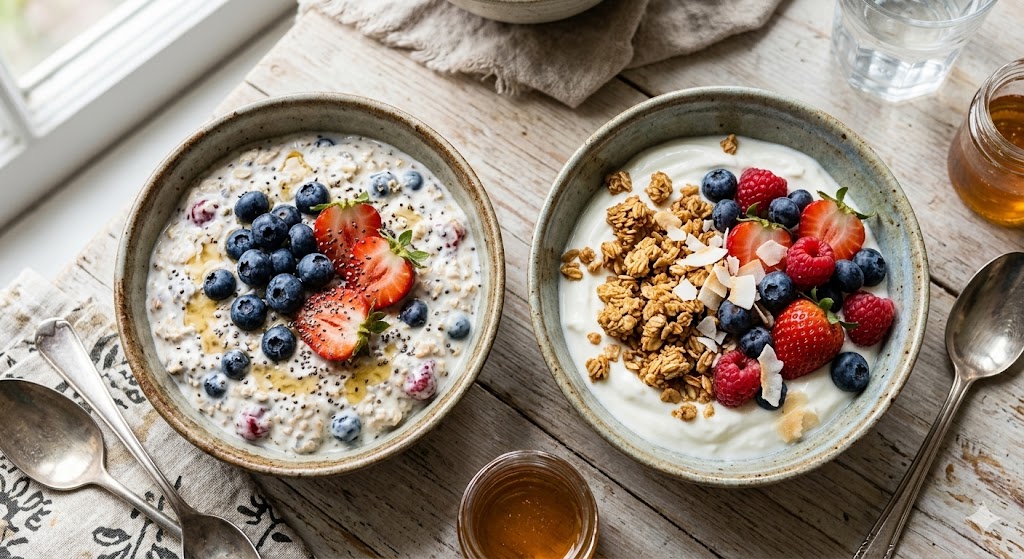
For fans of cold breakfasts, the daily battle is usually between overnight oats and yogurt bowls topped with crunchy granola. Both feel incredibly trendy and healthy, but their digestion rates and caloric footprints are very different.
The Overnight Oats Advantage
Overnight oats are made by soaking raw oats in a liquid like milk, soy milk, or water in the fridge overnight. This slowly hydrates and softens the oats, preserving their fiber structure while making them gentle on your digestion.
A standard overnight oats cup mixed with unsweetened applesauce, Greek yogurt, and chia seeds is highly balanced:
Calories: 193 kcal
Protein: 11.0 g
Fiber: 6.0 g
Fat: 4.0 g
More premium recipes loaded with extra nuts or seeds can offer up to 29.5 g of muscle-supporting protein and 7.4 g of fiber for 426 calories. The Greek yogurt supplies high-quality protein to support lean muscle and keep your hunger quiet, while the chia seeds expand to form a gel that slows digestion down to a peaceful crawl.
Yogurt Bowls with Granola
Yogurt topped with fresh berries and granola is a classic breakfast option. However, adding just 1/2 cup of standard granola introduces around 283 calories, 12.2 g of fat, and 14.7 g of sugar to your bowl. Because granola doesn't absorb liquid and swell up like overnight oats, it doesn't add much physical volume to your stomach.
Even though the yogurt provides excellent protein, the granola can easily double your meal's energy content without making you feel any fuller.
The Fiber Factor: How Oat Beta-Glucan Keeps You Full
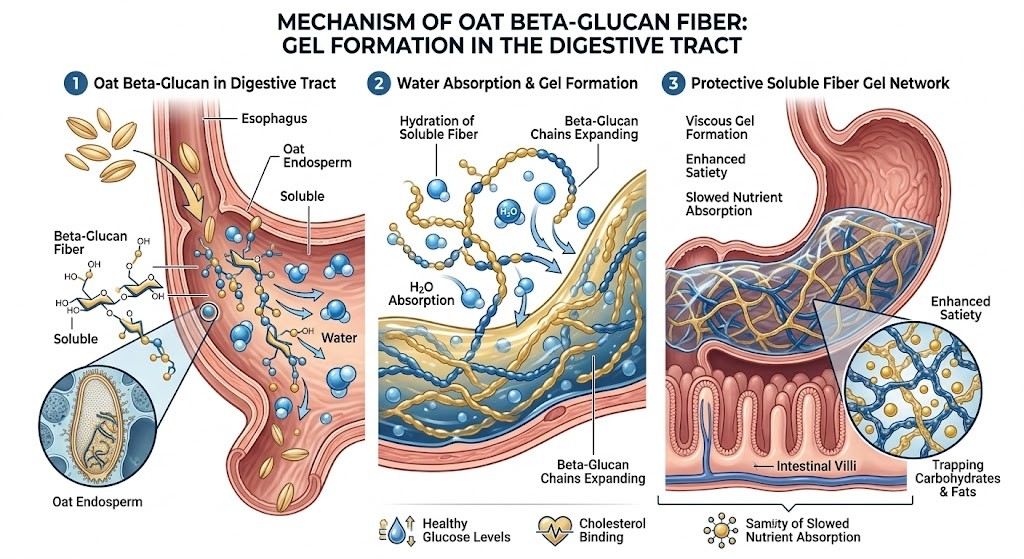
The real secret weapon inside oats is beta-glucan, a unique soluble fiber nestled inside the oat kernel's cell walls. Raw rolled oats contain about 3.82 g of beta-glucan per 100 g.
When beta-glucan mixes with water in your digestive tract, it dissolves and forms a thick, viscous gel. This gel acts like a gentle speed bump in your gut:
Slows Down Emptying: It keeps food in your stomach longer so you feel satisfied.
Gradual Nutrient Absorption: It slows down the absorption of glucose, preventing sudden blood sugar spikes.
Cleanses Cholesterol: The gel binds to cholesterol-rich bile acids and helps carry them out of your body. This prompts your liver to pull bad LDL cholesterol out of your blood to make more bile, lowering your overall cholesterol levels. This powerful heart benefit is why the FDA approved a dedicated heart-health claim for oats back in 1997.
However, the physical benefits of beta-glucan depend heavily on its structure being kept intact. The high-heat baking, processing, and mechanical rolling used to make commercial granola can break down these long fiber chains, reducing their ability to form a thick, protective gel in your gut.
Smarter Breakfast Tracking: How to Log Your Portions Painlessly
Because granola is so compact, our eyes are terrible at estimating how much we've actually poured. It is incredibly common to pour out a 1-cup portion (597 calories) when you visually estimated it as a 1/4-cup portion (141 calories), leading to a hidden calorie surplus that can stall your progress.
To keep your tracking completely stress-free, the voice-activated app VoCal lets you log your food using natural speech. Instead of typing, measuring, or scrolling through endless databases, you can just speak your meal out loud:
"I had half a cup of raw rolled oats soaked in half a cup of unsweetened soy milk, topped with a tablespoon of almond butter and a quarter cup of blueberries."
VoCal instantly processes your words, identifies the ingredients, and logs them accurately using verified USDA data:
Raw Rolled Oats (1/2 cup): 150 kcal
Unsweetened Soy Milk (1/2 cup): 40 kcal
Almond Butter (1 tbsp): 95 kcal
Fresh Blueberries (1/4 cup): 20 kcal
Total Breakfast Intake: 305 kcal
This voice logging feature prevents visual portion errors. The table below shows how visual errors can accumulate when tracking granola compared to cooked oatmeal.
Food Item | Intended Visual Serving | Actual Volumetric Serving (Unmeasured) | Intended Energy | Actual Energy | Caloric Discrepancy |
Plain Cooked Oatmeal | 1/2 cup (dry equivalent) | 1 cup (cooked) | 150 kcal | 150 kcal | 0 kcal (high-volume buffer) |
Baked Granola | 1/4 cup (28 g) | 1 cup (122 g) | 141 kcal | 597 kcal | +456 kcal (unintended surplus) |
When you are working to lose weight, your body's metabolism naturally adapts as your weight decreases, requiring you to be more precise with your intake to keep seeing results. Using VoCal gives you a low-friction, conversational way to track your meals, keeping your portions precise and your fat-loss goals on track.
The Verdict
When it comes to the ultimate breakfast showdown, plain rolled oats and overnight oats are the clear winners for fat reduction, heart health, and portion control. Their high water volume and intact beta-glucan fibers keep you full and satisfied with fewer overall calories.
Granola is a delicious, nutrient-dense treat packed with healthy fats from nuts and seeds, but its high sugar and fat content make it highly caloric and easy to overeat. Think of granola as a premium topping to be enjoyed in small, measured sprinkles rather than eating it by the bowlful.
By using a voice-activated tracking tool like VoCal, you can enjoy your morning bowls with absolute precision, logging your meals with a simple sentence to keep your healthy journey smooth and stress-free.
Frequently Asked Questions (FAQs)
Can I eat raw oats?
Yes, you can absolutely eat raw oats! However, eating them completely dry can be tough on your digestion. Try soaking them in water or your favorite milk for a few hours (or overnight) first; this softens the flakes and makes it much easier for your body to digest and absorb their wonderful nutrients.
Why does granola have so many more calories than oatmeal?
While both start with whole oats, granola is baked with oils (like coconut or canola oil) and sweeteners (like honey, sugar, or maple syrup) to create those crunchy clusters. It also often includes energy-dense ingredients like nuts, seeds, and dried fruit. Since the water is baked out, it packs a massive amount of calories into a small, dry volume compared to water-swollen cooked oatmeal.
Is steel-cut oatmeal better for weight loss than rolled oats?
Both types offer nearly identical amounts of fiber, protein, and heart-healthy beta-glucan. However, because steel-cut oats are minimally processed, they take longer for your body to break down. This leads to a slower, more gradual rise in blood sugar, making them slightly better for appetite control and sustained energy.
What is the recommended serving size for oats and granola?
The standard serving size for dry rolled oats is 1/2 cup (about 40 g), which cooks up to a highly satisfying 1 cup of hot oatmeal. For granola, a standard serving is typically only 1/4 cup to 1/2 cup (about 30 g to 60 g). Because granola is so calorie-dense, tracking it precisely is highly recommended.
Disclaimer: This article is for informational purposes only and does not substitute for professional medical advice, diagnosis, or treatment. Always consult a healthcare provider or registered dietitian before making significant changes to your diet or training routine.