

Oatmeal and granola are both absolute superstars of the breakfast aisle. They both start with the exact same healthy ingredient—whole-grain oats—but how they end up in your bowl is a completely different story.
If you have ever stared at your breakfast bowl wondering why your weight loss goals are playing hide-and-seek, the culprit might be your choice of morning cereal. Let's break down the ultimate breakfast showdown so you can make the healthiest choice for your morning routine.
What Is Oatmeal?
At its core, oatmeal is simply minimally processed rolled or steel-cut oats. These oats are steamed and flattened (or cut into small pieces) without any extra oils, artificial preservatives, or added sugars. When cooked in water or low-fat milk, they absorb liquid and expand, turning into a warm, creamy, and highly volumizing meal.
What Is Granola?
Granola takes those same oats and gives them a crispy, sweet makeover. To make granola, rolled oats are tossed with sweeteners (like honey, maple syrup, or sugar) and oils, clustered together with nuts, seeds, or dried fruit, and baked in an oven until perfectly crunchy. While it is incredibly delicious and packed with healthy fats, this processing turns it into a highly concentrated, calorie-dense food.
Oats vs. Granola Calories: The Serving Size Showdown
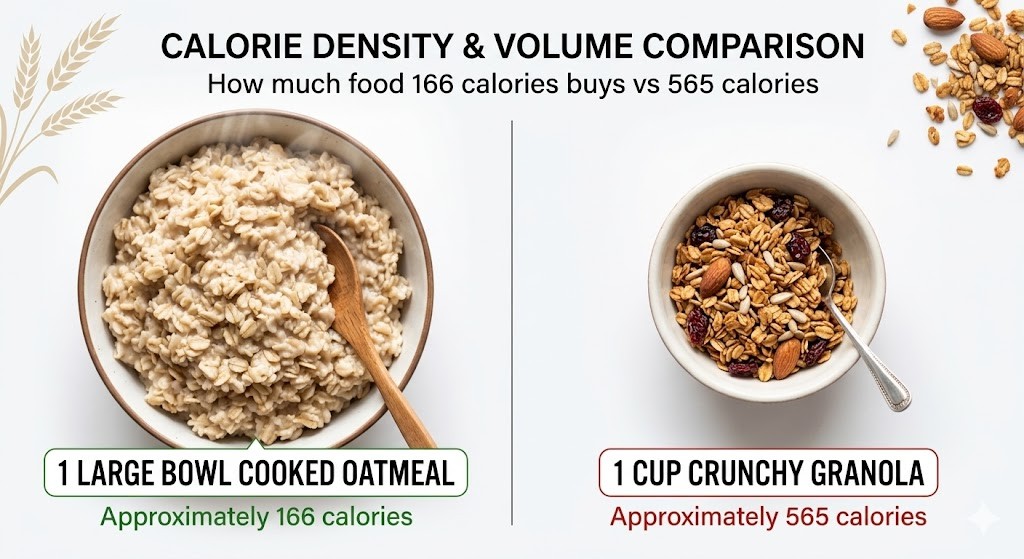
When it comes to weight management, energy density is the name of the game. Energy density refers to how many calories a food has relative to its physical weight. We can calculate it using this simple formula:
Energy Density =(Total Energy (kcal))/ (Weight (g))
When oats and granola are dry, their energy densities are actually somewhat close. But once you prepare them for breakfast, a massive gap opens up.
To see why, let's look at this oats vs granola calories comparison:
Food Product | USDA FoodData Central ID | Volume Measure | Weight (g) | Energy (kcal) | Energy Density (kcal/g) |
Old Fashioned Oats (Dry) | FDC 980451 | 1/2 Cup | 40.0 | 150 | 3.75 |
Cooked Oatmeal (Water) | FDC 173905 | 1 Cup | 234.0 | 166 | 0.71 |
Standard Granola (Dry) | N/A | 1/2 Cup | 60.0 | 283 | 4.71 |
Standard Granola (Dry) | N/A | 1 Cup | 120.0 | 565 | 4.71 |
Mayo Clinic Granola | N/A | 1/2 Cup | ~40.0 | 154 | 3.85 |
Harvard Low-Sugar Granola | N/A | 1/2 Cup | ~65.0 | 261 | 4.01 |
Here is the secret: cooking oatmeal in water dilutes its energy density down to a mere 0.71 kcal/g because the oats absorb so much moisture. On the flip side, granola stays completely dehydrated, keeping its density at a whopping 4.71 kcal/g.
This means that if you are looking for a How Many Calories Are in Oats vs Granola? Serving Size Comparison, eating a single cup of dry granola will set you back 565 calories. For that exact same cup size, a bowl of cooked oatmeal is only 166 calories. You would have to eat over three giant bowls of oatmeal to match the calorie count of just one cup of granola!
Macronutrient Matchup: Sugar, Fat, and Fiber
Calories do not tell the whole story. The nutrients inside your breakfast bowl affect how you feel, your blood sugar levels, and your energy throughout the day.
Here is how 100 grams of each option compare side-by-side:
Nutrient Component (per 100g) | Raw Rolled Oats | Standard Granola | Homemade Granola (with Nuts/Seeds) | Cooked Oatmeal (in Water) |
Energy (kcal) | 375.00 | 471.00 | 1790.00 | 71.00 |
Protein (g) | 12.50 | 10.30 | 50.00 | 2.50 |
Total Fat (g) | 7.50 | 20.30 | 89.00 | 1.50 |
Saturated Fat (g) | 1.00 | 3.50 | 14.50 | 0.31 |
Carbohydrates (g) | 67.50 | 64.40 | 197.20 | 12.00 |
Dietary Fiber (g) | 10.00 | 5.00 | 32.60 | 1.70 |
Total Sugars (g) | Trace (~0.0) | 24.50 | 72.50 | 0.27 |
Note: The whole-recipe values for homemade granola represent a larger batch size.
The Sugary Truth
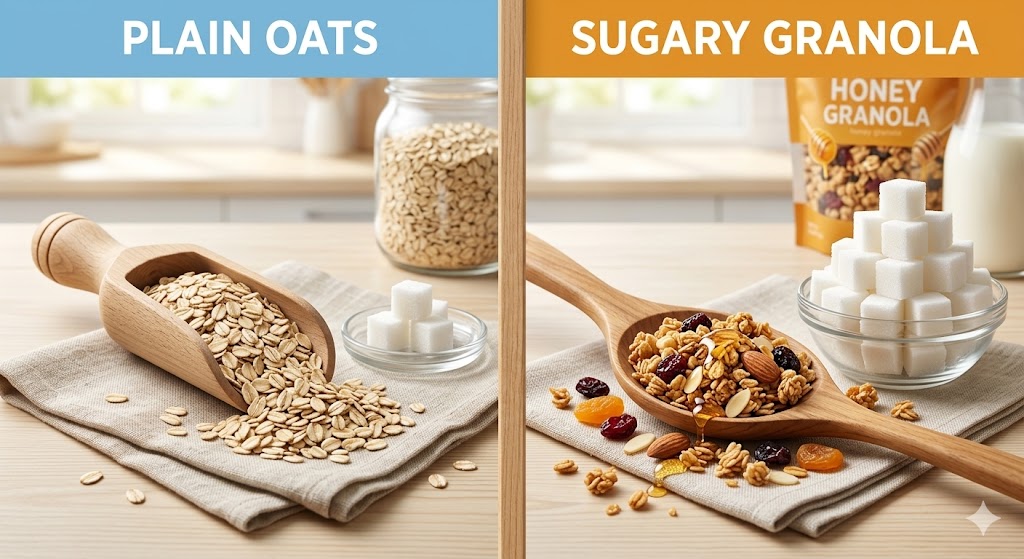
While raw oats have virtually zero sugar, commercial granola averages a staggering 24.5% sugar by weight. These added sugars can cause your blood sugar to spike and crash, leaving you feeling tired and reaching for snacks long before lunchtime.
The Fat Factor
Naturally, oats are a very low-fat food. Granola contains about three times the fat of raw oats because of the oils used to make it crispy and the addition of nuts and seeds. While nuts and seeds provide highly beneficial, heart-healthy unsaturated fats, they also heavily drive up the overall calorie count.
Satiety and the "Portion Distortion" Trap
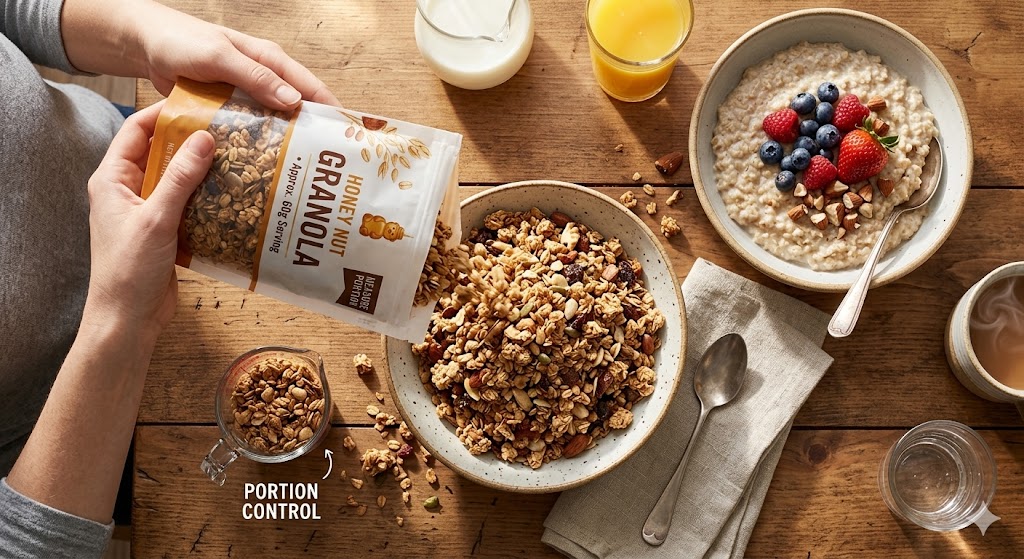
Why is it so easy to overeat granola? It all comes down to portion distortion.
Because granola is so crunchy and compact, a real-world serving size is surprisingly small—usually just 1/4 to 1/2 of a cup. When we pour granola by eye, we often accidentally dump a full cup (or more!) into our bowl, unknowingly consuming over 500 calories before we even add milk or yogurt.
Oatmeal, however, is a satiety champion. It physically fills up your stomach, which sends strong "I'm full" signals to your brain.
Oats are also loaded with beta-glucan, a special kind of soluble fiber. When cooked, beta-glucan forms a thick, gel-like texture in your digestive tract. This gel slows down digestion, keeps your blood sugar stable, and even helps lower bad LDL cholesterol.
Tracking Made Easy: Speak Your Breakfast with VoCal
Let’s face it: tracking these foods in a standard food diary app can be a massive headache.
If you accidentally log a cup of dry oats instead of a cup of cooked oatmeal, you might think you ate 300+ calories when you only had 166. Conversely, guessing how much granola you sprinkled on your morning yogurt can easily lead to hundreds of unlogged, "stealth" calories creeping into your day.
That is where VoCal makes life incredibly simple. Instead of scrolling through endless, confusing database entries, you can just speak your breakfast naturally:
"I had a cup of cooked old-fashioned oatmeal with a handful of blueberries and a tablespoon of raw walnuts."
Our advanced voice-recognition system instantly recognizes the difference between dry and cooked portions, calculates your exact nutritional breakdown, and logs it perfectly in seconds. No more math, no more guessing games.
Which One Wins the Breakfast Battle?
Both oats and granola can absolutely be part of a healthy lifestyle, but your choice should match your daily goals:
Choose Cooked Oatmeal if: You want to lose weight, stay full for hours on fewer calories, or manage your blood sugar. Top it with fresh berries, cinnamon, or a splash of low-fat milk for extra flavor.
Choose Granola if: You are highly active, need quick energy, or simply want some crunch. Treat granola as a delicious garnish rather than the main event. A tablespoon or two sprinkled over high-protein, unsweetened Greek yogurt is the perfect compromise.
Conclusion
Whichever option you choose, using a hands-free voice tracker like VoCal will keep your portion sizes in check, helping you hit your nutrition goals one delicious bowl at a time!
Frequently Asked Questions (FAQs)
Is granola healthier than oatmeal?
Not necessarily. While granola can offer beneficial protein and heart-healthy fats from added seeds and nuts, it also often contains high amounts of added oils and sugar. Oatmeal remains the lower-calorie, sugar-free whole-grain baseline.
Why are the calories in cooked oatmeal so much lower than dry oats?
As oats cook, they absorb water or milk, expanding significantly in size and weight. This processes dramatically dilutes their energy density, adding physical volume to keep you full without adding extra calories.
Can I eat granola on a weight loss diet?
Yes! The key is treating granola as a flavorful garnish rather than the main base of your bowl. Stick to a portion size of 1 to 2 tablespoons sprinkled over plain Greek yogurt or low-calorie fruit.
Disclaimer: This article is for informational and educational purposes only and is not intended as medical or professional nutrition advice. Please consult with a healthcare professional or registered dietitian before starting any new dietary plan.