

If you have ever stepped foot in a bodybuilding gym, you have probably seen the classic meal prep containers: rows of chicken, broccoli, and either a scoop of rice or a golden mound of sweet potato.
Carbs are the ultimate fuel for high-intensity lifting. While protein gets all the love for building muscle, carbohydrates are what actually fuel your workouts, keep your muscles looking full, and help you recover after a brutal leg day.
Packing a sweet potato for gym days is a classic fitness move, but how does it actually stack up against your trusty bowl of rice? Let’s dive into the science of sweet potatoes versus white and brown rice to help you choose the perfect carb for your fitness goals.
Quick Jump Links
Why Carbs Are Your Muscles' Best Friends
Sweet Potato vs. Rice: The Ultimate Nutrition Face-off
Satiety: How to Avoid Becoming a "Hangry" Gym Monster
Timing Is Everything: Pre-Workout vs. Post-Workout
Micronutrients: The Secret Recovery Helpers
Track Your Gains Without the Brain Strain
The Bottom Line
Frequently Asked Questions (FAQs)
Why Carbs Are Your Muscles Best Friends
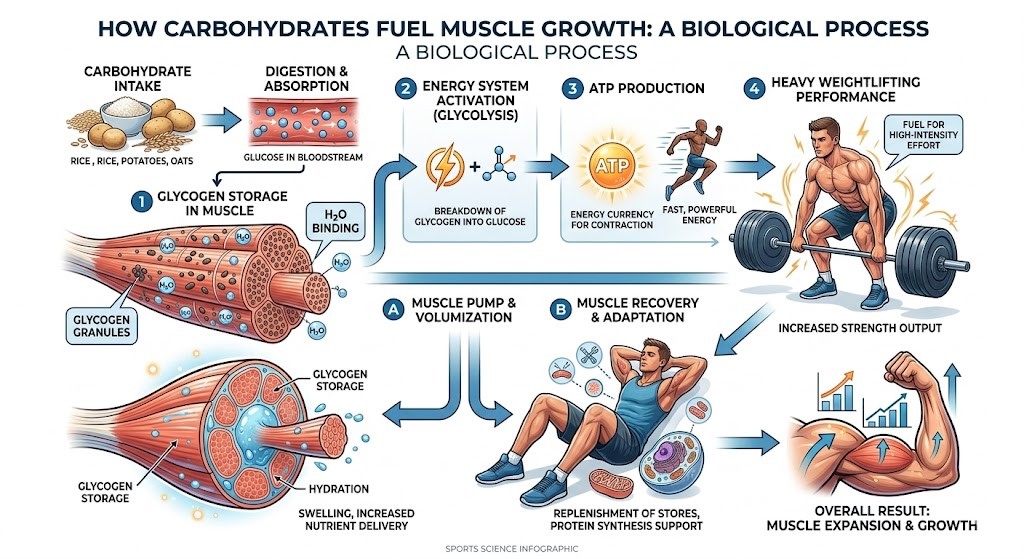
To understand why bodybuilders obsess over carbs, we have to look inside the muscle cell. Your body stores carbs as glycogen. When you lift heavy weights, your muscles use this glycogen to create adenosine triphosphate (ATP), which is the literal energy currency your muscles use to contract.
A tough, one-hour weight training session can deplete your muscle glycogen stores by about 16%. If you do not replenish these stores, your next workout is going to feel like lifting in quicksand.
Carbs also play a massive role in how "pumped" your muscles look. Every single gram of glycogen you store in your muscles holds onto about 3 grams of water. This water expands your muscle cells, giving you that full, hydrated look that strength athletes love.
When people go on extreme low-carb diets, their insulin levels drop, causing their kidneys to quickly flush out water and sodium. While stepping on the scale and seeing a sudden drop in "weight" feels exciting, much of it is just water loss from your muscle cells, which can leave your muscles looking flat and your joints feeling achy.
Sweet Potato vs. Rice: The Ultimate Nutrition Face-off
To figure out which carb belongs on your plate, let’s look at how they compare side-by-side. The United States Department of Agriculture (USDA) database shows some clear differences in calorie and carb density.
Here is how a 100-gram (about 3.5 ounces) cooked serving of each stacks up:
Nutrient (per 100g cooked portion) | Boiled Sweet Potato | Cooked Brown Rice | Cooked Long-Grain White Rice |
Energy (Calories) | 76 kcal | 111-112 kcal | 130 kcal |
Water Content | 80.0% | 73.2% | 68.6% |
Protein | 1.4 g | 2.3 g | 2.38 g |
Total Carbohydrates | 17.7 g | 23.6 g | 28.59 g |
Dietary Fiber | 3.0-4.4 g | 1.8 g | 0.3 g |
Total Lipids (Fat) | 0.14 g | 0.8 g | 0.21 g |
Potassium | 230-440 mg | 79 mg | 29-35 mg |
Magnesium | 18-54 mg | 44 mg | 12-13 mg |
Calcium | 27 mg | 10 mg | 3 mg |
Vitamin A (Beta-Carotene) | 787 mcg | 0 mcg | 0 mcg |
Vitamin C | 13 mg | 0 mg | 0 mg |
As you can see, sweet potatoes are less calorie-dense than rice. That is because they have a higher water content (80%). While a scoop of white rice is awesome for packing in the calories during a bulking phase, sweet potatoes are a fantastic tool when you are trying to cut fat but still want to eat a satisfying volume of food.
Satiety: How to Avoid Becoming a "Hangry" Gym Monster
If you have ever been on a calorie-restricted diet, you know the struggle of wanting to chew your own arm off two hours after lunch. This is where the concept of "satiety"—the feeling of fullness between meals—comes in.
Scientists measure how full different foods keep us using a tool called the Satiety Index. Check out how boiled potatoes and sweet potatoes compare to other common carbs, using white bread as the baseline (100%):
Food Source (Isoenergetic Servings) | Satiety Index Rating (%) | Satiety Classification |
Boiled Potatoes / Sweet Potatoes | 323% | Extremely High Satiety |
Brown Pasta | 188% | High Satiety |
Oatmeal / Porridge | 209% | High Satiety |
White Rice | 138% | Moderate Satiety |
Brown Rice | 132% | Moderate Satiety |
White Pasta | 119% | Moderate Satiety |
Croissant | 47% | Extremely Low Satiety |
Why are sweet potatoes such high-scorers on the fullness scale?
The "Gastric Stretch" Effect: Because boiled sweet potatoes are packed with water, they take up more physical space in your stomach. This activates physical stretch receptors in your stomach wall, which instantly send a memo to your brain saying, "We are officially full!"
Slower Digestion: Sweet potatoes contain soluble fibers like pectin, which slow down your digestion. This gradual digestion triggers the release of hunger-suppressing hormones like peptide YY (PYY) and cholecystokinin (CCK), keeping your appetite locked down for hours.
The rate at which a carb source raises your blood sugar is called the Glycemic Index (GI), and the overall impact of a realistic serving size is called the Glycemic Load (GL).
Glycemic Load (GL)= (Glycemic Index (GI)* Net Carbohydrates(g)) / 100
While white rice has a high GI (around 70 to 89) and digests rapidly, boiled sweet potatoes have a much lower GI of 44 to 63, meaning they give you a slow, steady trickle of energy instead of a massive spike and crash.
Timing Is Everything: Pre-Workout vs. Post-Workout
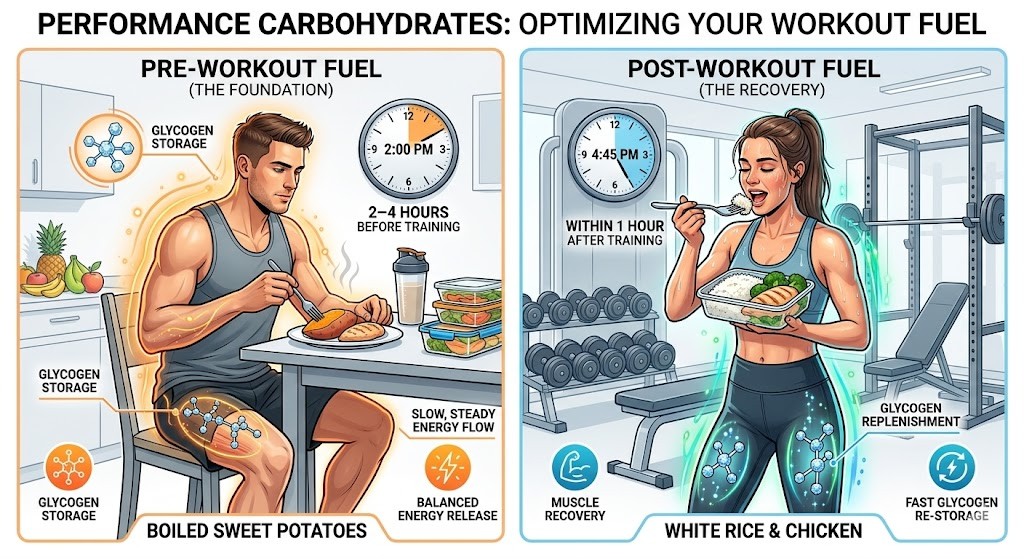
When it comes to bodybuilding, when you eat your carbs is almost as important as what you eat.
Your Pre-Workout Strategy
Choosing a slow-digesting sweet potato for gym fuel a few hours before you lift can keep your energy levels steady through your entire workout. Eating a boiled sweet potato 2 to 4 hours before your workout gives your body plenty of time to digest the food and pack your muscles with ready-to-use energy.
Pro Tip: Avoid eating high-fiber foods within an hour of your workout, as your body will divert blood flow away from your stomach to your working muscles, which can lead to bloating.
Your Post-Workout Strategy
Once your workout is done, the goal flips to rapid recovery. This is where white rice shines. Because white rice has had its fiber and fat-rich outer layer removed, it digests incredibly fast.
This rapid digestion creates a quick insulin spike, which acts like a key, unlocking your muscle cells to rapidly pull in glucose and kickstart the recovery process.
Micronutrients: The Secret Recovery Helpers
Muscles need more than just calories to grow—they also need vitamins and minerals to function properly.
Cramp-Busting Electrolytes
To make your muscles contract during a heavy lift, your cells rely on electrolytes like potassium and magnesium. If you sweat heavily and run low on potassium, you are looking at muscle weakness and painful cramps.
Sweet potatoes are absolute potassium powerhouses, delivering 230 to 440 mg per 100-gram serving compared to white rice's meager 29 to 35 mg. They also provide a solid dose of magnesium, which helps your muscles relax after a hard training session.
Fighting Muscle Soreness
Intense lifting actually causes tiny micro-tears in your muscles, creating temporary inflammation and oxidative stress (hello, delayed onset muscle soreness!). Sweet potatoes are loaded with antioxidants like beta-carotene (which your body turns into vitamin A) and vitamin C.
Purple sweet potatoes are also packed with anthocyanins, which have been shown to help reduce muscle inflammation, protect your cells, and speed up overall recovery so you can get back to the gym sooner.
Track Your Gains Without the Brain Strain
Let's be honest: fumbling with a scale, typing into search bars, and trying to guess the exact weight of your sweet potato while your hands are tired from lifting is a hassle.
This is where the voice-based calorie tracker VoCal completely changes the game. Instead of typing out your meals, you can simply tap a button and speak naturally:
"I just had one medium boiled sweet potato, six ounces of grilled chicken breast, and one cup of white rice."
The application’s AI automatically parses your meal, breaks down the macronutrients, and logs your calories in seconds. It is up to 98% accurate and takes the friction out of diet tracking so you can focus on your training, not on spreadsheets.
The Bottom Line
Neither sweet potatoes nor rice is a "bad" carb—they are simply different tools for different jobs.
Choose sweet potatoes during a fat-loss phase to keep your hunger levels at bay, or as a pre-workout meal 2 to 4 hours before training for sustained energy.
Choose white rice post-workout to quickly spike insulin and speed up muscle recovery, or during a bulking phase when you need to consume high volumes of clean calories without feeling bloated.
By strategically swapping between these two carb sources, you can keep your energy high, your muscles full, and your recovery on point.
Frequently Asked Questions (FAQs)
Is white rice better than brown rice for bodybuilding?
It depends on when you eat it! White rice is digested in a flash because it lacks fiber, making it the perfect post-workout fuel to jumpstart recovery. Brown rice, which retains its fiber-rich outer bran layer, digests slower and is a great source of steady, complex carbohydrates for standard meals. However, brown rice can cause bloating if eaten too close to training.
Can I eat sweet potato skin?
Absolutely! Eating the skin of a sweet potato roughly doubles its fiber content and contains essential vitamins and minerals. Just make sure to wash it thoroughly before boiling or baking!
How many carbs do I need per day to build muscle?
While individual needs vary based on your size and training volume, a general guideline for strength athletes and active gym-goers is to aim for roughly 4 to 7 grams of carbohydrates per kilogram of body weight daily.
Is a baked sweet potato better than a boiled sweet potato?
Boiling is actually the preferred cooking method for keeping the Glycemic Index (GI) low (around 44 to 63). Baking or roasting sweet potatoes breaks down the starches into simple sugars, which can spike the GI score to over 90. For steady energy, stick to boiling.
Disclaimer: This article is for informational purposes only and does not substitute for professional medical advice, diagnosis, or treatment. Always consult a healthcare provider or registered dietitian before making significant changes to your diet or training routine.