

Picture this: You are walking down the supermarket breakfast aisle, feeling like an absolute health superstar. You reach for a bag of crunchy, rustic-looking granola, thinking it is the ultimate fuel for your active lifestyle. But when you look at the back of the bag, you realize a tiny handful has about as many calories as a slice of birthday cake. What gives?
It is one of the classic morning dilemmas: the oats vs granola calories comparison. While both of these breakfast favorites start their lives as the exact same humble grain, they end up in wildly different neighborhoods when it comes to nutrition.
Here is a side-by-side comparison to help you understand exactly what you are putting in your breakfast bowl.
Side-by-Side Nutritional Scorecard
To see how these two stack up, let us look at the numbers. Here is the raw data per 100 grams (about 3.5 ounces) for uncooked oats, oatmeal cooked in water, and standard commercial granola:
Nutrient (per 100g) | Uncooked Oats | Cooked Oatmeal (in Water) | Standard Commercial Granola |
Energy (kcal) | 389.0 | 65.8 | 471.0 |
Protein (g) | 16.89 | 2.3 | 10.3 |
Total Lipids/Fat (g) | 6.9 | 1.1 | 20.3 |
Carbohydrates (g) | 66.27 | 11.5 | 64.4 |
Dietary Fiber (g) | 10.6 | 1.7 | 5.0 |
Total Sugars (g) | 0.0 | 0.0 | 24.5 |
Sodium (mg) | 2.0 | 1.0 | 257.0 |
The Volumetric Trick: Why Cooking Changes Everything
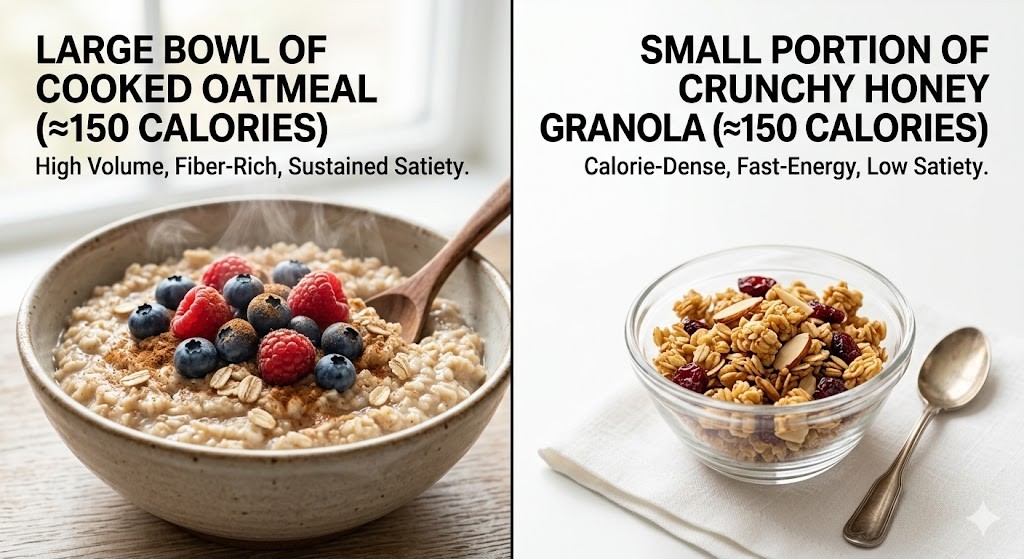
Why is there such a massive calorie gap when you actually sit down to eat? It all comes down to water and volume.
When you cook a cup of rolled oats, the starches absorb water and expand. That hot, comforting bowl of oatmeal is mostly water weight, giving you a highly satisfying, stomach-filling portion for only about 124 to 154 calories.
Granola goes in the opposite direction. It is baked and dehydrated to give you that signature satisfying crunch. Because all the moisture is removed, granola is highly concentrated. This means you can easily eat multiple servings' worth of calories in a single sitting without your stomach realizing it has been fed.
Why Granola Is Higher in Calories Than Oats?
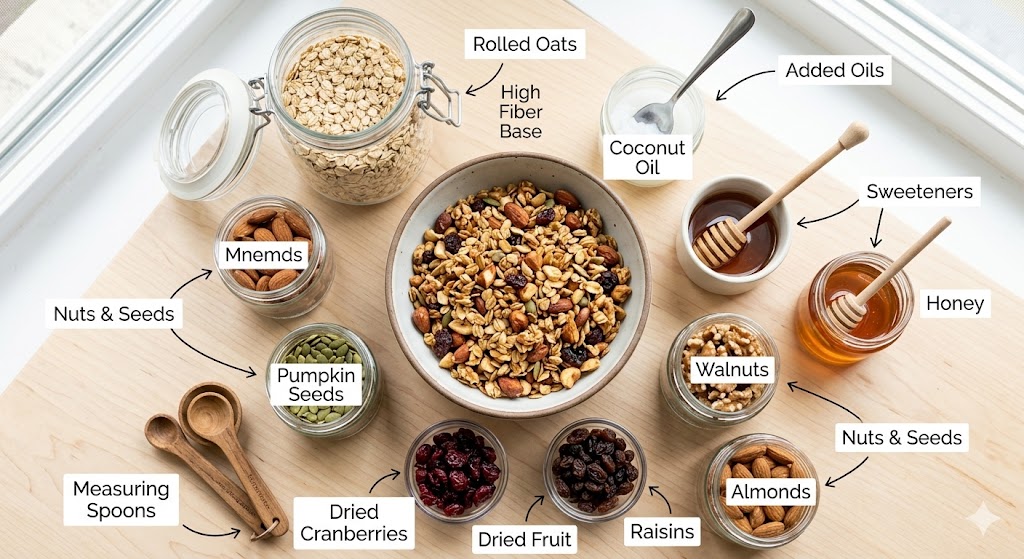
If granola is made from oats, why is it such a heavyweight on the calorie scale? The secret lies in how it is processed. To turn loose, flat oats into those clumpy, golden clusters we all love, manufacturers have to rely on a few calorie-dense "hidden" ingredients.
Baked-In Oils and Fats
Plain oats are naturally very low in fat—carrying just about 6.9 grams per 100-gram serving. But to get that crispy, melt-in-your-mouth texture, granola is coated in oil (like canola, coconut, or olive oil) or butter before it hits the oven. Since fat packs 9 calories per gram—more than double the calories of carbs or protein—even a light drizzle of oil sends the calorie count soaring. Some specialty olive oil granolas contain up to 12 grams of fat per small serving!
Sticky, Sweet Binders
How do you get oats to stick together? You glue them with sugar. Manufacturers use liquid sweeteners like honey, molasses, maple syrup, sucrose, or brown sugar syrup as binding agents to create those crunchy clusters.
In fact, a study of commercial breakfast cereals found that sugar-related ingredients were listed in the top three ingredients for over 85% of products surveyed. This intensive sweetening means commercial granola averages a whopping 24.5 grams of sugar per 100 grams.
Calorie-Dense Add-Ins
Granola is rarely just oats and syrup. It is usually loaded with nuts (like almonds, walnuts, and cashews), seeds, and dried fruits. Don't get us wrong—nuts and seeds are packed with healthy, heart-safe fats. But they are also incredibly energy-dense. For instance, 100 grams of walnuts has 654 calories, and almonds carry 579 calories. Dried fruit is also stripped of water, leaving behind concentrated fructose that adds to the sweet calorie load.
To see how quickly these additions add up, look at how the calorie count changes in these popular overnight oat recipes:
Raspberry Apricot Oats (Plain Oats + Fruit): 399 calories
Blueberry Granola Oats (Oats + 1 tbsp Granola): 413 calories
Apple Walnut Raisin Oats (Oats + Nuts + Raisins): 447 calories
Peanut Butter Banana Oats (Oats + Peanut Butter + Peanuts): 561 calories
The Science: How Oatmeal and Granola Affect Your Body
Your body treats a bowl of plain oatmeal and a bowl of sugary granola very differently.
Oatmeal: The Satiety Champion
Oats are rich in a unique soluble fiber called beta-glucan. When you eat oatmeal, this fiber mixes with fluid in your stomach to form a thick, gooey gel. This gel slows down your digestion, keeping you feeling full for hours and preventing blood sugar spikes.
Consuming 3 grams of soluble fiber from oats daily can also help lower your "bad" LDL cholesterol by about 12 points, which is why oatmeal was the first food to earn an official heart-health claim from the FDA.
Granola: The Blood Sugar Roller Coaster
Because commercial granola is packed with simple sugars, it digests much faster than steel-cut or rolled oats. This rapid digestion causes a sharp surge of glucose in your bloodstream, forcing your body to pump out a wave of insulin.
Insulin is a hormone that tells your body to store extra energy as fat instead of burning it. And when that sugar rush inevitably crashes a couple of hours later, it can leave you feeling tired, foggy, and reaching for another mid-morning snack.
Shopping Guide: Deciphering the Nutrition Label
If you love the convenience of granola but want to protect your health goals, you have to become a nutrition label detective. Many boxes boast "all-natural" or "whole grain" claims while hiding dessert-level sugar stats.
Here is what you should look for on the back of the box:
First Ingredient: Make sure a whole grain (like whole-grain oats) is listed first.
Sugar Limits: Aim for cereals with less than 9 grams of total sugar per serving. For granola, try to stay under 5 grams of sugar per serving.
Added Sugars % DV: Look for 5% Daily Value (DV) or less per serving (which is low), and avoid anything near 20% DV (which is high).
Fiber and Protein: Shoot for at least 3 grams of fiber and a decent protein punch to keep you full.
Watch the Sodium: Sweet cereals often hide salt to boost the flavor. Aim for less than 140 to 150 milligrams of sodium per serving.
Track Your Breakfast Without the Guesswork
The biggest trap with granola is portion control. A standard serving of granola on a nutrition label is a tiny quarter-cup or 30 grams (about 130 calories). But let’s be honest: when we pour directly from the box, most of us easily pour a full cup (over 500 calories!).
This is where a voice-activated calorie tracker like the one at VoCal can save the day. Instead of squinting at a scale or typing in complex recipes, you can just tell the app exactly what you ate—like "half a cup of rolled oats cooked in water with a tablespoon of honey" or "one cup of honey almond granola." By logging your meals with your voice on Vo-cal.com, you get instant, accurate calorie counts that keep your nutrition on track without the headache.
The Verdict
So, who wins the breakfast crown?
Choose Oatmeal if you are trying to lose weight, manage your blood sugar, or want a giant, warm bowl of comfort that will keep you full for very few calories.
Choose Granola if you are highly active, looking for a quick energy boost, or want a crunchy topping for your Greek yogurt—just remember to measure out your portions to avoid a calorie sneak-attack!
Frequently Asked Questions (FAQs)
Why is granola so much higher in calories than oatmeal?
It all comes down to processing and ingredients. While plain oats are simply rolled or steel-cut grains, granola is coated in vegetable oils, butter, or coconut oil and baked with sticky sweeteners like honey, maple syrup, or molasses to create those crunchy clusters. Manufacturers also mix in calorie-dense extras like nuts, seeds, and dried fruits. Because granola is baked and dehydrated, it loses its water weight, packing a heavy caloric punch into a very small, dense serving size.
Is oatmeal better than granola for weight loss?
Generally, yes. Oatmeal is a fantastic weight-loss food because it expands with water during cooking, providing a high-volume, physically filling meal for very few calories (typically 124 to 154 calories per cooked cup). It is also packed with a unique soluble fiber called beta-glucan, which slows down digestion, triggers satiety hormones, and helps keep you full until lunch. Granola, on the other hand, is so concentrated that a standard portion size is extremely small, making it very easy to accidentally overconsume.
Can I eat granola on a low-carb or ketogenic diet?
Standard commercial granola is usually avoided on low-carb and ketogenic diets. These eating styles require restricting daily carbohydrates (often to under 50 grams per day) to keep insulin levels low and promote fat-burning. Because most commercial granolas are loaded with simple sugars, syrups, and baked grains, even a tiny serving can exceed your carbohydrate limit for the entire day and spike your insulin. If you are eating low-carb, look for grain-free granolas made purely of nuts and seeds.
How can I spot a healthy granola at the grocery store?
Don't let "all-natural" packaging fool you—always turn the bag around and read the Nutrition Facts label. Look for a whole grain (like whole-grain oats) listed as the very first ingredient. Choose options with less than 9 grams of total sugar per serving, and check the percent Daily Value (% DV) for "Added Sugars"—aim for 5% DV or less. Finally, check the sodium; a healthy cereal should contain less than 140 to 150 milligrams of sodium per serving.
Disclaimer: This article is for informational and educational purposes only. It does not provide individualized medical advice, patient-specific diagnostic evaluation, or personalized treatment plans. Always consult with a qualified healthcare professional or registered dietitian before making significant changes to your diet, exercise routine, or weight-management strategy.