

Picture this: It is 7:00 AM. You are standing in your kitchen, half-asleep, staring down two breakfast contenders. In one corner, you have a warm, cozy bowl of oatmeal. In the other, a satisfyingly crunchy bowl of golden granola. Both claim to be the ultimate health foods, but when it comes to your waistline, they are definitely not created equal.
If you are trying to shed some pounds, making the wrong choice in the morning can quietly stall your progress. Let us dive into the ultimate oats vs granola calories comparison to settle the debate once and for all: Oatmeal vs Granola for Weight Loss: Which Breakfast Helps You Lose More Fat?
The Tale of the Tape: What Are We Actually Eating?
To understand why these two breakfast options behave so differently in your body, we have to look at how they are made. Fun fact: both actually start as the exact same ingredient—whole-grain oat groats. But from there, their paths split dramatically.
Plain Oats: The Minimalist Whole Grain
Plain oats are as close to nature as it gets. Depending on how they are cut, they usually come in three styles:
Steel-Cut Oats: The least processed version. Groats are simply chopped into tiny pieces with steel blades, keeping their dense, chewy texture intact.
Rolled Oats (Old-Fashioned): The groats are steamed and flattened with heavy rollers. These are your classic, versatile oatmeal flakes.
Instant Oats: These are rolled extra thin and pre-cooked so they absorb water in a flash.
Across all these styles, plain oats remain 100% pure grain—no added sugar, no added oils, and virtually zero sodium.
Granola: The Deliciously Deceptive Crunchy Mix
Granola starts with rolled oats, but then things get fancy—and calorie-dense. To get those delicious, crunchy clusters, manufacturers mix the oats with binders and sweeteners (like honey, maple syrup, brown sugar, or molasses) and healthy fats (like vegetable, coconut, or seed oils). Throw in some dried fruits, nuts, and chocolate chips, and bake it at high heat.
Suddenly, your simple grain has transformed into a highly concentrated, calorie-rich breakfast treat.
To see the real-world difference, let us look at the numbers from the United States Department of Agriculture (USDA) FoodData Central:
Nutritional Parameter | Unsweetened Rolled Oats (per 100g) | Commercial Cereal Granola (per 100g) | Unsweetened Cooked Oats (per 100g with Water) |
Energy (Calories) | 389 kcal | 423 kcal | ~60 kcal |
Protein | 16.89 g | 10.00 g | ~2.50 g |
Total Fat | 6.90 g | 5.80 g | ~1.10 g |
Saturated Fat | 1.22 g | 1.30 g | ~0.20 g |
Total Carbohydrate | 66.27 g | 88.90 g | ~11.00 g |
Dietary Fiber | 10.60 g | 8.20 g | ~1.60 g |
Total Sugars | 0.00 g | 31.00 g | 0.00 g |
Added Sugars | 0.00 g | High (variable by brand) | 0.00 g |
Sodium | 2.00 mg | 276.40 mg | 1.00 mg |
Potassium | 429.00 mg | 226.40 mg | ~70.00 mg |
The Takeaway: While dry oats and dry granola look relatively close in calories on paper, their internal chemistry is completely different. Granola carries a massive carbohydrate load, with nearly a third of its total weight coming straight from sugar. Meanwhile, cooked oatmeal is incredibly low in calorie density because it absorbs so much water.
The Satiety Secret: Viscosity and Gastric Volume
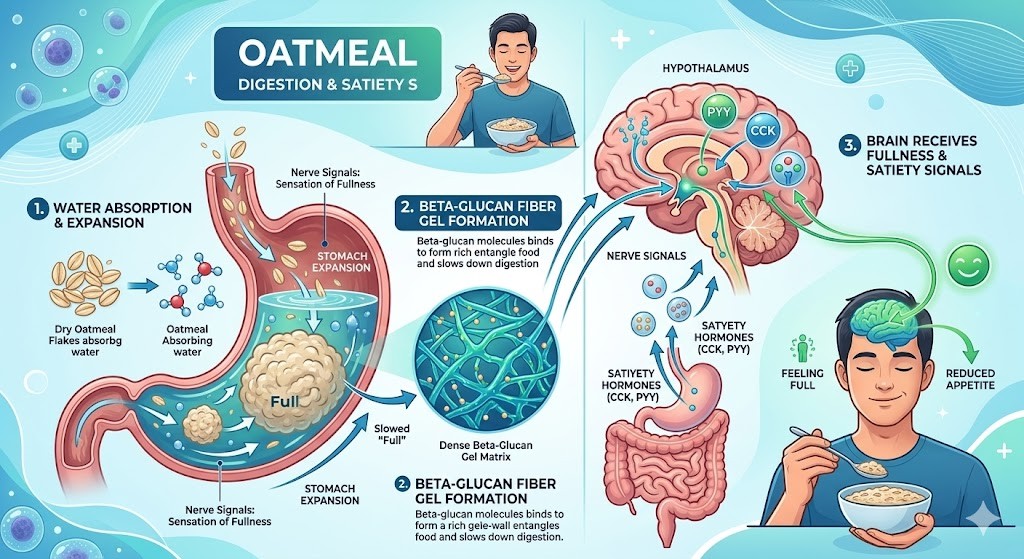
Losing fat is not just about willpower; it is about keeping your stomach happy. And this is where oatmeal has a secret superpower: a soluble fiber called beta-glucan. Beta-glucans are linear polysaccharides composed of D-glucose units.
When you cook oatmeal in water or milk, this unique fiber swells, absorbs the liquid, and turns into a thick, viscous gel.
This gel does amazing things inside your digestive system:
Stretches Your Stomach: The sheer volume of the cooked oats physically distends your stomach, signaling your brain that you are officially full.
Slows Down Digestion: This thick gel delays your gastric emptying, meaning the food stays in your stomach much longer.
Steady Nutrient Flow: It creates a physical barrier in your small intestine, slowing down how quickly digestive enzymes can break down starch.
Clinical studies have shown that oatmeal is vastly superior at keeping hunger at bay. In randomized trials, people who ate a bowl of oatmeal reported a 60% increase in fullness and a whopping 62.5% decrease in the desire to eat four hours later compared to those who ate a dry, ready-to-eat cereal.
Granola, on the other hand, is eaten dry and crunchy. Because it is not pre-hydrated and cooked, the beta-glucan fiber has not formed that thick gel network before it hits your stomach. It moves through your digestive system much faster, leaving your stomach empty and your brain screaming for snacks by mid-morning.
The Insulin Rollercoaster: Keeping Your Body in Fat-Burning Mode
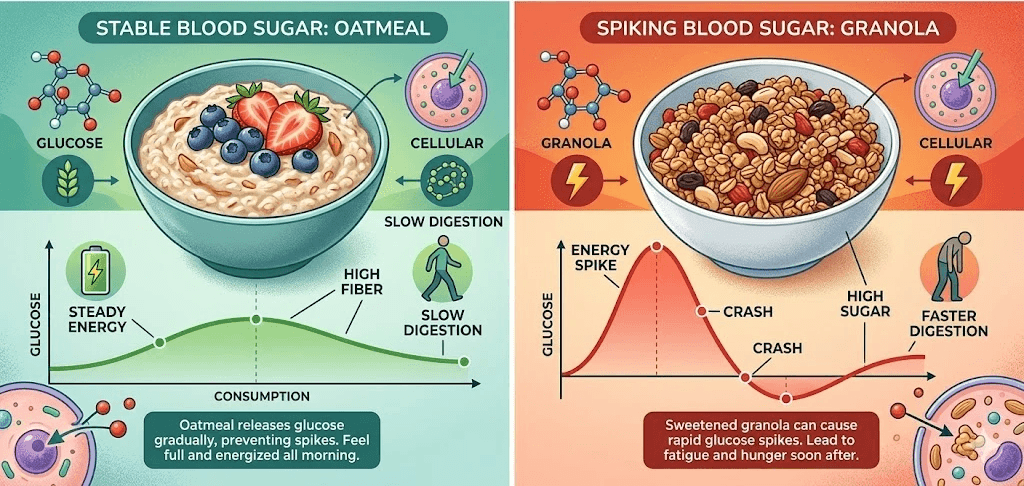
To lose body fat, you want to keep your body's primary fat-storage hormone—insulin—nice and calm. When insulin is low, your body can easily access and burn stored fatty acids for fuel. When insulin spikes, your body locks up its fat stores and goes into fat-saving mode.
This is where the Glycemic Index (GI) comes into play.
Plain Rolled Oats have a low glycemic index (around 55 to 57), resulting in a slow, gentle rise in blood sugar and a minimal insulin response. Your body stays in a happy fat-burning zone all morning.
Commercial Granola has a moderate-to-high GI (around 65 to 70+). Not only is it packed with added simple sugars, but the baking process actually "gelatinizes" the starches, making them incredibly easy for your digestive enzymes to rip apart and convert into instant glucose.
This rapid rush of sugar causes an insulin spike, which quickly sweeps the glucose out of your blood. The result? A mid-morning energy crash (reactive hypoglycemia) that leaves you tired, moody, and reaching for the nearest donut.
Pro-Tip: Try Overnight Oats!
Want the convenience of grab-and-go granola with the blood-sugar benefits of steel-cut oats? Try overnight oats. By cold-soaking rolled oats in milk or yogurt overnight, you preserve a special type of carbohydrate called resistant starch. Resistant starch acts like fiber, passing through your stomach undigested to feed your gut microbiome and dramatically flattening your post-breakfast blood sugar curve.
The "Health Halo" and the Portion Control Trap
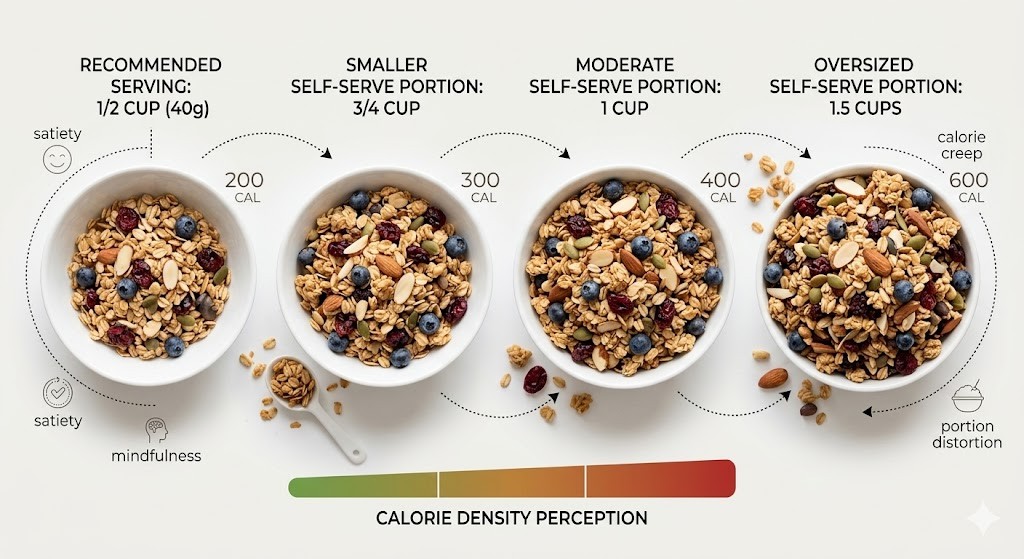
One of the biggest hurdles in weight loss is "portion distortion," and granola is the poster child for this trap. Because granola is packed with wholesome ingredients like oats, seeds, and nuts, it enjoys a massive "health halo". We assume it is good for us, so we let our guard down.
In portion awareness studies, researchers asked participants to pour themselves what they considered a "normal" serving of different cereals.
For high-density cereals like granola, the average self-served portion was 95 grams—almost double the standard recommended serving size of 45 to 50 grams!
That innocent-looking bowl of granola can easily climb to 400 or 500 calories before you even add milk or fruit.
Conversely, cooked oatmeal is physically fluffy and high-volume. It fills up your bowl quickly, providing a strong visual cue of a satisfying meal, making it much harder to accidentally overeat.
Even packaging plays a role. A study published in the Journal of Business Research found that people eat significantly more granola when serving from a larger bag compared to when it is divided into smaller, portion-controlled packets. Interestingly, because granola is perceived as healthy, people feel less "guilt" about overeating it than they would with cookies, leading to a silent calorie surplus.
What the FDA and Dietary Guidelines Say
If you look at the updated 2025–2030 Dietary Guidelines for Americans, the message is clear: prioritize whole, minimally processed foods, limit added sugars to under 10 grams per meal, and focus on high-quality, fiber-rich whole grains.
To align with this, the FDA recently updated its rules for which foods can legally put the word "healthy" on their packaging. To pass the test, a grain product must meet strict limits for added sugars, sodium, and saturated fats per serving:
Nutrient Category | FDA "Healthy" Claim Limit for Grains (per serving) | Rolled Oats (Standard ½ Cup Dry Serving) | Commercial Honey Granola (Standard ½ Cup Serving) |
Added Sugars | Under 10% DV (5 g) | 0 g (Passes) | 12 g – 16 g (Fails) |
Sodium | Under 10% DV (230 mg) | 2 mg (Passes) | 138 mg (Passes) |
Saturated Fat | Under 5% DV (1 g) | 0.5 g (Passes) | 1.3 g (Fails) |
Plain rolled oats glide right through the FDA’s strict standards with flying colors. Commercial granolas, however, almost always fail due to their sky-high added sugars and baked-in saturated fats.
A Quick Word on Sleep and Stress
While granola can be tough on a fat-loss diet, some specialized prebiotic-containing granolas (like those with oligofructose) have been shown in small clinical trials to boost beneficial gut bacteria (Bifidobacterium) and improve sleep quality and stress levels. But remember: you can get those exact same prebiotic gut benefits from unsweetened, fiber-rich oatmeal without the sugar and fat overload.
The Verdict: Oatmeal Wins the Fat-Loss Crown!
When it comes to Oatmeal vs Granola for Weight Loss, the crown goes to oatmeal.
Oatmeal's high water-absorption capacity, rich beta-glucan content, and low glycemic index keep your blood sugar stable, your insulin low, and your stomach full for hours. It naturally supports a calorie deficit and keeps your body primed to burn stored fat.
Granola is a fantastic, nutrient-dense energy source, but its high calorie density, added sugars, and susceptibility to "portion distortion" make it a tricky choice when fat loss is your primary goal.
If you do choose granola, use it like a seasoning—sprinkle a tablespoon or two over high-protein Greek yogurt to get the crunch without the calorie bomb! And whichever path you choose, make sure to log it easily with VoCal to stay precise, focused, and successful on your weight loss journey.
How to Track Like a Pro with VoCal
Let us face it: logging your breakfast can sometimes feel like a math exam. Did you eat a cup of cooked oatmeal, or a cup of dry oats? Did you sprinkle three tablespoons of granola, or did you pour a heavy-handed cup?
The physical differences between oats and granola can make calorie tracking a guessing game. A half-cup of cooked oatmeal is only about 75 calories, while a half-cup of dry granola can easily top 250 calories!
That is where VoCal comes in. As a voice-based calorie tracking app, Vo-cal.com makes it incredibly simple to log your breakfast accurately without typing or searching through endless databases.
Instead of guessing, you can simply tap the mic and say:
"I had one cup of cooked rolled oats made with water, topped with half a cup of blueberries."
Or:
"I had a small bowl of Greek yogurt with three tablespoons of honey granola."
Vo-cal’s intelligent voice-tracking system automatically distinguishes between cooked and dry volumes, understands the density of granola, and accounts for your toppings, ensuring you never accidentally under-report your morning calories. It is hands-free, hassle-free, and keeps your weight loss journey completely on track.
Frequently Asked Questions (FAQs)
Does all oatmeal raise blood sugar the same way?
No. Steel-cut and old-fashioned rolled oats undergo minimal processing, which helps them maintain their fiber integrity and results in a lower, more gradual rise in blood sugar. On the other hand, quick or instant oats are processed to digest much faster, causing sharper post-meal spikes.
Is instant oatmeal good for weight loss?
Plain, unsweetened instant oatmeal is fine, but it is processed to digest faster, which means it has a higher glycemic index (79-83) than rolled or steel-cut oats (53-57). This can cause your blood sugar to spike and drop more quickly. Additionally, many instant oat packets are loaded with added sugars. If you use instant oats, stick to plain versions and stir in some protein (like collagen or protein powder) and healthy fats to slow down digestion.
Can I eat granola and still lose weight?
Absolutely! Weight loss comes down to maintaining a consistent caloric deficit. However, because granola is so calorie-dense and easy to overeat, you must be extremely precise with your portion sizes. Keeping a voice-tracking tool like Vo-cal.com handy can make logging those dense granola spoonfuls effortless and accurate.
Why does oatmeal keep me full so much longer than granola?
Oatmeal is cooked in liquid, allowing its soluble fiber (beta-glucan) to expand and form a thick gel in your gut. This gel delays your stomach emptying and slows down nutrient absorption, keeping you satisfied for hours. Granola is dry and processed with sugars and fats, which bypasses this stomach-stretching, slow-digesting gel process.
Disclaimer: This article is for informational purposes only and does not substitute for professional medical advice, diagnosis, or treatment. Always consult a healthcare provider or registered dietitian before making significant changes to your diet or training routine.