
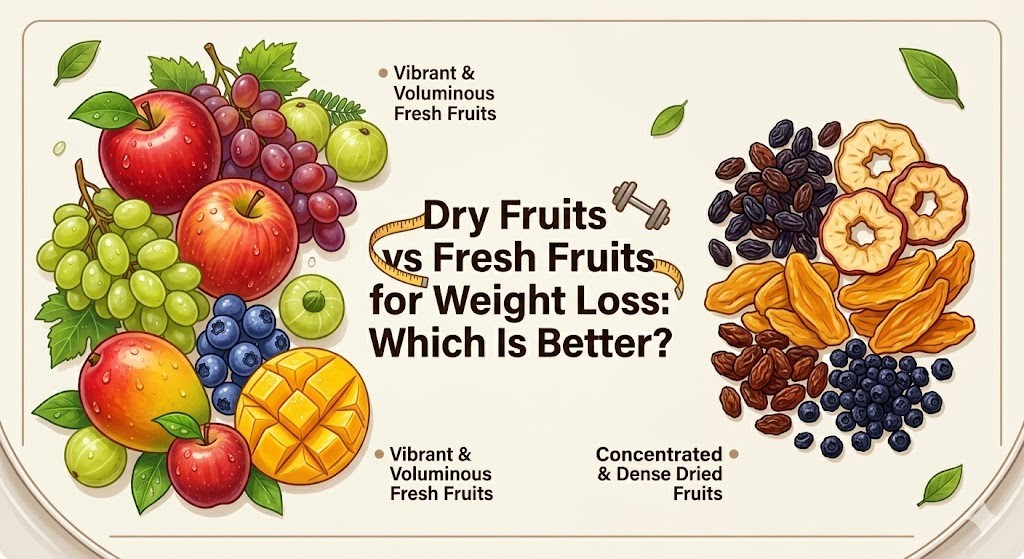
You’ve likely heard it both ways: "Dry fruits are nutrient powerhouses!" vs. "Fresh fruits are the only way to go!" So, what’s the real deal when you’re trying to shed those extra pounds?
If you’re a vegetarian looking for the best way to fuel your weight loss journey, the answer lies in how your body handles water, sugar, and volume. Let's break down the "Fruit Fight" so you can snack smarter!
Fresh Fruits: The Hydration Heroes
Fresh fruits are naturally whole, unprocessed, and—most importantly—loaded with water. In fact, most fresh fruits are 80% to 90% water. This high water content makes them "low energy density" foods, meaning you can eat a big, satisfying portion for very few calories.
The Fullness Factor: When you eat a juicy apple, the volume stretches your stomach. This triggers "mechanoreceptors" that tell your brain, "Hey, we’re full!".
Vitamin C Power: Fresh fruits like Amla (Indian Gooseberry) and citrus are packed with Vitamin C. Since this vitamin is heat-sensitive, it’s at its peak in fresh, raw fruit.
Steady Energy: The fiber and water in fresh fruit slow down sugar absorption, preventing those nasty energy crashes that lead to junk food cravings.
Dry Fruits: The Concentrated Munchies
Dry fruits are simply fresh fruits that have had their water removed through sun-drying or dehydration. This turns them into "nutrient nuggets," but it also makes them very easy to overeat.
Concentrated Goodness: Minerals like Iron and Potassium don't evaporate! You actually get more of these per gram in dried fruit than fresh.
The Calorie Trap: Removing water makes the fruit shrink. One cup of fresh grapes has about 100 calories, but if you dry them into raisins, that same cup could soar to nearly 500 calories!.
Convenience King: They don't spoil in your bag, making them great for busy professionals who need a quick energy boost.
The Calorie Showdown: Fresh vs. Dried
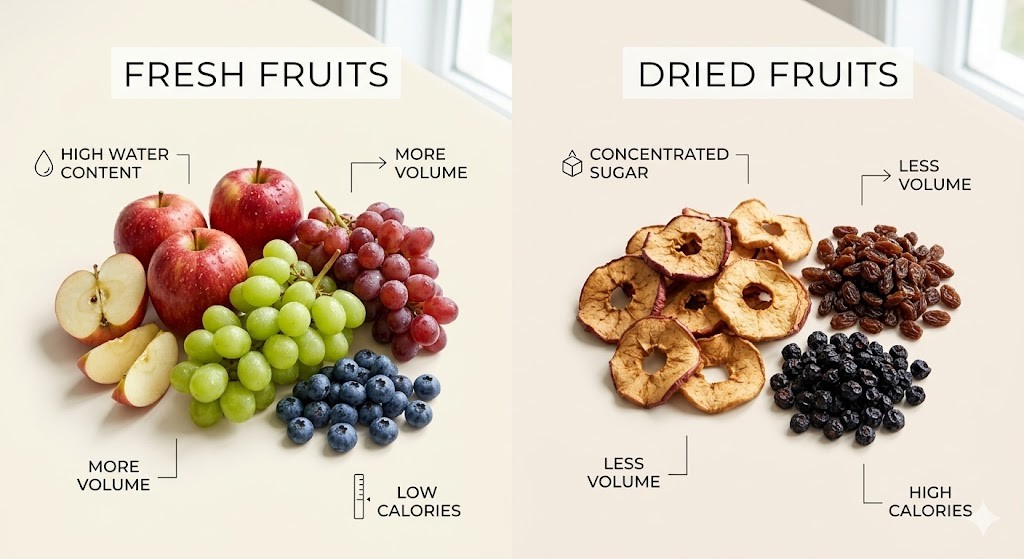
Check out how the numbers change when the water disappears:
Fruit Type | Form | Typical Serving Size | Calories | Sugar (g) | Fiber (g) |
Apple | Fresh | 1 Medium (182g) | 95 | 19 | 4.4 |
Apple | Dried | 1/2 Cup (43g) | 104 | 24 | 3.7 |
Grapes | Fresh | 1 Cup (151g) | 104 | 23 | 1.4 |
Raisins | Dried | 1/4 Cup (43g) | 130 | 25 | 1.6 |
Blueberries | Fresh | 1 Cup (1488g) | 84 | 15 | 3.6 |
Blueberries | Dried | 1 Cup (160g) | 500+ | 100+ | 12.0 |
The Indian Superfood: Amla (Gooseberry)
In the Indian context, Amla is a weight-loss legend. Fresh Amla is incredibly low in calories (only 30-40 per fruit) and has 20 times more Vitamin C than an orange!. While dried Amla (Supari) is a great digestive aid, watch out for "Amla Candy," which is often loaded with added sugar.
Weight Loss Substitution Guide

Want to save calories without feeling hungry? Try these swaps:
Scenario | Higher Calorie Option | Weight Loss Substitution | Calorie Savings |
Breakfast | 1/2 cup Raisins | 1 cup Fresh Blueberries | -50 kcal + More volume |
Afternoon Snack | 5 Dried Dates | 1 Medium Apple | -100 kcal + More crunch |
Dessert | Dried Mango (Sweetened) | Fresh Mango Slices | -150 kcal + Hydration |
Salad Garnish | 1/4 cup Dried Cranberries | 1/2 cup Pomegranate Arils | -70 kcal + Antioxidants |
A Quick Warning for Vegetarians
Did you know some dried fruits aren't strictly vegan?
Shellac (E904): Some dried fruits are coated in shellac to look shiny. Shellac comes from the lac bug, so many strict vegetarians and vegans choose to avoid it.
Added Sugars: Some tart fruits like cranberries are "infused" with sugar to make them tasty, which adds hidden calories.
The Verdict: Which Is Better?
For active weight loss, Fresh Fruit is the winner. It fills you up, keeps you hydrated, and is harder to overeat.
Dry fruits are best used as a "garnish" (think: a sprinkle on your oats) or as a quick energy boost before a workout.
Tracking Made Easy with VoCal
One reason weight loss is hard is the "tracking friction." Measuring 1/4 cup of raisins is annoying! That’s where VoCal comes in.
VoCal is a voice-based calorie tracker designed specifically for Indian food. Instead of searching a database for "one bowl of poha with three raisins," you just say it!.
Log in 15 Seconds: Just tap the mic and speak naturally.
Understand Indian Portions: It knows the difference between a "katori" of dal and a "handful" of walnuts in 11 Indian languages.
FAQs
1. Can I eat dry fruits daily while losing weight?
Yes, but keep it to a small handful (about 30g). They are very calorie-dense!.
2. Which is better for a sweet craving?
Fresh fruit like grapes or mango provides natural sweetness with more volume, which helps satisfy the craving longer than a tiny piece of dried fruit.
3. Does drying fruit lose nutrients?
Most minerals stay, but heat-sensitive vitamins like Vitamin C are often lost during the drying process.
Disclaimer: Always consult with a healthcare professional or a registered dietitian before making significant changes to your diet, especially if you have underlying health conditions like diabetes.