

When you are standing in the grocery aisle staring at a rustic, earthy bag of rolled oats next to a glossy, golden bag of honey-almond granola, they both look like health food rock stars. They are both whole grains, both promise a heart-healthy start, and both look great on an Instagram feed.
But when it comes to a direct oats vs granola calories comparison, these two morning favorites could not be more different. One is a volume-expanding hydration champion, while the other is a delicious, calorie-dense crunch fest.
To help you build the ultimate fat-loss or muscle-building breakfast, we are diving deep into the clinical science of satiety, glycemic responses, and how Overnight Oats vs Granola: Calories, Protein, and Fullness Compared stack up.
Quick Takeaways
The Calorie Gap: Oats are minimally processed and low in calories, while commercial granola is baked with oils and sugars, packing more than 20% more calories per dry gram.
The Fullness Winner: Oats contain a unique soluble fiber called beta-glucan that gels up in your stomach to keep you full for hours, giving oatmeal a massive satiety advantage.
The Overnight Oats Edge: Soaking oats cold preserves their volume and resistant starch, making overnight oats highly satisfying compared to compact granola toppings.
Track Wisely: Because granola is incredibly dense, logging "one bowl" on a voice-tracking app like Vo-cal.com can lead to underestimating your intake by hundreds of calories if you are not careful.
Raw Grain Chemistry: Rolled Oats vs. Granola
To understand where the extra calories in granola come from, we have to look at how these grains are processed.
Rolled Oats: Rolled oats are simply whole oat groats that have been steamed and flattened with heavy rollers to preserve their natural, fiber-rich cellular structure.
Granola: Commercial granola starts as rolled oats, but it is then tossed with simple sugars (like honey or maple syrup), vegetable oils, nuts, and dried fruit before being baked at high temperatures.
While baking creates those irresistibly crunchy clusters, it also drives up the energy density. A 100-gram serving of dry rolled oats delivers around 389 calories, whereas the same dry weight of commercial granola shoots up to 471 calories—a 21% jump caused by those added fats and sugars.
Table 1: Nutritional Profiles of Raw Grains and Cereal Blends (Per 100g Dry Weight)
Nutrient | Rolled Oats (Raw) | Quaker Oats & Honey Granola | General Commercial Granola |
Energy (kcal) | 389.00 | 464.10 | 471.00 |
Protein (g) | 10.60 | 10.82 | 10.30 |
Total Lipid (Fat) (g) | 1.00 | 19.20 | 20.30 |
Total Carbohydrate (g) | 66.00 | 67.76 | 64.40 |
Total Dietary Fiber (g) | 7.00 | 7.44 | 5.00 |
Total Sugars (g) | 0.00 | 26.68 | 24.50 |
How you cut your oats also matters. For example, steel-cut oats (made by chopping groats into small pieces) have a much tighter volume-to-weight ratio than fluffy rolled oats, packing double the fiber into a standard quarter-cup serving.
Overnight Oats vs. Granola: Calories, Protein, and Fullness Compared
Dry ingredient sheets only tell half the story. The real magic (and the real calories) happens when these grains hit your breakfast bowl. Let's look at how they compare when prepared as real meals.
Volume Expansion and the Soaking Secret
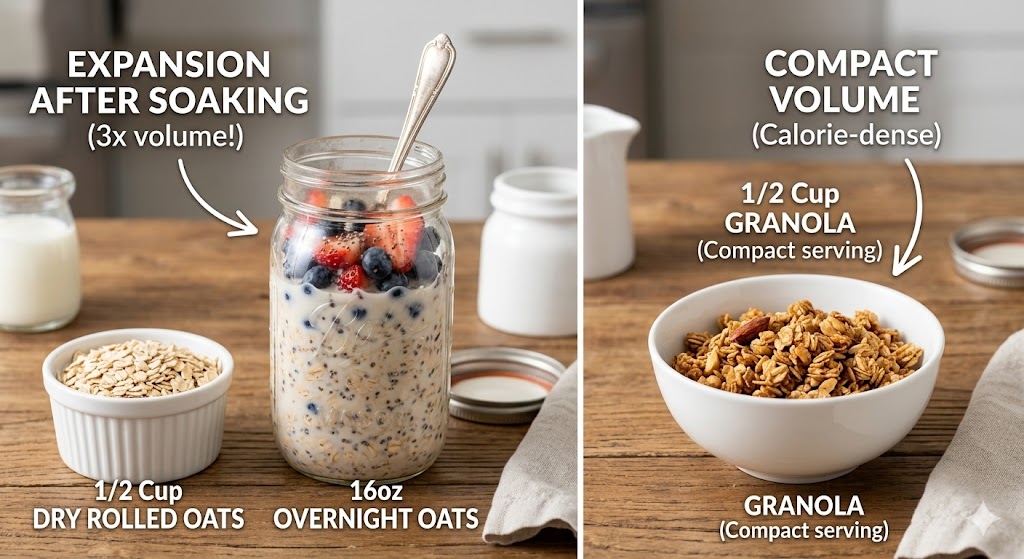
When you prep overnight oats, you soak raw rolled oats in water, milk, or yogurt. This cold-soaking process expands the starch granules and dissolves the soluble fiber without heat, which preserves a special kind of "resistant starch" that acts like dietary fiber and supports gut health.
More importantly, soaking causes oats to absorb liquid and expand to more than double their original volume. A half-cup of dry oats becomes a massive, stomach-stretching bowl.
Granola, on the other hand, has had almost all of its water baked out. It is highly compact. A half-cup of granola looks like a tiny pile in your bowl but packs double the calories of your expanded oats, leaving you with a physically empty stomach despite consuming plenty of energy.
Table 2: Prepared Breakfast Bowls Comparison
Nutritional Variable | Blueberry-Yogurt Overnight Oats | Fruit and Nut Overnight Oats | Granola High-Protein Yogurt Parfait |
Base Weight (g) | ~240g | ~380g | ~240g |
Oat/Granola Input | 1/2 cup Rolled Oats (40g) | 1/2 cup Rolled Oats (40g) | 1/2 cup Commercial Granola (60g) |
Energy Yield (kcal) | 311.00 | 460.00 | 440.00 |
Protein (g) | 17.00 | 17.50 | 16.20 |
Total Lipid (Fat) (g) | 4.00 | 18.00 | 12.20 |
Total Carbohydrate (g) | 53.00 | 65.00 | 66.30 |
Dietary Fiber (g) | 9.00 | 13.50 | 5.50 |
Total Sugars (g) | 21.00 | 24.00 | 43.40 |
While the calorie counts of these prepared options are in a similar range, the overnight oats provide up to double the dietary fiber of a yogurt-and-granola parfait. Plus, the sugars in the overnight oats are mostly natural sugars from fruit and dairy, whereas store-bought granola is often loaded with added sweeteners that can cause a post-breakfast crash.
The Satiety Showdown: Why Oats Keep You Fuller

Ever notice how a tiny bowl of granola leaves you hunting for snacks by 10 a.m., while a bowl of oatmeal keeps you satisfied until lunch? That is the power of satiety.
Viscous Fiber Dynamics
Oats are rich in beta-glucan, a unique soluble fiber that dissolves in water to form a thick, viscous gel inside your stomach. This gel delays gastric emptying, meaning food leaves your stomach slower and nutrients are absorbed at a steady, prolonged pace.
But when oats are baked into granola at high heat, the linear fiber chains can break down. This process reduces the fiber's molecular weight, making it less viscous and decreasing its ability to keep you full.
The Satiety Index
In a famous study by Dr. Susanna Holt at the University of Sydney, researchers compared the filling power of 240-calorie portions of popular foods, using white bread as a baseline score of 100%. Oatmeal scored an impressive 209%, making it one of the most filling breakfast options tested. Unbaked muesli scored a baseline 100%, and baked croissants trailed at a meager 47%.
Table 3: Satiety Index Scores for Common Breakfast Carbohydrates
Breakfast Food Type | Glycemic Score | Insulin Score | Satiety Index Value |
Boiled Potatoes | 141 | 121 | 323% |
Oatmeal / Porridge | 60 | 40 | 209% |
Brown Pasta | 68 | 40 | 188% |
Honeysmacks Cereal | 60 | 67 | 132% |
Cornflakes | 76 | 75 | 118% |
Muesli (Unbaked Oats/Nuts) | 43 | 46 | 100% |
Yogurt (Low Fat) | 62 | 115 | 88% |
Croissants | 74 | 79 | 47% |
Metabolic Benefits: Blood Sugar and Water Weight
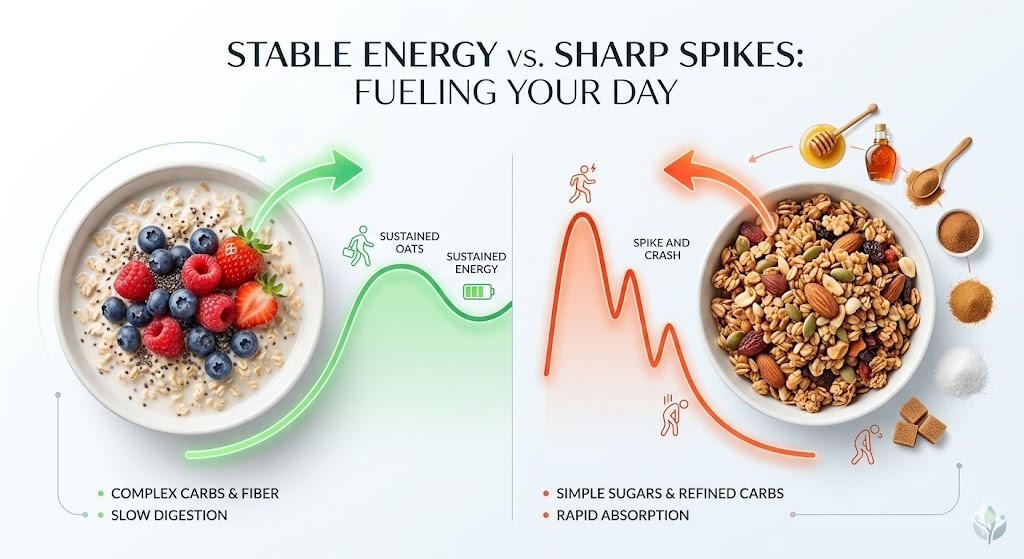
Opting for clean, slow-digesting oats over processed, high-sugar granolas can do wonders for your metabolism.
Keeping Insulin in Check
In clinical studies, overnight oats soaked in milk have been shown to elicit a 33% lower blood sugar response and a 33% lower insulin response compared to refined rice cereals. Keeping insulin stable prevents rapid fat storage and helps avoid sudden hunger pangs later in the day.
The Secret of Initial Water Weight Loss
If you transition from high-sugar commercial granolas to high-fiber, low-glycemic oats, you might notice the scale drop quickly in the first week or two. This is often due to shedding excess water weight.
When your insulin levels drop, your kidneys naturally excrete excess sodium, which reduces water retention and bloating. Additionally, choosing slow-digesting oats helps manage your glycogen stores. Because every gram of glycogen stored in your liver and muscles binds three to four grams of water, managing your carbohydrate quality helps shed that heavy, bloated feeling.
Tracking Wisely on VoCal : Avoid the "Granola Trap"
Because granola is baked with oils and sweeteners, it is incredibly calorie-dense. A single cup of granola can easily pack more than 500 calories, while a whole cup of cooked oatmeal is under 160 calories.
If you are using a voice-based tracking app like VoCal a simple entry like "I had a cup of oats for breakfast" could lead to massive tracking errors if you actually ate a cup of granola.
Table 4: Volume-to-Weight Conversions for Voice-App Users
Food Item as Logged via Voice | Typical Serving Size | Reference Weight (g) | Energy Yield (kcal) | Macronutrient Balance (P / F / C) (g) |
Oatmeal (Cooked in Water) [cite: 9] | 1 cup | 234.00 | 159.00 | 5.60 / 3.30 / 28.10 |
Rolled Oats (Dry Weight) [cite: 25] | 1/2 cup | 40.00 | 150.00 | 5.00 / 2.50 / 27.10 |
Steel-Cut Oats (Dry Weight) [cite: 14] | 1/4 cup | 44.00 | 170.00 | 6.00 / 3.00 / 29.00 |
Commercial Baked Granola [cite: 2] | 1 cup | 120.00 | 565.00 | 12.40 / 24.40 / 77.30 |
Commercial Baked Granola [cite: 2] | 1/2 cup | 60.00 | 283.00 | 6.20 / 12.20 / 38.60 |
Homemade Granola (Dry) [cite: 26] | 1 cup | 122.00 | 606.00 | 17.00 / 30.10 / 66.70 |
To make your voice-tracking as accurate as possible, keep these three logging tips in mind:
Specify Dry vs. Cooked: Always tell the app whether you measured your oats "dry" or "cooked" (e.g., "Log eighty grams of dry rolled oats" vs. "Log one cup of cooked oatmeal").
Deconstruct Your Bowl: Instead of logging a generic "granola bowl," list the yogurt, granola, and fruit separately so the app's database can use the precise weight densities for each ingredient.
Name the Preparation Style: If you are using store-bought granola, mention if it is "honey-baked" or "low-sugar" so the app can fetch the correct recipe from its database, protecting you from hidden fats and sugars.
The Verdict: Oats or Granola?
If weight loss, blood sugar control, and long-lasting fullness are your primary goals, plain oats and overnight oats are the clear winners. They provide massive physical volume, heart-healthy fiber, and a slow, steady release of energy without unnecessary fats and sugars.
However, if you love the crunch of granola, you don't have to banish it from your kitchen. Treat it like a high-value condiment rather than the main meal. A sprinkle of low-sugar or homemade granola on top of a warm bowl of oatmeal or Greek yogurt gives you the best of both worlds: the comforting volume of oats and the satisfying crunch of granola.
Frequently Asked Questions (FAQs)
Is oatmeal better than granola for weight loss?
Yes. Oats are naturally much lower in calories, fat, and sugar than commercial baked granolas. Additionally, when cooked or soaked in liquid, oats expand significantly. This high volume physically stretches your stomach, triggering stretch receptors that signal fullness to your brain.
How does the protein compare in Overnight Oats vs Granola?
Both oats and granola contain natural protein. However, overnight oats are typically built with high-protein bases like Greek yogurt or milk, which naturally boosts the overall protein content of your meal. While granola contains some protein from nuts and seeds, its high fat and sugar content means you have to consume a lot more calories to reach the same protein target.
Can I eat granola on a weight loss diet?
Absolutely. You don't need to banish granola to lose weight. Instead of pouring a massive bowl of it, use it strategically. A portion of 2 to 3 tablespoons makes an excellent, crunchy topping for high-volume oatmeal or Greek yogurt.
Why is commercial granola so much higher in calories than plain oats?
While both start with whole rolled oats, commercial granola is tossed with added sugars (like honey, cane sugar, or maple syrup) and fats (like vegetable oils) before being baked to a crisp. This process adds significant caloric density, making granola behave nutritionally more like a dessert than a clean whole grain.
Disclaimer: This article is for informational and educational purposes only and is not intended as medical or professional nutrition advice. Please consult with a healthcare professional or registered dietitian before starting any new dietary plan.