

We’ve all been there: standing in the grocery aisle or staring at our morning coffee, wondering if we should reach for the classic white sugar bowl or drizzle some golden honey instead.
We see "honey-sweetened" slapped on fancy snack boxes and immediately assume it's a health food. But if you're looking for a honey vs sugar healthier option, is switching actually doing your body a favor, or is it just clever marketing?
To figure out if raw honey is truly better than refined sugar, we have to look past the marketing hype and examine the actual biochemical science. Let’s break down the calories, glycemic index, baking science, and health benefits to find out which sweetener reigns supreme.
Sweet Breakdown: Raw Honey vs. White Sugar Nutrition

To understand how these two stack up, we have to look at what they are made of at a molecular level.
Granulated table sugar is 100% pure sucrose—a molecule made of equal parts glucose and fructose locked in a tight chemical bond. The processing of sugar beets or sugarcane strips away all plant-derived organic matter, leaving behind empty calories with absolutely zero vitamins, minerals, or proteins.
Raw honey, on the other hand, is a complex, natural substance crafted by honeybees from floral nectar. In honey, fructose and glucose aren’t chemically bonded; they float around freely alongside water, active enzymes, prebiotic fibers, and organic acids.
Here is how they compare side-by-side:
Nutrient / Metric (per tablespoon) | Raw Honey | Granulated White Sugar |
Calories (kcal) | 64 | 49 |
Total Carbohydrates (g) | 17.3 | 12.6 |
Glycemic Index (GI) | 58 (Average) | 65 |
Antioxidants | High (Polyphenols) | Zero |
Mineral & Vitamin Content | Trace amounts (Potassium, B-vitamins) | None |
Fructose-to-Glucose Ratio | ~1.2:1 | 1:1 (as sucrose) |
Water Content | ~17-18% | 0% |
Because honey is physically denser and contains water, a tablespoon of honey weighs more (about 21 grams) than a tablespoon of dry granulated sugar (about 12.5 grams). This is why a spoonful of honey packs 64 calories compared to sugar's 49 calories.
However, because honey is naturally richer in free fructose—which is much sweeter than glucose—honey tastes about 1.25 times sweeter than table sugar. This means you can actually use a smaller physical volume of honey to get the same level of sweetness, helping you save calories overall. Plus, raw honey retains trace minerals (like potassium and calcium) and B-complex vitamins that refined sugar has been completely stripped of.
The Glycemic Showdown: Does Honey Spike Your Blood Sugar Less?
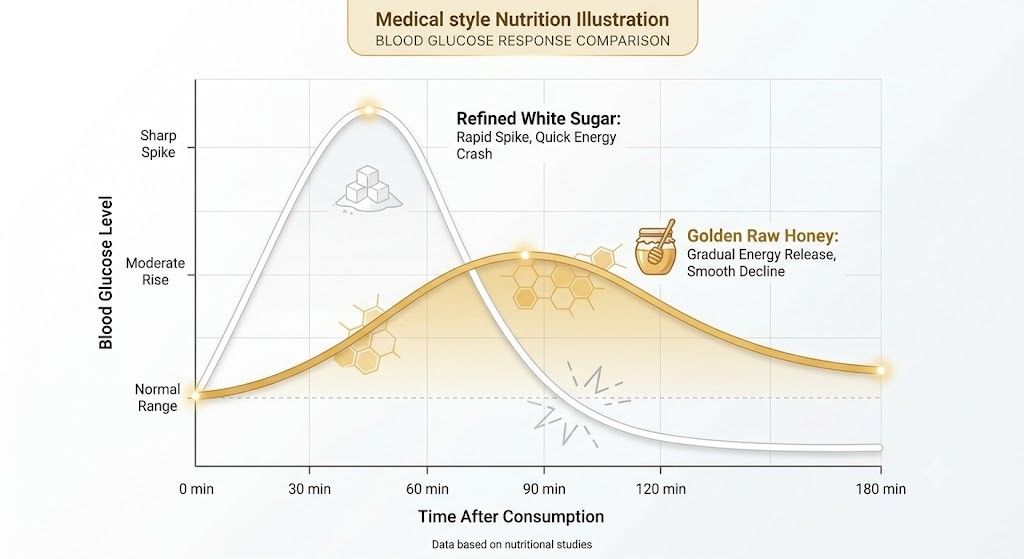
If you have ever experienced a "sugar crash" after eating a sweet treat, you know how blood sugar spikes can ruin your energy levels. The glycemic index (GI) is a scale from 0 to 100 that measures how quickly a carbohydrate makes your blood glucose rise.
Table sugar has a glycemic index of 65. Raw honey averages a lower GI of 58, meaning it raises blood glucose more slowly.
Why does honey win this round? In refined table sugar, the chemical bond holding glucose and fructose together is quickly split by your digestive enzymes, releasing a sudden wave of glucose into your bloodstream and triggering a sharp insulin spike from your pancreas.
In raw honey, the sugars are already separated. Fructose has an incredibly low glycemic index of just 19. It is absorbed slowly in the gut and processed by the liver through insulin-independent pathways, giving you a much gentler energy curve.
However, honey's glycemic impact changes dramatically depending on which flowers the bees visited to make it:
Honey Variety | Glycemic Index (GI) | Fructose Level | Metabolic Impact |
Acacia Honey | 32 - 35 | Very High | Clears slowly; very low insulin response |
Tupelo Honey | 35 - 40 | High | Stable, slow-burning blood sugar curve |
Raw Manuka Honey | 54 - 59 | Moderate | Moderate glycemic impact; high antibacterial activity |
Clover Honey | 56 - 62 | Moderate | Standard US honey; slightly slower than white sugar |
Sunflower Honey | 70+ | Low | Rapid absorption; spikes sugar like glucose |
Can You Buzz with Diabetes? How Honey Affects Blood Glucose
For those managing type 1 or type 2 diabetes, replacing table sugar with honey is a popular choice, but it requires careful portion control. Honey is not a miracle cure—it is still a concentrated source of carbohydrates (17 grams per tablespoon) and will raise blood sugar if overconsumed.
However, clinical research shows that low doses of honey have a much milder impact than pure glucose or sucrose. In a study of 97 patients with type 2 diabetes, a low dose of honey (30 grams) caused a small blood sugar rise of only 30 mg/dL after two hours. Meanwhile, pure glucose caused a massive spike of 170 mg/dL. Low doses of honey have also been shown to stimulate a healthier pancreatic insulin response.
The catch? High daily doses of honey (over 50 grams) taken over several weeks can actually worsen overall blood glucose control and raise HbA1c levels. If you have diabetes, you must treat honey as a carbohydrate and count it toward your strictly managed daily sugar limits.
The Weight Loss Debate: Honey vs. Sugar for Your Goals
When trying to manage weight, many people worry that honey's high calorie density will lead to weight gain. Surprisingly, clinical trials show that replacing refined sugar with raw honey does not promote increased body fat.
This is largely due to how honey affects your appetite and gut. Raw honey contains prebiotic oligosaccharides—complex carbs that resist digestion in the upper stomach and travel to the large intestine to feed beneficial gut microbes. These prebiotics help delay gastric emptying and prolong satiety by modulating appetite-regulating hormones like ghrelin.
In contrast, high amounts of refined white sugar trigger rapid insulin spikes that promote fat storage and can disrupt gut microbiome diversity, contributing to systemic inflammation.
If you are on a structured diet like a low-carb program, remember that early weight loss often comes from dropping water weight as glycogen stores deplete. While you have to limit all sugars on a low-carb plan, swapping white sugar for a smaller drizzle of honey allows you to satisfy sweet cravings with a much gentler metabolic impact.
Coffee and Tea Upgrades: Brewing with Honey vs. Sugar

Stirring a spoonful of raw honey into a hot cup of tea or coffee is a classic wellness swap. It lowers the glycemic load of your beverage and introduces natural antioxidants that fight oxidative stress. But to get those benefits, you have to watch the temperature!
Raw honey is packed with delicate, active enzymes, vitamins, and antioxidants added by the bees. These beneficial compounds start to break down and lose their nutritional value when exposed to temperatures above 140°F to 149°F (60°C to 65°C).
To get the absolute most out of your honey:
Let it cool down: Freshly brewed tea and coffee are usually scalding hot (160°F to 185°F). Let your drink cool to a warm, drinkable temperature before stirring in your honey to keep its active enzymes intact.
Mind the flavor: Unlike neutral white sugar, honey has a rich floral flavor. It pairs beautifully with black, green, and herbal teas, but it can mask the delicate tasting notes of light-roast specialty coffees.
Keep it measured: Liquid honey is easy to over-pour. Always use a spoon rather than squeezing directly from the bottle to keep your portions in check.
Baking Chemistry: How to Swap Sugar for Honey Like a Pro
If you want to ditch refined sugar in your favorite baking recipes, you cannot simply swap in honey on a 1:1 basis. Because honey is a liquid that contains 17% to 18% water and natural organic acids, it alters the chemistry of your batter.
Use this quick conversion guide for successful baking:
Granulated Sugar Required | Suggested Honey Volume | Liquid Volume Reduction | Baking Adjustments |
1 Cup (200g) | 3/4 Cup (180ml) | Reduce other liquids by 1/4 cup | Lower oven by 25°F; add 1/12 tsp baking soda |
1/2 Cup (100g) | 3/8 Cup (90ml) | Reduce other liquids by 2 tbsp | Lower oven by 25°F; add a small pinch of baking soda |
1/4 Cup (50g) | 3 Tablespoons | Reduce other liquids by 1 tbsp | Lower oven by 25°F; great for soft-baked cookies |
Three Golden Rules for Honey Baking
Reduce other liquids: For every cup of honey you use, cut the other liquids in the recipe (like milk, water, or juice) by 1/4 cup.
Turn down the oven heat: The free fructose in honey caramelizes at a much lower temperature (230°F) than sucrose (320°F). Lower the oven temperature by 25°F to prevent your baked goods from scorching on the outside before the inside is fully cooked.
Add a pinch of baking soda: Honey is naturally acidic, with a pH between 3.4 and 6.1. Adding a pinch of baking soda neutralizes the acid and helps your baked goods rise properly.
A Critical Warning: Why Honey and Babies Don’t Mix
While raw honey is a wonderful addition to an adult's diet, public health agencies enforce one absolute safety rule: never give honey to an infant under 12 months old.
Honey can contain dormant microscopic spores of Clostridium botulinum, a bacterium found in soil and dust. While these spores are harmless to adults and older children due to mature digestive systems that prevent germination, an infant's undeveloped gut lacks the competitive microflora and protective acidity to suppress them.
If ingested by an infant, the spores can colonize the large intestine, germinate, and produce a dangerous neurotoxin that causes infant botulism.
Symptoms to look for: Severe constipation, weak facial muscles (making their face look "flat"), a weak cry, drooling, and overall physical "floppiness".
Clinical Treatment: If diagnosed early, infant botulism is treated in a hospital ICU with an intravenous antitoxin called BIGIV (BabyBIG) to support a complete recovery.
Strict Prevention Rule: Never add honey to baby food, formula, or pacifiers. This applies to raw honey, commercial honey, and commercial baked goods containing honey, as standard home baking temperatures are not high enough to destroy these highly heat-resistant spores.
Track Your Sweet Tooth Effortlessly with VoCal
No matter which sweetener you choose, managing your total daily added sugar intake is essential for staying healthy. The American Heart Association recommends that women limit added sugars to 25 grams per day, and men limit them to 36 grams.
But let’s be honest—typing every single ingredient into a calorie-tracking app is tedious and takes up to 15 minutes of your day.
That is where VoCal comes in.
VoCal is a voice-first calorie tracking app designed to take the friction out of food logging. Instead of typing, searching databases, or dealing with photo fatigue, you simply tap the microphone and speak naturally:
In less than 5 seconds, VoCal’s AI converts your spoken words into calories, protein, carbs, and fats.
Why VoCal is the Ultimate Tracking Companion:
Photo + Voice Accuracy: Want to make sure your tracking is 100% accurate? Snap a quick picture of your plate and add a brief voice note to tell the AI exactly what went into the dish (e.g., "salad with a tablespoon of honey mustard dressing").
Insightful Health Reports: VoCal goes beyond daily numbers to provide personalized health reports, making it easy to see how swapping refined sugar for honey impacts your nutritional goals over time.
Frequently Asked Questions (FAQs)
Is raw honey actually better for you than white sugar?
Yes, based on clinical evidence. While both are sugars, white sugar is highly processed and stripped of all nutrients. Raw honey contains trace minerals, active enzymes, prebiotic fibers, and antioxidants that are completely absent in refined sugar.
Can I use honey as a 1:1 substitute for sugar?
No, because honey contains moisture and is sweeter. Use 3/4 cup of honey for every cup of sugar, reduce other liquids in the recipe by 1/4 cup, and lower the oven temperature by 25°F to prevent burning.
Does honey cause cavities like sugar?
Yes. Honey is still a sugar and can contribute to dental cavities if proper oral hygiene is not maintained.
What is the best honey for blood sugar management?
Acacia (Robinia) honey is the clear winner with a very low glycemic index (GI) of 32–35, meaning it enters the bloodstream much slower than standard clover honey or table sugar.
Is honey safe during pregnancy?
Yes! Pregnant women can safely consume honey. The risk of infant botulism only applies to babies under 12 months old because their immature digestive tracts are unable to handle the bacterial spores.
Disclaimer: This article is for informational and educational purposes only and does not substitute for professional medical advice, diagnosis, or treatment. Always consult a qualified healthcare professional, doctor, or registered dietitian before making significant dietary changes, especially if you have an underlying health condition such as diabetes.