

Do you find yourself staring at your morning cup of coffee or bowl of oatmeal, wondering if switching from white sugar to honey is actually a health upgrade? You are not alone! The debate over the honey vs sugar healthier option is one of the most common head-scratchers in modern nutrition.
Both of these ingredients satisfy our evolutionary sweet tooth—a survival mechanism designed to help our ancestors seek out safe, calorie-dense foods in the wild. But in a modern world where sweet treats are always within arm's reach, we have to make smart choices to protect our waistlines and metabolic health.
Let’s dive deep into the science, comparing the nutrition, calories, health benefits, and risks of raw honey versus white sugar, so you can make the sweetest decision for your health goals.
Fast Facts: Honey vs. Sugar at a Glance
The Processing: White sugar is highly refined sucrose (C12H22O11) stripped of all nutrients, while raw honey is a minimally processed liquid packed with antioxidants and trace minerals.
Blood Sugar Impact: Raw honey typically has a lower average glycemic index (GI) than white sugar, meaning it won't trigger the same rapid sugar crash.
Calorie Count: Gram for gram, honey contains slightly fewer calories than sugar due to its water content. However, honey is physically denser, meaning a single tablespoon of honey has more calories than a tablespoon of sugar.
Safety Warning: Raw honey is strictly off-limits for babies under 12 months of age due to a risk of infant botulism.

What is Raw Honey?
Raw honey is a complex, golden liquid produced by the western honeybee (Apis mellifera) using flower nectar. Unlike commercial pasteurized honey, raw honey bypasses heavy heating and aggressive filtration. This hands-off approach preserves its natural enzymes, pollens, and organic compounds, making it a "bioactive" food. Because bees forage locally, raw honey's exact flavor, color, and nutrient profile vary based on the geographic and environmental landscape of the hive.
What is White Sugar?
Granulated white sugar is highly refined crystallized sucrose (C12H22O11) extracted from sugar beets or sugarcane. While all green plants produce sucrose naturally through photosynthesis, the industrial refining process is much more intensive. Plant juices are clarified (often with sulfur), crystallized, and spun in centrifuges. This yields a highly purified white crystal that is 99% pure sucrose and completely stripped of water, proteins, fiber, and vitamins.
Nutritional Showdown: Head-to-Head Tables
How do these sweet options compare on a molecular level? Let's take a look at the data from USDA databases:
Table 1: Nutritional Profile Comparison (per 100g)
Component | Raw Honey | Refined White Sugar |
|---|---|---|
Energy (kcal) | 300 - 304 | 387 |
Water (g) | 17.0 - 21.0 | 0.03 |
Protein (g) | 0.3 | 0.0 |
Total Lipids (g) | 0.02 | 0.0 |
Carbohydrates (g) | 82.4 | 100.0 |
Total Sugars (g) | 82.1 | 99.8 |
- Sucrose (g) | 2.03 | 99.8 |
- Free Fructose (g) | 37.07 - 42.65 | 0.0 |
- Free Glucose (g) | 18.20 - 32.10 | 0.0 |
Dietary Fiber (g) | 0.2 | 0.0 |
Table 2: Micronutrient and Mineral Profile (per 100g)
Mineral / Vitamin | Raw Honey | Refined White Sugar |
|---|---|---|
Calcium (mg) | 6.0 | 1.0 |
Iron (mg) | 0.42 | 0.01 |
Magnesium (mg) | 2.0 | 0.0 |
Phosphorus (mg) | 4.0 | 0.0 |
Potassium (mg) | 52.0 | 2.0 |
Sodium (mg) | 4.0 | 1.0 |
Zinc (mg) | 0.22 | 0.0 |
Vitamin C (mg) | 0.5 - 1.0 | 0.0 |
Riboflavin (B2) (mg) | 0.038 | 0.019 |
Niacin (B3) (mg) | 0.121 | 0.0 |
Pantothenic acid (B5) (mg) | 0.068 | 0.0 |
Pyridoxine (B6) (mg) | 0.024 | 0.0 |
Folate (B9) (μg) | 2.0 | 0.0 |
Table 3: Portion-Based Nutrition (1 Tablespoon Serving)
Metric | Raw Honey (1 Tbsp / 21g) | White Sugar (1 Tbsp / 12g) |
|---|---|---|
Weight (g) | 21.0 | 12.0 |
Energy (kcal) | 64 | 46 - 48 |
Total Carbohydrates (g) | 17.3 | 12.0 |
Total Sugars (g) | 17.2 | 12.0 |
Dietary Fiber (g) | 0.04 | 0.0 |
Potassium (mg) | 10.9 | 0.24 |
Calcium (mg) | 1.3 | 0.12 |
Iron (mg) | 0.09 | 0.0 |
Health Benefits: Is Honey Really Better for You?
When evaluating the honey vs sugar healthier option, raw honey scores several physiological wins over refined sugar.
1. Better for Your Blood Sugar
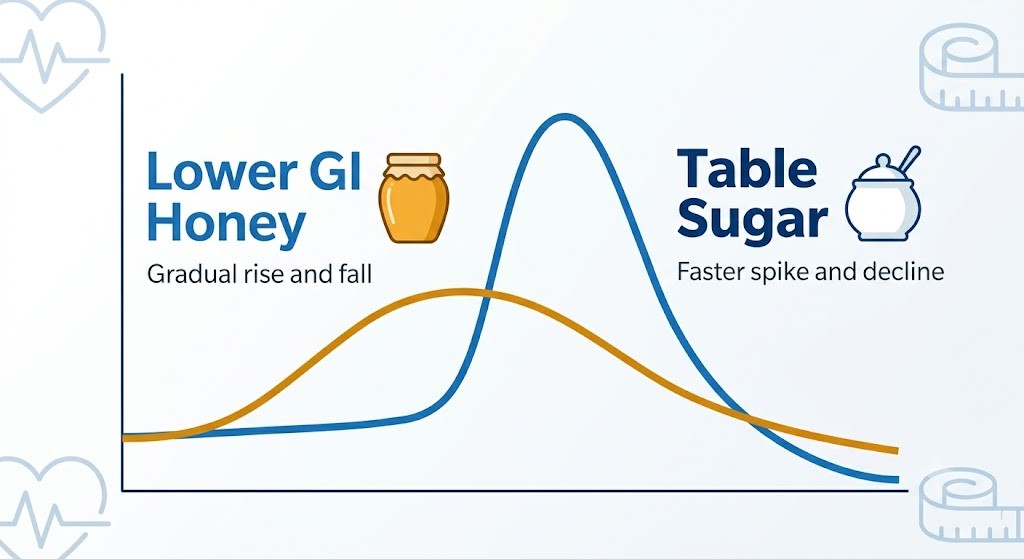
Refined white sugar has a stable Glycemic Index (GI) of 60, triggering a sudden spike in blood sugar followed by an insulin surge. Raw honey, on the other hand, averages a GI of 58 (ranging from 32 to 85 depending on its floral source). Specific honeys rich in fructose (like acacia, fir, or chestnut honey) have a low glycemic index (≤55), resulting in a much gentler blood sugar curve. Fructose is absorbed slower and metabolized primarily in the liver, which prevents sudden insulin spikes.
2. Surprising Weight Management Support
If you're on a low-carb diet or looking to lose weight, replacing table sugar with raw honey might give your metabolism a slight edge. Animal studies indicate that diets containing clover or honeydew honey produce significantly lower weight gain and less body fat accumulation than diets containing equal calories of refined sugar.
Even better, raw honey contains rare sugar isomers that naturally support weight control:
Turanose: A sucrose isomer that has been shown to reduce fat accumulation in fat cells.
Leucrose: A disaccharide that helps reduce fat storage in the liver while encouraging the body to break down fat for energy.
Trehalose & Trehalulose: These unique sugars slow the release of simple carbohydrates into your bloodstream and help prevent fat cells from growing excessively large.
3. Cardioprotective Power
Consuming too much refined sugar can trigger the liver to produce triglycerides, elevating your risk of heart disease. Substituting sugar with raw honey, however, has been shown to improve cardiovascular risk factors. Studies show that daily honey consumption can help lower triglycerides, total cholesterol, and LDL ("bad") cholesterol while raising cardioprotective HDL ("good") cholesterol. Raw honey is also rich in antioxidants like quercetin, which helps lower blood pressure and protect blood vessels.
Are There Risks to Keep in Mind?
Despite the nutritional advantages of honey, both options are classified as "added sugars" by the FDA. Here are some key risks to remember:
Infant Botulism: Raw honey can contain Clostridium botulinum spores. While harmless to older children and adults, an infant's immature gut allows these spores to grow and release dangerous neurotoxins. Never feed raw or pasteurized honey to babies under 1 year of age.
Fructose Overload: While the slower absorption of fructose in honey prevents immediate blood sugar spikes, consuming too much of it can overload the liver, leading to fatty liver disease and insulin resistance over time.
Tooth Decay: Both sugar and honey are highly cariogenic. The bacteria in your mouth ferment these sugars into acid, which dissolves tooth enamel and leads to cavities.
How to Track Your Sweeteners with Voice Technology
Because both honey and sugar are calorie-dense, tracking your portions is essential to stay within recommended limits. The American Heart Association recommends limiting added sugars to about 100 calories per day for women (around 2 tablespoons of honey) and 150 calories for men (around 3 tablespoons of honey).
Traditional tracking can be a hassle, involving tedious typing and database searches. Voice-activated calorie tracking apps like VoCal make this process hands-free and incredibly fast.
Simply speak naturally to log your sweeteners:
"I had one tablespoon of raw chestnut honey with my morning oatmeal."
The app's AI immediately processes the portion size, searches its extensive database, and logs the precise calorie count, macronutrient (PFC) breakdown, and glycemic index. Tips for Perfect Voice Tracking Accuracy
To get the most out of your voice tracker, follow these quick tips:
Find a Quiet Spot: Background noise from appliances or televisions can confuse speech recognition software.
Mind the Distance: Speak clearly about 6 to 12 inches away from your phone's microphone.
Be Specific: Always state the exact preparation and type of food (e.g., "raw acacia honey" vs "honey") so the app pulls the correct nutritional data.
Enumerate Your Meal: List ingredients individually rather than grouping them together (e.g., "one cup of plain Greek yogurt, one tablespoon of raw honey" instead of "sweet yogurt bowl").
The Takeaway
When choosing the honey vs sugar healthier option, raw honey is the clear winner. Its slow-digesting rare sugars, lower average glycemic index, and rich antioxidant profile make it a far superior choice for your body than highly refined white sugar.
However, moderation is still the golden rule. Honey is still a calorie-dense sweetener. Using voice-activated tracking apps like VoCal is an easy, highly efficient way to keep your sweet habits in check and hit your metabolic health goals.
Frequently Asked Questions (FAQs)
Is honey better than sugar for weight loss?
Yes. Studies indicate that diets using honey in place of white sugar lead to less body fat accumulation, lower weight gain, and better lipid levels. However, because honey is still calorie-dense, you must track your daily portions to prevent overeating.
Can people with diabetes eat honey?
Some varieties of honey, like acacia and fir, have a low glycemic index (≤55), making them a better sugar substitute for people with type 1 or type 2 diabetes. However, eating large amounts of honey will still raise HbA1c levels, so you should consult your healthcare provider to find the right balance.
Does heating raw honey destroy its benefits?
Yes. High-heat pasteurization or cooking raw honey can destroy its sensitive live enzymes, antioxidants, and trace pollens, turning it into a basic syrup. For maximum health benefits, consume raw honey straight from the jar or stir it into warm (not boiling) liquids.
Disclaimer: This article is for informational and educational purposes only and is not a substitute for professional medical advice, diagnosis, or treatment. Always consult a qualified healthcare provider or registered dietitian before making significant changes to your diet, especially if you have an underlying metabolic condition such as diabetes or insulin resistance.