

Who doesn't love a good avocado? Whether you’re smearing it on sourdough, blending it into a green smoothie, or digging into a giant bowl of guacamole at your favorite Mexican spot, this creamy fruit has completely taken over the culinary world.
But as you reach for that next tortilla chip, a question might pop into your head: How do guacamole vs avocado calories actually stack up? Is guacamole just a calorie-packed indulgence, or is it secretly better for your waistline than a plain old raw avocado?
Let’s dive into the delicious science of these green superstars, compare their nutrition, and help you decide which one deserves a spot on your plate.
The Raw Truth About Avocado Calories
To understand guacamole, we have to start with its parent: the humble raw avocado (known scientifically as Persea americana).
Avocados are a bit of an oddball in the fruit world. While most fruits are packed with natural sugars and carbs, avocados are loaded with healthy monounsaturated fats—the "good" kind of fat that supports a healthy heart and keeps your skin glowing.
According to the official USDA FoodData Central database (entry 171705), raw avocado contains 160 calories per 100 grams of edible, creamy flesh.
But let's talk real-world portions because nobody walks around with a food scale at a dinner party! Here is how the calories break down by standard servings:
1/4 of a medium avocado (37g): About 60 calories
1/3 of a medium avocado (50g / FDA standard serving): About 80 calories
1/2 of a medium avocado (75g): About 120 calories
1 whole medium avocado (150g of edible flesh): About 240 calories
1 whole large avocado (201g of edible flesh): About 322 calories
Bottom Line: A standard whole medium Hass avocado delivers around 240 calories of nutrient-dense, heart-healthy fats.
Hass vs. Florida Avocados: Size Matters!
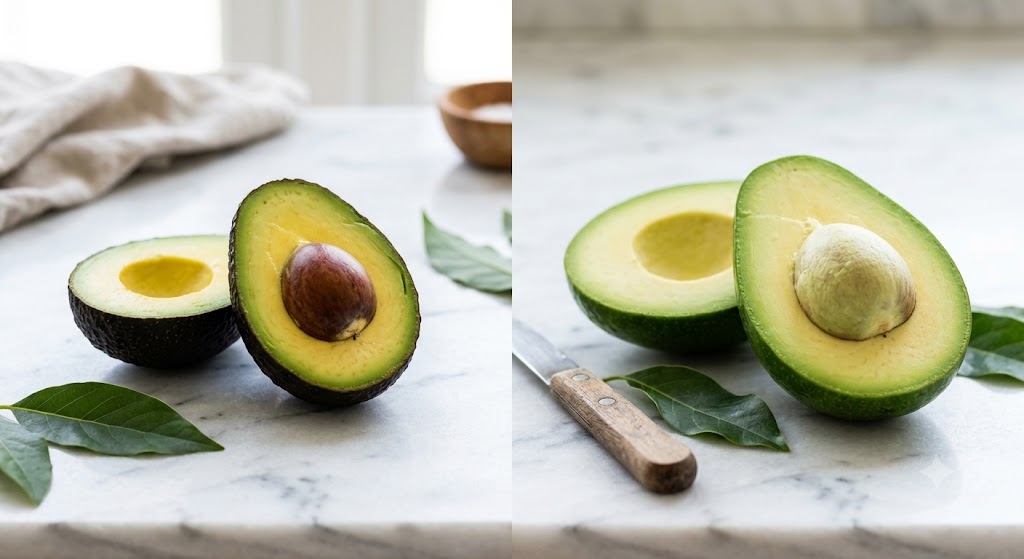
Did you know that not all avocados are created equal? If you’ve ever walked down the produce aisle, you’ve probably seen two main contenders: the small, bumpy, dark-green Hass avocado (mostly from California or Mexico) and the large, smooth, bright-green Florida avocado (sometimes marketed as a "Slimcado").
Here is where the calorie math gets interesting:
Hass Avocados: These are the creamy, rich crowd-favorites. They are higher in fat (mostly oleic acid, the same fat found in olive oil) and have an energy density of about 1.6 to 1.67 calories per gram.
Florida Avocados: These are physically much larger but have a higher water content. Per gram, they actually have 33% less fat and 25% fewer calories than Hass avocados (around 120 calories per 100 grams).
But here is the catch: because Florida avocados are massive, eating a whole one can easily blow past your calorie goals if you aren't paying attention to the total weight.
According to USDA and clinical data, here is how they stack up side-by-side with commercial guacamole:
Food Item (100-Gram Portion) | Calories (kcal) | Total Fat (g) | Saturated Fat (g) | Monounsaturated Fat (g) | Total Carbs (g) | Dietary Fiber (g) | Net Carbs (g) | Protein (g) | Sodium (mg) |
Raw Hass Avocado (Edible Flesh) | 160 | 14.7 | 2.1 | 9.8 | 8.5 | 6.7 | 1.8 | 2.0 | 7.0 |
Raw Florida Avocado (Edible Flesh) | 120 | 8.0 | 1.5 | 5.3 | 8.0 | 5.6 | 2.4 | 1.1 | 5.0 |
Homemade Guacamole (Traditional) | 106 | 9.7 | 1.3 | 6.2 | 7.1 | 4.4 | 2.7 | 1.8 | 177.0 |
Commercial Processed Guacamole | 166 | 13.3 | 1.7 | 8.3 | 10.0 | 6.6 | 3.4 | 3.3 | 400.0 |
Chipotle Mexican Grill Guacamole | 203 | 19.4 | 2.6 | 13.2 | 7.1 | 5.3 | 1.8 | 1.8 | 327.0 |
Bottom Line: Hass avocados are richer and creamier but pack more calories per gram. Florida avocados are lighter on fat but physically much larger.
What Happens When Avocado Becomes Guacamole?
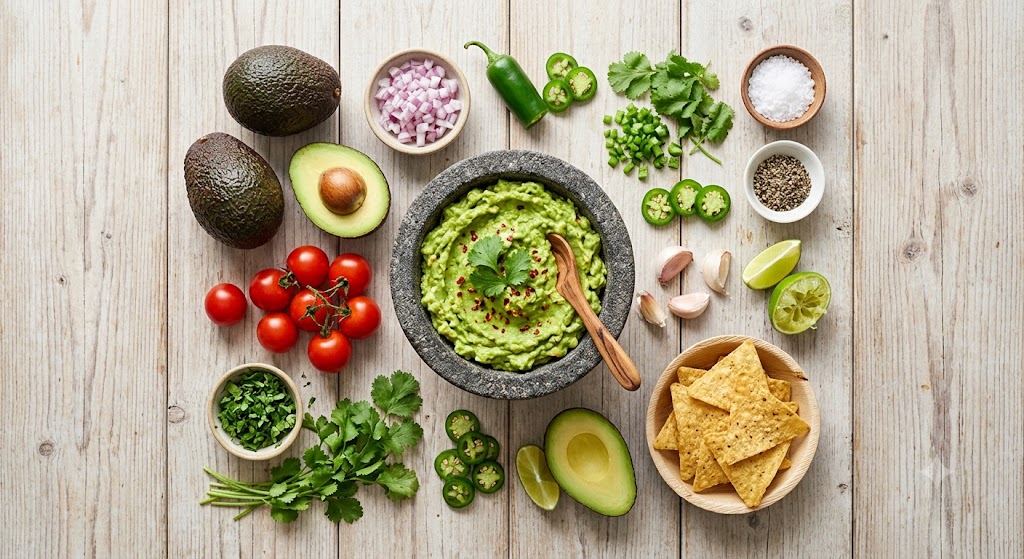
Now for the main event: guacamole vs avocado calories.
When you mash up an avocado to make a traditional Mexican guacamole, you're not just eating avocado. You're adding delicious, fresh, water-rich vegetables like diced tomatoes, chopped onions, cilantro, jalapenos, and a splash of lime juice.
Because these veggies are incredibly low in calories (tomatoes have just 0.18 calories per gram and onions have 0.40 calories per gram), they create a dilution effect. They physically bulk up the guacamole while lowering the overall calorie density!
This means a 1/4-cup scoop (about 60 grams) of fresh, homemade guacamole usually clocks in between 60 and 94 calories, while the same weight of pure Hass avocado pulp is around 100 calories.
Warning! This calorie discount only applies to authentic, homemade guacamole. Commercial store-bought tubs and restaurant preps often sneak in sour cream, heavy cream, emulsified oils, or stabilizers to keep it green and creamy. These additives can easily skyrocket the calorie count higher than plain avocado.
Bottom Line: Thanks to water-rich veggies like tomatoes and onions, traditional homemade guacamole has fewer calories per gram than pure avocado. But watch out for store-bought versions that sneak in extra fats and sodium.
The Incredible Health Benefits of Your Daily Green
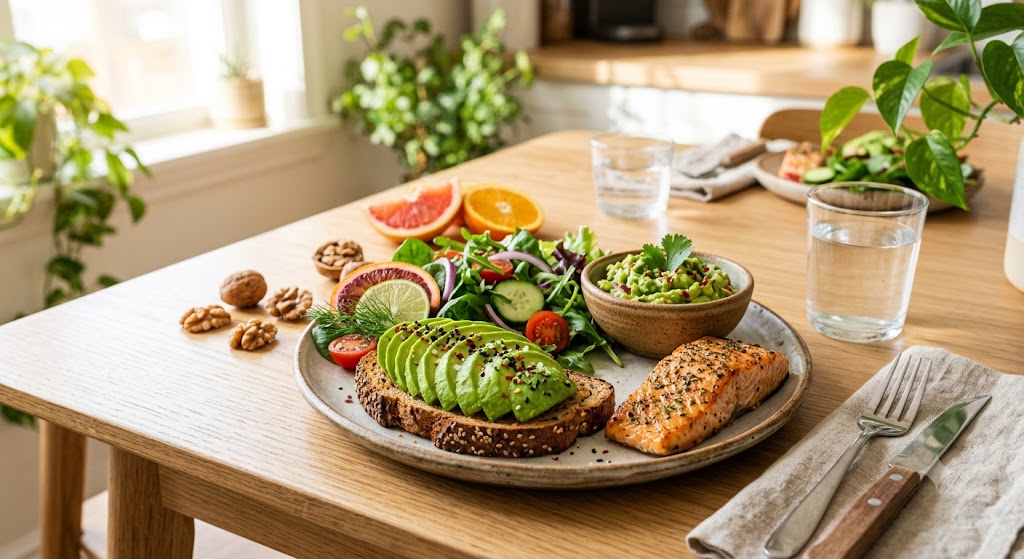
Whether you choose the avocado or the guac, your body is getting a massive dose of nutrition.
A Cardiovascular Shield
Replacing saturated fats (like butter or cheese) with the monounsaturated fats in avocados is a major win for your heart.
A clinical study published in the Journal of the American Heart Association put 45 overweight adults on three different cholesterol-lowering diets. The results? Those who ate one Hass avocado per day saw a whopping 13.5 mg/dL drop in LDL (bad) cholesterol! That reduction was nearly double the effect of the moderate-fat diet without avocado.
Another massive 30-year study tracking over 110,000 people showed that eating at least two servings of avocado a week (or one whole avocado) was linked to a 16% lower risk of cardiovascular disease and a 21% lower risk of coronary heart disease compared to those who rarely ate them.
Weight Loss and the "Magic" of Dietary Compensation
"But wait," you might ask, "if avocados have so many calories, won't they make me gain weight?"
Surprisingly, science says no. In a large 6-month clinical trial (NCT03528031) of over 1,000 participants, one group ate a large Hass avocado every single day (adding an extra 281 calories to their daily intake). At the end of the 6 months, the avocado group did not gain any weight or belly fat compared to those who didn't eat avocados.
How is that possible? It's all thanks to spontaneous dietary compensation. The healthy fats and rich dietary fiber (about 10 grams per medium avocado!) slow down your digestion and keep you feeling incredibly full. Your body naturally triggers satiety hormones, making you eat less of other foods throughout the day without even trying!
Because your body compensates so well due to delayed gastric emptying and satiety signaling, the net calorie change is virtually zero ($\Delta E\approx0$).
Bottom Line: Avocados are fantastic for your heart and cholesterol levels. Plus, their fiber and healthy fats keep you so full that they won't lead to weight gain.
The Calorie Tracking Nightmare (And How to Stop It)
Let's be honest: logging avocados and guacamole in a standard food diary can be a total headache. Most people make three major mistakes:
Forgetting the pit-and-skin discount: A medium avocado weighs around 150 to 200 grams whole. But the skin and massive seed take up about 30% of that weight! If you weigh the whole fruit and log that number, you're overestimating your calories by a long shot.
Generic entry traps: Most apps have one generic entry for "avocado". This completely ignores the huge fat and calorie differences between Hass and Florida varieties.
The guacamole guessing game: Guacamole recipes vary wildly. A restaurant serving might have added oils or sour cream, while your homemade version is light and veggie-packed.
Enter VoCal: The Hands-Free Acoustic Solution
VoCal (available on iOS and Android) is a revolutionary voice-based calorie tracking app that makes logging these tricky foods as easy as talking.
Instead of tapping through databases and guessing portion weights, you just tap the microphone and say:
"I had half a medium Hass avocado on whole-wheat toast."
VoCal's smart Natural Language Processing (NLP) parser instantly goes to work:
Identifies the cultivar: It knows you ate "Hass avocado".
Calculates the edible yield: It automatically subtracts the seed and skin weight, recording exactly 75 grams of edible flesh (~120 calories).
Logs your macros instantly: No typing required!
Photo + Voice Integration for Perfect Guac Tracking
Have a bowl of restaurant guac and don't know what's in it? Just snap a quick photo with the VoCal app to capture the volume, and add a quick voice note:
"I had a four-ounce scoop of homemade guacamole with fresh tomatoes, lime, and cilantro."
The app combines the visual scale of the photo with your voice description to log a highly accurate nutritional entry.
Here is how VoCal compares to traditional tracking methods:
Tracking Feature | Traditional Manual Apps | Standard Image Recognition | VoCal Multimodal Voice App |
Acoustic Logging Speed | No (Manual text input required) | No (Requires physical photo only) | Yes (Logs complete meals in 3 to 5 seconds) |
Preparation Context | Requires searching and editing multiple entries | Ineffective (Cannot see hidden oils or dilution) | Yes (Captures ingredients and prep via natural voice notes) |
Skin/Seed Refuse Discount | Must be manually calculated or guessed | Inaccurate (Visual estimation of whole fruit weight) | Yes (NLP automatically applies the edible yield discount) |
Adherence Rates | Low (High user fatigue over time) | Moderate (Frustration with inaccurate matches) | High (Reduces friction and supports long-term consistency) |
Bottom Line: Say goodbye to logging fatigue. With VoCal, you can speak your meals naturally, get instant accurate calorie counts, and keep moving with your day.
Frequently Asked Questions (FAQs)
Q: Does guacamole have more calories than plain avocado?
A: Traditionally, no! Authentic, homemade guacamole is actually lower in calories per gram than pure avocado because it is diluted with low-calorie vegetables like tomatoes, onions, and lime juice. However, watch out for store-bought and restaurant versions, which sometimes add extra oils or sour cream.
Q: Is it okay to eat an avocado every day?
A: Yes! Large-scale clinical trials have shown that eating one avocado daily is highly beneficial for heart health and lowering bad cholesterol, and does not lead to weight gain thanks to its high fiber and satiety-promoting healthy fats.
Q: What is the difference between California (Hass) and Florida avocados?
A: Hass avocados are smaller, bumpy, and have a rich, buttery texture with higher fat and calories. Florida avocados are larger, smooth, and have a higher water content, yielding 33% less fat and 25% fewer calories per gram.
Q: How does the VoCal app help with tracking avocados?
A: VoCal allows you to log meals using just your voice. Its natural language parser automatically subtracts the weight of the inedible pit and skin from your logged entry, keeping your calorie counts extremely accurate.
Disclaimer: This article is for informational purposes only. It is not intended to provide medical advice, diagnosis, or treatment. Always consult with a registered dietitian, doctor, or qualified healthcare professional before starting any new diet plan, especially if you have chronic medical conditions like kidney disease or are taking medications like blood thinners.