

Picture this: You are standing in your kitchen, spoon in hand, staring down a warm bowl of oatmeal. You want to add a touch of sweetness, but you also want to keep your metabolic health in check. You might wonder if choosing the honey vs sugar healthier option is actually backed by clinical science.
While honey has a reputation for being a "natural" superfood, regular white sugar is often treated as the ultimate dietary villain. But when it comes to blood sugar spikes, insulin response, and overall energy intake, does honey actually treat your body any differently than table sugar?
Let's dive into what the research says about these two popular sweet foods and how you can manage them using your favorite voice-based calorie tracking app.
Similarities and differences

At their core, both honey and white sugar are simple carbohydrates. They are packed with glucose and fructose—the basic sugar molecules your body uses for fuel. However, how these molecules are packaged is where the two sweet options split paths.
Table Sugar (Sucrose): White sugar is highly refined and consists of pure sucrose. Sucrose is a disaccharide, meaning it is made of equal parts glucose and fructose chemically bonded together. It contains no vitamins, minerals, or fiber—just empty calories.
Honey: Honey is a liquid sweetener created by bees using flower nectar. Because it is less processed, it retains water, trace enzymes, organic acids, local pollen, and antioxidants. Instead of being chemically bonded, the fructose and glucose molecules in honey float around freely.
Because honey contains water, it is slightly less calorie-dense by weight than dry granulated sugar. However, because liquid honey is physically much denser, a single spoonful packs a bigger punch than a spoonful of crystals.
Nutrient (per 100g) | White Sugar | Average Honey |
|---|---|---|
Calories | ~385 kcal | ~304 kcal |
Carbohydrates | ~99.8 g | ~80.0 g–82.0 g |
Free Fructose | 0.0 g | ~39.5 g–47.0 g |
Free Glucose | 0.0 g | ~32.0 g–35.0 g |
Sucrose | ~99.8 g | ~2.2 g–7.3 g |
Water Content | ~0.02% | ~15.0%–18.0% |
Trace Nutrients | Negligible | Potassium, Magnesium, Zinc, B-Vitamins. |
When you are doing your daily calorie tracking, these numbers matter! A single teaspoon of honey serves up about 21 calories, while a teaspoon of white sugar gives you 16 calories.
How they affect blood sugar
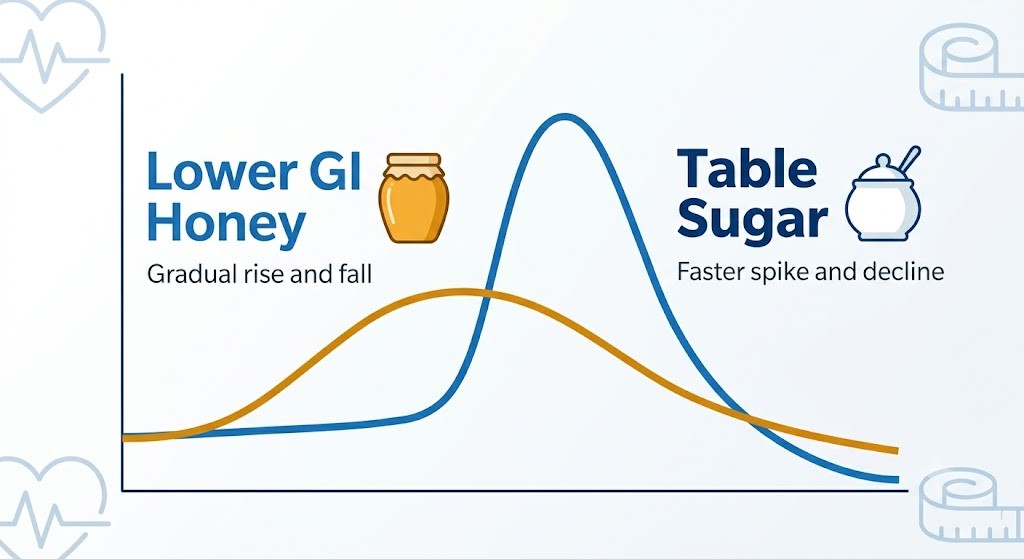
To understand how these sweeteners trigger blood sugar spikes, we have to look at the Glycemic Index (GI). The GI ranks foods from 0 to 100 based on how fast they cause your blood glucose levels to rise.
Pure Glucose: Has a GI of 100 and shoots straight into your bloodstream.
Pure Fructose: Has a very low GI of about 19 because your liver has to process it first.
Because white sugar is a perfect 50/50 split of glucose and fructose, it has a steady and predictable glycemic index of about 60 to 65.
Honey, however, is a bit of a metabolic wild card. Depending on the type of flower the bees visited, the GI of honey can swing anywhere from 32 to 85.
If you choose a honey with a high fructose-to-glucose ratio (like Acacia or Yellow Box honey), it has a lower GI and raises your blood sugar much more gradually than table sugar. But if you grab a honey that is naturally higher in glucose (such as Rape or Dandelion honey), it will spike your blood sugar just as quickly as refined white sugar.
What the clinical research says
Does honey actually perform better in real-world clinical trials? The science suggests that while honey has a slight edge in some areas, your metabolism cannot really tell them apart when consumed in large amounts over time.
The Fasting and Insulin Response Study: In a clinical trial conducted by the USDA Agricultural Research Service, participants consumed 50 grams of carbohydrates daily from clover honey, white sugar, or high-fructose corn syrup for two weeks. The researchers found that fasting blood sugar, insulin levels, and insulin resistance did not differ significantly between any of the sweeteners.
The Lipid Profile Study: On a brighter note, a 30-day clinical trial on healthy young adults compared eating 70 grams of honey daily against 70 grams of white sugar. While the sugar group saw a rise in "bad" LDL cholesterol and triglycerides, the honey group actually saw a reduction in total cholesterol, LDL, and triglycerides, along with a boost in "good" HDL cholesterol.
Clinical Study | Participants & Dosage | Glycemic Outcomes | Lipid Outcomes |
|---|---|---|---|
USDA Crossover Trial | 55 adults; 50g carb/day from honey or sugar for 14 days | No difference in fasting glucose, insulin, or HOMA-IR | Triglycerides increased in all groups |
Young Adult Trial | 60 adults; 70g/day of honey or sugar for 30 days | Fasting blood sugar remained unchanged | Honey reduced LDL & TG, increased HDL; sugar did the opposite |
Systematic Review | 13 clinical trials (diabetic & nondiabetic cohorts) | High honey intake worsened HbA1c in type 2 diabetics | No significant metabolic improvement in healthy individuals |
The main takeaway? Honey might have some protective, anti-inflammatory perks, but high daily doses will still stress your metabolism and worsen your long-term blood sugar markers if you have type 2 diabetes.
Benefits of honey
If you do choose to use honey in moderation, it brings some unique biological tools to the table that white sugar lacks:
Rich in Antioxidants: Dark honey, in particular, is packed with flavonoids and phenolic acids that help fight cell damage and lower your risk of chronic diseases.
Keeps You Fuller Longer: A clinical study found that a breakfast sweetened with honey delayed the hunger-inducing hormone ghrelin and boosted the satiety hormone peptide YY (PYY) compared to a breakfast sweetened with sugar. This means honey might help with appetite control.
Cough and Wound Care: High-quality medical-grade honey has natural antibacterial qualities. It is clinically proven to quiet a nighttime cough in children over age 1 and assist in soothing minor skin burns.
Disadvantages and risks of honey
Before you swap all your sugar alternatives for honey, keep these risks in mind:
Slightly Higher Calories: Honey packs 64 calories per tablespoon, compared to sugar's 50 calories. If you do not practice portion control, those extra calories can sneak up on you.
Risk of Infant Botulism: Never give honey—raw or pasteurized—to a baby under 12 months old. It can contain bacteria spores that can cause infant botulism, a rare but life-threatening illness.
Still an Added Sugar: No matter how organic it is, your body still registers honey as added sugar. Overconsuming it can lead to weight gain, high blood pressure, and tooth decay.
Benefits of sugar
Refined white sugar is not all bad. It has a few practical benefits in everyday life:
Perfect for Baking: Because white sugar consists of pure sucrose crystals, it provides structure, browning, and moisture to baked goods in a way liquid honey cannot easily replicate.
Long Shelf Life and Low Cost: Sugar is highly stable, incredibly cheap, and accessible to everyone.
Quick Energy: Because it breaks down rapidly, it can serve as an immediate source of fuel for athletes undergoing intense endurance training.
Disadvantages and risks of sugar
Empty Calories: White sugar offers absolutely zero vitamins, minerals, fiber, or healthy fats.
Dental Cavities: Sugar combines with the bacteria in your mouth to produce acid, which directly erodes tooth enamel and leads to cavities.
Disrupts Gut Health: A diet very high in refined sugar can reduce the diversity of your gut microbiome, triggering low-grade systemic inflammation.
Tips for cutting down (and tracking with your voice!)

Managing your sweet tooth does not mean you have to cut out all sweets forever. Try these smart strategies to enjoy the occasional drizzle of honey while keeping your health on track:
Pair It Wisely: To stop blood sugar spikes in their tracks, never eat simple sugars by themselves. Instead, drizzle a small amount of honey onto plain Greek yogurt, chia pudding, or oatmeal. The healthy fats, protein, and soluble fiber in these foods will slow down digestion and keep your insulin response stable.
Watch the Daily Limits: The American Heart Association recommends that women limit added sugars to 100 calories per day (~5 teaspoons of sugar or ~4.5 teaspoons of honey) and men stick to 150 calories (~9 teaspoons of sugar or ~7 teaspoons of honey).
Use Your Voice with VoCal: Precision is key when it comes to macronutrient tracking and calorie tracking. Because honey is so dense, a heavy-handed pour can easily add an extra 100 calories to your meal without you realizing it.
With the VoCal app, you do not have to spend time searching through databases or typing out complex weight measurements. You can simply tap your microphone and say:
"Log one teaspoon of raw wildflower honey on my morning oats."
"Add two teaspoons of granulated sugar to my afternoon black tea."
Our voice-activated system immediately logs the precise daily carbohydrate intake, caloric value, and keeps your nutrition goals perfectly aligned.
Frequently Asked Questions (FAQs)
Does raw honey spike insulin less than white sugar?
In acute, single-dose settings, certain high-fructose honeys produce a slightly lower insulin response than refined sucrose. However, clinical research shows that if you eat honey consistently every day, its long-term impact on your insulin sensitivity is virtually identical to table sugar.
Is honey allowed on a keto or low-carb diet?
Generally, no. Because honey is highly concentrated in simple carbohydrates, even a single tablespoon (containing 17 grams of carbs) can quickly eat up your entire daily carbohydrate budget if you are trying to stay in ketosis.
Why does honey have more calories than sugar?
It comes down to physical density. White sugar consists of airy, dry crystals, whereas honey is a heavy liquid. Because of this, a tablespoon of honey weighs more and contains more sugar molecules than a tablespoon of white sugar, resulting in 64 calories versus sugar's 50.
Can people with diabetes use honey as a sugar alternative?
While honey is a delicious whole food, it is not a free pass for individuals with diabetes. Both honey and sugar will raise your blood glucose levels. If you have diabetes, you must count the carbs in honey as a direct part of your daily carbohydrate tracking plan and consume it only in strict moderation.
Disclaimer: This article is for informational and educational purposes only and does not substitute for professional medical advice, diagnosis, or treatment. Always consult a qualified healthcare professional, doctor, or registered dietitian before making significant dietary changes, especially if you have an underlying health condition such as diabetes.