

If you are a coffee or tea lover, your morning ritual probably starts with a warm cup of comfort. But as you reach for the sweetener, a classic morning debate begins: is honey vs sugar healthier option? Many of us swap white sugar for honey, assuming we are making a massive health upgrade. But is honey really a superfood, or is it just sugar in a stickier coat?
Let’s dive into the science, the calories, and the chemistry to find out which sweetener deserves a spot in your mug!
In this article:
Similarities and differences
Benefits of honey
Disadvantages and risks of honey
Benefits of sugar
Disadvantages and risks of sugar
The temperature trouble: Honey in hot coffee and tea
Ethical and lifestyle factors: Vegans take note!
Tracking sweeteners with VoCal
Summary
Frequently asked questions (FAQs)
Similarities and differences
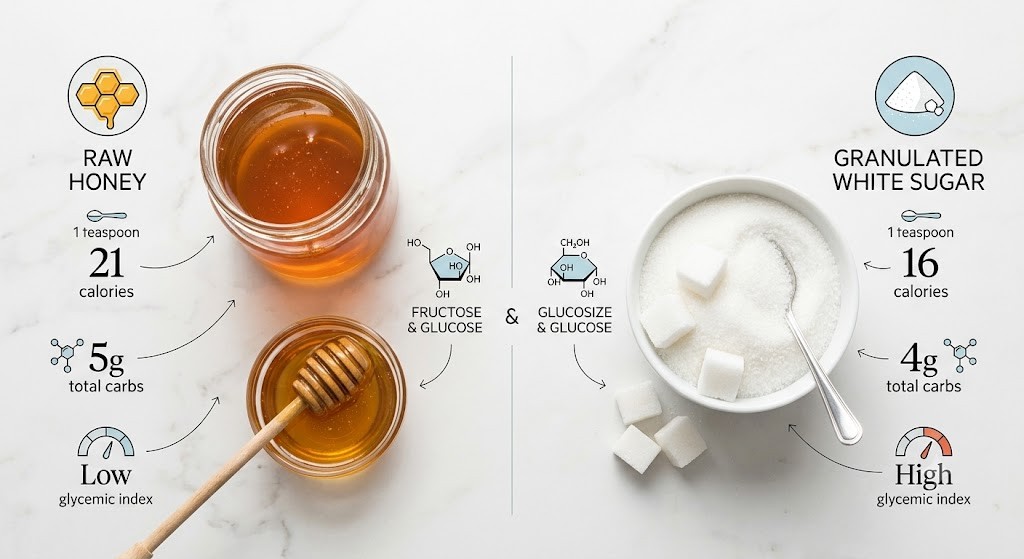
At their core, both honey and white sugar are classified as added sugars. The Food and Drug Administration (FDA) defines added sugars as any sugars put into foods or drinks during preparation or processing. This means that whether you pour refined white crystals or drizzle sweet clover honey into your tea, your body is receiving extra calories that do not naturally occur in the food itself.
Chemically, both of these kitchen staples are made of the same two basic building blocks: glucose and fructose.
Glucose: This is your body's main energy source. Your cells burn it for fuel, and it triggers insulin release to help clear it from your bloodstream.
Fructose: This is fruit sugar. It is processed mainly by your liver and does not trigger insulin the same way glucose does.
Table sugar (sucrose) is a 50-50 split of glucose and fructose chemically bonded together. Honey is a mixture of free-floating glucose and fructose molecules, with a bit of water and trace nutrients.
The Dietary Guidelines for Americans recommend keeping your added sugars to less than 10% of your daily calories. For a standard 2,000-calorie diet, that is 50 grams (about 12 teaspoons) of sugar. Currently, the average American adult downs a whopping 17 teaspoons of added sugar a day. That is about 270 extra calories! Overdoing it can lead to weight gain, type 2 diabetes, and heart disease.
Let’s look at how they stack up side-by-side:
Table 1: Sweetener Comparison per Teaspoon
Sweetener Type | Weight per Teaspoon | Calories per Teaspoon | Carbohydrate Mass | Glycemic Index (GI) |
Granulated White Sugar | 4.19 grams | 16.2 kcal | 4.19 grams | ~60 |
Clover Honey | 5.75 grams | 22.0 kcal | 4.60 grams | 32 to 85 (Variable) |
Benefits of honey
Honey is often crowned the favorite in the "honey vs sugar healthier option" debate, and it does bring some unique properties to the table:
Nutritional content: Honey is more than just sugar water. It contains trace amounts of vitamins (like B vitamins and vitamin C), minerals, amino acids, and organic acids. It also packs antioxidants, which help fight off cell-damaging free radicals in your body. Darker honeys usually boast a higher concentration of these healthy compounds.
Slightly lower glycemic index: The glycemic index (GI) measures how fast a food spikes your blood sugar. Table sugar has a GI of around 60. Because honey has a higher ratio of fructose (which gets processed slowly by your liver rather than flooding your bloodstream), its GI is typically lower, ranging between 32 and 85 depending on the floral source.
Perceived sweetness and the aroma bonus: Here is where honey gets incredibly cool! Scientific research reveals that honey's natural volatile aromas (like floral and fruity scent notes) send signals to your brain that actually boost your perception of sweetness. When these aromas are vaporized in a warm mug of coffee or tea, they make the honey taste much sweeter than it actually is on paper. This means you can use nearly 40% less volume of honey to get the exact same sweetness as white sugar!
Because of this aroma-sweetness boost, you do not have to swap your sweeteners on a strict 1-to-1 basis. Take a look at the equivalent sweetener portion sizes:
Table 2: Sweetness Equivalency in Hot Beverages
Desired Sweetness Level | Granulated Sugar Required | Equivalent Honey Volume | Net Caloric Savings | Saved Carbohydrate Mass |
1 Teaspoon Equivalent | 1.00 tsp (4.19g) | 0.58 tsp (3.34g) | 3.4 kcal | 0.85 grams |
1 Tablespoon Equivalent | 1.00 tbsp (11.98g) | 0.58 tbsp (9.53g) | 9.72 kcal | 2.45 grams |
1 Cup Equivalent | 1.00 cup (199.00g) | 0.58 cup (158.00g) | 162.0 kcal | 41.00 grams |
Disadvantages and risks of honey
While honey sounds like a dream, it has a few sticky downsides:
Higher calorie density: A teaspoon of honey actually has more calories than a teaspoon of sugar. Because honey is a dense liquid and sugar is a fluffy crystal, honey packs 22 calories per teaspoon compared to sugar's 16.2 calories. If you swap them one-for-one without adjusting, you will end up consuming more calories!
Worsened glycemic control in large doses: If you are managing type 2 diabetes, do not assume honey is a free pass. Clinical research shows that eating large daily portions of honey (like 50 grams) can actually worsen long-term blood sugar levels, raising your HbA1c.
Risk of infant botulism: Never give honey to infants under 12 months. It can contain bacterial spores (Clostridium botulinum) that can grow in an infant's underdeveloped digestive system, causing a rare but serious illness.
Benefits of sugar
Good old table sugar isn't all bad. It has some highly practical perks:
Low cost and long shelf life: White sugar is incredibly cheap, highly accessible, and practically never spoils.
Predictable sweetness: You know exactly what you are getting. It has a neutral sweet flavor that does not alter the taste profile of your premium coffee beans or delicate tea leaves.
Familiar caloric profile: At 16.2 calories per teaspoon, it is highly predictable for calorie tracking.
Disadvantages and risks of sugar
Zero nutritional value: Refined sugar is the definition of "empty calories." It contains absolutely no vitamins, minerals, or antioxidants.
Rapid blood sugar spikes: With a steady glycemic index of ~60, white sugar causes rapid spikes in blood glucose and insulin levels.
Dental cavities: Refined sugar is the favorite food of cavity-causing bacteria in your mouth.
Long-term health risks: Regularly consuming too much sugar is heavily linked to visceral weight gain, systemic inflammation, high blood pressure, and type 2 diabetes.
The temperature trouble: Honey in hot coffee and tea

Here is the ultimate catch for hot beverage drinkers. The primary reason people choose honey over sugar is for its natural health benefits—the active enzymes, antioxidants, and immune-supporting compounds.
But here is the thermal plot twist: high heat destroys these benefits.
Freshly brewed coffee and tea are usually served at temperatures between 140°F and 185°F (60°C to 85°C). Research shows that exposing raw honey to temperatures above 140°F (60°C) denatures its fragile enzymes (like diastase and glucose oxidase) and degrades its heat-sensitive antioxidants and vitamins.
Even worse, heating honey under acidic conditions (and yes, coffee and tea are slightly acidic) can generate advanced glycation end products (AGEs) and a heat contaminant called hydroxymethylfurfural (HMF). This is why traditional Ayurvedic medicine actively warns against heating honey, stating that it can produce toxic compounds.
So, if you stir raw honey into your piping-hot morning brew, it loses its raw nutritional perks. Scientifically speaking, it gets downgraded into a basic syrup of glucose and fructose, acting just like refined sugar in your body.
Ethical and lifestyle factors: Vegans take note!
If you are living a plant-based lifestyle, the choice between these two isn't just about calories—it's also about ethics.
Is white sugar vegan? Not always! In the United States, many sugar refineries use bone char (made from cattle bones) to filter and decolorize cane sugar. While the finished sugar does not contain actual bone particles, the use of animal products in processing means strict vegans avoid conventional refined cane sugar. Beet sugar and certified organic sugars are safe, as they are refined using vegetative activated charcoal.
Is honey vegan? No. Because honey is made through the labor of honeybees, it is classified as an animal byproduct and is excluded from vegan diets.
Table 3: Ethical Sweetener Overview
Sweetener | Vegetarian Status | Vegan Status | Primary Processing Agents | Potential Plant-Based Substitutes |
Conventional Cane Sugar | Acceptable | Often Excluded | Animal Bone Char | Beet Sugar, Coconut Sugar |
Organic Cane Sugar | Acceptable | Acceptable | Vegetative Activated Carbon | N/A |
Natural Honey | Acceptable | Excluded | Insect Secretions & Nectar | Maple Syrup, Agave Nectar |
Tracking sweeteners with VoCal
If you are trying to stay on top of your health, liquid calories are the easiest ones to forget. A splash of syrup here, a spoonful of sugar there, and suddenly your daily limit is blown. That's where VoCal comes in!
With VoCal, you can track calories by voice in seconds. No more tedious searching or typing in a tiny search bar. Just say, "Added half a teaspoon of honey to my green tea," and our smart voice system does the heavy lifting.
But remember the math! Because honey is physically denser than sugar, a spoonful of honey contains about 30% more calories than the same volume of sugar. If you track a "teaspoon of sugar" when you actually used a "teaspoon of honey," your calorie tracking won't be accurate. VoCal understands these volumetric differences and adjusts your calorie logs based on precise sweetener portion sizes, ensuring your tracking stays razor-sharp.
The Summary
When it comes down to choosing a honey vs sugar healthier option for your hot tea or coffee, the physical differences are pretty minor once they hit your mug. The intense heat of your freshly brewed beverage rapidly degrades honey's healthy enzymes and antioxidant compounds, rendering it metabolically similar to table sugar.
However, honey holds one secret weapon: its sweet-smelling volatile aromas. Because honey smells incredibly sweet, you can use about 40% less of it to get the same level of sweetness as sugar, saving you a few calories and carbs per cup.
Whether you choose the golden drizzle of honey or the classic white sugar, moderation is key. Keeping a close eye on your sweetener portion sizes and logging those liquid calories will ensure you reach your wellness goals. And with the ability to track calories by voice on VoCal, keeping your diet on track has never been easier!
Frequently asked questions (FAQs)
Is honey safer than sugar for people with diabetes?
Not necessarily. While honey has a slightly lower glycemic index than table sugar, it is still an added sugar that contains a high amount of glucose and fructose. Clinical trials show that large daily doses of honey can worsen long-term blood sugar levels (HbA1c) in people with type 2 diabetes. Always consult your healthcare provider to find the safest sweetener limits for your personal health situation.
Does heating honey make it toxic?
Exposing honey to high heat (like boiling water) denatures its beneficial enzymes, degrades its antioxidants, and can produce heat-induced compounds like hydroxymethylfurfural (HMF). While it won't instantly poison you, it strips honey of its healthy "raw" properties and turns it into a basic sugar syrup. To preserve honey's natural enzymes, let your coffee or tea cool down to a warm, drinkable temperature (below 140°F or 60°C) before stirring it in.
How can I naturally cut back on sweeteners in my hot drinks?
You can try a few delicious, calorie-free tricks:
Add a dash of spices like cinnamon, nutmeg, or cardamom to naturally trick your palate into tasting sweetness.
Use vanilla or almond extract to boost the sweet aroma of your coffee or tea.
Slowly cut your sweetener portion sizes in half over a couple of weeks to let your tastebuds adapt to less sugar.
Disclaimer: The information provided in this article is for educational and informational purposes only and is not intended as medical advice, diagnosis, or treatment. It should not be used as a substitute for professional, informed medical advice from a qualified healthcare provider. Always consult with a physician or other healthcare professional before making any major changes to your diet, nutrition, or lifestyle, especially if you are managing a chronic health condition such as diabetes or heart disease.