

Ah, the sweet life. Whether it’s a morning cup of coffee, a warm bowl of oatmeal, or a homemade batch of blueberry muffins, we all crave a little sweetness now and then. But if you are managing diabetes or keeping an eye on your insulin sensitivity, that harmless-looking drizzle of sweetener can feel like a game of metabolic Russian roulette.
Naturally, you might find yourself searching for a honey vs sugar healthier option to satisfy your sweet tooth without sending your continuous glucose monitor (CGM) into a panic.
Is honey really the golden ticket to sweet, diabetes-friendly bliss, or is it just table sugar in a fancier, bee-approved jacket? Let's dive into the sticky science of how both affect your body so you can make the smartest choice for your health.
Honey vs. Sugar: Similarities and Differences
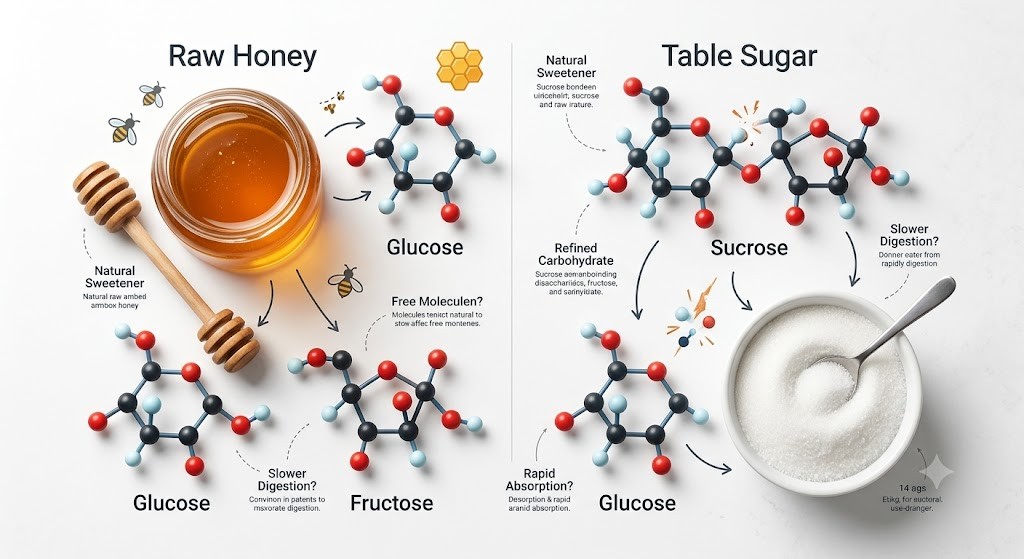
At first glance, honey and white sugar seem like twins. They are both classified as "added sugars" on food labels, and both are composed of the same two basic simple sugars: glucose and fructose.
However, the way their chemical structures are put together makes a massive difference in how your digestive system processes them:
Table Sugar (Sucrose): White sugar is a disaccharide. This is just a fancy science word meaning the glucose and fructose molecules are chemically bonded together. Because of this bond, your stomach cannot absorb it directly. It has to travel to your small intestine, where a special enzyme called sucrase cleaves the bond, flooding your system with glucose and fructose at the exact same time.
Raw Honey: Honey is a complex, supersaturated liquid composed of independent, unbound glucose and fructose molecules. Bees add special enzymes (like invertase) to the flower nectar, pre-splitting the sucrose before it ever hits your jar. Because these sugars are already separated, honey bypasses that heavy-duty enzymatic cleavage step, making it much easier on your digestive tract.
However, because honey is much denser and contains a small amount of water, a tablespoon of honey actually packs more calories and carbohydrates than a tablespoon of granulated sugar.
The table below breaks down the nutrient profiles of both sweeteners based on data from the United States Department of Agriculture (USDA) National Nutrient Database.
Nutrient (per 1 tbsp) | Raw Honey (21g) | White Sugar (12.6g) |
Calories | 64 kcal | 48 kcal |
Carbohydrates | 17.3 g | 12.6 g |
Sugars | 17.2 g | 12.6 g |
Free Fructose | ~8.6 g | 0 g (all chemically bound) |
Free Glucose | ~7.5 g | 0 g (all chemically bound) |
Antioxidants | Present | Absent |
The Glycemic Index: Why Honey Rises More Gently

To understand how these sweeteners affect your blood sugar, we look at the Glycemic Index (GI)—a scale that measures how quickly a carbohydrate spikes your blood glucose.
Refined table sugar has a moderately high GI of around 65 to 80. Honey, on the other hand, averages a slightly lower GI of 55 to 58.
Why the difference? It all comes down to the fructose. Unlike glucose, which requires insulin to enter your cells, fructose is metabolized primarily by your liver. In small amounts, free fructose stimulates an enzyme in your liver called glucokinase, which acts like a sponge, clearing glucose out of your blood and storing it safely as glycogen. This natural tag-team effort blunts the immediate blood sugar spike, giving honey a smoother curve than table sugar.
But there's a catch: not all honey is the same. Cheap, commercial honeys are highly pasteurized (heated to 65°C/149°F or higher), which destroys these active bee enzymes and complex oligosaccharides. This leaves you with a processed syrup that spikes your blood sugar almost as fast as table sugar.
The floral source also dictates the glycemic impact. Honeys with a higher fructose-to-glucose ratio (like Acacia honey) have an exceptionally low GI, while common US honeys (like clover or buckwheat) sit much higher on the scale.
Sweetener Variety | Average Glycemic Index (GI) | Primary Sugar Profile |
Pure Glucose | 100 | 100% Glucose |
Table Sugar | 65 to 80 | 50% Fructose, 50% Glucose |
Acacia Honey | 32 to 35 | High Fructose-to-Glucose Ratio |
Clover Honey (US) | 69.2 | Near-equal Fructose/Glucose |
Buckwheat Honey (US) | 73.4 | Near-equal Fructose/Glucose |
What the Science Says: The Biphasic Dosage Effect
If you are looking for clinical proof, a landmark systematic review and meta-analysis from the University of Toronto (published in Nutrition Reviews) analyzed 18 controlled trials. The researchers found that when raw, single-source honey replaces other added sugars in a healthy diet, it can actually reduce fasting blood glucose and lower "bad" LDL cholesterol.
But don't go grabbing the squeeze bottle just yet! The clinical reality follows a biphasic dosage response—which is a fancy way of saying "the dose makes the poison".
The Helpful Zone: Studies show that keeping your daily honey intake very low (between 5 and 25 grams, or about 1 to 5 teaspoons) can help improve long-term blood sugar control (HbA1c).
The Danger Zone: Once your daily intake reaches or exceeds 50 grams (about 10 teaspoons), the metabolic benefits vanish. High doses of simple sugars saturate your liver, trigger de novo lipogenesis (fat production), raise your triglycerides, and cause your HbA1c to climb.
Benefits and Disadvantages of Honey
While honey is more natural, it is still a concentrated source of carbohydrates that requires respect.
Benefits of Honey
Antioxidant Powerhouse: Unlike empty white sugar, raw honey contains flavonoids and phenolic acids that fight inflammation and cellular damage.
Gentler on Blood Sugar: Thanks to its free fructose and active enzymes, raw honey avoids the steep "spike-and-crash" effect of table sugar.
Natural Therapeutic Uses: Cleaned, medical-grade honey is a clinical champion for healing wounds and diabetic foot ulcers, while standard raw honey is a highly effective, natural cough suppressant for kids.
Disadvantages and Risks of Honey
Calorie and Carb Dense: It is physically heavier than sugar, meaning a tablespoon of honey actually delivers more calories and carbohydrates directly into your daily limit.
Infant Botulism Risk: Honey can contain Clostridium botulinum spores. While safe for adults, an infant's immature digestive tract can't handle them, which can lead to a rare, life-threatening muscle-weakness disease. Never give honey to an infant under 12 months.
Stomach Troubles: Because honey is high in free fructose (a FODMAP), it can cause gas, bloating, and diarrhea for people with irritable bowel syndrome (IBS).
Benefits and Disadvantages of Sugar
Table sugar is highly refined, but it still has its place in the kitchen.
Benefits of Sugar
Baking Champion: Sugar provides predictable structure, moisture, and leavening in baked goods.
Cheap and Shelf-Stable: It is incredibly budget-friendly and lasts indefinitely in your pantry.
Fast-Acting for Lows: If you experience a sudden drop in blood sugar (hypoglycemia), refined sugar or candy is highly predictable for raising your glucose quickly.
Disadvantages and Risks of Sugar
Completely Empty Calories: The intense processing of table sugar strips away every single vitamin, mineral, and antioxidant.
The Sugar Roller Coaster: It causes a rapid, sharp spike in blood sugar followed by a heavy crash, leaving you feeling tired, foggy, and hungry.
Disrupts Gut Bacteria: High intake of refined sugar can alter your gut microbiome, triggering systemic inflammation and compromising digestion.
Causes Cavities: Sugar directly feeds the bacteria in your mouth that cause tooth decay.
Practical Application: Baking Swaps & Tracking with VoCal
If you want to swap honey for sugar in your kitchen, you can’t just do a simple 1:1 switch. You need to play a little food chemistry:
Use Less: Honey is sweeter than sugar. Use 1 part honey for every 1.25 parts sugar in your recipes.
Cut the Liquids: Honey contains about 17% water. Reduce other liquids in the recipe by 1/4 cup for every cup of honey you use.
Lower the Oven Temp: Honey browns much faster due to its simple sugars. Table sugar caramelizes at 160°C (320°F), but honey begins to brown at just 110°C (230°F). Lower your baking temperature by 25°F to prevent burning.
Protect the Enzymes: High heat kills honey's helpful antioxidants and enzymes. If you are sweetening tea or coffee, let it cool down to a comfortably warm temperature (under 40°C or 104°F) before stirring in raw honey.
How VoCal Makes Sugar Tracking Effortless
Because honey is thick and sticky, trying to guess if you just drizzled a teaspoon or a tablespoon onto your morning Greek yogurt is almost impossible. Overestimating or underestimating added sugars can cause unexpected blood sugar spikes and throw off your insulin dosing.
This is where the voice-based calorie-tracking application VoCal saves the day. No more scrolling through long databases or trying to type with sticky fingers.
Simply say: "VoCal, add one teaspoon of raw buckwheat honey to my morning oatmeal."
The app instantly accesses the USDA database to log the exact nutritional values: 21 calories and 5.8 grams of carbs directly into your daily target. It is the easiest, hands-free way to enjoy natural sweetness responsibly and keep your glycemic curves beautifully flat!
Frequently Asked Questions (FAQs)
Is honey a safe alternative to sugar for Type 2 diabetes?
Yes, but only in strict, tiny quantities (under 25 grams, or 1 to 5 teaspoons a day). If your blood glucose is poorly managed or your insulin resistance is high, you should skip both honey and sugar and opt for zero-glycemic natural sweeteners like stevia or monk fruit instead.
Can eating too much honey cause diabetes?
No, honey itself does not cause diabetes. However, regularly overconsuming any form of added sugar (including honey) leads to excess calories, weight gain, high triglycerides, and fatty liver—all of which are major building blocks for insulin resistance and Type 2 diabetes.
Which honey has the lowest glycemic index?
Authentic, raw Acacia (Robinia) honey is the absolute champion, boasting a low GI of 32 to 35. By comparison, standard US clover honey has a GI of around 69.
Why is honey dangerous for babies?
Raw honey can contain spores of a bacterium called Clostridium botulinum. While an adult’s mature digestive tract easily destroys these spores, an infant’s digestive system is too weak. The spores can grow and release toxins, causing infant botulism, a serious disease that causes muscle weakness and breathing difficulties. Do not give honey to infants under 12 months.
Disclaimer: This article is for informational purposes only. It is not intended to be a substitute for professional medical advice, diagnosis, or treatment. Always seek the advice of your physician or another qualified healthcare provider with any questions you may have regarding a medical condition, diet, or treatment plan. Never disregard professional medical advice or delay in seeking it because of something you have read in this article.