

It is 6:00 PM on a hectic Tuesday. Your stomach is growling, your energy is tanked, and the ultimate dinner dilemma looms: What is for dinner?
If you are trying to eat healthy, chicken is probably your default setting. It is the most popular lean protein in the United States. But when you are staring down your options, you generally end up choosing between two contenders:
Grilled Chicken: The squeaky-clean, meal-prep champion that you seasoned and cooked yourself.
Rotisserie Chicken: The ultra-convenient, juicy, $4.99 savior of busy weeknights that you grabbed from the grocery store deli on your way home.
They both offer high-quality protein to support your muscles. However, they are definitely not created equal when it comes to sodium, hidden fats, and how they impact your wallet.
Here is the ultimate breakdown of grilled vs. rotisserie chicken so you can make the best choice for your goals.
The Nutrient Showdown: Calories and Protein Compared
When it comes to basic nutrition, the winner depends heavily on which cut of the bird you choose, whether you eat the skin, and how the chicken was cooked.
Chicken breast is the leanest cut you can get, offering the most protein for the fewest calories. Thighs and drumsticks are juicier, but they also pack more fat.
If you are cooking at home, grilling is a dry-heat method that does not add extra calories unless you go heavy on the oil. Rotisserie chicken, on the other hand, rotates on a spit. This slow-roasting process allows the fat from the skin to melt and self-baste the meat. While this makes the chicken incredibly tender and tasty, it can also slightly raise the calorie count.
There is also a science to what happens when you cook meat. Chicken loses about 25% to 30% of its weight in water as it cooks. This water loss actually concentrates the protein.
So, while 100 grams of raw chicken breast has about 120 calories and 23 grams of protein, that same portion cooked concentrates down to 165 calories and 31 grams of protein.
To see how grilled and rotisserie chicken stack up, check out this quick comparison for a standard 3-ounce (85g) serving:
Chicken Cut & Style (3-oz serving) | Calories | Protein | Fat | Carbs |
Rotisserie Breast, skinless | 122 | 24g | 3g | 0g |
Rotisserie Breast, skin eaten | 149 | 22g | 7g | 0g |
Rotisserie Thigh, skinless | 165 | 21g | 9g | 0g |
Rotisserie Thigh, skin eaten | 192 | 18g | 12g | 0g |
Grilled Breast, skinless | 140 | 26g | 31g | 0g |
The Bottom Line Skinless, grilled chicken breast remains the gold standard for pure, lean protein. However, skinless rotisserie breast is an incredibly close second—just make sure to toss the skin if you want to keep your fat and calorie intake low.
Weight Loss: Which Helps You Drop Fat Faster?
If you are trying to lose weight or build muscle, eating plenty of protein is your secret weapon. Protein keeps you full, preserves your hard-earned muscle, and actually boosts your metabolism.
In fact, protein has a much higher Thermic Effect of Food (TEF) than carbs or fats. This means your body has to work harder and burn more calories just to digest it.
For every 100 calories of lean chicken you eat, your body burns about 25 to 30 of those calories simply processing the meal! Eating protein also triggers hormones like GLP-1 that tell your brain you are full, which naturally helps you eat less throughout the day.
To get the most out of your fat-loss efforts, you will want to skip the chicken skin. While the crispy skin on a rotisserie chicken is delicious, it is loaded with saturated fat and calories. Removing the skin reduces the total fat content of your chicken portion by up to 75%!
By keeping the skin off, you lower the overall energy density of your meal, which is calculated as:
Energy Density= Calories/Weight (g)
A lower energy density means you can eat a larger, more satisfying volume of food for fewer total calories.
The Bottom Line Skinless grilled chicken breast is the ultimate tool for weight loss because of its low calorie density and high protein content. If you choose rotisserie chicken, stripping away the skin is a non-negotiable step to avoid accidental calorie bombs.
Is Store-Bought Rotisserie Chicken Actually Bad for You?
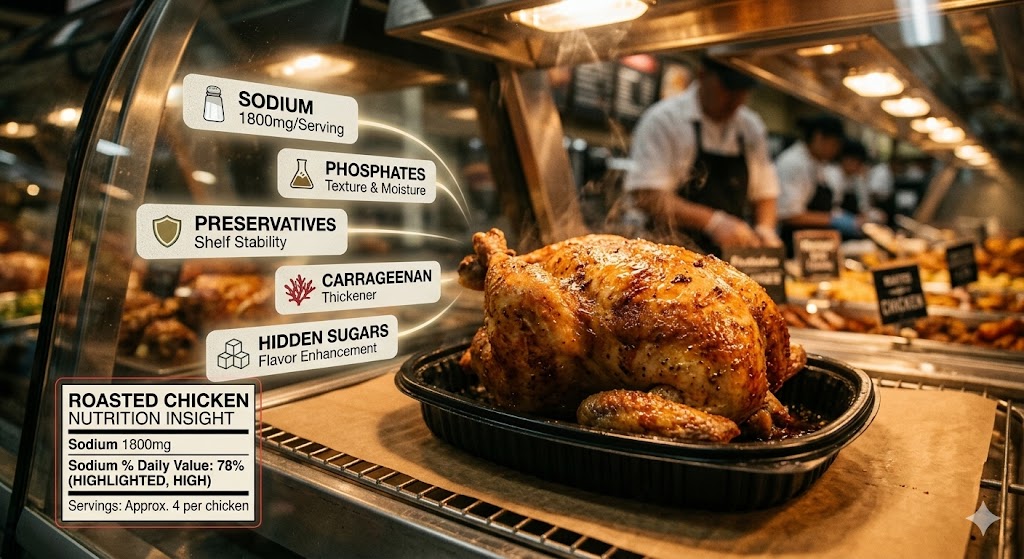
We hate to break it to you, but that juicy grocery store bird has a salty secret.
While a home-grilled chicken breast is usually just meat and basic seasonings, store-bought rotisserie chickens are often injected with a heavy brine solution containing water, salt, chemical preservatives, and binders. This is done to keep the meat plump and juicy while it sits under hot deli lights.
Because of this modification, rotisserie chicken is technically classified as a processed meat. Here is what you are actually getting under the hood:
The Sodium Bomb
The American Heart Association recommends that healthy adults limit their sodium intake to 1,500 milligrams per day, with an absolute maximum limit of 2,300 milligrams.
A single 3-ounce serving of some popular store-bought birds can easily knock out nearly a third of your daily limit!
Compare these sodium levels:
Retailer & Product Type (3 oz serving) | Sodium (mg) | % of AHA Daily Ideal Limit (1,500 mg) |
Homemade Grilled Chicken Breast | ~63 mg | 4.2% |
Whole Foods Market Plain Rotisserie | 60 mg | 4.0% |
Walmart Traditional Rotisserie Whole Chicken | 250 mg | 16.7% |
Costco Kirkland Signature Rotisserie | 460 mg | 30.7% |
Walmart Garlic-Flavored Rotisserie | 690 mg | 46.0% |
Too much sodium can lead to fluid retention, high blood pressure, and strain on your cardiovascular system.
Hidden Phosphates and Binders
Commercial brines often use sodium phosphate to help the meat hold onto water. Unlike natural phosphates found in whole foods, these added phosphates are highly bioavailable, meaning your body absorbs almost 90% of them. Over time, excessive phosphate intake can strain kidney function and even harden arteries.
Many brands also add carrageenan, a seaweed-derived binder that helps keep the meat moist. While approved by the FDA, some people find that carrageenan irritates their digestive system and causes bloating or diarrhea. Additionally, the glazes used to get that beautiful, crispy exterior often contain hidden sugars like dextrose or maltodextrin.
The Bottom Line Store-bought rotisserie chicken is convenient, but the added sodium and preservatives are a drawback. If you want absolute control over your ingredients, grilling at home is the way to go. If you do buy rotisserie, stick to plain versions (like Whole Foods) and remove the skin to discard most of the sodium and additives.
Meal Prep: Which Saves You More Time and Money?

Eating healthy over the long term comes down to two practical things: your schedule and your budget.
If you choose to grill at home, you have to buy raw chicken breast—which averages around $4.17 to $4.18 per pound in the US —trim the fat, marinate it, preheat your grill, cook it safely to an internal temperature of 165°F, and wash all the dishes. It is healthy, but it takes time.
Rotisserie chickens, on the other hand, are often sold as "loss leaders". Grocery stores actually lose money on them just to get you through the door. A fully cooked, hot, 3-pound bird typically costs just $4.99.
A standard whole chicken is about 58% edible meat.
You can calculate your expected meat yield using this formula:
Y=W *0.58
Where Y is the edible yield and W is the total cooked weight of your whole chicken.
For a 2-pound bird, that gives you about 20 ounces of cooked, shredded meat (about 3 to 4 cups), which is perfect for throwing into salads, wraps, and quick dinners all week long.
Operational Metric | Homemade Grilled Chicken | Store-Bought Rotisserie Chicken |
Retail Cost | $4.17 to $4.18 per raw pound | $4.99 for a whole 3 lb bird |
Active Prep & Cook Time | 30 to 45 minutes | 0 minutes (ready to eat) |
Yield Efficiency | 100% of purchased weight (boneless) | ~58% of cooked weight |
Ingredient Control | Absolute control over oils & seasonings | Restricted; dictated by commercial brining |
The Bottom Line Rotisserie chicken is the undisputed champion of convenience and budget. It saves you hours in the kitchen and is incredibly cost-effective. However, you pay for that convenience by giving up control over the salt and additives.
How to Track Your Chicken Without Getting a Headache
If you are tracking your daily calories and macros, chicken can occasionally cause some tracking confusion.
A common mistake is using a "raw" database entry for cooked chicken. Because chicken loses water when cooked, 100g of cooked chicken has about 37.5% more calories and protein than 100g of raw chicken!
If you weigh your food after cooking but log it as raw, you are underreporting your calories.
This is where a voice-activated calorie tracker like VoCal comes in handy. Instead of searching through endless, confusing database entries, you can simply tap a button and speak your meal naturally :
"Three ounces of skinless rotisserie chicken breast and a cup of steamed broccoli."
The app’s AI instantly parses your voice, recognizes whether the food is cooked or raw, accounts for the specific retail brand's sodium levels, and logs your macros in seconds.
Tracking Feature | Traditional Manual Tracking | VoCal Voice Tracking |
Average Logging Speed | 60 to 90 seconds per meal | 5 to 15 seconds per meal |
Database Verification | Crowdsourced; prone to user errors | Verified nutritional databases |
Contextual Parsing | Requires manual portion & state input | Automatically identifies cooked vs. raw |
Hands-Free Capability | None | Fully functional while cooking or driving |
The Bottom Line Consistent tracking is key to reaching your fitness goals. Moving away from tedious manual typing and using a verified voice-powered tracker like VoCal removes the friction of logging, keeping your daily numbers highly accurate.
The Final Verdict
Both grilled and rotisserie chicken deserve a place in a healthy diet, depending on your lifestyle:
Choose Grilled Chicken if: You want absolute control over your sodium intake, prefer to avoid food additives, and enjoy the process of cooking and customizing your seasonings.
Choose Rotisserie Chicken if: You are short on time, eating on a tight budget, or need a quick, healthy alternative to fast food. Just remember to peel off the skin to keep it as lean and low-sodium as possible!
Frequently Asked Questions
Is rotisserie chicken processed meat?
Yes, most store-bought rotisserie chickens are considered processed because they are injected with sodium, phosphates, and other flavor enhancers to keep them moist.
Does removing the skin of a rotisserie chicken reduce the sodium?
Yes! Most of the salt and seasoning glazes sit directly on the skin. Stripping away the skin significantly lowers both the sodium and the saturated fat content of your meal.
How much meat is on an average rotisserie chicken?
An average 2-pound cooked rotisserie chicken yields about 20 to 21 ounces of edible, shredded meat, which translates to roughly 3 to 4 cups of chicken.
Can people with kidney disease eat store-bought rotisserie chicken?
If you have kidney disease, you should be cautious. The highly absorbable sodium phosphates added to commercial chickens can strain compromised kidneys. Homemade grilled chicken prepared without salt is a much safer option.
Disclaimer: Individuals managing hypertension, cardiovascular disease, or chronic kidney disease should consult a healthcare professional or registered dietitian before incorporating processed, sodium-brined rotisserie poultry into their routine.