

Ah, chicken. The undisputed king of the meal prep kingdom, the ultimate muscle builder, and the reliable backbone of busy weeknight dinners across America. Whether you are a dedicated gym rat trying to hit precise macros or just a busy human trying to feed a family without breaking the bank, chicken is likely a staple in your grocery cart.
But when Sunday meal prep rolls around, you face a classic kitchen crossroads. Do you buy raw chicken breasts, marinate them, and sweat over a hot grill? Or do you take the ultimate supermarket shortcut and grab a store-bought rotisserie chicken that is already cooked, seasoned, and looking like a million bucks under those warm grocery store lamps?
In this ultimate showdown of grilled chicken vs rotisserie chicken, we are going to break down the nutrition, the math, the cost per pound, and the time saved. Let us find out which chicken reign supreme for your weekly meal prep!
Nutritional Profiles: How Do They Stack Up?
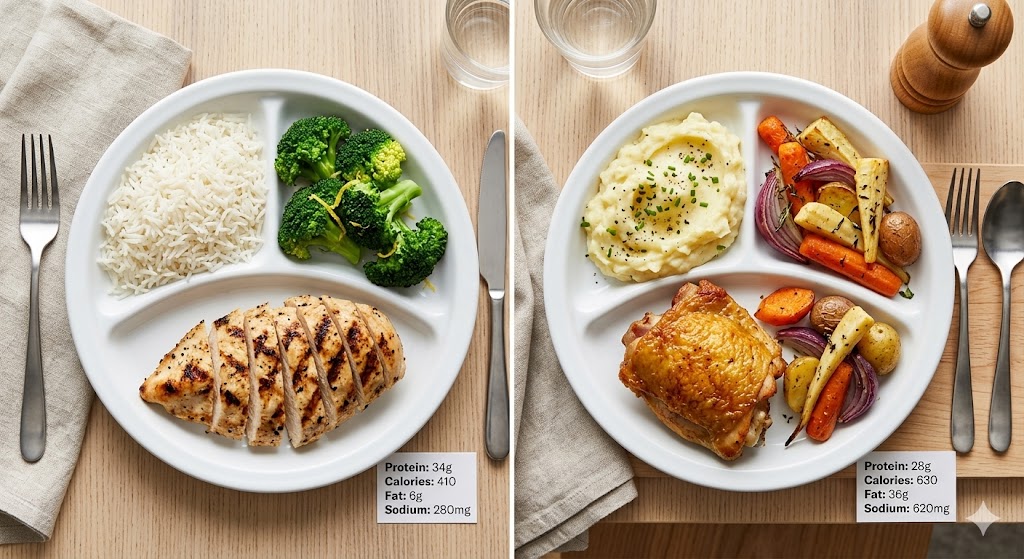
Before we talk about dollars and cents, let us talk about macros. Both grilled chicken and rotisserie chicken are fantastic sources of high-quality animal protein. However, how they are prepared can dramatically change what actually ends up on your plate.
The Moisture-Loss Magic Trick
A major trap people fall into when tracking their food is confusing raw weight with cooked weight. When raw chicken breast hits a hot grill, it loses about 25% of its weight in water.
Because of this water loss, the nutrients in cooked chicken are much more concentrated. A 100-gram serving of raw chicken breast has about 22 to 23 grams of protein. Cook that exact same piece of chicken, and that same 100-gram serving now packs a whopping 31 grams of protein!
If you weigh your chicken cooked but log it using raw values, you are seriously underestimating your daily protein and calorie intake.
Breast vs. Thigh and the Skin Factor
Are you team white meat or team dark meat? Your choice makes a big difference in the fat department. Dark meat (like thighs) is naturally juicier because it contains more fat, while white meat (breast) is incredibly lean.
Furthermore, eating the skin is like turning on the calorie booster. The skin holds a concentrated amount of saturated fat, which can quickly double the fat content of your serving.
According to USDA FoodData Central, here is how a 3-ounce (85-gram) serving of rotisserie chicken compares across different cuts :
Cut and Preparation | Calories | Protein | Fat | Carbs |
Thigh, skin eaten | 192 | 18g | 12g | 0g |
Thigh, skin not eaten | 165 | 21g | 9g | 0g |
Breast, skin eaten | 149 | 22g | 7g | 0g |
Breast, skin not eaten | 122 | 24g | 3g | 0g |
If you are grilling at home, your cooking method also dictates the final calorie count. Adding just a single teaspoon of cooking oil to your grill pan adds about 40 calories and 4.5 grams of fat to your lean breast.
Cooking Method (per 100g skinless breast) | Calories | Notes |
Boiled / Poached | 155–160 | Lowest calorie method; retains no added fats. |
Grilled / Baked (No Oil) | 165 | Standard baseline; optimal flavor-to-calorie ratio. |
Pan-Fried (1 tsp Oil) | 185–200 | Absorbs lipids, increasing overall fat density. |
Deep-Fried / Battered | 250–300 | Highest calorie density; introduces refined carbs. |
Bottom Line: If your goal is pure, lean protein with minimal fat, skinless breast is your best friend—whether you grill it yourself or peel the skin off a rotisserie bird.
The Sodium Situation: A Heart-to-Heart
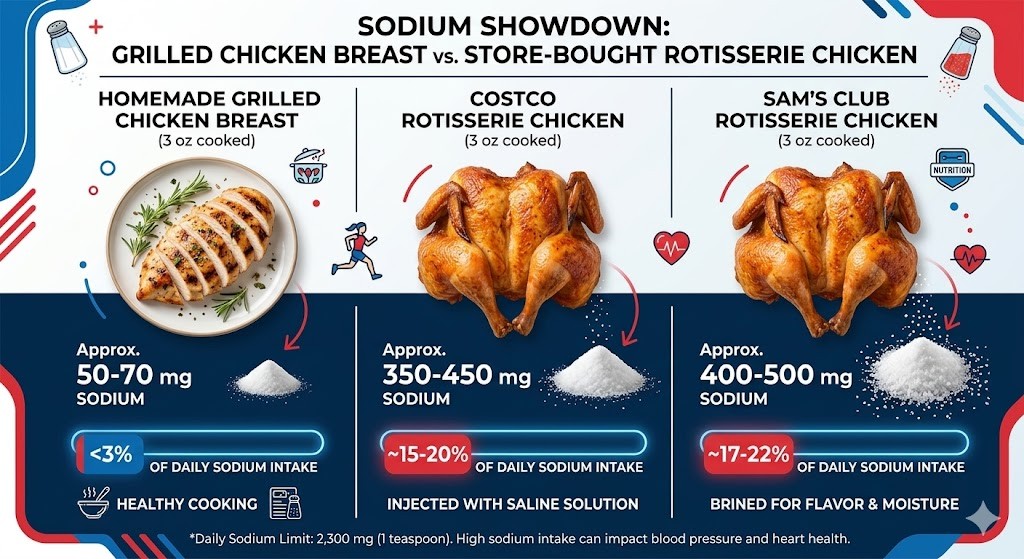
Now for the elephant in the grocery store aisle: sodium. Store-bought rotisserie chickens are notoriously delicious for a reason—they are heavily injected with saline brines, sodium phosphates, and seasonings to keep them incredibly juicy and fresh under those heat lamps.
Breaking Down the Salt Numbers
Fresh, unprocessed raw chicken breast naturally contains only about 45 mg of sodium per 100g. When you grill it at home with a bit of garlic powder, pepper, or salt-free herbs, the sodium stays incredibly low.
On the flip side, commercial rotisserie chicken averages between 350 mg and 415 mg of sodium per 100g.
Federal guidelines from the Dietary Guidelines for Americans recommend that adults limit their sodium intake to less than 2,300 mg per day. For anyone managing high blood pressure, the American Heart Association prefers an ideal daily limit of 1,500 mg.
Let us look at how those numbers add up in the real world:
Costco Rotisserie Chicken: Packs 460 mg of sodium per 3-ounce serving.
Sam's Club Rotisserie Chicken: Tops the charts at 550 mg of sodium per 3-ounce serving.
If you eat a generous 6-ounce portion of Costco rotisserie chicken for dinner, you have already consumed 920 mg of sodium. That is over 40% of your entire daily allowance and over 60% of your ideal blood pressure target in just one meal! High-sodium diets can lead to fluid retention, annoying bloating, and long-term cardiovascular risks.
Bottom Line: Preparing your chicken at home on the grill gives you 100% control over the salt shaker, making it the clear winner for heart health and keeping bloating at bay.
The Financial Showdown: Raw vs. Rotisserie Yields
Is a store-bought rotisserie chicken actually cheaper than raw chicken? To find out, we have to look past the retail sticker price and calculate the cost per cooked pound of edible meat.
Remember, raw chicken shrinks when cooked, and whole birds are full of bones, skin, and cartilage that you cannot eat.
Calculating Your True Yield
A standard raw, whole chicken is about 60% edible meat and 40% bone and skin.
Standard Store Rotisserie (approx. 2.2 lbs): Yields about 1.32 lbs (or 21 ounces) of edible meat.
Costco Rotisserie (approx. 3.0 lbs): Thanks to their larger size, these legendary $4.99 birds yield a solid 2.0 lbs of pure cooked meat.
When we look at typical U.S. grocery prices, the math gets very interesting.
Poultry Sourcing Option | Retail Sticker Price | Edible Meat Yield | True Cooked Cost |
Standard Raw Whole Chicken | $2.06 / lb | 58% meat only | $3.55 / cooked lb |
Raw Boneless, Skinless Breasts | $4.17 / lb | 75% due to water loss | $5.56 / cooked lb |
Organic Raw Breasts (Retail Avg) | $7.41 / lb | 75% due to water loss | $9.88 / cooked lb |
Standard Store Rotisserie Chicken | $5.99 / bird | 1.32 lbs edible meat | $4.54 / cooked lb |
Costco Rotisserie Chicken | $4.99 / bird | 2.00 lbs edible meat | $2.50 / cooked lb |
Because raw chicken breasts lose 25% of their weight during grilling, their true cooked cost jumps from $4.17 to $5.56 per pound.
Supermarket rotisserie chickens—especially warehouse loss-leaders like Costco's $4.99 bird—are an absolute steal, delivering cooked protein for as little as $2.50 per pound!
Bottom Line: If you want the absolute cheapest price per edible pound of cooked chicken, store-bought rotisserie birds win by a landslide.
Time and Efficiency: Is Your Time Worth Money?
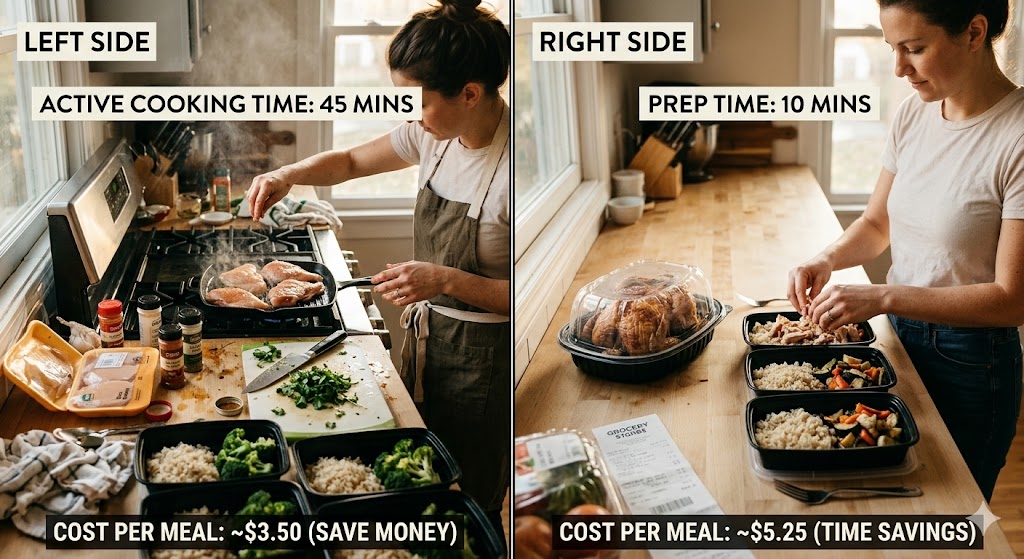
Let us be real: Sunday afternoon prep can feel like a part-time job. Between grocery shopping, trimming raw fat, marinating, grilling, and scrubbing those oily pans, you can easily burn through two hours of your weekend.
Using store-bought rotisserie chicken is the ultimate convenience hack, saving you an estimated 2 to 3 hours of kitchen labor every single week.
To put a value on this, let us look at the opportunity cost. If you value your free time at a modest $20 an hour, preparing a batch of chicken breasts from scratch adds an implied labor cost of about $6.00 to your weekly meal prep budget.
By grabbing a pre-cooked bird, you avoid raw chicken juices on your counters, minimize cleanup, and can have a week's worth of protein shredded and packed in under 15 minutes.
Bottom Line: For pure convenience and getting your weekend hours back, store-bought rotisserie chicken is a lifesaver.
The Quick Cheat Sheet: Grilled vs. Rotisserie
Selection Factor | Home-Grilled Chicken Breast | Store-Bought Rotisserie Chicken |
Financial Cost | Moderately high ($5.56 per cooked lb). | Extremely low ($2.50 to $4.54 per cooked lb). |
Time Investment | High (1.5 to 2 hours of prep and cleaning). | Extremely low (10 to 15 minutes of shredding). |
Sodium Control | Excellent (naturally low, about 74 mg per 100g). | Poor (brined, 350 mg to 415 mg per 100g). |
Saturated Fat Control | High (easy to isolate lean white breast). | Moderate (white meat is lean, but dark meat has more fat). |
Chemical Additives | None (fully controlled by you). | Common (may contain sodium phosphates and maltodextrin). |
Pro Tips for Calorie Tracking Apps
If you are using a voice-based calorie tracking app like VoCal, accuracy is everything. To avoid major tracking mistakes, keep these tips in mind when logging your meals :
Specify "Raw" or "Cooked" Weight: Since cooked chicken is more calorie-dense than raw chicken, always let the app know which one you are weighing.
Name the Cut: Explicitly say "chicken breast" or "chicken thigh". Thighs have about three times more fat than skinless breast.
Include the Skin Status: Say "skinless" or "with skin" so the database can accurately calculate those extra lipid calories.
Bottom Line: For highly accurate calorie and protein tracking, be specific with your voice logs about the cut, cooking method, and whether you ate the skin.
The Final Verdict
For the ultimate budget and convenience win, store-bought rotisserie chicken is your champion. It saves you hours of prep time, cuts down on dirty dishes, and is incredibly cost-effective per edible pound.
However, if you are focusing heavily on heart health, low-sodium diets, and complete nutritional control, stick to home-grilled chicken breasts. It is the absolute gold standard for clean eating, letting you skip the industrial brines and chemical preservatives altogether.
Whichever bird you choose, just remember to log it accurately in your voice app to keep your health goals right on track!
Frequently Asked Questions (FAQs)
Does removing the skin of a rotisserie chicken get rid of all the sodium?
Unfortunately, no. While stripping off the skin removes a lot of the surface salt and seasonings, the chicken itself has been deeply injected with a liquid saline solution to keep it juicy. The inner meat will still contain significantly more sodium than fresh, home-grilled breast.
How long does cooked chicken last in the refrigerator?
According to USDA food safety guidelines, cooked chicken can safely hang out in an airtight container in your fridge for 3 to 4 days. If you prepped a massive batch, freeze half of it to keep it fresh and safe!
Is it better to meal prep chicken breasts or chicken thighs?
It depends on your goals! Chicken breast is highly prized for weight loss and lean gains because it has the lowest calories and highest protein. Chicken thighs have more fat and calories, but they are much more forgiving to cook and stay incredibly juicy even when reheated.
Disclaimer: This article is for informational purposes only and does not constitute medical advice or personalized treatment recommendations. If you have specific health conditions, such as high blood pressure or heart disease, please consult a qualified healthcare professional or a registered dietitian before making major changes to your sodium or fat intake.