

Picture this: It’s a beautiful Saturday morning, the coffee is brewing, and you’re about to crack a couple of fresh eggs into a sizzling pan. But just as the yolks slide in, a tiny voice in the back of your mind whispers: "Wait! Is this going to clog my arteries?"
For decades, eggs were treated like the ultimate breakfast bad boys. Health campaigns in the late 20th century warned us to keep our egg intake low, and many well-meaning folks switched to chalky egg whites to protect their hearts. But is the yolk really the villain it was made out to be?
If you’re ready to have the eggs and cholesterol myth explained once and for all, you've come to the right place. Let's look at what the latest science actually says about eggs, cholesterol, and your ticker.
The Tale of Two Cholesterols: Why Eggs Don't Affect Us All the Same
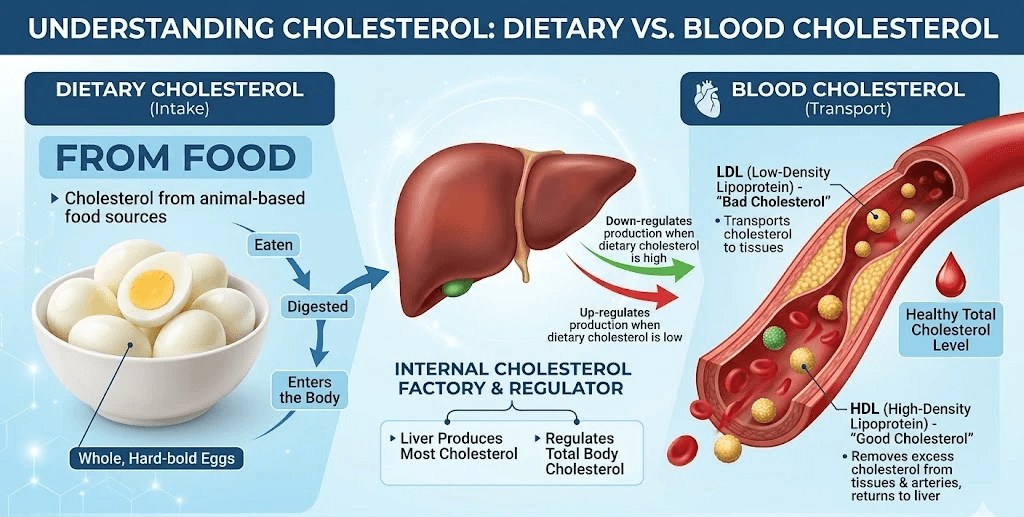
To understand why the old egg warnings were a bit half-baked, we need to clear up a major point of confusion: dietary cholesterol is not the same thing as blood cholesterol.
Dietary cholesterol is the cholesterol you find in foods like eggs, shrimp, and dairy.
Blood cholesterol (like your LDL and HDL numbers) is a waxy, fat-like substance made by your liver.
Your body actually needs cholesterol to build cell membranes, produce vitamin D, and make essential hormones. In fact, your liver is so good at its job that it makes about 80% to 90% of the cholesterol in your body on its own.
Because cholesterol is so vital, your body has a built-in thermostat. When you eat more cholesterol from foods like eggs, your liver simply dials back its own production to keep things balanced.
However, we aren’t all wired exactly the same way. Depending on your genetics, you likely fall into one of two categories:
The "Hypo-responders" (About 70% of us): If you’re in this group, you can eat eggs without seeing your blood cholesterol budge at all. Your body's internal thermostat works perfectly.
The "Hyper-responders" (About 30% of us): Some people have genes that make them extra sensitive to dietary cholesterol. When they eat eggs, their blood levels of both LDL ("bad") and HDL ("good") cholesterol go up in tandem.
Because both numbers go up together, the overall ratio of "bad" to "good" cholesterol stays balanced, keeping their cardiovascular health out of the danger zone.
Take a look at how differently these two groups respond to an egg-rich diet in this clinical study:
Response Cohort | Diet Intervention | Total Cholesterol (mg/dL) | LDL-C (mg/dL) | HDL-C (mg/dL) | Triglycerides (mg/dL) |
Hyper-responders (n = 15) | Whole Egg Diet | 210.6 +/- 43.3 | 130.8 +/- 45.4 | 60.3 +/- 13.6 | 97.5 +/- 62.8 |
Hyper-responders (n = 15) | Egg Substitute | 175.6 +/- 41.4 | 103.4 +/- 28.0 | 54.6 +/- 10.5 | 95.3 +/- 75.2 |
Hypo-responders (n = 27) | Whole Egg Diet | 178.6 +/- 27.6 | 101.9 +/- 39.4 | 55.3 +/- 14.9 | 99.9 +/- 42.2 |
Hypo-responders (n = 27) | Egg Substitute | 181.5 +/- 25.7 | 106.2 +/- 24.6 | 54.2 +/- 14.5 | 106.0 +/- 42.5 |
Bottom Line: For the vast majority of people, the cholesterol you eat doesn't translate to higher cholesterol in your blood. Even if you are a "hyper-responder," your body naturally keeps your heart-healthy lipid ratios in check.
Do Eggs Actually Raise "Bad" LDL Cholesterol?
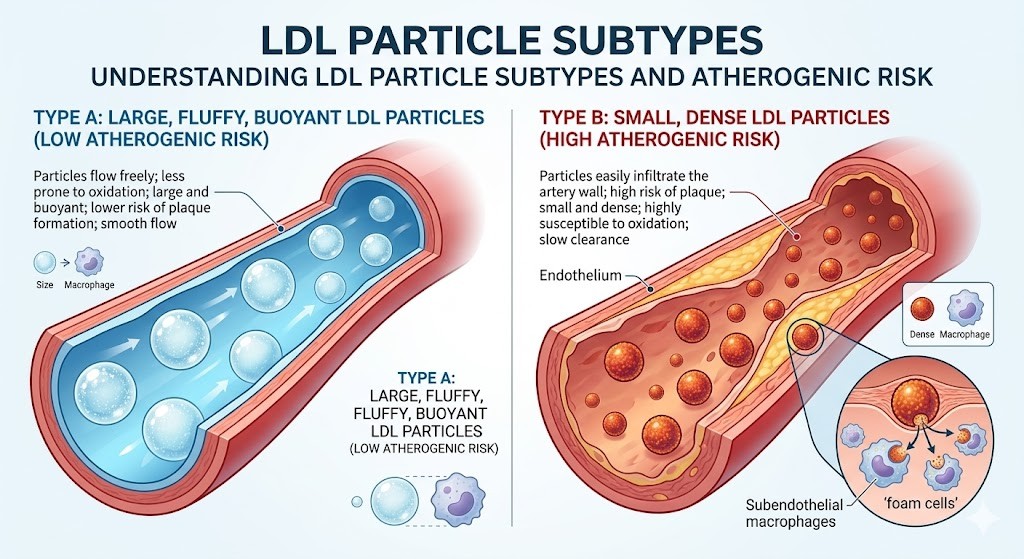
Low-Density Lipoprotein (LDL) is often called the "bad" cholesterol because too much of it can build up in your arteries. But modern science has shown that not all LDL particles are created equal.
Think of LDL particles like vehicles on a highway:
Pattern A (Large and fluffy): These are like big, bouncy SUVs. They bounce right through your bloodstream without causing any trouble.
Pattern B (Small and dense): These are like tiny, heavy marbles. They can easily slip into your artery walls, oxidize (or "rust"), and start building up plaque.
Studies show that when eggs raise your LDL levels slightly, they primarily increase the size and buoyancy of the particles, shifting them from the harmful Pattern B to the harmless, fluffy Pattern A.
To estimate your LDL-C levels, doctors typically use the Friedewald formula:
LDL-C = TC - HDL-C -(TG/5)
where TC is total cholesterol, HDL-C is high-density lipoprotein, and TG stands for triglycerides.
Here is the real kicker: saturated fat is the real culprit behind rising blood cholesterol, not dietary cholesterol. Saturated fats block the receptors in your liver that clean up LDL from your blood. Because a large egg yolk only contains about 1.5 grams of saturated fat, it doesn't cause this clog.
A clinical trial published in The American Journal of Clinical Nutrition proved this by testing three diets on 61 adults:
Diet 1: High cholesterol (two whole eggs a day) + low saturated fat.
Diet 2: Low cholesterol (no eggs) + high saturated fat.
Diet 3: High cholesterol (one egg a day) + high saturated fat.
The researchers found that LDL levels only went up when saturated fat was high. In fact, those on the two-eggs-a-day, low-saturated-fat plan (Diet 1) actually saw their LDL levels improve compared to the egg-free, high-saturated-fat plan.
Bottom Line: Saturated fat, not the cholesterol in your morning eggs, is what drives up your blood cholesterol. Eggs contain very little saturated fat, and any minor shift they cause in LDL is toward the harmless, fluffy kind.
Can You Eat Eggs Every Day if Your Cholesterol Is Already High?

If you are already managing high cholesterol or Type 2 diabetes, you might be wondering if you should sit out the egg game. The answer is all about moderation and context.
For healthy individuals, eating 1 to 2 eggs a day is highly safe. However, if you are actively managing hypercholesterolemia or have Type 2 diabetes, clinical guidelines suggest limiting yourself to about three whole eggs per week (though you can enjoy unlimited egg whites).
Why the caution? It often comes down to what is sharing the plate with your eggs.
An egg scrambled with fresh spinach, onions, and mushrooms in a teaspoon of olive oil is a nutritional powerhouse. An egg fried in bacon grease, topped with processed cheese, and sandwiched in a greasy biscuit is a different story.
National nutrition data (NHANES) highlights this "sandwich effect" perfectly:
Nutrient Parameter (Per 1,000 kcal Basis) | Individual Egg / Omelet Consumers | Egg Sandwich Consumers | Non-Consumers (Control) |
Mean Energy Contribution (kcal) | 213 kcal | 506 kcal | Reference Baseline |
Protein Intake | Higher | Moderate | Reference Baseline |
Saturated Fat Intake | Modestly Higher | Significantly Elevated | Low to Moderate |
Dietary Cholesterol (mg) | Elevated (312 mg) | Moderate (227 mg) | Low (114-145 mg) |
Choline Intake | Extremely High | Moderate | Often Deficient |
Vitamin D Intake | Significantly Higher | Low to Moderate | Low |
As you can see, egg sandwich eaters consume more than double the calories of omelet eaters, along with a massive dose of saturated fats. The problem isn’t the egg itself—it’s the company it keeps!
Bottom Line: Healthy adults can easily eat 1 to 2 eggs daily as part of a balanced diet. If you have high cholesterol or diabetes, stick to three whole eggs a week and use healthy oils like olive or canola instead of butter or bacon grease.
Why the Official Rules on Eggs Made a Major U-Turn
If eggs are so healthy, why did our doctors tell us to avoid them for so long?
Back in 1977, US dietary goals set a strict daily cap of 300 milligrams of dietary cholesterol. Because a single egg yolk has about 186 mg of cholesterol, eating two eggs meant you blew past your daily limit before you even finished your morning coffee.
But after decades of high-quality studies found no real link between eating eggs and heart disease, things changed. In 2015, the federal Dietary Guidelines for Americans quietly dropped the 300 mg limit, stating that dietary cholesterol is no longer a "nutrient of concern for overconsumption".
Today, major health organizations—including the American Heart Association (AHA)—have shifted their focus from restricting single nutrients to encouraging overall healthy eating patterns. They agree that a whole egg a day fits comfortably within a heart-healthy diet.
Bottom Line: Nutrition science changes as we learn more! Federal and clinical guidelines dropped the strict limits on cholesterol years ago, recognizing that eggs are a nutrient-dense, healthy food.
Cracking Open the Benefits: What Else Is in an Egg?
Focusing only on the cholesterol in eggs is like ignoring the plot of a movie because you don't like the title screen. Eggs are a budget-friendly nutritional goldmine!
They are packed with highly bioavailable, complete protein, but they also contain rare nutrients that many Americans miss out on:
Choline: Crucial for your brain, nerves, liver, and pregnancy health. Eggs provide over 40% of the daily choline intake for people who eat them.
Lutein and Zeaxanthin: These are powerful antioxidants that accumulate in your eyes, protecting them from cataracts and macular degeneration.
Vitamin D: Essential for bones and immunity. Eggs are one of the very few natural food sources of Vitamin D, giving you about 41 IU per yolk.
Vitamin B12: Critical for brain function and keeping your energy levels high, making eggs a staple for lacto-ovo vegetarians.
Bottom Line: Eggs are much more than just a protein source. They are packed with essential vitamins, brain-boosting choline, and eye-protecting antioxidants that are hard to find anywhere else.
The Hassle of Food Tracking: How to Log Your Scramble in Seconds
Keeping your heart healthy means staying on top of your overall calories, protein, and saturated fat intake. But let’s be honest: traditional food tracking apps can feel like a part-time job.
Searching endless databases, typing in weights, or taking photos of your meals before you eat gets exhausting fast, which is why most people end up quitting.
That is where VoCal comes in.
VoCal is a voice-first, AI-powered calorie tracking app designed to remove all that friction. Instead of typing, you just tap the microphone and speak your breakfast naturally:
"I had two soft-boiled eggs, one slice of whole-wheat toast, and a cup of black coffee."
Within 15 seconds, VoCal’s AI processes your voice, identifies the foods, estimates the portions, and logs your calories, macronutrients, and saturated fats directly onto your dashboard with up to 95% accuracy.
Feature Comparison | VoCal Voice Tracker | Traditional Tracking Apps | Photo-Based Tracking Apps |
Primary Input Method | Natural Voice Logging | Manual Database Search | Camera Scanning |
Logging Time Per Meal | ~15 Seconds | 5 to 15 Minutes | 1 to 2 Minutes |
Friction Level | Low | High | Medium |
Nutritional Breakdown | Calories, Macros, Micronutrients | Calories, Macros | Estimated Calories |
Bottom Line: Staying consistent is the absolute key to heart health. VoCal removes the daily headache of calorie counting, letting you track your meals with your voice in just seconds.
The Takeaway
The eggs and cholesterol myth is officially cracked. For most healthy adults, enjoying an egg or two a day won't hurt your heart, raise your bad cholesterol, or ruin your health goals. Just be mindful of how you cook them, watch the saturated fats on the side, and let VoCal handle the daily tracking math for you!
Frequently Asked Questions
Do eggs raise your LDL ("bad") cholesterol?
For the vast majority of people, eggs do not significantly raise blood LDL cholesterol. Saturated fat in your overall diet is the primary driver of elevated LDL levels. While eggs do contain dietary cholesterol, they are very low in saturated fat (about 1.5 grams per large egg yolk), meaning they don't block the liver receptors that clear LDL from your bloodstream.
Can you eat eggs every day if you have high cholesterol or diabetes?
If you have healthy lipid levels, eating 1 to 2 eggs daily is safe and highly nutritious. However, if you are actively managing hypercholesterolemia or type 2 diabetes, health guidelines suggest moderating your intake to about three whole eggs per week, while enjoying unlimited egg whites.
Why did health organizations change their recommendations on eggs?
For decades, guidelines capped dietary cholesterol at 300 mg per day. However, as decades of scientific research showed no strong link between dietary cholesterol and heart disease risk, federal guidelines officially removed this numerical restriction in 2015. The focus has now shifted from isolating single foods to encouraging overall healthy dietary patterns.
What is the healthiest way to prepare eggs?
The healthiest way to eat eggs is poached, boiled, or scrambled with fresh vegetables (like spinach, mushrooms, and onions) using a heart-healthy liquid vegetable oil like olive or canola oil. Avoid frying them in butter or bacon grease, and try to limit highly processed side meats like bacon and sausage.
Disclaimer: The information in this article is for educational and informational purposes only and is not intended as personal medical advice. Always consult a healthcare professional or qualified registered dietitian before making significant changes to your diet, especially if you have pre-existing cardiovascular conditions, diabetes, or high cholesterol.