

Ah, the humble chicken egg. It is affordable, packed with protein, and delicious. Yet, for decades, the poor egg has been treated like public enemy number one in the cardiac world. If you have been diagnosed with high cholesterol, you have probably stared at a carton of eggs in the grocery store aisle, wondering: Is this breakfast staple a direct ticket to clogged arteries?
If you have been skipping your favorite morning scramble because of your lipid numbers, we have some sunny news. In this guide, we are getting to the bottom of the eggs and cholesterol myth explained in plain, easy-to-understand English. We will break down what science actually says, who needs to be a bit careful, and how you can use hands-free tools like VoCal to enjoy your breakfast entirely stress-free.
The Great Cholesterol Mix-Up: Dietary vs. Blood Cholesterol
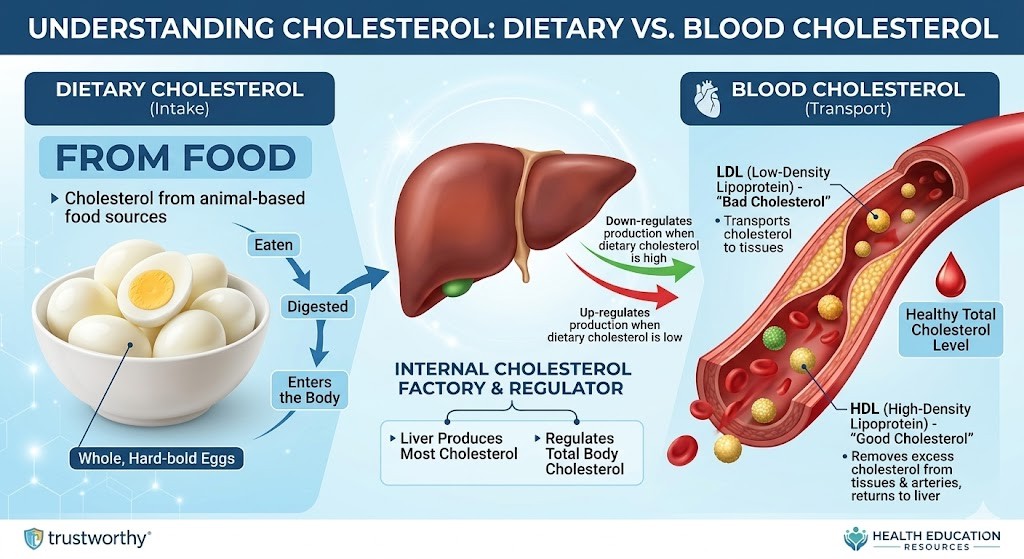
To understand why eggs got a bad rap, we have to look at a classic case of mistaken identity: confusing the cholesterol on your plate with the cholesterol in your blood vessels.
Blood Cholesterol: This is a waxy, fat-like substance made naturally by your liver. Your body actually needs it to perform some pretty crucial jobs, like building cell membranes, producing vitamin D, and churning out hormones like estrogen and testosterone.
Dietary Cholesterol: This is the cholesterol found in the foods you eat, which comes strictly from animal products like meat, dairy, and yes, egg yolks.
For years, scientists assumed that eating dietary cholesterol directly translated to higher blood cholesterol. But modern science has shown us that this relationship is actually quite weak for most of us.
Your body runs on an incredibly smart internal feedback loop. Your liver is essentially your personal cholesterol factory. It produces about 80% of the cholesterol circulating in your bloodstream, while food only contributes about 20%. When you eat more eggs, your liver simply dials back its own production to keep things in a healthy balance.
Bottom Line: Your liver makes the vast majority of the cholesterol in your body. For most healthy people, eating cholesterol-rich foods has a very minor effect on the actual cholesterol circulating in your blood.
Meet the Real Villain: Saturated Fat
If dietary cholesterol isn't the primary bad guy, what is? Enter saturated fat.
While a single egg yolk is high in cholesterol, it is relatively low in saturated fat. Saturated fats—found in heavy amounts in butter, fatty meats, full-fat cheese, and tropical oils like coconut oil—are the primary drivers that raise your low-density lipoprotein (LDL, or "bad") cholesterol.
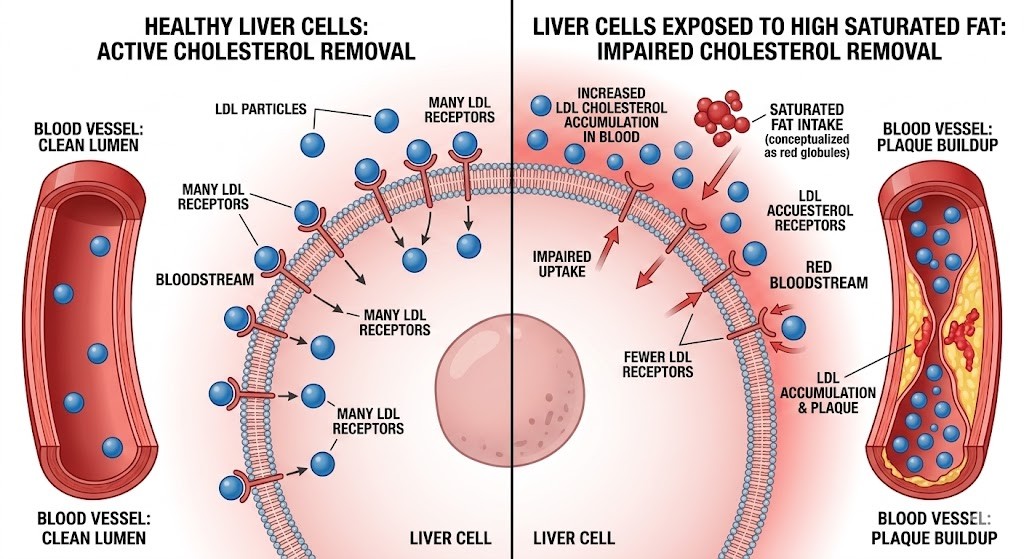
But how does this happen? Think of your liver cells as having tiny "trash vacuums" called LDL receptors on their surface. When bad cholesterol floats by in your blood, these receptors grab it and pull it into the liver to be broken down and flushed away.
When you consume too much saturated fat (specifically palmitic and myristic acids), it tells your liver cells to put those trash vacuums away. With fewer active receptors on duty, LDL particles build up in your blood, raising your cardiovascular risk.
To help you see which fats do what, here is a quick guide to how different fatty acids affect your body's trash-clearing system:
How Different Fats Affect Your Cholesterol levels
Fatty Acid Name | Chemical Notation | Primary Food Sources | Metabolic Pathway | Effect on LDL Clearance |
Butyric Acid | C4:0 | Butter, fermented dairy | Absorbed directly into the portal vein; bypasses chylomicron packaging. | Neutral |
Lauric Acid | C12:0 | Coconut oil, palm kernel oil | Partially absorbed via portal vein; raises both LDL and HDL. | Moderate Elevation |
Myristic Acid | C14:0 | Butter, whole dairy, nutmeg | Strong inhibitor of ACAT; downregulates LDL receptors. | High Elevation |
Palmitic Acid | C16:0 | Palm oil, red meat, dairy | Suppresses SREBP-2 pathway; reduces hepatic LDL clearance. | High Elevation |
Stearic Acid | C18:0 | Cocoa butter, beef fat | Desaturated in hepatocytes to oleic acid via stearoyl-CoA desaturase. | Neutral |
Oleic Acid | C18:1 | Olive oil, avocados, canola oil | Monounsaturated; increases cellular fluidity and maintains hepatic LDL receptor activity. | Reduction |
Linoleic Acid | C18:2 | Corn, soybean, sunflower oils | Polyunsaturated; enhances receptor-dependent LDL transport and clearance. | Significant Reduction |
Bottom Line: Saturated fats are the real troublemakers. They slow down your liver’s ability to clear bad cholesterol from your bloodstream, causing it to build up over time.
Who Should Hit the Pause Button on Daily Eggs?
While an egg a day is perfectly fine for the average adult, nutrition is never one-size-fits-all. Certain groups of people are highly sensitive to dietary lipids and need to manage their intake more carefully.
The APOE4 Gene Carriers: About 14% of the population carries a genetic variant called the APOE4 allele. These individuals are known as "hyper-responders". Their bodies are naturally more sensitive to dietary cholesterol, and eating eggs can cause a sharper rise in their blood lipid levels.
People with Type 2 Diabetes: Large studies, including Harvard's Nurses' Health Study, have shown that individuals with diabetes who eat an egg a day have a higher risk of developing heart disease. If you have diabetes, it is best to keep your egg yolks to a minimum.
Those with Familial Hypercholesterolemia (FH): This is an inherited genetic condition that causes extremely high LDL levels from birth because the liver's LDL receptors do not function properly. For individuals with FH, both saturated fat and dietary cholesterol must be strictly managed.
Clinical Guidelines for Daily Egg Yolks
Patient Clinical Profile | Recommended Egg Yolk Limit | Biological Mechanism | Clinical Goals |
Healthy Adults | 1 to 2 whole eggs per day | Normal feedback loop; efficient clearance of LDL particles. | Maintain optimal total cholesterol ~150 mg/dL. |
APOE4 Carriers | 3 to 4 whole eggs per week | Impaired hepatic lipid transport; higher baseline oxidized LDL. | Prevent lipid oxidation; monitor oxidized LDL and CRP. |
Type 2 Diabetics | Max 3 egg yolks per week | Diabetic dyslipidemia impairs lipoprotein clearance; increased baseline vascular inflammation. | Monitor HbA1c and lipid particle numbers (ApoB). |
Familial Hypercholesterolemia | Minimize yolk consumption | Inherited mutation causing defective or absent LDL receptors on hepatocytes. | Aggressive LDL-C lowering; combine diet with statin therapy. |
Cracking the Nutritional Code: What's Inside an Egg?
It is easy to get hyper-focused on the yolk's cholesterol, but let’s not throw the baby out with the bathwater. Whole eggs are absolute nutritional powerhouses.
Complete Protein: Eggs are the "gold standard" of protein, scoring a 93.7% biological value. They contain all nine essential amino acids that your body needs to build and repair muscles.
Choline: Crucial for your brain and liver function. Cell studies even suggest choline can help balance lipid disruptions in those with the APOE4 gene.
Lutein and Zeaxanthin: These are powerful antioxidants that act like natural sunglasses, protecting your eyes from macular degeneration and cataracts.
Hard-to-Find Vitamins: Eggs are one of the very few natural food sources of Vitamin D, along with rich stores of Vitamin A, Vitamin E, and essential B vitamins.
Nutrient Breakdown of One Large Grade-A Egg
Nutrient | Whole Egg (50g) | Egg White (33g) | Egg Yolk (17g) |
Calories (kcal) | 72 | 17 | 55 |
Protein (g) | 6.3 | 3.6 | 2.7 |
Total Fat (g) | 4.8 | 0.06 | 4.5 |
Saturated Fat (g) | 1.6 | 0 | 1.6 |
Monounsaturated Fat (g) | 1.8 | 0 | 2.0 |
Polyunsaturated Fat (g) | 1.0 | 0 | 0.72 |
Carbohydrate (g) | 0.36 | 0.24 | 0.61 |
Cholesterol (mg) | 186 | 0 | 184 |
Choline (mg) | 126 | 0.4 | 116 |
Vitamin D (IU) | 41 | 0 | 37 |
Vitamin A (IU) | 270 | 0 | 245 |
Selenium (mcg) | 15.4 | 6.6 | 9.5 |
Iron (mg) | 0.88 | 0.03 | 0.46 |
Sodium (mg) | 71 | 55 | 8 |
How to Build a Heart-Healthy Breakfast (With Eggs!)
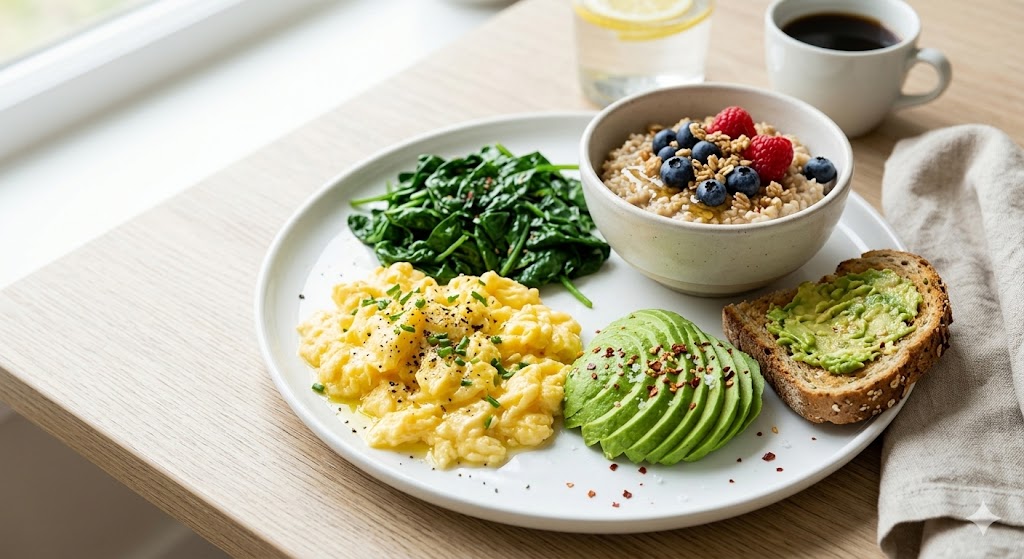
The cardiovascular impact of eggs relies heavily on how you prepare them and what you pair them with.
If you scramble your eggs in butter and pair them with bacon, sausage, and white toast, you are loading up on saturated fats that will trigger a spike in blood cholesterol. However, if you scramble them in olive oil and serve them with avocado, spinach, and a side of oatmeal, you are setting your body up for cardiovascular success.
Here are three simple strategies to enjoy your eggs safely:
Swap Your Cooking Fats: Ditch the butter, ghee, and bacon grease. Use liquid, nontropical plant oils like olive, canola, or avocado oil, which are packed with heart-healthy monounsaturated fats.
Load Up on Soluble Fiber: Soluble fiber acts like a magnet in your digestive system. It binds to cholesterol-rich bile acids and helps carry them out of your body. This forces your liver to pull bad cholesterol from your blood to make new bile. Pair your eggs with black beans, spinach, or oatmeal.
Try the Egg White Stretch: If you are watching your lipid budget, mix one whole egg with two egg whites. This gives you all the protein and volume of a three-egg scramble while cutting the cholesterol and saturated fat of the yolks in half.
Keep Track Hands-Free with VoCal
Because the average US daily cholesterol intake is 282 mg and a single egg yolk contains about 184 mg, fitting eggs into your daily lipid budget requires keeping an eye on your overall numbers.
But let’s be honest: tracking fats, cholesterol, and fiber shouldn't feel like a part-time math job. That is where VoCal comes in.
Vo-cal.com is a revolutionary, hands-free, voice-based calorie and nutrient tracking app. Instead of scrolling through endless databases and typing in your food while your hands are covered in cooking prep, you can simply speak to your phone:
"Hey VoCal, I had one whole egg scrambled in a teaspoon of olive oil with a cup of fresh spinach and a slice of whole-wheat toast."
Our intelligent voice tracking instantly logs your meal, breaks down your saturated fat intake, and monitors your dietary fiber in real time. It keeps you perfectly aligned with your cardiovascular health goals without the headache.
Frequently Asked Questions (FAQs)
Do eggs raise LDL ("bad") cholesterol?
For most people, the dietary cholesterol in eggs has a very small, negligible effect on LDL cholesterol. Saturated fats in your diet are far more likely to raise your bad cholesterol by slowing down how your liver clears it. However, about 1 in 4 people are "hyper-responders" and may see a more notable rise in blood cholesterol from eggs.
How many eggs can a healthy person eat?
According to the American Heart Association, healthy individuals can safely enjoy 1 to 2 whole eggs per day as part of a balanced, heart-healthy diet.
Why does saturated fat matter more than egg cholesterol?
Saturated fat directly downregulates the number of active LDL receptors on your liver cells. Because of this, your liver cannot clear bad cholesterol from your blood effectively, leading to higher circulating cholesterol levels. Egg yolks, while high in cholesterol, are relatively low in saturated fat.
Is it better to eat only egg whites?
Egg whites are an excellent source of pure, fat-free protein. However, if you skip the yolk entirely, you miss out on essential nutrients like choline, lutein, and Vitamin D. A great compromise is combining one whole egg with two egg whites.
Disclaimer: The information provided in this article, including text, graphics, tables, and nutritional guidelines, is for general educational and informational purposes only. It is not intended to be a substitute for professional medical advice, clinical diagnosis, or individualized treatment plans. Always consult with your primary care physician, cardiologist, or a registered dietitian before making significant changes to your diet.