

Ah, the humble egg. It’s the ultimate breakfast champion, a gym-bag staple, and the subject of one of the longest-running debates in fitness history.
For decades, bodybuilding culture told us to toss the yolks down the drain. "Eat your egg whites to keep things lean!" the gurus screamed. But is throwing away the "golden center" of the egg actually holding back your gains?
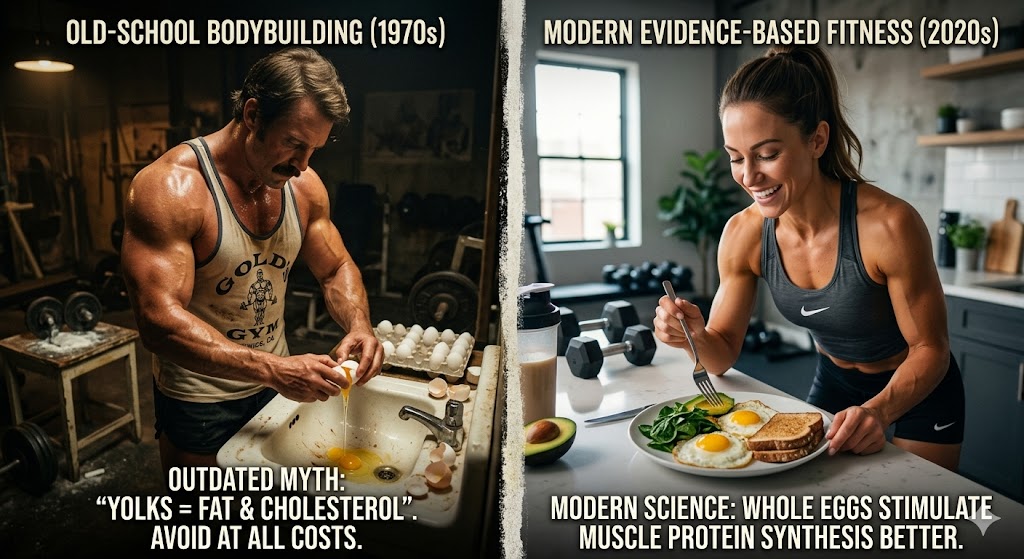
While egg whites are basically pure, low-calorie protein, modern science suggests that the whole egg is a metabolic powerhouse. It turns out that the natural combination of nutrients in a whole egg works together to help your body build and repair muscle much more effectively than isolated egg whites.
Whether you are trying to bulk up, lean out, or just hit your daily macro targets, tracking what you eat is key. That’s where a voice-activated calorie tracker like VoCal comes in handy. Instead of typing out complex ingredient lists, you can just tell the app what you ate—like "three scrambled whole eggs and two egg whites"—and let it do the math for you.
Let's crack open the science and see which egg option reigns supreme for your muscles.
Nutritional Breakdown: What’s Under the Shell?
To understand how eggs help you build muscle, we have to look at what's inside. Think of the egg white (the albumen) as the low-calorie, high-protein bodyguard. It is made of about 90% water and 10% protein, with almost no fat or extra nutrients.
The yolk, on the other hand, is the nutrient headquarters. It holds about 40% of the egg's total protein, alongside healthy fats, vitamins, and minerals that are completely missing from the white.
Here is how a large raw whole egg stacks up against a raw egg white, according to the United States Department of Agriculture (USDA):
Nutritional Component | Raw Whole Egg (Large, 50g) | Raw Egg White (Large, 33g) |
Calories (kcal) | 72 | 17 |
Protein (g) | 6.3 | 3.6 |
Total Fat (g) | 4.8 | Trace |
Saturated Fat (g) | 1.6 | 0 |
Cholesterol (mg) | 186 | 0 |
Choline (mg) | 146.9 | Trace |
Vitamin A (% DV) | 9% | 0% |
Vitamin D (% DV) | 5% | 0% |
Selenium (% DV) | 28% | 12% |
The Ultimate Amino Acid Profile
For muscle building, you need essential amino acids (EAAs)—the building blocks of protein that your body cannot make on its own. Whole eggs are packed with these, especially leucine, which acts as the ultimate "on-switch" for muscle growth.
Here is the essential amino acid profile for a three-egg serving (about 150 grams) :
Essential Amino Acid (EAA) | Content per 150g Raw Whole Egg (approx. 3 Large Eggs) |
Leucine (mg) | 1627 |
Lysine (mg) | 1367 |
Valine (mg) | 1286 |
Phenylalanine (mg) | 1019 |
Isoleucine (mg) | 1006 |
Threonine (mg) | 833 |
Methionine (mg) | 569 |
Histidine (mg) | 463 |
Tryptophan (mg) | 250 |
Bottom Line: Egg whites are great if you are on a strict low-calorie diet and need isolated protein. But if you want a complete package of vitamins, healthy fats, and rich amino acids, the whole egg is hard to beat.
The Science: Do Whole Eggs Build More Muscle?
Now, let's talk about the fun stuff: muscle protein synthesis (MPS). This is the biological process where your body repairs and builds new muscle fibers after a tough workout.
A famous study conducted by researchers at the University of Illinois put this debate to the test. They took ten young, resistance-trained men and had them do a heavy leg workout. Afterward, one group ate whole eggs (18 grams of protein, 17 grams of fat, and 226 calories) while the other group drank an equal amount of protein from egg whites (18 grams of protein, 0 grams of fat, and 73 calories).
Using special metabolic tracers, the researchers tracked how the protein traveled through the body. Surprisingly, both groups had almost the exact same amount of amino acids enter their bloodstream.
However, when they took direct muscle biopsies, they found a massive difference. The guys who ate the whole eggs experienced a 40% greater post-workout muscle-building response compared to those who just had the egg whites.
What's even more interesting? Simply adding fat to egg whites afterward doesn't trigger this boost. There is something special about the natural "whole-food matrix" of the entire egg that helps your muscles use the protein more efficiently.
Bottom Line: Even though both options put the same amount of amino acids into your blood, eating whole eggs triggers a 40% higher muscle-building response after your workout.
Deep Inside the Muscle Cell: The mTORC1 Activation Trick
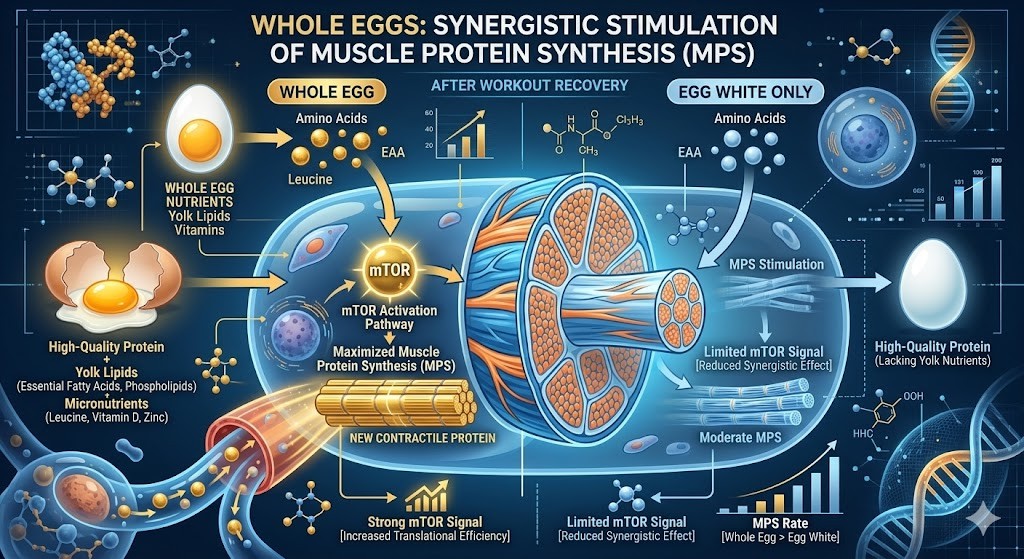
To understand why the whole egg is so powerful, we have to look inside the muscle cells at a tiny coordinator called mTORC1. Think of mTORC1 as the "construction foreman" of muscle growth—it has to be activated and sent to the right spot (the lysosome) to start building muscle.
During the University of Illinois trials, scientists looked closely at how these cell signals moved.
While both the whole egg and egg white groups successfully primed the muscle cells for growth, only the whole egg group successfully triggered the translocation of mTORC1 to the lysosomal membrane.
This key cell movement increased by 14% at two hours and 12% at five hours post-workout exclusively in the whole egg group.
Why does this happen? Scientists believe that the fats, phospholipids (like phosphatidic acid), and minerals hiding inside the egg yolk act as cellular messengers. They tell mTORC1 exactly where to go, accelerating your body's muscle-repair process.
Bottom Line: The yolk contains unique fats and lipids that send direct signals to your muscle cells, telling them to switch on muscle-repair mode—a signal that egg whites alone cannot deliver.
What Happens Over Time? Strength, Testosterone, and Fat Loss
Acute laboratory studies are great, but do they translate to real-world results over a longer training program?
To find out, researchers designed a 12-week study comparing whole eggs to egg whites in 30 young men undergoing a heavy lifting program three times a week. One group ate three whole eggs post-workout, while the other ate six egg whites (matched for total protein).
By the end of the 12 weeks, both groups built similar amounts of raw muscle mass. However, the whole egg group achieved some distinct fitness upgrades :
Outcome Measure | Whole Egg + RT (WER Group) | Egg White + RT (ERT Group) | Statistical Significance (Intergroup) |
Knee Extensor Muscle Mass | Significant Increase | Significant Increase | No significant difference |
Knee Extensor Cross-Sectional Area | Significant Increase | Significant Increase | No significant difference |
Lean Body Mass (LBM) | Greater Trend toward Increase | Significant Increase | Strong trend favoring WER |
Knee Extension Strength | Superior Improvement | Moderate Improvement | Significant difference favoring WER |
Handgrip Strength | Superior Improvement | Moderate Improvement | Significant difference favoring WER |
Serum Testosterone | Significant Increase | No significant change | Significant difference favoring WER |
Body Fat Percentage | Greater Reduction | Moderate Reduction | Significant difference favoring WER |
This trial proved that while overall daily protein dictates raw muscle size, whole eggs promote better functional strength, support natural testosterone levels, and help you burn more body fat during a training program.
Bottom Line: Over a 12-week period, lifting weights and eating whole eggs led to greater improvements in strength, higher testosterone levels, and better fat loss than eating egg whites.
The Cholesterol Elephant in the Room
We can't talk about egg yolks without addressing cholesterol. For years, eggs were blacklisted because a single yolk has about 186 mg of dietary cholesterol.
However, modern research has cleared the egg's name. Saturated fats and trans fats are the real culprits behind high blood cholesterol, not clean sources of dietary cholesterol like eggs. In fact, long-term studies show that eating up to 12 eggs a week does not raise cardiovascular risk factors in most people, including those with prediabetes.
Major health organizations suggest these daily guidelines :
For Healthy Adults: The American Heart Association (AHA) says eating one whole egg (or two egg whites) daily fits perfectly into a heart-healthy diet.
For Older Adults: Those with healthy lipid levels can safely enjoy up to two whole eggs daily to support cognitive health and preserve aging muscle.
If You Have Heart Concerns: If you have high cholesterol, heart disease, or diabetes, health experts recommend limiting yolks to about four per week. You can easily use egg whites to get the rest of your daily protein.
Bottom Line: Dietary cholesterol in eggs does not impact heart health for most healthy people. If you have pre-existing heart concerns, simply mix whole eggs with egg whites to keep your fat intake in check.
How to Crack the Perfect Muscle-Building Diet
If you want the anabolic power of the yolk without overshooting your daily calories, a hybrid strategy is your best friend.
Try mixing two whole eggs with three egg whites. This gives you a lean, high-protein meal (around 23 grams of protein and 10 grams of fat) while ensuring you get enough yolk nutrients to trigger those muscle-building signals.
Managing these custom ratios is incredibly easy with a voice calorie tracker like VoCal. Instead of navigating databases or weighing things out meticulously, you can simply speak into your phone:
"Log two whole eggs and three egg whites."
The app automatically splits the nutrients, making sure you stay on track with your goals while keeping your diet "egg-ceptional".
Frequently Asked Questions
Are whole eggs better than egg whites for muscle gain?
Yes! When matched for protein, whole eggs stimulate a 40% greater post-workout muscle protein synthetic response and lead to better strength gains, higher testosterone, and more fat loss over time compared to egg whites alone.
How many egg whites equal the protein of one whole egg?
One large whole egg has about 6.3 grams of protein. Because an egg white contains about 3.6 grams of protein, you will need to eat approximately two egg whites to get the same amount of protein as one whole egg.
Does eating raw eggs build more muscle?
No, and it is actually a bad idea! Cooked eggs are around 90% bioavailable, while raw eggs are only about 50% bioavailable. Plus, raw eggs carry a risk of Salmonella and contain a protein called avidin, which blocks your body from absorbing biotin (Vitamin B7).
Can vegetarian athletes build similar muscle without eggs?
Absolutely. While eggs are a highly bioavailable protein source, vegetarian athletes can achieve fantastic results using plant-based proteins, Greek yogurt, or whey protein, as long as they hit their daily protein targets.
Disclaimer: This article is for informational and educational purposes only and does not constitute medical advice, diagnosis, or treatment. Always consult with a qualified healthcare professional or registered dietitian before making significant changes to your diet, exercise regimen, or nutritional routine.