

Imagine this: It’s Saturday morning, the sun is shining, and your kitchen smells like heaven. You’re standing at the stove, spatula in hand, ready to crack open a couple of fresh, golden eggs. But just as you’re about to enjoy a delicious breakfast, a tiny voice in your head whispers, "Wait! Aren't those yolks going to clog my arteries?"
For decades, the humble chicken egg has been cast as the ultimate breakfast villain. But is it really a heart-stopping threat, or is it actually a nutritional powerhouse? If you use a voice-based tracking app like Vo-cal.com to log your breakfast, manage your weight, or hit your macro goals, it’s time to get the facts straight. Let’s crack this case wide open!
To get the eggs and cholesterol myth explained, we first have to look at how our bodies handle cholesterol. Here is the ultimate plot twist: dietary cholesterol (the kind you eat in foods like eggs) and blood cholesterol (the HDL "good" and LDL "bad" levels your doctor checks) are two completely different things!
Historically, back in 1968, the American Heart Association (AHA) told everyone to limit themselves to three eggs per week, fearing that eating cholesterol directly raised the cholesterol circulating in your bloodstream. Consequently, egg consumption in the United States took a massive dive. But modern science has stepped in to bust this myth.
Think of your liver as a smart cholesterol factory. It actually makes the vast majority of the cholesterol circulating in your body. When you eat more cholesterol from food, your liver simply dials back its own production to keep your body in a perfect state of balance.
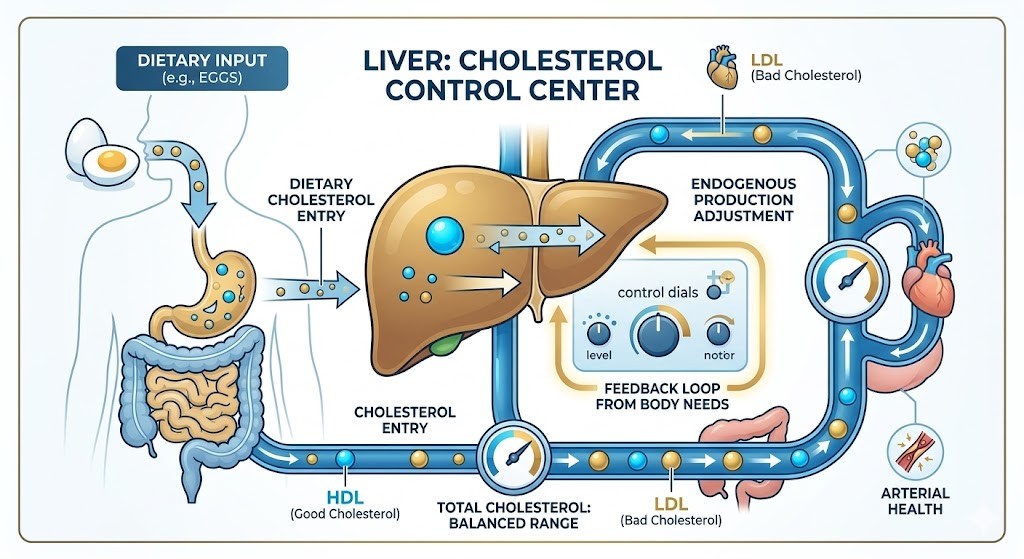
So, what actually triggers your liver to pump out too much "bad" LDL cholesterol? The real culprits are saturated fats and trans fats, not dietary cholesterol itself! Saturated fats act like a clog in your liver's cleanup system, keeping it from clearing out bad cholesterol. While an egg contains around 186 to 275 mg of dietary cholesterol, it has very little saturated fat—only about 1.5 to 1.6 g.
Do Eggs Increase LDL Cholesterol?
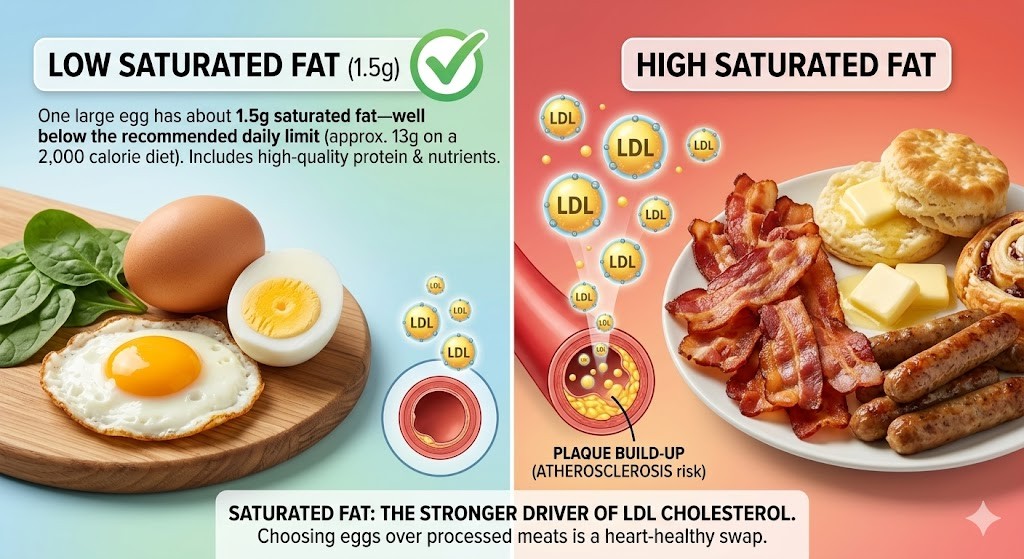
If you’re wondering, Do Eggs Increase LDL Cholesterol? What Recent Research Shows paints a much more reassuring picture.
A major clinical study published in the American Journal of Clinical Nutrition put this to the test. Researchers took 61 healthy adults and put them on different diets. One group ate a whopping two eggs per day but kept their overall saturated fat intake low (around 6%).
The result? The two-eggs-a-day group actually ended up with lower LDL cholesterol levels compared to a group eating a high-saturated-fat diet with only one egg per week. The study found that saturated fat was strongly linked to higher LDL (beta = 0.35, P = 0.002), while the cholesterol from the eggs had virtually no correlation (beta = -0.006, P = 0.42).
However, the researchers did note a slight catch: consuming eggs shifted the type of LDL particles. It decreased the large, fluffy LDL particles and increased the small, dense ones. Small, dense LDL is considered more active in building up plaque in your arteries, so moderation and an overall healthy lifestyle are still key.
Let’s take a quick look at how different studies view this relationship:
Research Study / Cohort | Design | Participant Pool | Key Findings & Lipid Outcomes | Cardiovascular Risk Association |
Buckley et al. AJCN (2025) | Randomized Controlled Cross-Over (5-Week Phases) | 61 healthy adults | Saturated fat correlated with LDL (beta = 0.35); dietary cholesterol did not (beta = -0.006). Eggs lowered overall LDL but increased small, dense LDL particles. | No overall risk increase when consumed within a low-saturated fat diet. |
PURE Study (Dehghan et al.) | Prospective Cohort (9-Year Follow-up) | 177,555 adults (21 countries) | Consuming 7 eggs/week vs. < 1 egg/week showed no significant association with blood lipids. | No significant association with cardiovascular disease (CVD) events or mortality. |
Meta-Analysis of 17 RCTs (2020) | Systematic Review of RCTs in Healthy Subjects | Healthy populations | High egg consumption elevated overall LDL and the LDL-to-HDL ratio, particularly in studies over 2 months. | Unclear long-term cardiovascular impact; requires longer follow-up trials. |
China Health & Nutrition Survey (CHNS) | Longitudinal Cohort (11.4-Year Follow-up) | 8,095 hypertensive patients | Consuming > 7 eggs/week was associated with up to a 29% reduction in overall mortality compared to 2 eggs/week. | Suggests a protective cardiovascular effect from egg nutrients unique to this cohort. |
Satiety, weight loss, and the low-carb connection
If you're tracking your meals on VoCal for weight loss, you probably already know that hunger is the ultimate diet-killer. This is where eggs shine like a beacon of hope.
Eggs are packed with premium, high-quality protein that contains all the essential amino acids your body needs. This protein does wonders for your satiety hormones. It tames your hunger hormone (ghrelin) while boosting hormones that tell your brain you are completely full, like peptide YY (PYY) and GLP-1.
For anyone following a low-carb (50 to 150g of carbs daily) or keto diet (under 50g of carbs daily), eggs are an absolute dream food. They have virtually zero carbs, meaning they won't spike your blood sugar or insulin. When your insulin levels drop, your body gets the green light to tap into stored fat for energy.
In the first week or two of a low-carb diet, you will often notice a rapid drop in water weight as your body burns through stored glycogen. Meanwhile, your liver stays busy converting fats into brain-fueling ketones (ketogenesis) and making a little extra glucose out of proteins (gluconeogenesis). Eggs provide the perfect balance of fats and proteins to support this shift.
Diet Protocol | Carbohydrate Target | Primary Fuel Source | Metabolic Pathway Activation | Role of Eggs in Macronutrient Profile |
Standard Low-Carb | 50 to 150 grams/day | Mixed (Glucose & Fatty Acids) | Moderate glycogen depletion, lipid mobilization. | Core protein and healthy fat source to replace starchy carbohydrate sources. |
Ketogenic (Keto) | < 50 grams/day | Ketones & Fatty Acids | High ketogenesis, gluconeogenesis, rapid drop in water weight. | Ideal macronutrient fit; zero digestible carbs, high-quality fat and protein. |
High-Protein, Low-Carb | < 130 grams/day (under 26%) | Mixed (Fatty Acids & Glucose) | Thermic effect of food (TEF), intense hunger hormone regulation. | Preserves lean muscle mass during calorie deficits. |
What do the latest US dietary guidelines say?
Federal guidelines have come a long way since the 1960s egg ban. The Dietary Guidelines for Americans 2025–2030 (DGA) have officially taken whole, nutrient-dense foods off the blacklist.
In fact, the newest guidelines don't even mention a numerical limit for dietary cholesterol. Instead, they focus on cutting out highly processed foods, keeping added sugars low (under 10 g per meal), and staying active.
Even more surprising? The Recommended Dietary Allowance (RDA) for protein was actually bumped up to 1.2 to 1.6g of protein per kilogram of body weight per day. For a 180-pound adult (82kg), that means aiming for 98 to 131 g of protein daily. Eggs, chicken, and other wholesome animal proteins are front and center in the guidelines' new visual eating plans to help you hit those targets.
But don't toss out the moderation rulebook just yet. The American Heart Association still recommends that healthy adults limit their intake to one whole egg (or two egg whites) per day.
Dietary Parameter | Previous Federal Guidelines | 2025–2030 Dietary Guidelines for Americans | Clinical / Scientific Basis for Change |
Dietary Cholesterol Limit | Restricted to under 300 mg/day | No quantitative limits mentioned | Weak relationship between dietary cholesterol and circulating blood LDL. |
Protein Intake Goal | 0.8 g/kg/day | 1.2 to 1.6 g/kg/day | Preserves lean muscle, supports healthy aging, and enhances metabolic health. |
Added Sugar Limits | Limited to under 10% of daily calories | Restricted to under 10 g per meal; zero for children under age 10 | Prevents insulin resistance, dental caries, and metabolic syndrome. |
Saturated Fat Target | Limited to under 10% of daily calories | Maintained at under 10% of daily calories | Promotes hepatic LDL receptor activity to clear circulating blood lipids. |
Sodium Daily Target | Limited to under 2,300 mg/day | Maintained at under 2,300 mg/day | Prevents arterial stiffening and manages high blood pressure. |
Vegetarians vs. meat-lovers: Balancing your plate

How eggs affect your heart depends heavily on who you are—and what else is on your plate!
For the Veggies: If you follow a lacto-ovo vegetarian diet, eggs are a fantastic, budget-friendly source of hard-to-get nutrients like Vitamin B12, Vitamin D, and iron. However, plant-based proteins like beans, lentils, and soy are still the undisputed champions for lowering LDL cholesterol. Why? Because they're loaded with soluble fiber—something animal products like eggs and meat don't have. Soluble fiber acts like a magnet in your gut, binding to cholesterol and dragging it out before it can get into your blood.
For the Meat-Lovers: The real danger of eggs often isn't the egg itself, but its "trimmings". Sizzling bacon, pork sausage, and white toast slathered in butter are loaded with saturated fats and refined carbs that can send your LDL levels soaring. The famous Framingham Offspring Study found that folks who ate five or more eggs a week without abnormal lipids were the ones pairing them with fiber-rich foods and fish. Combining eggs with high-fiber veggies can actually lower your risk of developing high blood pressure or blood sugar issues.
How many eggs can you eat?
So, what is the golden number? According to Julia Zumpano, RD, LD, a preventive cardiology dietitian, "Be mindful of how many eggs you're eating, how you prepare them, and the other sources of saturated fat in your diet".
For general healthy adults: One whole egg (or two egg whites) per day is a great, heart-healthy standard.
If you have high cholesterol, heart disease, or diabetes: You might want to limit yourself to four yolks per week and prioritize egg whites or plant proteins.
How to prep your eggs the heart-healthy way
Preparation is everything! Frying your eggs in a lake of butter or bacon grease adds heaps of saturated fat. Instead, try these lighter cooking methods:
Poaching: Simple, elegant, and requires zero added fat.
Hard or Soft Boiling: Great for on-the-go snacking and salad toppings.
Pan-Frying with Cooking Spray: Gives you that classic fried texture without the calorie bomb.
The Sourdough Upgrade: Mash a quarter of an avocado on whole-grain sourdough toast and top it with a poached egg for a dose of cholesterol-blocking soluble fiber and healthy monounsaturated fats.
Make logging effortless with VoCal
Keeping track of your daily saturated fat, protein, and fiber ratios can feel like a full-time job. But with VoCal, you don't have to navigate a maze of search menus or guess your portions.
Just tap the microphone and say:
"For breakfast, I had two poached eggs, a slice of whole-wheat toast, and a quarter of an avocado."
In seconds, VoCal’s smart voice tracking logs your protein, calculates your fiber intake, and tracks your saturated fat to make sure your heart-healthy goals stay on track. No typing, no stress—just pure, simple health tracking.
Ready to start your day with an egg-cellent, worry-free breakfast? Keep your fats low, your fiber high, and let VoCal do the heavy lifting!
Frequently Asked Questions (FAQs)
1. Do eggs raise LDL (bad) cholesterol?
For most healthy individuals, dietary cholesterol from eggs has a very minimal impact on circulating blood LDL levels. The liver naturally regulates its internal cholesterol production based on dietary intake. Saturated fats and trans fats in your overall diet are much stronger drivers of elevated LDL.
2. Can I eat eggs every day if I have high cholesterol?
If you have high cholesterol, heart disease, or type 2 diabetes, clinical experts recommend exercising caution. It is generally advised to limit yolk intake to no more than four per week, though you can enjoy egg whites freely as they contain no cholesterol or saturated fat.
3. Are egg whites healthier than egg yolks?
Egg whites are virtually fat-free and contain pure, high-quality protein. However, the yolk contains the majority of the egg’s micronutrients, including vitamin A, vitamin D, lutein, zeaxanthin, and choline. If you do not have heart disease, eating the whole egg is recommended to capture these essential nutrients.
4. What is the healthier cooking oil to use for eggs?
To keep saturated fat levels low, avoid butter, bacon grease, and coconut oil. Opt for heart-healthy unsaturated liquid fats such as extra virgin olive oil or canola oil, or use a light mist of non-stick cooking spray.
Disclaimer: The information in this article is for educational and informational purposes only and is not intended as personal medical advice. Always consult a healthcare professional or qualified registered dietitian before making significant changes to your diet, especially if you have pre-existing cardiovascular conditions, diabetes, or high cholesterol.