

For decades, typing or voice-logging "two scrambled eggs" on your calorie tracker felt like admitting to a minor health crime. You could almost hear the imaginary sirens warning of impending heart trouble.
But if you are using the voice-activated tracking system on Vo-cal.com, it is time to set the record straight. We have the eggs and cholesterol myth explained with the latest science, showing why official guidelines completely flipped their stance on this breakfast favorite.
The Great Bio-Mixup: Dietary vs. Blood Cholesterol
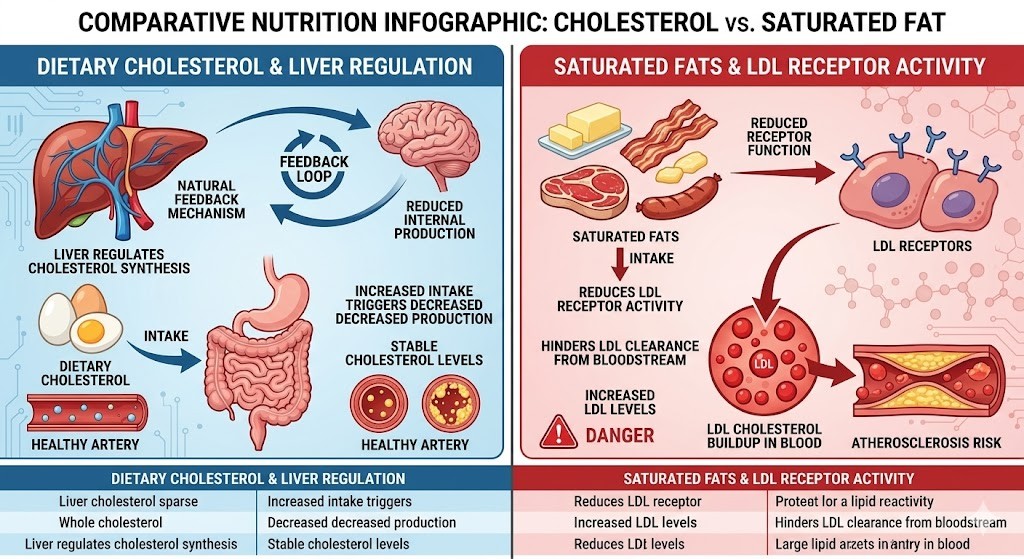
To understand why the old advice cracked, we have to look at a classic case of mistaken identity: the difference between dietary cholesterol (what is on your plate) and blood cholesterol (what is in your veins).
Our bodies need cholesterol to build cell walls, make hormones (like estrogen and testosterone), and produce Vitamin D. Because it is so important, your liver actually manufactures about 75% to 80% of your body's cholesterol itself.
When you eat more cholesterol, your liver simply dials back its own production to keep things balanced. The real drivers of high blood cholesterol are actually saturated fats and trans fats, which tell your liver to keep pumping out "bad" LDL cholesterol.
Biological Lipid Parameter | Dietary Cholesterol | Saturated Fatty Acids |
Primary Sources | Egg yolks, organ meats, shellfish, and cold-water seafood | Butter, beef tallow, lard, full-fat dairy, and fatty cuts of meat |
Hepatic Mechanism | Modulates endogenous synthesis via biological feedback loops | Down-regulates hepatic LDL receptors, reducing blood lipid clearance |
Systemic Impact on LDL | Modest, selective elevation; preserves the LDL-to-HDL ratio | Significant elevation of atherogenic, small, dense LDL particles |
Federal Policy Status | De-emphasized as an independent target for cardiovascular risk | Capped at less than 10% of total daily energy intake |
The Bottom Line: Your body makes most of its own cholesterol. Eating cholesterol on your plate does not automatically mean it winds up clogging your pipes. Saturated fat is the real culprit to watch.
Timeline of an Egg-cellent Comeback
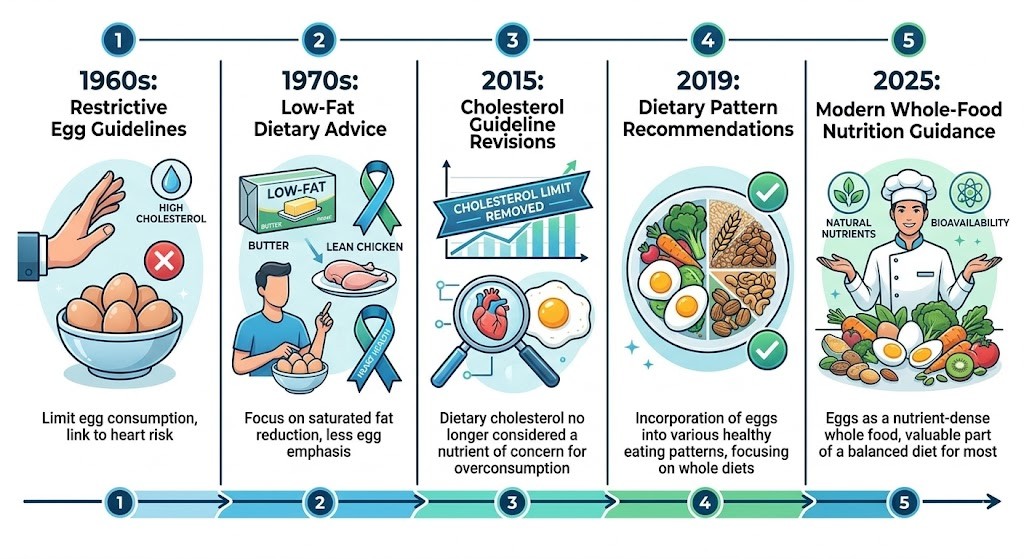
How did eggs go from public enemy number one to a dietary superstar? It was a sixty-year journey of scientific discovery.
Era or Policy Milestone | Core Recommendation on Cholesterol | Scientific and Political Driver |
1968 AHA Guideline | Max 300 mg/day of dietary cholesterol; max 3 whole eggs per week | Early animal trials utilizing herbivores (e.g., rabbits) and unadjusted population correlations |
1977 McGovern Report | Shift to low-fat, high-carbohydrate diets; restrict egg yolks | Congressional mandates promoting complex carbs while demonizing animal-derived fats |
2015–2020 DGA | Abolished the 300 mg/day cholesterol restriction limit | Systematic reviews demonstrating no significant relationship between dietary cholesterol and CVD |
2019 AHA Advisory | Emphasized overall dietary patterns over numerical lipid targets | Accumulating data proving that dietary cholesterol cannot be isolated from total dietary fat matrices |
2025–2030 DGA | Focus on whole, minimally processed protein sources; "Eat Real Food" | The modern metabolic health crisis, where chronic, diet-driven illnesses dominate healthcare costs |
Dismantling the 1968 Restrictions
In 1968, the American Heart Association (AHA) capped dietary cholesterol at 300 mg per day and limited eggs to just three per week. Early studies fed massive amounts of cholesterol to rabbits—animals that are strict herbivores and cannot process cholesterol the way humans do.
The Landmark 2015 Reset and the New "Inverted" Pyramid
By 2015, the Dietary Guidelines Advisory Committee officially declared that "cholesterol is not a nutrient of concern for overconsumption," and dropped the 300 mg daily cap.
The latest 2025–2030 Dietary Guidelines for Americans—unveiled by HHS Secretary Robert F. Kennedy Jr. and USDA Secretary Brooke Rollins—took this even further with a clear message: "Eat real food".
They replaced the old upright food graphics with an inverted food pyramid. This new model puts high-quality proteins (including eggs), full-fat dairy, and healthy fats at the widest top tier, while demoting ultra-processed foods, refined grains, and added sugars to the tiny bottom point.
The Bottom Line: Decades of tracking human eating patterns proved that isolating single nutrients like cholesterol was a mistake. The focus is now on eating whole, minimally processed, real foods.
The Low-Carb Companion
If you are using VoCal to manage a low-carb diet or stay in a fat-burning state of ketosis, eggs are your ultimate sidekick. A standard low-carb diet limits carbohydrates to between 60 and 130 grams a day, while ketogenic diets push that target below 60 grams.
Dietary Standard | Daily Carbohydrate Allowance | Primary Energy Sources | Primary Metabolic State |
Standard DGA Guidance | Approx. 130–300 g/day | Complex grains, vegetables, fruits, starches | Glycolysis (utilization of glucose for cellular energy) |
Moderate Low-Carb | 60–130 g/day | Lean proteins, healthy lipids, non-starchy vegetables | Mixed glucose and lipid oxidation |
Very Low-Carb / Keto | Under 60 g/day | High-quality fats, moderate animal/plant proteins | Ketosis (metabolic state utilizing ketone bodies) |
A whole egg contains zero carbohydrates, 5 grams of healthy fat, and 6 grams of highly bioavailable protein.
When you restrict carbs, your body experiences metabolic changes that help you burn stored fat:
Water Weight Drops: Lowering carbs lowers insulin, prompting your kidneys to quickly shed excess water weight.
No More Hangry Spikes: Protein and fats digest slowly, keeping you full and satisfied without energy crashes.
The Gluconeogenesis Surtax: In the early stages of a low-carb shift, your body expends extra energy converting protein into glucose, giving you a temporary metabolic advantage.
Brain Power & Muscle Synthesis: The Yolk Secrets
Beyond macronutrients, eggs are packed with vital micronutrients that are hard to find elsewhere.
Nutrient Fraction | Protein Content | Key Micronutrients | Bioavailability Highlights | Clinical Indications |
Egg White | 3.6 g | Riboflavin, Selenium, Sodium, Potassium | High protein digestibility (97% PDCAAS score) | Muscle protein synthesis, sarcopenia prevention, calorie-restricted diets |
Egg Yolk | 2.7 g | Choline, Lutein, Zeaxanthin, Vitamins A, D, E, B12, Iron | Choline bioavailability at 101%–104% compared to supplements | Cognitive support, neurological development, cellular membrane structure |
The Choline Connection
Choline is an essential nutrient your brain uses to make acetylcholine—the chemical messenger responsible for memory, mood, and muscle control. It is also needed to export fat from your liver; without enough of it, you risk developing non-alcoholic fatty liver disease (NAFLD).
The recommended Adequate Intake (AI) is 550 mg/day for men and 425 mg/day for women. Yet, NHANES data reveals that less than 9% of Americans actually meet this goal.
Because one large egg delivers about 126 to 147 mg of highly bioavailable choline, simply adding eggs to your plate is the easiest way to close this nutritional gap.
The Genetic Puzzle: Are You a Hyper-Responder?
Not everyone processes food the same way, and genetics explain why some people see different blood test results:
The 70% (Hypo-Responders): For the vast majority of people, eating eggs has zero impact on blood cholesterol. Your liver simply adjusts its internal production to keep your levels stable.
The 30% (Hyper-Responders): Some people absorb dietary cholesterol more efficiently. If you are a hyper-responder, eating eggs might cause a modest rise in both your LDL and HDL cholesterol. Crucially, because both rise in tandem, your overall LDL-to-HDL ratio stays balanced.
The ApoE4 Gene and Choline Rescue
If you carry the ApoE4 gene variant (which is present in about 25% of the global population and is linked to a higher risk of Alzheimer's and heart disease), your body is naturally more sensitive to dietary lipids.
However, groundbreaking research from MIT has shown that ApoE4-carrying cells suffer from lipid imbalances that can be rescued by providing extra choline. Because eggs are a powerhouse of bioavailable choline, they can be highly beneficial for individuals with this genetic profile.
Watch Out for the "Confounding Breakfast" Trap
If eggs are so healthy, why did early studies find a link to heart disease? It is all about the company they keep.
Logged Breakfast Option (Vo-cal.com Voice Input) | Saturated Fat & Sodium Load | Metabolic and Clinical Impact | Recommended Logged Alternatives |
"Three fried eggs with bacon, sausage, white toast, and butter" [cite: 11, 12] | High Saturated Fat: Butter/lard raise circulating LDL-C. High Sodium: Elevates blood pressure. | Promotes atherogenesis, systemic inflammation, insulin resistance, and gut microbiota imbalances. | Fry in cold-pressed olive oil; swap processed meats for grilled mushrooms or avocado slices. |
"Two poached eggs served over whole-grain toast with half an avocado" [cite: 36] | Low Saturated Fat: Kept well under the 10% daily caloric limit. High Fiber: Avocado and whole grains improve lipid profiles. | Stabilizes postprandial glucose, improves the LDL-to-HDL ratio, and supports cardiovascular health. | Maintain this balanced composition; voice-log additional herbs or spices for flavor with minimal sodium. |
When you use your voice to track meals on VoCal, remember to log the cooking fats and side dishes too. Saturated fat from frying in butter, paired with sodium-packed processed meats like bacon and sausage, is what actually raises your cardiovascular risk.
Frequently Asked Questions (FAQs)
Are eggs bad for my cholesterol?
For most healthy people, no. The cholesterol naturally found in eggs does not impact blood cholesterol the way saturated and trans fats do. Your body regulates its own cholesterol levels by adjusting internal production based on what you eat.
How many eggs can I safely eat in a week?
The American Heart Association and federal guidelines note that healthy individuals can safely enjoy up to one whole egg per day (or seven per week) within a balanced, healthy eating pattern. Older adults with healthy lipid profiles can comfortably consume up to two eggs per day due to their excellent nutrient density.
Should I skip the yolk and only eat egg whites?
If you want to completely avoid dietary cholesterol, egg whites are a great choice because they contain zero cholesterol while providing clean, highly digestible protein. However, by skipping the yolk, you miss out on essential nutrients like brain-boosting choline, lutein for eye health, and fat-soluble vitamins.
Do eggs pose a risk if I have Type 2 diabetes?
If you have Type 2 diabetes, some research suggests a link between high egg consumption and increased heart disease risk, though other studies have found no such connection. If you have a metabolic condition or a family history of hypercholesterolemia, it is always best to work with your healthcare provider to monitor your lipid levels.
Disclaimer: The information provided in this article, including text, graphics, tables, and nutritional guidelines, is for general educational and informational purposes only. It is not intended to be a substitute for professional medical advice, clinical diagnosis, or individualized treatment plans. Always consult with your primary care physician, cardiologist, or a registered dietitian before making significant changes to your diet.