

Have you been avoiding whole eggs because you're worried about your heart? You are definitely not alone. For decades, the humble egg was treated like public enemy number one in the breakfast world. But is the yolk really the bad guy? Let's crack open the science and get the eggs and cholesterol myth explained once and for all!
Are Eggs Bad for Your Heart?
To understand why eggs got a bad rap, we have to travel back a few decades. In 1968, the American Heart Association recommended eating no more than three egg yolks a week. The logic seemed simple: egg yolks are packed with cholesterol, so eating them must clog your arteries.
But nutritional science has come a long way since the 1960s. Today, major health guidelines have dropped those strict limits, encouraging people to look at their overall dietary pattern instead of obsessing over a single ingredient.
The Quick Takeaway: Eggs are not a one-way ticket to heart trouble. They are an affordable, nutrient-dense whole food that fits beautifully into a healthy lifestyle.
Dietary Cholesterol vs Blood Cholesterol
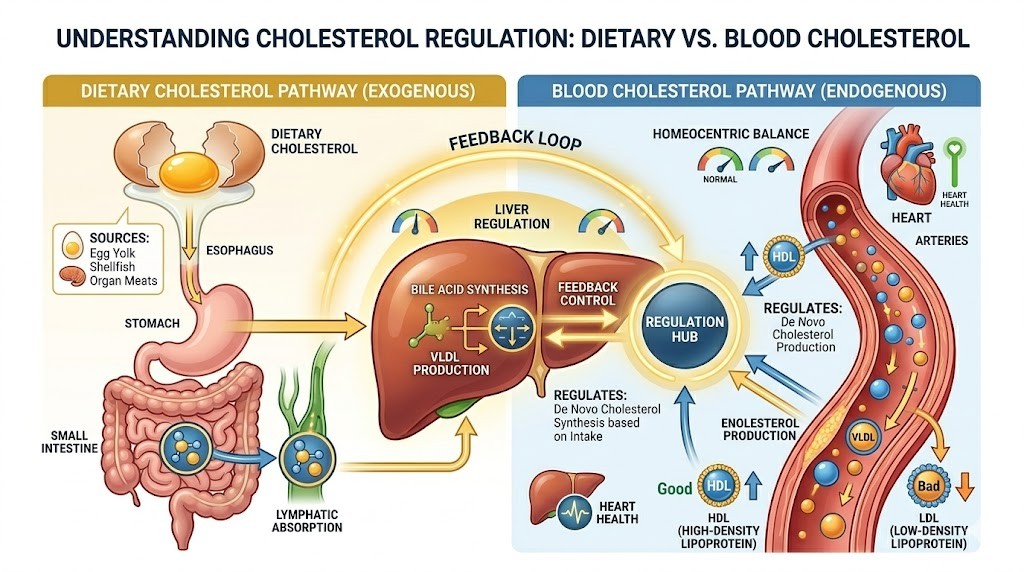
The real secret to solving this breakfast mystery lies in a simple distinction: Dietary Cholesterol vs Blood Cholesterol: Why Eggs Affect People Differently.
Here is the difference:
Dietary cholesterol is the cholesterol you find naturally in your food (like the 186 mg tucked inside a single medium egg yolk).
Blood cholesterol refers to the lipoproteins (the HDL "good" and LDL "bad" cholesterol) floating through your circulatory system.
Our bodies are incredibly smart. Your liver actually makes all the cholesterol you need to survive. When you eat a couple of eggs, your liver detects the incoming supply and simply dials back its own internal production to keep things steady.
For about 70% of us (known as "non-responders" or "hypo-responders"), eating eggs has virtually zero impact on blood cholesterol.
But what about the other 30% of the population? These "hyper-responders" do see their blood cholesterol numbers rise when they eat eggs. However, studies show that both their "bad" LDL transporter and their "good" HDL scavenger rise in a parallel, balanced partnership. Because the ratio of good-to-bad cholesterol stays steady, their actual heart health risk doesn't change!
In clinical terms, doctors calculate total cholesterol (TC) using this formula:
TC=LDL-C+HDL-C+(TG/5)
When both LDL-C and HDL-C rise proportionally, your heart's risk profile remains beautifully balanced.
Meet Your Gut's Cellular "Bouncers"
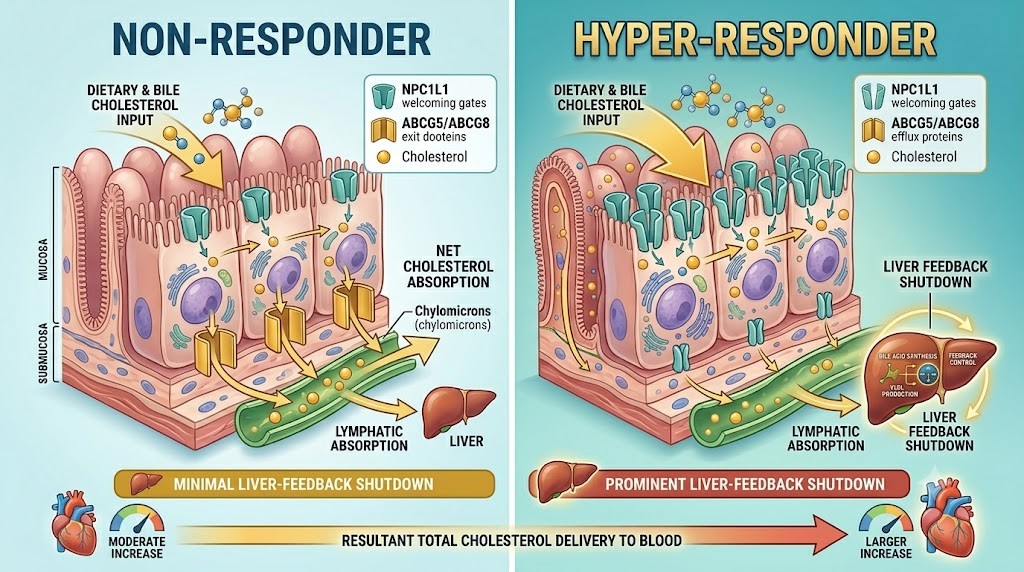
Why are some people hyper-responders while others can eat eggs all day without a budge? It mostly comes down to genetic gatekeepers in your digestive tract:
NPC1L1: Think of this protein as a friendly bouncer at the door of your small intestine. It helps pull free cholesterol from your food into your body. If your genetics make this bouncer extra welcoming, you'll absorb more cholesterol.
ABCG5 and ABCG8: These proteins act like the exit doors. They actively pump excess sterols back out into your intestine to be flushed away.
If your genetic exit doors are a little slow, or if your cellular bouncers are a bit too eager, you might find yourself in the "hyper-responder" camp.
Another genetic player is the APOE gene, specifically the APOE4 variant, which is linked to higher baseline cholesterol. You might think APOE4 carriers should banish eggs forever, but a landmark 20-year study followed participants and found absolutely no link between eating eggs and heart disease—even in these highly susceptible individuals!
Egg Whites vs. Egg Yolks: A Powerhouse Partnership
An egg is a fascinating biological package. Rather than just a vehicle for fat, it provides an array of protective, high-quality proteins. In fact, the egg white and the yolk play very different, complementary roles in your health:
Egg Fraction | Primary Protein Components | Physiological & Biological Properties |
Egg White | Ovotransferrin, Ovomucin, Lysozyme | Ovotransferrin: Binds metal ions to restrict bacterial growth. Ovomucin: Demonstrates antiviral properties. Lysozyme: Enzymatically disrupts the cell walls of Gram-positive bacteria. |
Egg Yolk | Lipovitellin, Phosvitin | Lipovitellin: Represents the high-density lipoprotein (HDL) subfraction in the yolk. Phosvitin: Binds heavy metal ions to protect against lipid oxidation. |
Scrambled vs. Sandwiched: What the Data Shows
To see how Americans actually eat their eggs, researchers analyzed data from the National Health and Nutrition Examination Survey (NHANES). On any given day, about 19% of U.S. adults eat eggs or omelets, while 8% opt for an egg sandwich.
But how you eat your eggs makes a massive difference to your health:
Consumption Parameter | Eggs or Omelets | Egg Sandwiches |
Daily Prevalence (U.S. Adults) | 19% | 8% |
Gender Distribution | Equal prevalence between males and females | Significantly higher consumption among males |
Ethnic Variations | Highest prevalence among Hispanic adults compared to non-Hispanic Black and White adults | Highly prevalent across urban populations |
Mean Daily Energy Contribution | 213 kcal | 506 kcal |
Primary Meal Occasion | Breakfast (75% of total intake) | Breakfast (75% of total intake) |
Proportion of Daily Energy Intake | Only 6% of consumers get >= 25% of daily energy from this source | 32% of consumers get >= 25% of daily energy from this source |
A whole, soft-boiled egg is incredibly clean and nutrient-dense, providing high-quality protein, vitamin D, and choline. But when we tuck those eggs into a greasy sandwich with processed sausage, melted cheese, and a buttery croissant, the calories and saturated fats skyrocket.
The Ultimate Brain and Body Fuel
Eggs are a nutrient jackpot for children and teenagers. NHANES data shows that kids who regularly eat eggs have much higher intakes of:
Essential proteins and healthy unsaturated fats
Lutein and zeaxanthin (antioxidants that act like internal sunglasses to protect developing eyes)
Choline (a critical brain-building nutrient that most kids and adults don't get enough of)
Just adding one egg a week to an infant’s diet can dramatically improve their choline adequacy, helping support vital neurodevelopment.
The Secret Heart-Health Hack: Eggs and Fiber

Want to know how to have your eggs and eat them too? Pair them with soluble fiber!
The famous Framingham Offspring Study evaluated 1,852 healthy adults and found that eating five or more eggs a week was not adversely associated with blood lipid levels. Even better, the researchers noticed a powerful synergy: participants who ate eggs and got plenty of dietary fiber had the lowest total cholesterol, lowest bad LDL, and the healthiest lipid ratios.
How does this magic work? Viscous soluble fiber—found in oatmeal, barley, and beans—acts like a sticky sponge in your digestive tract. It physically traps bile acids (which are made of cholesterol) and drags them out of your body.
To replace those lost bile acids, your liver has to pull bad LDL cholesterol out of your bloodstream to make more! Pairing your morning eggs with a warm bowl of oatmeal is like giving your cardiovascular system a high-five.
Who Should Still Be Careful with Eggs?
While eggs get a green light for most healthy people, there are a few exceptions:
People with Type 2 Diabetes: Multiple studies suggest that high egg consumption can increase cardiovascular risks in individuals with diabetes. If you have diabetes, it is best to consult your healthcare provider and keep your egg intake moderate.
The Saturated Fat Trap: Remember, it's often the company eggs keep that causes trouble. Saturated fats (found in butter, bacon, sausage, and full-fat cheese) downregulate your liver's LDL receptors, which directly spikes bad blood cholesterol. Keep your meals heart-healthy by choosing poached or boiled eggs and pairing them with avocado, whole grains, and fresh vegetables.
Speak Up: Smarter Tracking on VoCal
Tired of typing in every single ingredient, oil, and side dish into a clunky manual tracking app? Voice-assisted logging on VoCal makes managing your nutrition completely effortless.
Just speak naturally:
"I had two soft-boiled eggs, a cup of rolled oats with blueberries, and a black coffee."
VoCal's advanced clinical logic doesn't just look at numbers in isolation. Instead of triggering a scary red warning about the cholesterol in your eggs, our smart algorithms recognize that the soluble fiber in your oats is actively helping your liver clear LDL cholesterol. We look at your whole dietary pattern to give you personalized, scientifically sound feedback that empowers your health goals.
Ready to stop stress-tracking and start talking? Try VoCal today!
Frequently Asked Questions
How many eggs can I safely eat every day?
According to the American Heart Association, healthy individuals can enjoy up to one whole egg per day as part of a heart-healthy diet. Older adults with healthy cholesterol levels can safely consume up to two eggs per day. If you have Type 2 diabetes or heart disease, it is best to consult your doctor and keep your intake more moderate.
Are egg whites healthier than egg yolks?
Egg whites are low-calorie and virtually fat-free, serving as an exceptional source of high-quality protein. However, the yolk contains almost all of the egg's essential nutrients—including brain-building choline, lutein and zeaxanthin for eye health, and vitamins A and D. Eating the whole egg gives you the complete nutritional package!
Will eating eggs raise my cholesterol?
For about 70% of the population, dietary cholesterol has a negligible effect on circulating blood cholesterol. For the other 30% ("hyper-responders"), blood cholesterol may rise slightly, but both the "good" HDL and "bad" LDL transporters increase in tandem, maintaining a stable and healthy cardiovascular risk ratio.
What is the best way to cook eggs for heart health?
We recommend boiling, poaching, or scrambling your eggs using a quick spray of a liquid vegetable oil (like olive or canola oil) instead of frying them in butter or lard. Be mindful of high-saturated-fat side dishes like bacon, sausage, or biscuits.
Disclaimer: The information in this article is for educational and informational purposes only and is not intended as personal medical advice. Always consult a healthcare professional or qualified registered dietitian before making significant changes to your diet, especially if you have pre-existing cardiovascular conditions, diabetes, or high cholesterol.