

If you are on a quest to build some serious size, you’ve probably searched high and low for the best egg breakfast for muscle gain. Well, stop chugging those chalky protein shakes and step away from the egg-white cartons. It turns out that cracking open whole eggs is the ultimate natural cheat code for your biceps.
Let’s dive into why eggs are the undisputed champions of the breakfast table, how to time them perfectly, and how you can whip up some delicious meals that will make your taste buds do a happy dance.
Key Facts
The Whole Truth: Whole eggs spark significantly more post-exercise muscle growth than just egg whites—yes, the fats and micronutrients in the yolk actually boost your protein's efficiency!
Overnight Reset: Eating a protein-packed breakfast reverses the catabolic "muscle breakdown" state your body enters while you sleep.
Post-Workout Sync: Pairing your eggs with healthy carbs triggers an insulin release that rushes those muscle-building amino acids straight to your cells.
Tracking Simplified: Traditional logging can be a total pain, but VoCal uses AI voice tracking to help you hit your macro goals in under 15 seconds.
3 Delicious Muscle-Building Egg Recipes
We’ve got you covered with three mouth-watering, protein-packed recipes that will fuel your recovery and satisfy your morning cravings.
1: Southwest Egg and Black Bean Scramble (The Vegetarian Powerhouse)
Who says you need meat to make massive gains? This zesty vegetarian scramble packs a double punch of fiber-rich black beans and whole eggs, making it one of the absolute best options for a vegetarian muscle-building breakfast.
Preparation Tips:
Heat a large skillet over medium-high heat with a light coat of cooking spray. Sauté some chopped bell peppers and red onions for about 8 minutes until tender.
Toss in 1/2 cup of drained, rinsed black beans and a cup of raw baby spinach. Sauté for an additional 2 minutes until the spinach is wilted.
Whisk 3 whole eggs in a bowl, reduce the heat to medium, and pour them into the skillet.
Stir gently with a spatula for 4 to 5 minutes until the eggs are beautifully scrambled and fully cooked.
Meal Idea: Serve this hot scramble with a warm slice of toasted whole-wheat bread to add those complex carbs your muscles need to recover.
2: Smoked Salmon and Spinach Scramble on Sourdough (The Omega-3 Legend)
If you are looking for a savory, gourmet treat, this recipe is a home run. Pairing whole eggs with smoked salmon gives you high-quality proteins and healthy omega-3 fatty acids, which help reduce muscle soreness and speed up repair.
Preparation Tips:
Warm a teaspoon of extra virgin olive oil in a skillet over medium heat. Sauté a cup of raw spinach for 1 to 2 minutes until wilted.
Whisk 3 whole eggs in a bowl, pour them into the skillet, and stir continuously to form soft, creamy curds.
Just before the eggs are fully set (at about the 3-minute mark), gently fold in 2 ounces of flaked wild-caught smoked salmon.
Cook for 1 more minute to warm the salmon, then remove from heat.
Meal Idea: Spoon this creamy scramble onto a thick slice of toasted sourdough bread. Sourdough is easy on the stomach and provides the perfect carbohydrate boost to replenish your energy after training.
3: Sweet Potato, Spinach, and Egg Feta Skillet (The Slow-Carb Champion)
This rustic, one-pan meal is perfect for those who want a hearty, slow-digesting breakfast that keeps their energy levels steady for hours.
Preparation Tips:
Heat a teaspoon of extra virgin olive oil in your skillet over medium heat. Sauté 1 cup of cubed, pre-cooked sweet potato for 4 to 5 minutes until lightly browned and crispy.
Add a cup of raw spinach and sauté for 1 minute until wilted.
Use your spatula to make three small wells in the sweet potato and veggie mixture, and crack an egg directly into each well.
Cover the skillet with a lid and let it cook for 5 to 6 minutes, or until the egg whites are firm but the yolks are still soft and runny.
Sprinkle with 1 ounce of crumbled feta cheese just before serving.
Meal Idea: This skillet is a complete, well-balanced meal all on its own! Enjoy it straight from the pan for a comforting, savory breakfast that hits all your fitness goals.
Recipe Formulation | Protein | Fat | Carbs | Total Energy | Key Post-Exercise Recovery Benefit |
Southwest Egg & Black Bean Scramble | 31.0 g | 16.7 g | 38.6 g | 425 kcal | High fiber (13 g) to stabilize blood sugar; balanced carbohydrate-to-protein ratio. |
Smoked Salmon & Spinach Sourdough | 35.5 g | 23.1 g | 27.1 g | 465 kcal | Rich in omega-3 fatty acids to help reduce muscle soreness and support repair. |
Sweet Potato, Spinach, & Feta Skillet | 25.0 g | 25.7 g | 30.1 g | 453 kcal | Low-glycemic, complex carbohydrates to support prolonged glycogen resynthesis. |
Why Eggs Are Your Ultimate Muscle-Building Sidekick
For years, old-school bodybuilders threw away egg yolks like they were bad luck. They thought the fat in the yolk would slow down digestion and ruin their gains. But modern science has officially busted that myth!
Clinical studies have compared people eating whole eggs (18 g of protein, 17 g of fat) to those eating just egg whites (18 g of protein, 0 g of fat) after a tough workout. The result? Even though egg whites send amino acids into your bloodstream a little faster, whole eggs trigger a significantly greater muscle-building response.
At a cellular level, whole eggs recruit a key protein pathway called mTORC1 and physically move it to the lysosome—which is basically the cellular construction site where muscle repair happens. In short: don't ditch the yolk! The complex mix of healthy fats, vitamins, and minerals in the yolk works together to help your muscles grow much better than egg whites alone.
Egg Component | Protein Content | Lipid Content | Key Bioactive Molecules | Anabolic Efficiency |
Whole Large Egg | 6.0 to 6.3 g | 4.5 to 5.0 g | Choline, phospholipids, lutein, vitamin D, phosphatidic acid | Superior (Drives lysosomal mTORC1 colocalization) |
Egg White (Albumin) | 3.6 to 4.0 g | 0.0 g | Pure ovalbumin, high leucine concentration | Moderate (Rapid amino acid spike, lower spatial efficiency) |
Egg Yolk | 2.4 to 2.7 g | 4.5 to 5.0 g | Saturated and unsaturated lipids, cholesterol, fat-soluble vitamins | High (Serves as a metabolic cofactor when paired with protein) |
The Ultimate Post-Workout Nutrient Timing
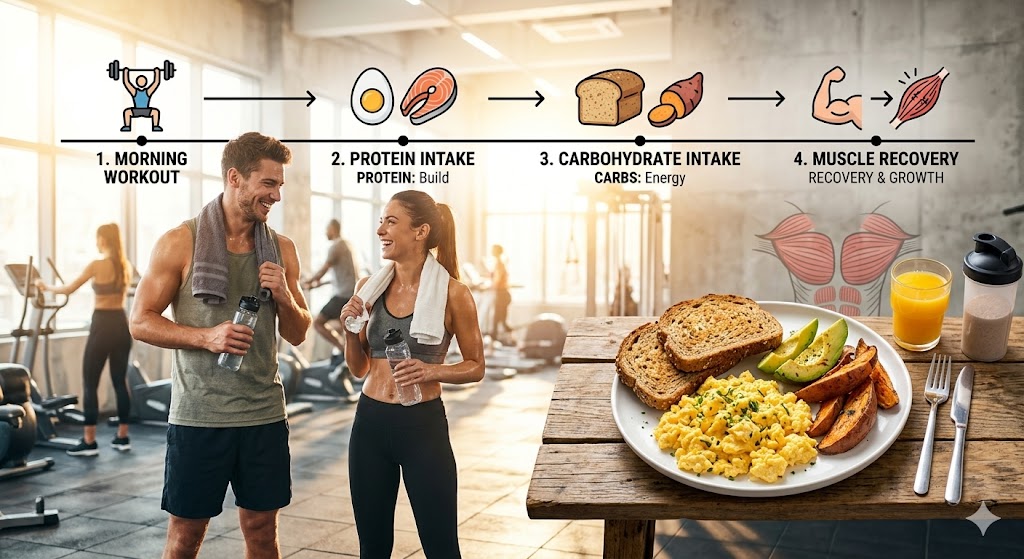
When it comes to whipping up the Best Egg Breakfast for Muscle Gain After Morning Workouts, timing and balance are everything.
While you sleep, your body runs low on fuel and enters a catabolic state, which is a fancy way of saying it starts breaking down your hard-earned muscle for energy. To stop this muscle breakdown in its tracks, you need to hit the "leucine trigger"—which is about 3 grams of the amino acid leucine, easily found in roughly 30 grams of high-quality protein. Eating a solid protein dose at breakfast instead of back-loading all your protein at dinner boosts your overall daily muscle growth by about 25%.
If you've just crushed an intense morning workout, your muscle glycogen (stored energy) is depleted. Pairing your eggs with healthy carbohydrates is the ultimate post-workout strategy. The carbs trigger a release of the hormone insulin, which acts like a VIP pass, ushering the egg's amino acids straight into your muscle cells to rebuild them stronger.
The Gymgoer's Daily Protein & Cholesterol Guide
How much protein do you actually need to build a stellar physique? The old Recommended Dietary Allowance (RDA) of 0.8 g/kg of body weight is just the bare minimum to keep sedentary folks from getting sick. If you are lifting weights, you need to aim higher.
Population Category | Recommended Daily Protein Intake | Key Physiological Objective |
Sedentary Baseline | 0.8 g/kg/day (or ~7 g per 20 lbs of body weight) | Prevention of clinical deficiency and maintenance of nitrogen balance. |
Active Strength & Resistance Trained | 1.4 to 2.0 g/kg/day (up to 1.6 g/kg/day is maximal for energy balance) | Optimization of muscle remodeling, hypertrophy, and chronic training adaptations. |
Endurance Trained (High Volume) | 1.8 g/kg/day | Replacement of amino acids oxidized during training and tissue repair. |
Hypocaloric/Lean Mass Maintenance | 2.3 to 3.1 g/kg/day | Prevention of skeletal muscle catabolism during periods of caloric restriction. |
And what about the old warnings about egg cholesterol? Modern science has cleared the egg's reputation! The newest 2025–2030 Dietary Guidelines for Americans actually list eggs first among recommended animal protein sources and don't place a strict limit on dietary cholesterol. For most healthy people, dietary cholesterol has a minimal effect on blood cholesterol.
The American Heart Association (AHA) notes that healthy adults can comfortably enjoy a whole egg every day, and older adults with healthy cholesterol can go up to two! If you have high cholesterol, diabetes, or heart issues, sticking to four yolks a week is a smart plan, but you can still eat as many egg whites as you want to hit your daily goals.
Streamlining Your Macros with VoCal
Let’s be honest: tracking your food can feel like a part-time job. When you’re busy crushing your fitness goals, the last thing you want to do is spend 15 minutes typing, weighing, and searching databases to log a single breakfast scramble.
That is where VoCal comes in to make your life infinitely easier!
VoCal is a voice-activated food tracking app that eliminates manual entry. Instead of typing, you simply tap the microphone and speak naturally:
"For breakfast, I had a scramble with three large eggs, a cup of spinach, half a cup of black beans, and one slice of whole-wheat toast."
In less than 15 seconds, VoCal’s smart AI parses your words, calculates your calories, and breaks down your macros with up to 95% accuracy.
Platform Metric | VoCal | MyFitnessPal | Cal AI | Yazio |
Primary Input Method | Voice-First | Manual Search | Photo Upload | Manual Search |
Average Logging Time | ~15 seconds | 5 to 10 minutes | 1 to 2 minutes | ~5 minutes |
Tracking Accuracy | Up to 95% | Variable | ~60% | Variable |
User Interface Friction | Minimal | High | Medium | High |
Final Words
Building muscle shouldn't feel like a chore—and neither should your diet. By choosing whole eggs over plain egg whites, you are giving your body a highly efficient, nutrient-dense package that maximizes muscle growth. Pair those eggs with healthy, complex carbs, and you have the perfect post-workout recovery meal ready to roll.
To make sure you are consistently hitting your macro targets without the headache of manual data entry, download the VoCal app. You can track your meals effortlessly using just your voice and spend more time focusing on your gains. Happy cooking!
Frequently Asked Questions (FAQs)
Why are whole eggs better than egg whites for muscle building?
Even though egg whites digest slightly faster, whole eggs trigger a significantly higher rate of post-exercise muscle protein synthesis. The natural fats, vitamins, and minerals found inside the egg yolk act as key cellular signaling helpers that recruit mTORC1 directly to the lysosome, unlocking superior long-term muscle repair and growth.
How many whole eggs can I eat daily if I am trying to build muscle?
For most healthy adults, eating up to one to two whole eggs daily is perfectly safe, highly nutritious, and fully supported by modern dietary guidelines. However, if you have pre-existing high LDL cholesterol, type 2 diabetes, or cardiovascular concerns, the American Heart Association suggests keeping your yolk intake to about four per week while consuming egg whites freely.
When is the best time to eat my egg breakfast after a morning workout?
While muscle protein sensitivity remains heightened for up to 24 to 48 hours post-exercise, consuming your egg-based breakfast within 30 minutes to 2 hours of finishing your workout is highly recommended. This strategic timeline reverses overnight muscle catabolism (breakdown) and capitalizes on the nutrient delivery window to accelerate muscle glycogen replenishment.
Can I build muscle with vegetarian egg breakfasts?
Absolutely! Eggs contain all nine essential amino acids, making them a complete protein source. When paired with plant-based, nutrient-dense foods like black beans, pinto beans, or cooked sweet potato, you create a balanced meal that delivers both the protein and complex carbohydrates necessary to support muscle remodeling.
Disclaimer: This article is for informational and educational purposes only. It does not provide individualized medical advice, patient-specific diagnostic evaluation, or personalized treatment plans. Always consult with a qualified healthcare professional or registered dietitian before making significant changes to your diet, exercise routine, or weight-management strategy.