
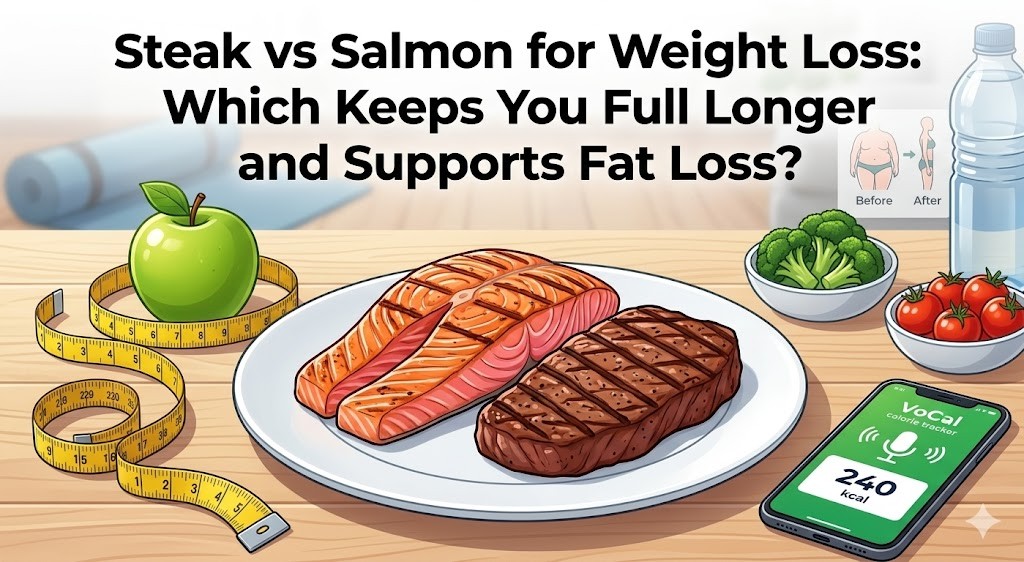
Let’s be real: trying to lose weight can sometimes feel like a full-time job. Between counting calories, hitting the gym, and dodging your coworker’s homemade donuts, the last thing you want is a stomach that won't stop growling.
If you are looking to trim down, packing your plate with high-quality protein is your best secret weapon. Protein boosts your metabolism, preserves your hard-earned muscle, and is the ultimate champion of keeping you full.
But when dinner rolls around, which heavyweight champion should you choose: a juicy beef steak or a flaky fillet of salmon?
This steak vs salmon health comparison dives deep into the science of satiety, digestion, and metabolism to help you decide which of these delicious options belongs in your fat-loss routine.
The Battle of the Macros (and Calories)
Before we look at how these proteins make you feel, let’s look at what they are actually made of.
The calorie and fat content of steak depends heavily on the cut you choose. If you opt for a lean cut like top sirloin, you are getting a massive protein punch with very little fat. Go for a heavily marbled ribeye, however, and your calorie count will skyrocket.
Salmon has a similar story. Wild sockeye salmon is a leaner, highly dense protein, while farmed Atlantic salmon packs about twice as much fat (and extra calories).
Nutritional Comparison per 100g Cooked Portion
To see how they stack up side-by-side, here is the raw data straight from the United States Department of Agriculture (USDA) National Nutrient Database:
Nutrient (per 100g Cooked) | Cooked Wild Atlantic Salmon | Cooked Farmed Atlantic Salmon | Cooked Sockeye Salmon | Cooked Beef Top Sirloin (Lean Only) | Cooked Beef Ribeye Steak |
Calories (kcal) | 182 | 206 | 156 | 170 | 291 |
Protein (g) | 25.4 | 22.1 | 26.48 | 28.0 | 24.0 |
Total Fat (g) | 8.13 | 12.4 | 5.57 | 6.1 | 22.0 |
Saturated Fat (g) | 1.26 | 2.4 | 0.97 | 2.3 | 8.5 |
Omega-3 Fatty Acids (g) | 2.31 | 2.50 | 0.95 | 0.01 | Minimal |
Heme Iron (mg) | 0.8 | 0.3 | 0.52 | 1.8 | 2.1 |
Zinc (mg) | 0.43 | 0.40 | 0.55 | 5.4 | 4.9 |
Vitamin D (mcg) | 11.0 | 11.0 | 16.7 | 0.1 | Minimal |
Vitamin B12 (mcg) | 3.05 | 2.8 | 4.5 | 2.7 | 2.5 |
As you can see, lean top sirloin gives you the most protein per bite, but wild sockeye salmon is a close runner-up.
Bottom Line: Lean cuts of beef and wild sockeye salmon are incredibly protein-dense and perfect for weight loss. Just keep an eye on ribeyes and farmed salmon, as their higher fat levels can sneakily eat into your daily calorie budget.
The Satiety Showdown: Which Keeps the "Hanger" Away?
"Hanger"—that hostile mix of hunger and anger—is the ultimate diet-killer. To keep it at bay, you need foods that score high on the Satiety Index.
Developed in 1995 by Dr. Susanna Holt at the University of Sydney, the Satiety Index measures how full a 240-calorie portion of food keeps you compared to a baseline of white bread (100%). Here is how our contenders fared :
White Fish (Ling): 225%
Beef: 176%
Eggs: 150%
Fish takes a commanding lead, proving that marine protein has an incredibly powerful ability to satisfy hunger.
The 11% Calorie-Saving Secret
To see if this feeling of fullness actually changes how much people eat, a clinical trial published in the European Journal of Clinical Nutrition put fish and beef to the test. Healthy young men were fed a high-protein lunch consisting of either fish or beef.
Four hours later, the men were served an all-you-can-eat dinner. The results were eye-opening: the men who ate fish at lunch naturally consumed 11% fewer calories at dinner compared to the beef group.
Even better, they didn't make up for it by overeating later in the night.
Brain Signaling and the Serotonin Connection
Why does fish have this magical appetite-crushing effect? It all comes down to brain chemistry.
Eating fish boosts your post-meal ratio of tryptophan to other large neutral amino acids (Trp:LNAA). Tryptophan is the building block your brain uses to make serotonin, the "feel-good" hormone that tells your body you are happy, relaxed, and completely satisfied.
By raising this ratio, salmon essentially sends a high-speed message to your brain saying, "We're full, you can stop thinking about pizza now."
Bottom Line: Fish protein is incredibly satisfying. Eating it can help you naturally cut down your food intake by 11% later in the day, thanks to a boost in the satiety-signaling hormone serotonin.
Why Does Steak Feel "Heavy" While Salmon Feels "Light"?
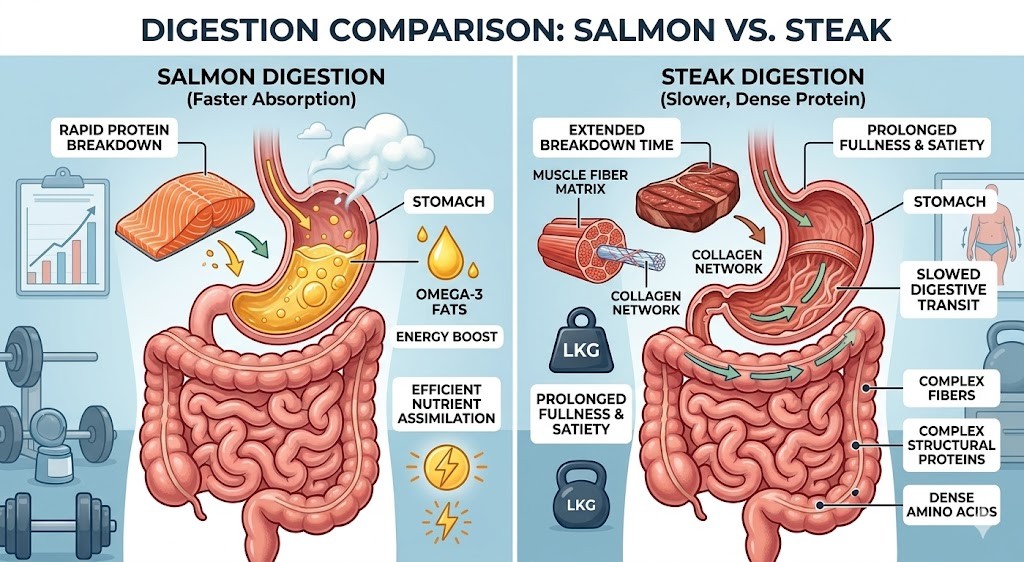
Have you ever noticed that a steak dinner leaves you feeling like you need a three-hour nap, while a piece of salmon leaves you feeling light and energized? That isn't just in your head—it is basic biology.
The Toughness of the Chew
Seafood is incredibly easy to digest because it has very little connective tissue, specifically collagen. This is why cooked fish flakes apart with just a fork and breaks down quickly in your stomach.
Beef, on the other hand, is packed with dense muscle fibers and tough collagen. Your stomach has to churn mechanically for a long time to break a steak down.
This physical bulk activates stretch receptors in your stomach, giving you that distinct "heavy" feeling of fullness.
Saturated vs. Unsaturated Fat Melting Points
The type of fat in these foods also changes how they move through your digestive tract.
Salmon fat is loaded with omega-3 polyunsaturated fatty acids. Because salmon live in freezing waters, their fats are designed to stay liquid at very cold temperatures. At your body temperature, salmon fat is completely liquid, allowing your digestive enzymes to rinse through it smoothly.
Beef fat is rich in saturated fatty acids, which have a much higher melting point. At body temperature, beef fat remains semi-solid, slowing down your gastric emptying and keeping your digestive system working overtime.
Bottom Line: Salmon’s low collagen and liquid omega-3 fats make it light and easy to digest, preventing that post-meal brain fog. Steak's dense fibers and solid fats stay in your stomach longer, offering a physical sensation of fullness at the cost of heavier digestion.
Metabolic Magic: Thyroid Boosters vs. Muscle Builders
To lose fat and keep it off, your metabolism needs to be firing on all cylinders. Both steak and salmon support your metabolism, but they do it in completely different ways.
Salmon: The Thyroid and RMR Accelerator
Your thyroid gland is the master controller of your metabolism, and it cannot function without two crucial minerals: iodine and selenium.
Salmon is a goldmine for both. It provides the selenium needed for the enzymes that convert inactive thyroid hormone (T4) into the active, calorie-burning form (T3).
Additionally, the marine omega-3 fatty acids in salmon have been shown in clinical studies to boost your resting metabolic rate (RMR) by up to 14%, helping you burn more calories even while resting.
Beef Steak: Oxygen, Energy, and Lean Muscle
Steak fights metabolic slowdown by keeping your muscles healthy and your energy levels high:
Heme Iron: This highly absorbable form of iron is essential for carrying oxygen to your muscles. Good iron levels prevent fatigue and keep you moving throughout the day.
Natural Creatine: Concentrated in beef, creatine helps rebuild the energy molecules your muscles need during heavy lifting, helping you preserve calorie-burning muscle tissue while in a deficit.
Zinc: A powerhouse mineral that supports protein synthesis and immune function, with top sirloin providing a massive chunk of your daily needs.
Bottom Line: Salmon acts as a direct metabolic spark plug by optimizing thyroid health and boosting resting metabolism via omega-3s. Steak acts as a muscle-preserver and fatigue-fighter by supplying your body with bioavailable iron, zinc, and creatine.
Long-Term Real-World Results

Do these short-term benefits translate to real weight loss over time?
A massive study conducted by Harvard University researchers tracked the eating habits of over 120,000 people for up to 24 years. The findings were clear :
People who increased their intake of red meat over time tended to steadily gain weight.
People who increased their intake of seafood, nuts, and yogurt saw progressive, long-term weight loss and easier weight maintenance.
While a lean steak can absolutely be part of a healthy diet, the higher calorie and saturated fat content of fatty red meats makes it easier to accidentally overconsume calories over time.
Pro-Tips for Vocally Tracking Your Wins
If you are using a voice-based calorie tracker like VoCal, precision is your best friend. Simply telling the app "I ate a steak" or "I had salmon" can lead to major tracking errors.
For example, 100g of beef ribeye has 291 calories, while the same amount of lean top sirloin has only 170 calories!
Similarly, logging farmed Atlantic salmon instead of wild sockeye salmon can cost you an extra 50 calories per serving due to the farmed fish's higher fat content.
To keep your tracker accurate, try using descriptive voice logs on VoCal like:
"I had 150 grams of grilled lean top sirloin, fat trimmed."
"I ate 6 ounces of baked wild sockeye salmon."
This small habit ensures your recorded intake matches reality, keeping your weight-loss goals completely on track.
The Verdict: Do You Have to Choose?
You don’t have to pick a single winner! The most successful, sustainable diets are built on variety. For the ultimate fat-loss strategy, try a rotational approach:
Eat Fatty Fish (Salmon) 2 to 3 times a week: This keeps your thyroid happy, reduces inflammation, and gives you a metabolic boost.
Eat Lean Beef (Top Sirloin) 2 to 3 times a week: This ensures you get plenty of iron and zinc to power your workouts and preserve lean muscle.
Track the details: Use Vo-cal.com to easily log the specific cuts and preparation methods to keep your calorie deficit locked in.
Comparative Summary of Steak and Salmon
Feature | Salmon (Wild Sockeye / Atlantic) | Beef Steak (Lean Top Sirloin) |
Primary Satiety Mechanism | High Trp:LNAA ratio leads to brain serotonin synthesis. | Gastric mechanoreceptor activation via prolonged digestion. |
Metabolic Impact | Thyroid hormone conversion (T4 to T3) via selenium/iodine. | Preserves lean mass and NEAT via heme iron, zinc, and creatine. |
Digestibility | Highly digestible due to low collagen and liquid-state lipids. | Heavy, slow digestion due to dense collagen and solid saturated fats. |
Long-Term Weight Link | Strongly correlated with progressive weight loss and fat reduction. | Higher cuts can lead to excess calories if not tracked closely. |
Tracking Focus | Distinguish wild vs. farmed species to prevent logging errors. | Specify exact lean cut and trimming to avoid hidden fats. |
Frequently Asked Questions
Is salmon or steak better for building muscle while losing weight?
Both are fantastic, but they support you differently. Beef steak provides natural creatine, zinc, and highly bioavailable iron, which help maintain strength and preserve muscle during a calorie deficit. Salmon is packed with omega-3 fatty acids, which reduce muscle soreness and help you recover faster from intense workouts.
Can I eat salmon every day and still lose weight?
Absolutely. Weight loss comes down to creating a calorie deficit. As long as your total daily calories are below what you burn, eating salmon daily can support your goals. However, try to vary your protein sources to make sure you get a wide range of micronutrients.
How do the fats in steak and salmon differ?
Salmon fat is rich in polyunsaturated omega-3 fatty acids, which are highly anti-inflammatory and excellent for heart and brain health. Steak fat is mostly made of saturated and monounsaturated fats. While saturated fat is fine in moderation, eating too much of it from fatty cuts of meat can raise LDL (bad) cholesterol.
Disclaimer: This article is for informational and educational purposes only and is not a substitute for professional medical advice, diagnosis, or treatment. Always consult with a qualified healthcare provider or registered dietitian before starting any new diet, supplement, or weight-loss program.