
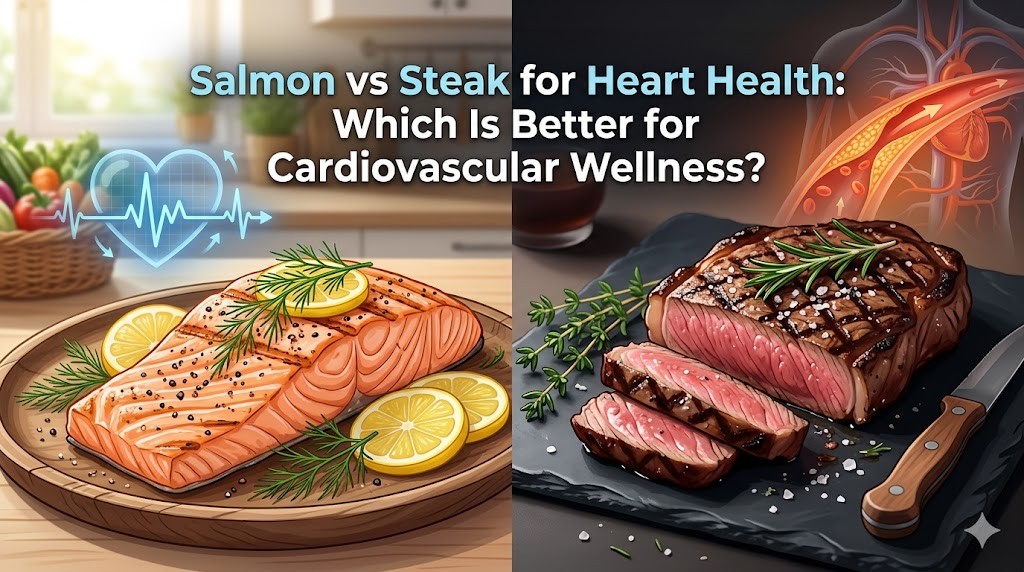
Picture this: It’s Friday night, you’re looking at the dinner menu, and you’re stuck in the ultimate culinary face-off. On one side, we have a juicy, perfectly seared steak, sizzling with rich, savory flavor. On the other, a gorgeous, flaky pink salmon fillet, grilled with a squeeze of fresh lemon. Both look delicious, but your heart is whispering (or maybe shouting) for the healthiest pick.
When it comes to the classic steak vs salmon health comparison, who actually takes the crown for cardiovascular wellness? Let’s dive into the friendly science of how these two protein heavyweights treat your ticker.
The Nutrient Showdown: What's on Your Plate?
Both options are fantastic sources of complete protein, meaning they give your muscles all the essential building blocks they need. However, their overall vibe is very different. Salmon is like the cool, light, nutrient-dense friend, while steak is the heavy-duty iron-and-zinc powerhouse.
Let’s look at the baseline numbers for a cooked 100-gram (about 3.5 ounces) portion of both :
Nutrient Component (per 100g cooked portion) | Cooked Atlantic Salmon | Cooked Beef Tenderloin | Cardiovascular/Physiological Implication |
Energy (Calories) | 206 kcal | 218 kcal | Regulates overall metabolic rate and energy balance |
Protein | 22.3 g | 27.58 g | Preserves lean tissue mass and promotes satiety |
Total Fat | 12.4 g | 11.12 g | Represents total circulating lipid exposure |
Saturated Fat | 2.41 g | 4.12 g | Modulates LDL receptor expression in hepatocytes |
Omega-3 Fatty Acids | 2.32 g | Minimal | Stabilizes cardiac membranes and reduces inflammation |
Vitamin D3 | 13.12 mcg | Minimal | Supports vascular endothelial function |
Selenium | 41.4 mcg | 25 mcg | Co-catalyzes antioxidant pathways |
Heme Iron | 0.34 mg | 2.99 mg | Prevents anemia; excess may promote oxidative stress |
Zinc | 0.43 mg | 4.94 mg | Modulates arterial immune and cellular repair |
If you are trying to beat an iron deficiency, steak is your best ally because it is loaded with super-absorbable heme iron. But if you want a natural dose of vitamin D and selenium (the cell-protecting antioxidant), salmon is the clear winner.
Bottom Line: Steak is great for zinc and absorbable iron, but salmon wins for vitamin D, selenium, and packing all that protein with a lighter caloric density.
Fatty Acid Face-Off: The Good, the Bad, and the Marble-y
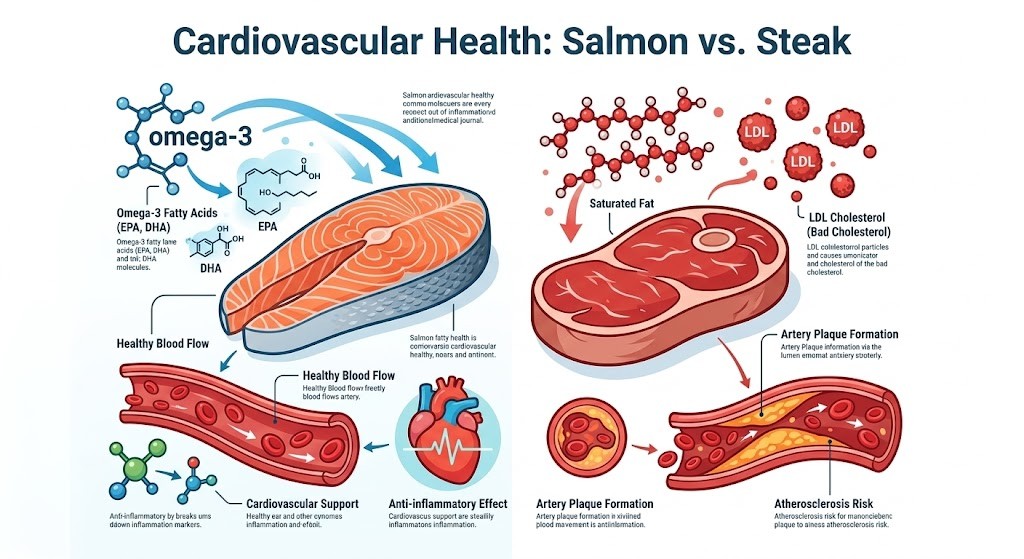
This is where our two contenders take completely different paths.
Steak is famous for its beautiful marbling. That delicious white fat is rich in saturated fatty acids (SFAs). When you eat a lot of saturated fat, your liver dials down its LDL receptor activity. This makes it harder for your body to clear out low-density lipoprotein (LDL) cholesterol—the "bad" stuff—which can lead to clogged arteries over time.
Salmon, on the other hand, is the proud "avocado of the sea". It is brimming with polyunsaturated fatty acids (PUFAs), specifically those heart-protecting marine omega-3s: EPA and DHA. These healthy fats actually help lower your triglycerides, reduce your blood pressure, keep blood platelets from clumping together, and stabilize your heart's electrical rhythm to prevent sudden issues.
Let’s see how they compare in a standard 3-ounce (85g) serving :
Lipid Parameter (per 85g / 3 oz serving) | Cooked Wild Atlantic Salmon | Cooked Skirt Steak (Grilled) | Cardiovascular Wellness Impact |
Total Fat | 6.9 g | 14.5 g | Modulates daily energy density |
Saturated Fat | 1.1 g | 5.2 g | Influences serum LDL and ApoB levels |
Monounsaturated Fat | 2.292 g | 5.643 g | Neutral to beneficial for lipid clearance |
Polyunsaturated Fat | 2.768 g | 0.853 g | Precursor to anti-inflammatory mediators |
Total Omega-3s | 1.877 g | 0.024 g | Direct reduction of cardiovascular risk factors |
Omega-6 to Omega-3 Ratio | 0.1:1 | 26.7:1 | Reflects systemic inflammatory potential |
The American Heart Association suggests limiting saturated fat to less than 6% of your daily calories. For a 2,000-calorie diet, that’s about 13 grams a day. One small grilled steak can easily take up nearly half of that daily budget in one go!
Bottom Line: The saturated fats in steak can raise your bad cholesterol, while the omega-3s in salmon actively work to lower triglycerides, reduce inflammation, and keep your heart beating steadily.
The Gut-Heart Connection: Say Hello to TMAO
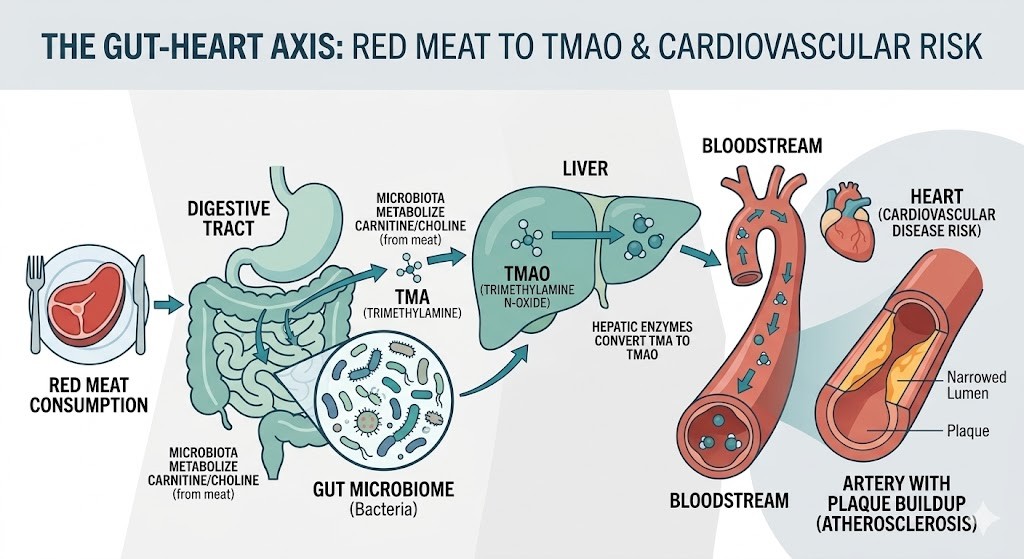
As if saturated fat wasn't enough, scientists have found another way red meat can impact your vascular system: the gut-heart axis.
When you digest red meat, your intestinal microbes feast on nutrients like L-carnitine and choline. They turn these into a gas called trimethylamine (TMA). Your liver then converts TMA into a compound called trimethylamine N-oxide, or TMAO.
Think of TMAO as the uninvited guest of your cardiovascular system. High levels of TMAO in your blood are strongly linked to arterial plaque buildup, damaged blood vessel linings, and an increased risk of heart attacks. In a study tracking nearly 4,000 older adults, eating red meat daily was associated with a 22% higher risk of heart disease—and researchers found that gut-derived metabolites like TMAO were directly responsible for a chunk of that added risk.
Bottom Line: Digesting red meat triggers your gut microbes to produce TMAO, a compound that can drive arterial plaque buildup and blood vessel inflammation.
What the Science Says: Real-World Heart Outcomes

Let's look at the long-term data on what actually happens when real people choose these proteins over several decades.
A massive pooled study of 29,682 US adults followed people for 30 years. They found that regularly eating unprocessed red meat is significantly tied to higher rates of cardiovascular disease and premature death. Fish, on the other hand, was completely neutral or protective.
Here is how the risk changes when adding just 2 servings of each per week :
Clinical Outcome Parameter | Unprocessed Red Meat (per +2 servings/week) | Fish (per +2 servings/week) | Clinical Significance Comparison |
Incident CVD Hazard Ratio (HR) | 1.03 (95% CI: 1.01-1.06) | 1.00 (95% CI: 0.98-1.02) | Red meat increases CVD risk; fish does not |
30-Year Absolute Risk Difference (ARD) | +0.62% (95% CI: 0.07%-1.16%) | +0.12% (95% CI: -0.40% to 0.65%) | Red meat adds notable absolute risk over time |
All-Cause Mortality HR | 1.03 (95% CI: 1.01-1.05) | 0.99 (95% CI: 0.97-1.01) | Red meat raises risk of early death; fish does not |
30-Year Absolute Mortality Risk | +0.76% (95% CI: 0.19%-1.33%) | -0.34% (95% CI: -0.88% to 0.20%) | Swapping meat for fish lowers absolute death rates |
Even better, swapping red meat for fish can significantly protect your brain. Substituting fatty fish for unprocessed red meat has been linked to a 12% lower risk of small-vessel occlusive strokes.
Bottom Line: Long-term studies show that swapping out red meat for fish is a proven way to lower your risk of cardiovascular events, stroke, and early death.
Sourcing Secrets: Grass-Fed vs. Wild-Caught
If you are going to eat steak or salmon, how they are raised matters :
Grass-Fed Beef: Cows allowed to graze on open pastures produce leaner meat with more antioxidants and a slightly higher omega-3 profile compared to corn-fed cows. But keep in mind: even the finest grass-fed steak has about 10 times fewer omega-3s than fatty fish.
Wild-Caught Salmon: Wild salmon eats a natural diet of marine prey, resulting in a perfectly balanced, low-contaminant, and highly anti-inflammatory fat profile. Farmed salmon is still excellent for your heart, but wild-caught is the gold standard for avoiding persistent pollutants.
Bottom Line: Opting for wild-caught salmon and grass-fed beef is the best way to get cleaner, more anti-inflammatory fats on your plate.
Track Your Heart-Healthy Fats Effortlessly with VoCal
Let’s be real: trying to calculate your exact saturated fat percentages or tracking your daily omega-3 targets can feel like a chore. Who wants to spend 15 minutes typing, weighing, and searching databases after every meal?
That’s where VoCal steps in to save your sanity.
VoCal is a smart, voice-based calorie and macro tracker app that lets you log your food just by speaking naturally. You tap the mic and say:
"Six ounces of grilled wild-caught salmon with a side of asparagus and olive oil."
In under 15 seconds, VoCal’s advanced AI parses your voice, estimates your portion sizes, and tracks your calories, proteins, and fats with 95% accuracy. It’s the ultimate zero-friction tool to keep your saturated fat under that crucial 6% heart-healthy threshold while ensuring you get enough marine omega-3s.
Bottom Line: Logging your meals with the voice-activated app VoCal makes tracking your daily fats and protein seamless, hands-free, and incredibly easy to stick to.
The Takeaway
When it comes to the ultimate steak vs salmon health comparison, salmon is the clear champion for your heart. It lowers triglycerides, fights blood vessel inflammation, and keeps your cholesterol in a happy place.
Does that mean you have to banish steak forever? Not at all! Just treat steak as an occasional indulgence, choose lean cuts like sirloin, and let salmon take center stage on your plate twice a week. Your heart will thank you!
Frequently Asked Questions
Can replacing meat with fish help me lose weight?
Absolutely. Salmon is naturally lower in calories and fat compared to most cuts of steak, making it a fantastic, high-satiety option for weight loss.
How often should I eat fish for heart health?
The American Heart Association recommends eating at least two 3.5-ounce servings of fatty fish (like salmon) per week to get those heart-protecting benefits.
Is grass-fed beef really better for my cholesterol?
While grass-fed beef has a slightly healthier fat profile than grain-fed beef, it is still high in saturated fat. To actively lower your bad cholesterol, swapping red meat for fish or plant-based proteins is a much more effective strategy.
Is salmon easier on my stomach than steak?
Yes. Salmon has a lighter protein structure and lower fat density, making it generally much easier to digest than a heavy steak.
How does the VoCal app work?
VoCal is a hands-free, voice-powered calorie and macro tracker. Instead of manual typing, you just speak your meals naturally, and the app uses advanced AI to instantly log your nutrients with 95% accuracy.
Disclaimer: This article is for informational purposes only and does not substitute for professional medical advice, diagnosis, or treatment. Always consult a healthcare professional or qualified dietitian before making significant changes to your diet, especially if you have pre-existing cardiovascular conditions.