

If you have ever stood in front of your fridge, hands on your hips, wondering whether to throw chicken or shrimp into your skillet, you are not alone. Both are massive hits in the health and fitness world, especially if you are trying to log your macros effortlessly using a voice-based calorie tracker like VoCal.
But while they both qualify as elite, ultra-lean proteins, they have surprisingly different superpowers. One is the classic heavyweight champion of the gym, while the other is a secret weapon for cutting calories without sacrificing protein.
In this article, we will break down the nutrition of shrimp vs chicken protein to help you choose the best option for your goals.
Chicken Breast: The Muscle Mascot
Ah, the skinless, boneless chicken breast. It is practically the official mascot of muscle growth. And honestly, it has earned its reputation.
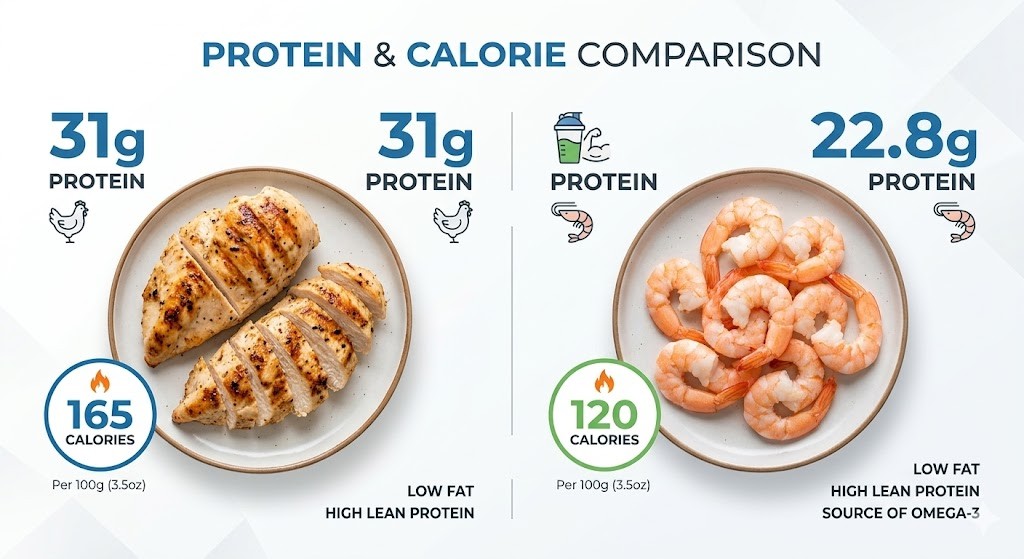
According to the USDA, a standard 100-gram serving of cooked lean chicken breast packs a whopping 31 grams of protein and only 165 calories. It is an exceptionally rich source of amino acids—which are the building blocks your body needs to rebuild and grow muscle tissue.
To maximize muscle growth, active individuals typically aim for a daily protein target using this clinical formula :
Protein Target = 1.6 to 2.2 g * Body Weight (kg)
Chicken breast is a highly bioavailable complete protein , containing a heavy dose of the branch-chain amino acid leucine , which acts as the metabolic trigger to activate muscle protein synthesis.
Bottom Line
Chicken breast is your go-to for maximum protein bang-for-your-buck. It is highly bioavailable, complete, and the ultimate ally for muscle-building goals.
Shrimp: The Clean Macro Shortcut
Now, let's look at cooked shrimp. If chicken breast is the heavyweight champion, shrimp is the nimble, lightweight ninja.
At just 120 calories and 22.8 grams of protein per 100 grams, shrimp is almost pure protein. In fact, more than 80% of its total calories come directly from protein, with practically zero fat and carbs to slow you down.
If you are on a strict caloric budget, shrimp allows you to stack up your protein intake while leaving plenty of room in your daily calorie goal for other delicious foods. Plus, shrimp is incredibly rich in leucine and arginine, giving you high-quality muscle fuel in a tiny calorie package.
Bottom Line
If you are on a tight calorie budget or pursuing aggressive weight loss, shrimp is incredibly hard to beat. It offers a massive protein hit with almost zero fat or carbohydrates.
Macronutrient Comparison
When you are tracking your food by voice on Vo-cal.com, preparation methods and exact portions matter.
The tables below use verified USDA database metrics to show how these lean proteins stack up across different portions.
Table 1: Macronutrient Profile per 100g (Cooked, Plain)
Nutrient | Cooked Lean Chicken Breast (100g) | Cooked Shrimp (100g) | Chicken Thigh (100g) | Ground Beef (97% Lean, 100g) |
Calories | 165 kcal | 120 kcal | 209 kcal | 153 kcal |
Protein | 31.0 g | 22.8 g | 26.0 g | 26.4 g |
Total Fat | 3.6 g | 1.7 g | 10.9 g | 4.5 g |
Saturated Fat | 1.0 g | 0.4 g | 2.9 g | 2.2 g |
Carbohydrates | 0.0 g | 1.5 g | 0.0 g | 0.0 g |
Table 2: Nutritional Profile per 3 oz (85g) Serving
Nutrient | Cooked Lean Chicken Breast (85g) | Cooked Shrimp (85g) |
Calories | 133 kcal | 101 kcal |
Protein | 27.2 g | 19.4 g |
Total Fat | 2.8 g | 1.4 g |
Saturated Fat | 0.8 g | 0.44 g |
Carbohydrates | 0.0 g | 1.3 g |
Cholesterol | 98.6 mg | 179.4 mg |
Sodium | 40.0 mg | 804.9 mg |
The Cholesterol vs. Saturated Fat Debate
Wait a minute, doesn't shrimp have a ton of cholesterol?
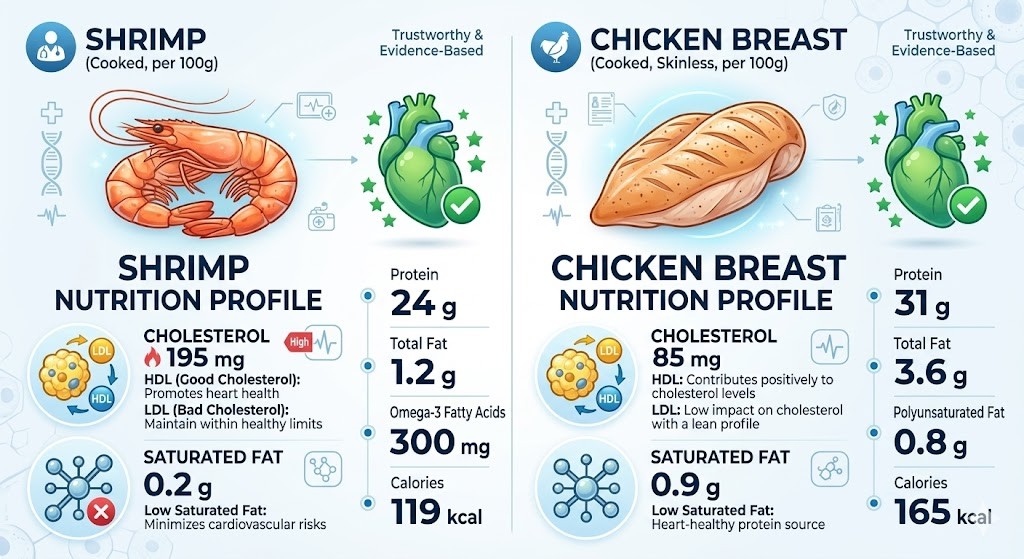
Yes, a 3-ounce serving of cooked shrimp has about 179.4 mg of cholesterol, while chicken breast has only 98.6 mg. Because of this, shrimp was once unfairly blacklisted by health agencies.
However, modern research from the NIH and American Heart Association shows that dietary cholesterol does not drive up blood cholesterol levels in most people. Instead, the real culprit is saturated fat.
A landmark study by Rockefeller University and Harvard compared a shrimp-rich diet with an egg diet. The researchers found that while steamed shrimp raised "bad" LDL cholesterol by 7.1%, it boosted "good" HDL cholesterol by a massive 12.1%. It also reduced blood triglycerides by 13%.
Because shrimp is incredibly low in saturated fat, it is officially classified as a heart-healthy food.
Bottom Line
Saturated fats are the primary driver of elevated blood cholesterol. Since shrimp contains virtually no saturated fat, its high dietary cholesterol is not a heart health concern for most individuals.
Micronutrients and Astaxanthin Power

Looking strictly at macros ignores the rich vitamin and mineral profiles of these two foods.
Chicken Breast is a powerhouse of metabolic B-vitamins. A 170-gram cooked portion satisfies 100% of the Daily Value (DV) for niacin (B3) and 92% of the DV for Vitamin B6, both of which are essential for cellular energy and cognitive health.
Shrimp is incredibly mineral-dense. A 3-ounce serving provides 76% of your DV for selenium (essential for thyroid and immune health) and 59% of your DV for Vitamin B12, along with dietary iodine and calcium.
Even cooler? Shrimp contains astaxanthin, a vibrant red antioxidant synthesized by marine algae. Astaxanthin has a unique chemical structure that allows it to cross the blood-brain barrier. Research suggests astaxanthin offers several impressive health benefits:
Brain Power: It reduces oxidative stress and helps protect against neurodegeneration.
Glowing Skin: It prevents lipid damage, maintains skin moisture, and helps minimize UV-induced age spots.
Eye Protection: It boosts blood flow to the retina, helping to relieve computer eye strain and protect against macular degeneration.
Bottom Line
Chicken breast provides vital B-vitamins for your daily metabolism, while shrimp acts as a mineral vault supplying anti-aging, brain-boosting antioxidants like astaxanthin.
Which One is Best for You?
So, how do you decide which one should land on your dinner plate tonight?
Choose Chicken Breast If:
You are on a budget: Chicken is highly cost-effective and easy to buy in bulk.
You want to build serious muscle: It offers a higher absolute concentration of protein and leucine to maximize muscle recovery.
You are watching your sodium: Fresh, raw chicken breast is naturally low in sodium. (Just watch out for frozen shrimp, which is often processed with sodium tripolyphosphate (STPP) to hold moisture, bumping sodium to over 800 mg per serving!)
Choose Shrimp If:
You are trying to drop body fat: Shrimp's low calorie-to-protein ratio makes it an incredibly powerful food for weight loss.
You want to support heart, brain, and skin health: The trace minerals and astaxanthin offer unique antioxidant benefits you can't get from poultry.
You want quick, versatile meals: Shrimp cooks in under 5 minutes and is perfect for light salads, wraps, and stir-fries.
The Summary
When evaluating shrimp vs chicken protein, there is no single winner. Both are elite, high-quality lean proteins.
Chicken breast excels in absolute protein density and muscle-building efficiency , while shrimp shines for calorie-restricted fat loss and unique antioxidant support. To build a balanced, nutrient-dense lifestyle, try rotating both into your weekly routine.
And remember—whichever you choose, keep your voice logs active on VoCal to track your nutrition with total accuracy!
Frequently Asked Questions
Is shrimp higher in protein than chicken breast?
No. Cooked chicken breast contains approximately 31 grams of protein per 100 grams , while cooked shrimp contains about 22.8 grams of protein per 100 grams.
Is shrimp safe for a low-cholesterol diet?
Yes. Despite being high in dietary cholesterol, shrimp is exceptionally low in saturated fat. Clinical trials show that steaming or boiling shrimp actually improves your overall HDL-to-LDL cholesterol ratio and lowers triglycerides.
Why is the sodium content in frozen shrimp so high?
Frozen shrimp is frequently treated with sodium tripolyphosphate (STPP) to retain moisture, which can increase the sodium content to over 800 mg per 3-ounce serving.
Disclaimer: This article is for informational and educational purposes only and does not constitute medical or personalized dietary advice. Always consult a qualified healthcare professional or registered dietitian before making significant changes to your diet, especially if you have pre-existing health conditions or food allergies.