
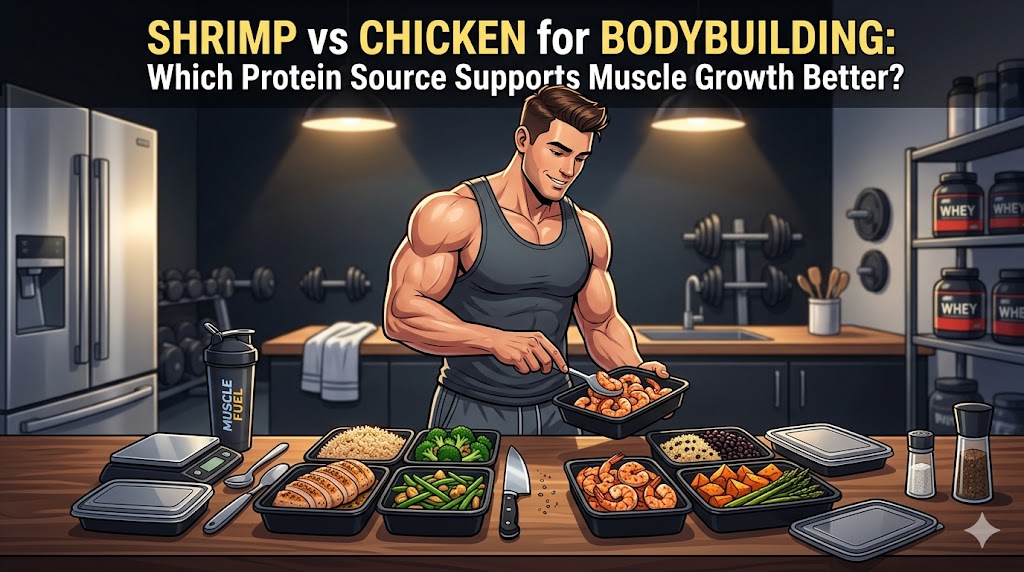
Walk into any commercial gym, and you can practically smell the meal prep. The classic "chicken and rice" combo has been the official fuel of gym-goers and fitness enthusiasts for decades.
But let’s be honest—eating dry, rubbery chicken breast multiple times a day can make you want to throw your tupperware out the window.
Enter shrimp: the light, tasty seafood alternative that is low-key a macro cheat code.
So, is chicken breast still the undisputed king of muscle growth, or is it time to swap your poultry for some shellfish? Let’s break down the ultimate protein showdown to see which one supports your gains better.
The Tale of the Tape: Cooked Chicken vs. Cooked Shrimp
When it comes to nutrition, both chicken and shrimp are complete animal proteins. This means they provide all the essential amino acids your body can't make on its own.
But how do they stack up head-to-head?
Here is the side-by-side macronutrient breakdown per 100-gram (about 3.5-ounce) cooked portion, according to the USDA database :
Nutrient (per 100 g cooked portion) | Cooked Skinless Chicken Breast | Cooked Shrimp |
Energy (Calories) | 187 kcal | 119 kcal |
Protein | 33.0 g | 22.78 g |
Total Fat | 4.7 g | 1.7 g |
Saturated Fat | 1.3 g | 0.52 g |
Monounsaturated Fat | 1.7 g | 0.36 g |
Polyunsaturated Fat | 1.1 g | 0.59 g |
Carbohydrates | 0.51 g | 1.52 g |
Water Content | 53.0 g | 71.56 g |
Chicken breast packs a denser protein punch gram-for-gram. If you want pure protein volume per bite, chicken is hard to beat.
However, shrimp has a hidden superpower: it is almost entirely fat-free. Because it has virtually no fat, it offers a jaw-dropping protein-to-calorie ratio.
Shrimp yields about 19 grams of protein for every 100 calories you eat. Chicken breast gives you about 18 grams of protein per 100 calories. This makes shrimp incredibly efficient for cutting calories while keeping your protein high.
Bottom Line: Chicken breast gives you more total protein per ounce, but shrimp is incredibly lean and wins on protein density per calorie.
Muscle Building Magic: The Leucine Trigger
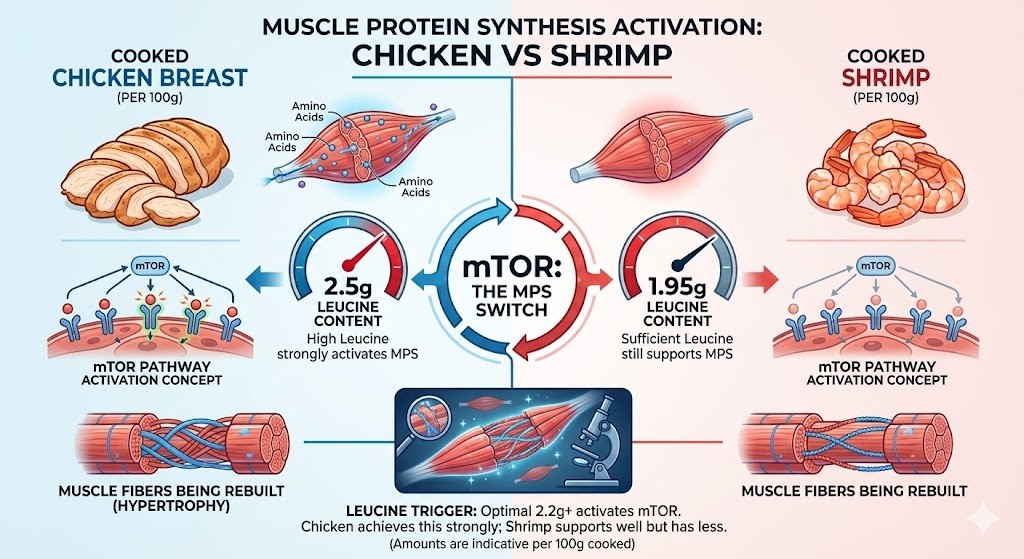
To build muscle, your body needs a molecular light switch to turn on muscle protein synthesis (MPS). In sports science, this switch is called the mTORC1 pathway, and it is turned on by an essential branched-chain amino acid (BCAA) called leucine.
Think of leucine as the project manager for your muscles. Without enough of it, the construction crew won't start building new tissue.
The International Society of Sports Nutrition (ISSN) indicates that you need about 2.0 to 3.0 grams of leucine per meal to activate this "leucine trigger" and maximize muscle growth.
Let's look at how these two stack up when it comes to the amino acids that build muscle :
Amino Acid (per 100 g cooked portion) | Cooked Skinless Chicken Breast | Cooked Shrimp |
Leucine | 2.50 g | 1.95 g |
Isoleucine | 1.80 g | 1.05 g |
Valine | 1.70 g | 1.06 g |
Lysine | 2.80 g | 2.17 g |
Methionine | 0.93 g | 0.67 g |
Threonine | 1.40 g | 0.90 g |
Tryptophan | 0.39 g | 0.26 g |
As you can see, a standard 100-gram serving of cooked chicken breast naturally hits that sweet spot with 2.5 grams of leucine.
To get that same 2.5-gram leucine trigger from shrimp, you'll need to eat about 128 grams of cooked shrimp.
Both options score incredibly well on the Digestible Indispensable Amino Acid Score (DIAAS). This means your body easily digests and absorbs every gram of protein they offer.
Bottom Line: Chicken breast is slightly richer in branch-chain amino acids, meaning you can trigger muscle protein synthesis with a slightly smaller food volume.
Micronutrients: The Spark Plugs of Recovery
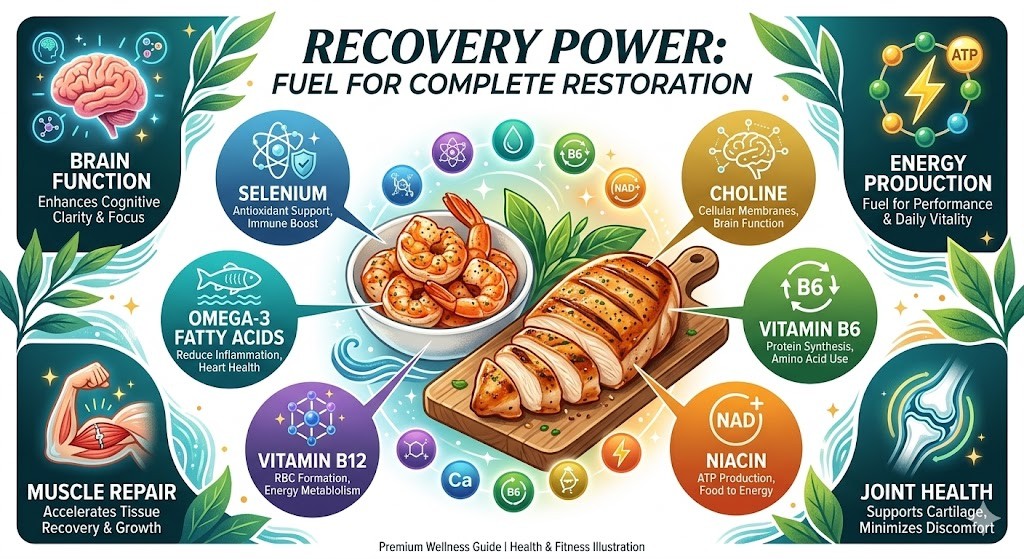
Muscle growth isn't just about protein and carbs. Your body needs vitamins and minerals to act as "spark plugs" that convert your food into cellular energy and keep your hormone levels happy.
Chicken breast is packed with B-vitamins—especially Vitamin B3 (niacin) and Vitamin B6. These vitamins are crucial for cellular energy production and protein metabolism. It is also richer in zinc and iron, which support healthy testosterone levels.
In contrast, shrimp is a marine treasure chest of unique minerals. It is loaded with Vitamin B12, selenium (a powerhouse antioxidant that fights exercise-induced muscle damage), and choline (which supports brain-to-muscle coordination).
Most importantly, shrimp naturally contains omega-3 fatty acids. These healthy fats are amazing for reducing joint inflammation after heavy lifts.
Here is how their micronutrient stats compare side-by-side :
Micronutrient (per 100 g cooked portion) | Cooked Skinless Chicken Breast | Cooked Shrimp |
Vitamin B12 | 0.37 mcg | 1.70 mcg |
Vitamin B3 (Niacin) | 15.0 mg | 2.70 mg |
Choline | 96.0 mg | 135.0 mg |
Calcium | 16.0 mg | 91.0 mg |
Phosphorus | 246.0 mg | 306.0 mg |
Potassium | 276.0 mg | 170.0 mg |
Selenium | 26.0 mcg | 50.0 mcg |
Sodium | 79.0 mg | 947.0 mg |
There is one catch with shrimp: it's naturally high in sodium. While sodium is an essential electrolyte that helps you get a great muscle "pump" in the gym, eating too much shrimp right before a bodybuilding competition can cause temporary water retention under the skin.
Bottom Line: Chicken excels in energy-boosting B-vitamins, while shrimp takes the crown for anti-inflammatory omega-3s, brain-boosting choline, and antioxidant selenium.
The Cholesterol Myth: Is Shrimp Bad for Your Heart?
For years, shrimp got a bad rap in the fitness community because of its high cholesterol content—211 milligrams per 100 grams.
But science has officially debunked this myth.
Modern research shows that eating dietary cholesterol does not automatically raise the cholesterol levels in your blood. Your liver actually has a built-in safety valve: when you eat more cholesterol, your liver slows down its own production to keep things balanced.
In a famous clinical study, participants ate 300 grams of shrimp daily. While their "bad" LDL cholesterol went up slightly by 7.1%, their "good" cardioprotective HDL cholesterol jumped by a whopping 12.1%.
As a result, their overall cholesterol ratio stayed perfectly healthy, and their triglycerides actually dropped by 13%!
Bottom Line: The cholesterol in shrimp is nothing to fear. Because it is extremely low in saturated fat, shrimp is fully heart-healthy.
Bulking vs. Cutting: When to Eat Which?
The choice between chicken and shrimp often comes down to your budget and your current training phase.
The Budget Factor
Let’s address the elephant in the room: price. Chicken breast is incredibly budget-friendly and easy to buy in bulk. Shrimp, on the other hand, is a bit more of a luxury. If you're looking for the most cost-effective way to hit 150+ grams of protein a day, chicken is your MVP.
The Hypercaloric Phase (Bulking)
When you are trying to build mass and eating in a calorie surplus, you need plenty of calories and protein without feeling too full to finish your meals. Chicken breast is perfect here. It's affordable, easy to batch-cook, and packs a high caloric density so you don't feel uncomfortably bloated.
The Hypocaloric Phase (Cutting)
When you are shredding body fat, every single calorie counts. You want to maximize your protein intake while keeping calories as low as possible.
This is where shrimp shines. Because it has almost zero fat, you can eat a massive volume of shrimp for very few calories, keeping your stomach full and your muscles protected from breakdown.
Pro-Tip for Precision Tracking
Tired of typing endless numbers into your phone while meal prepping? To keep those drastic calorie and sodium differences in check, try a voice-based tracker like VoCal. You can literally just speak to log your meal—say "one hundred and fifty grams of grilled shrimp" or "six ounces of baked chicken breast"—and let technology handle your macros instantly.
Bottom Line: Chicken is the go-to champion for budget-friendly bulking, while shrimp is a premier fat-loss tool when you're cutting calories.
Sourcing, Food Safety, and Cooking Tips
If you're ready to add more shrimp to your diet, keep these safety and culinary tips in mind:
Check the Mercury: Don't worry about heavy metals. The FDA and EPA classify shrimp as a "Best Choice" seafood with exceptionally low mercury levels, making it safe to eat multiple times a week.
Smell and Sight Test: Fresh shrimp should smell mild and sweet—never fishy, sour, or like ammonia. The flesh should be translucent and pearly.
Skip the Fryer: To keep your macros clean, stick to grilling or boiling your shrimp. A study published in PMC showed that grilling and boiling perfectly preserved the shrimp's beneficial omega-3s, while deep-frying in oil degraded the fats and added unwanted calories.
Bottom Line: Buy high-quality fresh or frozen shrimp, and stick to grilling or boiling to keep them lean and nutrient-rich.
Frequently Asked Questions
Does chicken have more protein than shrimp?
Yes, gram-for-gram, chicken breast has more protein. Cooked skinless chicken breast contains about 33 grams of protein per 100 grams, while cooked shrimp contains about 22.8 grams.
Is it safe to eat shrimp every day?
For most healthy people, yes. Since shrimp is incredibly low in mercury, daily consumption is safe. Just keep an eye on your sodium intake, as shrimp naturally contains more sodium than chicken.
Can you substitute chicken with shrimp in recipes?
Absolutely! They are highly interchangeable in stir-fries, bowls, and salads. Just remember that shrimp cooks much faster than chicken (usually in under 5 minutes), so adjust your cooking times to avoid a rubbery texture.
Does shrimp raise your cholesterol?
Shrimp does not negatively impact your cholesterol profile. Research shows it actually increases "good" HDL cholesterol and lowers triglycerides, making it a heart-healthy addition to your diet.
Disclaimer: The information provided in this article is for educational and informational purposes only and should not be construed as medical advice. Always consult a healthcare professional or a registered dietitian before making significant changes to your diet or starting a new fitness program.