
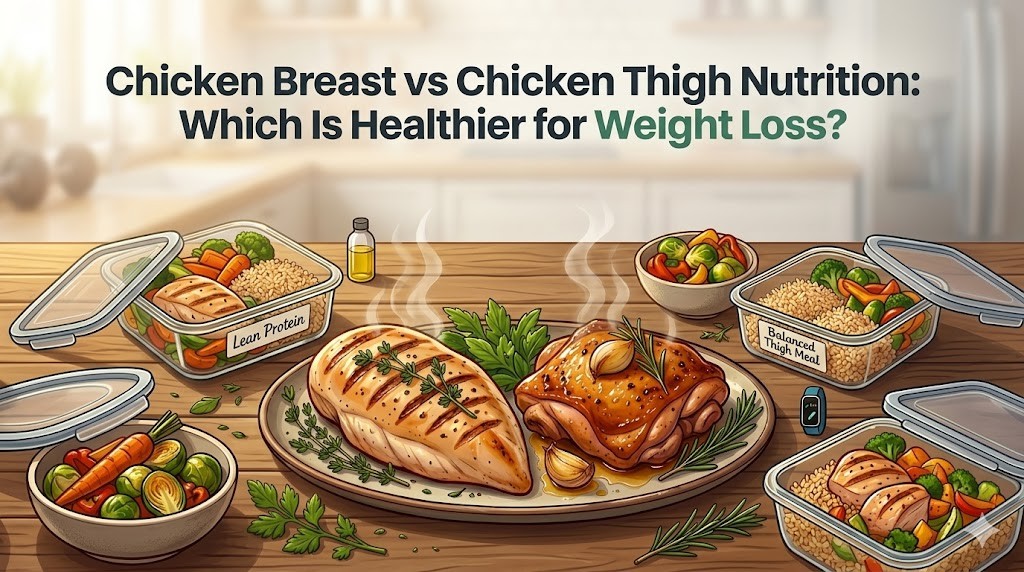
Whether you’re prepping containers like a seasoned fitness influencer or just trying to navigate your weight loss journey without eating cardboard, chicken is likely your go-to protein. It is affordable, highly versatile, and packed with the muscle-building blocks your body craves.
But when you stand in the grocery aisle, a classic poultry battle lines up: chicken breast versus chicken thigh.
Chicken breast is the darling of the dieting world—super lean, disciplined, and efficient. Chicken thigh, on the other hand, is the flavorful friend who brings a little more fat to the party but keeps you incredibly satisfied.
To help you decide which belongs on your plate to maximize fat loss, we are breaking down the science of white versus dark meat, thermic calorie burns, micronutrients, and how to track them effortlessly.
White Meat vs. Dark Meat: Why They Aren’t Twins
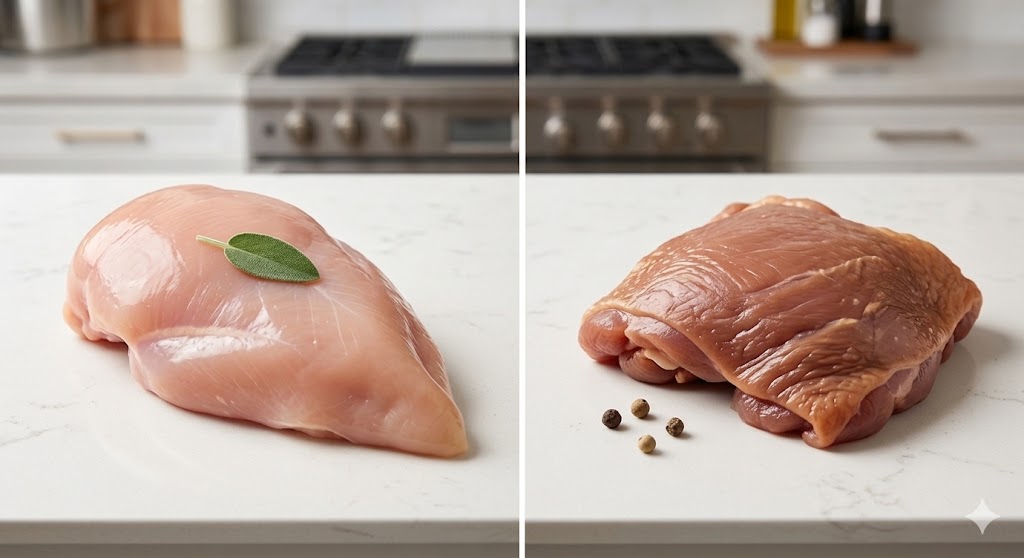
The physical differences between chicken breast and chicken thigh come down to avian biology. Chickens are ground-dwelling birds. They spend their days walking, standing, and foraging, which heavily works their leg muscles.
This continuous, low-intensity exercise develops slow-twitch muscle fibers in the thighs. These fibers are packed with myoglobin—an iron-rich, oxygen-carrying protein that gives dark meat its reddish pigmentation and juicy flavor.
Conversely, chickens rarely fly. Their breast muscles are composed of fast-twitch muscle fibers designed for short bursts of energy rather than long-distance travel. Because they don't require heavy oxygen transport, these muscles have very little myoglobin, resulting in white meat that is extremely dense in protein but contains almost no intramuscular fat.
Bottom Line: Avian biology dictates that thighs develop slow-twitch, myoglobin-rich "dark meat" for walking, while breasts develop fast-twitch, ultra-lean "white meat".
Chicken Breast Nutrition: The Lean King
If your goal is to get the absolute most protein for the absolute fewest calories, boneless, skinless chicken breast is the undisputed champion.
A standard 3.5-ounce (100-gram) serving of raw chicken breast delivers only 106 calories and a tiny 1.93 grams of fat, while packing in 22.5 grams of pure, high-quality protein. Once cooked, those numbers scale up because water is lost during cooking. A 3.5-ounce serving of cooked chicken breast yields about 165 calories, 31 grams of protein, and 3.6 grams of fat.
This incredible macronutrient profile means roughly 80% of the calories in a skinless chicken breast come directly from protein, making it one of the most calorie-sparse foods on the planet.
Bottom Line: Chicken breast is highly efficient, giving you massive amounts of protein with minimal fat and calories to help you maintain a tight daily calorie budget.
Chicken Thigh Nutrition: The Flavor Champion
There is a reason why professional chefs almost always reach for chicken thighs: the fat. That extra lipid content makes thigh meat forgiving to cook, incredibly juicy, and naturally rich.
A 3.5-ounce (100-gram) serving of raw, skinless chicken thigh contains 144 calories, 18.6 grams of protein, and 7.92 grams of total fat. When cooked, a 3.5-ounce serving of boneless, skinless thigh supplies around 179 to 208 calories, 26 to 28.8 grams of protein, and up to 9.5 grams of fat.
While it has nearly four times the fat of a chicken breast, relative to red meat like pork or beef, thighs are still considered a moderately lean protein source. Plus, that fat helps keep the meat from drying out, making it much more palatable for long-term eating.
Bottom Line: Chicken thighs contain more fat and calories than breasts, but they reward you with a tender texture and rich flavor that can make dieting feel less like a chore.
Macronutrient Breakdown: Side-by-Side
To see how the numbers stack up, let's look at the USDA raw nutrition data side-by-side :
Nutrient (per 100g raw serving) | Chicken Breast | Chicken Thigh |
Calories | 106 kcal | 144 kcal |
Protein | 22.5 g | 18.6 g |
Total Fat | 1.93 g | 7.92 g |
Saturated Fat | 0.56 g | 2.00 g |
Carbohydrates | 0.00 g | 0.00 g |
Cholesterol | 73 mg | 94 mg |
And here is how they compare once cooked (boneless, skinless, plain):
Nutrient (per 100g cooked serving) | Chicken Breast | Chicken Thigh |
Calories | 165 kcal | 179 kcal |
Protein | 31.0 g | 26.0 g |
Total Fat | 3.6 g | 8.8 g |
Carbohydrates | 0.0 g | 0.0 g |
Bottom Line: Chicken breast saves you roughly 38 calories per 100 grams raw and gives you an extra 3.9 grams of protein, whereas thighs have nearly triple the raw fat content.
The Thermic Effect: How Protein Secretly Burns Calories
Did you know that you burn calories simply by chewing and digesting your food? This is known as the Thermic Effect of Food (TEF).
Our bodies don't process all nutrients equally. When you eat, your metabolism gets a temporary boost to break down what you consumed. The percentage of calories burned during digestion varies wildly by macronutrient :
Protein: 20% to 30% of its calories are burned during digestion.
Carbohydrates: 5% to 10% of their calories are burned.
Fats: Only 0% to 3% of their calories are burned.
Because chicken breast has a much higher protein-to-fat ratio, it triggers a higher absolute thermic response. The liver must work hard to strip off amino groups (deamination) and convert them into urea, a process that expends significant cellular energy (ATP).
This metabolic math can be modeled in a basic energy expenditure equation:
Daily Energy Balance = Calories In - (Basal Metabolic Rate + Physical Activity + Thermic Effect of Food)
By choosing a protein source with a higher TEF, like chicken breast, you naturally increase the energy output side of the equation.
Bottom Line: The high protein content of chicken breast leverages the thermic effect of food, meaning your body burns up to 30% of its protein calories just to digest it.
Keeping the Hanger at Bay: Satiety and Staying Full
While chicken breast wins on raw calorie efficiency, the battle for hunger control (satiety) is a bit more nuanced.
Clinical research on the Satiety Index shows that foods high in protein, water, and fiber keep us full the longest, while fatty foods can sometimes lead to passive overconsumption because they are so calorie-dense. Under the "protein leverage hypothesis," your body will keep driving your appetite until you hit your daily protein target. Because breast is packed with protein, it triggers immediate satiety quickly.
However, dietary fats play a vital role in long-term satisfaction. Fat slows down gastric emptying—meaning the food stays in your stomach longer. While a meal of dry chicken breast might leave you searching the pantry for a snack two hours later, the moderate fat in chicken thighs provides sustained, slow-release satiety that can prevent late-night cravings.
In fact, clinical trials prove that as long as your total daily calories and protein are controlled, the specific lean protein source doesn't stop weight loss. A 12-week study on overweight women found that participants lost similar amounts of body weight and fat regardless of whether their primary protein was beef or chicken. Another study in Spain showed that swapping lean poultry for lean lamb three times a week produced identical healthy lipid outcomes.
Bottom Line: Chicken breast satisfies hunger quickly due to its high volume and protein density, but the fat in chicken thighs slows digestion to keep you satisfied for hours.
Micronutrients: The Thigh’s Secret Weapon
Don't write off dark meat just yet! Because thigh muscles are so active, they are vastly more nutrient-dense than breasts :
Iron: Thighs deliver 0.81 mg of iron per 100 grams—more than double the 0.37 mg found in breasts. Iron is essential for keeping your energy levels high and transporting oxygen.
Zinc: Thighs contain more than double the zinc (1.58 mg vs. 0.68 mg), supporting immune defense and hormone health.
Vitamin B12: Thighs pack nearly three times the B12 (0.61 mcg vs. 0.21 mcg), which is vital for nerve function and red blood cell production.
Meanwhile, chicken breast holds its own with higher levels of Vitamin B3 (Niacin) and Vitamin B6 to help convert food into usable energy, along with potassium for fluid balance.
Bottom Line: Thigh meat is a micronutrient powerhouse, serving up double the iron and zinc, and triple the vitamin B12 of white meat.
The Verdict: Which One Wins for Weight Loss?
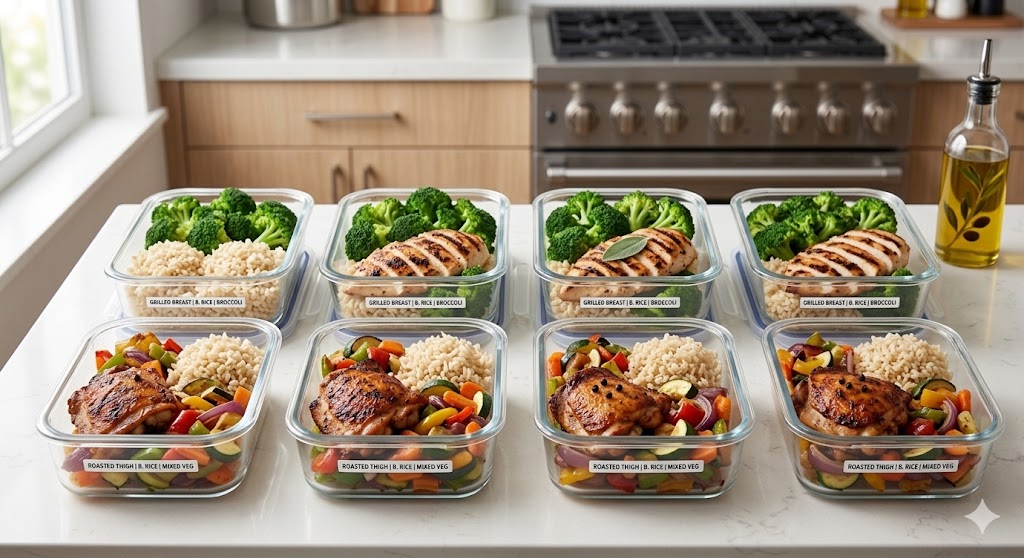
In the battle of chicken breast vs. chicken thigh, there is no single "correct" answer—it depends entirely on your lifestyle and goals :
Choose Chicken Breast if: You are on a strict, low-calorie budget, want to maximize protein density, or are preparing for a bodybuilding phase.
Choose Chicken Thigh if: You want long-term diet sustainability, suffer from diet fatigue, need stable, slow-release satiety, or love rich flavors.
For the absolute best results, clinical dietitians suggest a mix of both. Eat chicken breast for lighter meals and workouts, and swap in chicken thighs for satisfying dinners.
Whatever you choose, leverage low-friction tools like VoCal to log your meals effortlessly and keep your weight loss goals on track!
VoCal: Track Your Chicken in 15 Seconds Flat
No matter which cut you choose, weight loss ultimately comes down to keeping an accurate record of your calories. But let's be honest: traditional calorie tracking is a tedious chore. Spending 15 minutes a day typing ingredients, weighing food, and navigating clunky databases is the number-one reason people give up on their diets.
This is where the voice-activated tracker VoCal completely changes the game.
VoCal utilizes cutting-edge AI to eliminate manual entry. You simply tap the microphone and speak naturally: "I just ate two roasted chicken thighs and a cup of brown rice."
The app understands your portions, cooking methods, and complex recipes with 95% accuracy, updating your daily macros and calories in under 15 seconds. Clinical research on voice assistant systems and interactive voice platforms shows that low-friction reporting significantly improves consistency, helping users lose up to 3% of their body weight in just three months.
Bottom Line: Diet consistency requires zero tracking friction. Switching to a voice-based app like VoCal saves you time and keeps you on target.
Frequently Asked Questions
Which cut is better for a Keto or Low-Carb diet?
Chicken thighs are much better suited for low-carb and ketogenic diets. Their natural fat content helps you hit your daily fat targets and keeps your body in ketosis without requiring you to pour extra oil over your meals.
Does eating chicken thighs raise bad cholesterol?
Eating skinless chicken thighs in moderation is perfectly healthy. However, keeping the skin on significantly increases the saturated fat, which can raise cholesterol levels in sensitive individuals.
Is chicken breast better for building muscle?
Both cuts provide complete high-quality proteins with all the essential amino acids. However, because chicken breast is more protein-dense, it allows you to hit your daily protein requirements with fewer overall calories, making muscle preservation during a fat-loss phase easier.
Disclaimer: The contents of this article, including all text, graphics, nutrition metrics, and analysis, are for informational and educational purposes only. This content is not a substitute for professional medical advice, diagnosis, or treatment. Always seek the advice of your physician, registered dietitian, or other qualified health provider with any questions you may have regarding a dietary regimen, metabolic health, or medical condition.