
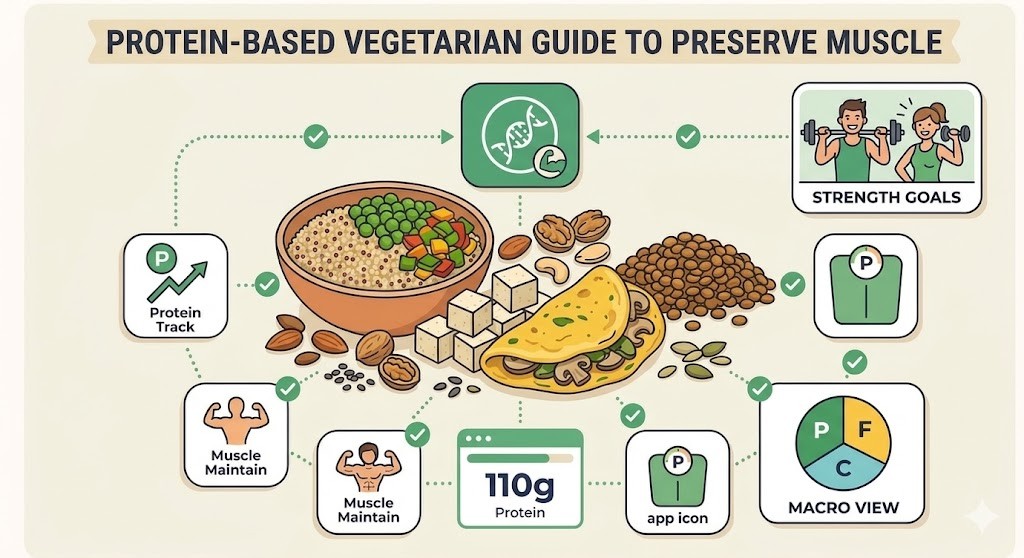
Losing weight is often seen as a numbers game: cut the calories, move more, and watch the scale drop. But there is a sneaky "uninvited guest" that often hitches a ride during weight loss—muscle loss.
When you're in a calorie deficit, your body looks for energy wherever it can find it. If you aren't careful, it might start "eating" your hard-earned muscle instead of just burning fat. This is a bummer because muscle is your metabolic engine; the more you have, the more calories you burn even while binging your favorite show.
The secret weapon to keeping your muscle while shedding the fluff? Protein. Here is your light, fun, and science-backed guide to using protein to preserve muscle during weight loss using only vegetarian sources.
Why Protein is Your Best Friend (and Fat’s Enemy)
Think of protein as the "security guard" for your muscles. While you’re cutting back on food, protein steps in to tell your body: "Hey, leave the muscle alone! Burn that stored fat instead".
Protein works its magic in three main ways:
Satiety: It keeps you feeling full longer, so you aren’t diving into the pantry at 10 PM.
Thermic Effect: Your body actually burns more calories just trying to digest protein compared to carbs or fats.
Repair: It provides the amino acids needed to fix the tiny tears in your muscle fibers after a workout.
The Bottom Line Eating enough protein during weight loss ensures that the weight you lose comes from body fat, not your metabolically active muscle tissue.
How Much Protein Do You Actually Need?
The "standard" recommendation (RDA) is about 0.8 grams per kilogram of body weight. But here’s the catch: that’s the minimum to keep you from getting sick, not the optimum for someone trying to get lean and stay strong.
To protect your muscle while the scale goes down, you need to aim higher. Science suggests aiming for 1.2 to 1.6 grams of protein per kilogram of body weight.
Activity Level / Goal | Daily Protein Target (g/kg of Body Weight) |
Sedentary (Just maintaining) | 0.8 – 0.83 |
Active Weight Loss (The "Sweet Spot") | 1.0 – 1.2 |
Muscle Preservation (High Deficit) | 1.2 – 1.6 |
Athletes / Strength Trainers | 1.6 – 2.2 |
Older Adults (65+) | 1.2 – 1.6 |
The Vegetarian Protein Powerhouses
You don't need chicken breast to hit your goals. The vegetarian world is full of "Muscle MVPs." The king of the hill? Soy. It’s a "complete" protein, meaning it has all the essential amino acids your body can't make on its own.
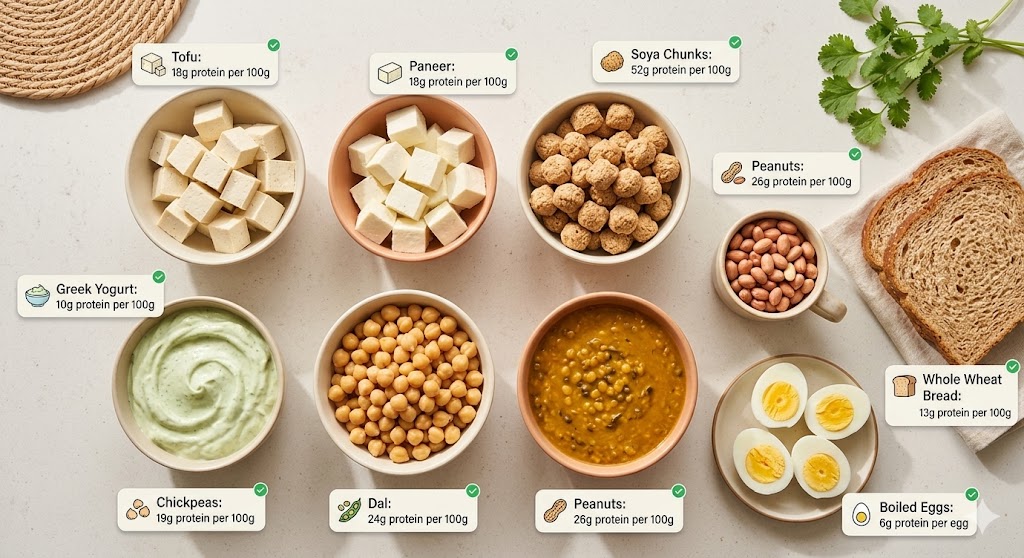
Check out how these vegetarian staples stack up:
Vegetarian Food Source | Serving Size | Protein (g) | Calories (approx.) |
Soya Chunks (The "Veggie Meat") | 50 g (dry) | 26 | 170 |
Greek Yogurt (Thick & Creamy) | 170 g | 17 | 100 |
Paneer (Indian Classic) | 100 g | 18 | 265 |
Seitan (The "Wheat Meat") | 100 g | 21 | 120 |
Tofu (Extra Firm) | 100 g | 13 | 120 |
Lentils (Cooked Dal) | 1 cup | 18 | 230 |
Eggs (The Perfect Protein) | 2 Large | 12 | 140 |
Chickpeas (Cooked) | 1 cup | 15 | 270 |
Note: For a leaner option, choose low-fat paneer or tofu to keep calories in check while keeping protein high.
The Secret "Complementary" Strategy
Many plant proteins are "incomplete," meaning they are missing one or two essential amino acids. But don't panic! You don’t need every amino acid in every single bite. By pairing different foods, you create a "complete" protein.
A classic rule of thumb is the 3:1 Cereal-to-Pulse ratio. Think:
Dal + Rice: The amino acids missing in lentils are found in rice, and vice versa.
Hummus + Pita: Chickpeas meet wheat for a perfect match.
Peanut Butter + Whole Wheat Toast: A delicious way to build muscle.
Use It or Lose It: The Role of Exercise
Eating protein is half the battle; the other half is giving your muscles a reason to stick around. Resistance training (lifting weights, using bands, or even bodyweight squats) sends a loud signal to your body: "I'm using this! Don't burn it for fuel!".
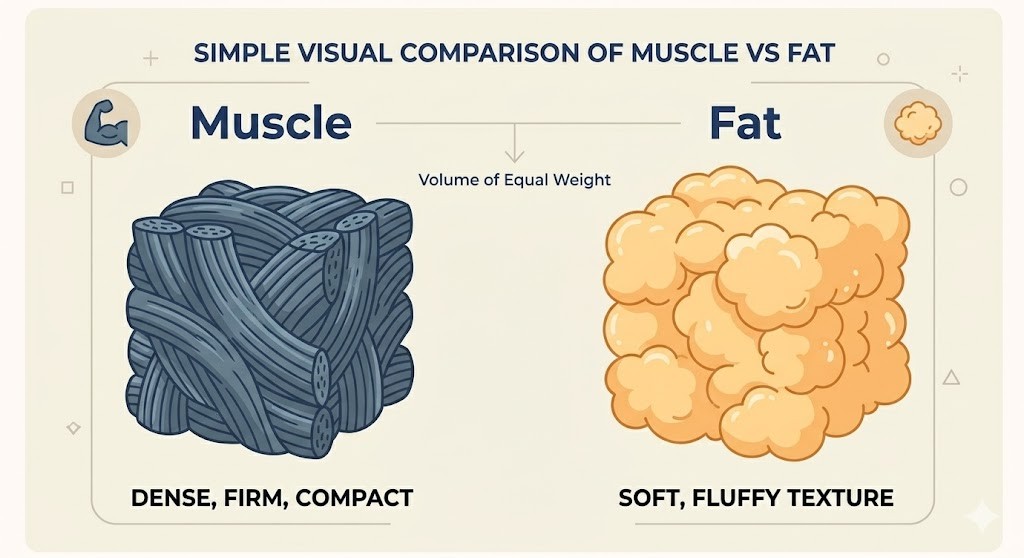
When you combine high protein with strength training, you achieve "body recomposition"—losing fat while potentially even gaining a little muscle at the same time.
Stop Tapping, Start Talking: Effortless Tracking
We get it—logging every gram of protein is a chore. Most people quit tracking because it takes 15 minutes a meal to search through clunky databases .
That is where VoCal comes in. Instead of searching for "low-fat paneer bhurji with two rotis," you just say it. Our AI understands portions, complex Indian dishes, and even regional languages in about 15 seconds .
Feature | VoCal (Voice Tracking) | Traditional Manual Apps |
Time per Meal | 15 Seconds | 5–15 Minutes |
Method | Natural Speech | Manual Search/Entry |
Accuracy | 95% (AI-powered) | Variable (User-dependent) |
Friction | Zero/Minimal | High |
The Bottom Line Consistency is the only way to ensure you're hitting your protein targets. If tracking is easy, you'll actually do it.
FAQs
Can I really get enough protein as a vegetarian?
Absolutely! Between soya chunks, Greek yogurt, paneer, and lentils, you can easily hit 100g+ of protein a day without touching meat.
Is too much protein bad for my kidneys?
For most healthy people, high protein (up to 2.2g/kg) is perfectly safe. However, if you have pre-existing kidney issues, definitely chat with your doctor first .
When is the best time to eat protein?
"Protein Pacing" is the way to go. Try to get 20–30 grams of protein at every meal (breakfast, lunch, and dinner) rather than eating it all at once.
Disclaimer: This guide is for informational purposes only. Consult a healthcare professional or nutritionist for personalized medical advice.