
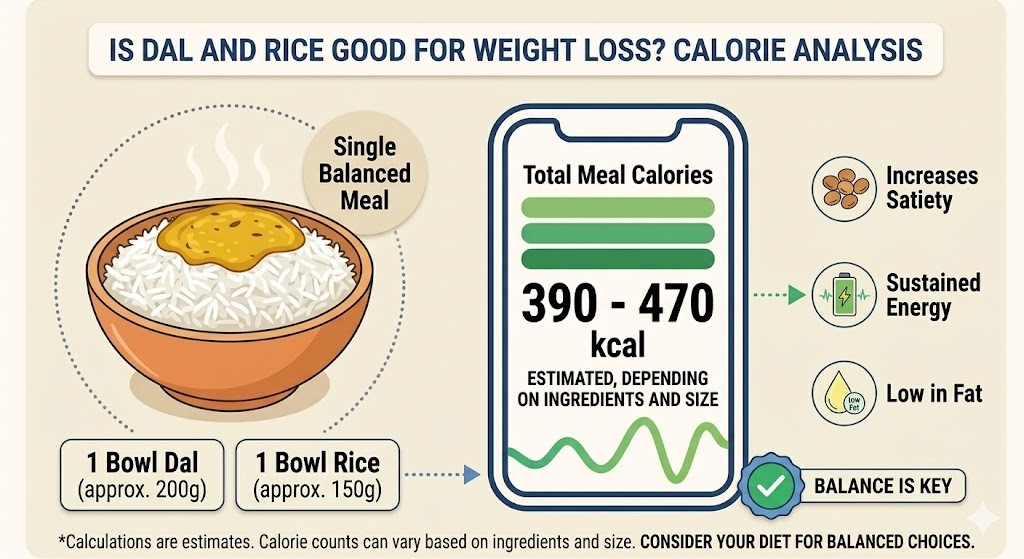
Dal Chawal (dal and rice) is the ultimate comfort food. Whether you’ve had a long day or just want a "hug in a bowl," this traditional Indian staple is the go-to for millions.
But if you’re trying to shed a few pounds, you might wonder if this carb-heavy duo belongs on your plate. Some modern diets treat rice like a villain, but science—and the National Institute of Nutrition (NIN)—suggests otherwise.
This article dives into the calorie count of your favorite bowl and explains how to eat dal and rice without stalling your weight loss goals.
The Calorie Breakdown: What’s in a Bowl?
When people ask about calories in 1 bowl dal and rice indian style, the answer depends entirely on the size of the bowl and how much "love" (read: ghee and oil) you put into the tadka.
In a clinical setting, a standard katori (small bowl) is usually about 100 to 150 grams of cooked food.
Calorie Estimates for Common Dals
Most dals are relatively similar in calories when boiled, but their nutrient "superpowers" vary.
Pulse Type (100g Cooked, Plain) | Calories (kcal) | Protein (g) | Fiber (g) |
Moong Dal (Green Gram) | 97 | 7.0–9.0 | 8.0–10.0 |
Urad Dal (Black Gram) | 105–115 | 7.5–8.5 | 7.0–9.0 |
Toor Dal (Pigeon Pea) | 107 | 7.0–8.0 | 6.0–8.0 |
Masoor Dal (Red Lentil) | 116 | 9.0 | 7.9 |
Chana Dal (Bengal Gram) | 120–130 | 8.0–9.0 | 10.0–12.0 |
Data synthesized from.
The Rice Reality
Rice provides the energy you need to get through your day. While white rice is the standard, switching to unpolished varieties can give you a fiber boost.
Rice Variety (100g Cooked) | Calories (kcal) | Fiber (g) | Glycemic Index (GI) |
Brown Rice (Unpolished) | 110–120 | 1.8–2.0 | 50–55 |
Basmati Rice | 121 | 0.6–0.8 | 50–58 |
Milled White Rice | 130 | 0.4 | 72–75 |
Data synthesized from.
Bottom Line A simple home-cooked bowl with 100g of dal and 100g of rice contains roughly 190–240 calories. However, a restaurant-style "Dal Fry" can easily double that count due to extra fats.
Why Dal and Rice is a Weight Loss Powerhouse
It’s not just about the calories—it’s about the chemistry! When you eat dal and rice together, two magical things happen:
1. The "Complete Protein" Effect
Plant proteins are often "incomplete," meaning they miss certain essential amino acids. Dal is high in lysine but low in methionine, while rice is the exact opposite. When they meet on your plate, they form a "complete protein" similar to what you’d find in animal products. This helps you maintain muscle mass while your body burns fat.
2. The Satiety Signal
Dal is a fiber bomb. High fiber intake triggers hormones like GLP-1 and PYY, which tell your brain, "Hey, we're full!". This prevents the dreaded 4:00 PM snack attack.
The Golden Ratio: How Much Rice vs. Dal?
The biggest mistake in the Indian diet is the "Rice Mountain" with a tiny "Dal Lake." For weight loss, the National Institute of Nutrition (NIN) suggests a shift in proportions.
The Weight Loss Strategy:
Instead of the usual cereal-heavy plate, aim for a 1:1 or even a 2:1 ratio of dal to rice.
Food Group | NIN Recommended Weight (Raw, g/day) | Energy Contribution |
Cereals & Millets | 250–270 | ~840–900 kcal |
Pulses (Dal) | 85–90 | ~300–340 kcal |
Vegetables | 350 | ~100 kcal |
Fruits | 150 | ~100 kcal |
Data based on the "My Plate for the Day" model.
3 Pro-Tips for Weight Loss Dal Chawal
Cool Your Rice: Letting your rice cool down after cooking increases "resistant starch," which lowers the calories your body actually absorbs.
Lighten the Tadka: A single tablespoon of ghee adds about 120 calories. Use a teaspoon for flavor, or try a "dry tadka" with just roasted spices.
Soak Your Dals: Soaking pulses for a few hours before cooking makes them easier to digest and reduces bloating.
Tracking Made Easy with Voice AI
Let’s be honest: manual calorie counting is a chore. Trying to search for "medium bowl toor dal with 1 tsp ghee" in a database can be exhausting.
This is where Vo-cal.com changes the game. Instead of typing, you just speak.
Using advanced Natural Language Processing (NLP), our AI understands the nuance of Indian cooking. When you say, "I had a small bowl of moong dal and half a cup of brown rice," the system instantly parses the calories and macros using data from the Indian Food Composition Tables. It’s fast, hands-free, and keeps you consistent—which is the real secret to weight loss.
Bottom Line
Dal and rice isn't just "okay" for weight loss—it’s actually an excellent choice. By focusing on a higher dal-to-rice ratio, choosing fiber-rich varieties, and using a voice-based tracker like Vo-cal.com to stay mindful of your portions, you can reach your goals without giving up your favorite meal.
FAQs
Is dal and rice a complete protein?
Yes! When eaten together, the amino acids in rice and dal complement each other, creating a high-quality protein source for vegetarians.
Which dal is best for weight loss?
Moong dal and Masoor dal are top choices because they are high in protein and easier on the stomach than heavier legumes like Chana dal.
Can I eat dal chawal for dinner?
Absolutely. Just keep the portions light and try to eat at least 2–3 hours before bed to give your body time to digest the fiber.
Disclaimer: Consult a healthcare professional before starting any weight-loss diet, especially if you have health conditions like diabetes or kidney disease.