
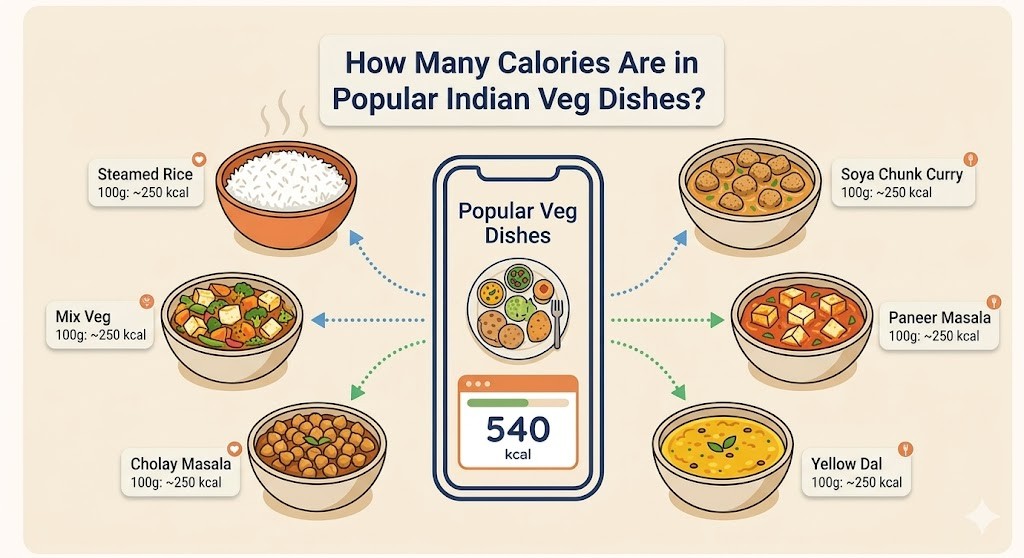
Let’s be honest: Indian vegetarian food is a celebration on a plate. From the aroma of a fresh tadka to the comfort of a warm phulka, our cuisine is as diverse as it is delicious. But if you’ve ever tried to track your calories, you know the struggle is real. How do you log a "medium bowl" of homemade dal or a paratha that’s been lovingly (and liberally) basted with ghee?
The good news? You don’t have to give up your favorites to stay healthy. Using the latest data from the Indian Council of Medical Research (ICMR-NIN) and the Indian Food Composition Tables (IFCT), we’ve decoded the caloric secrets of your favorite vegetarian staples.
The Bread Basket: Rotis, Parathas, and More
The humble roti is the backbone of the Indian meal. While a plain phulka is quite diet-friendly, the calories can sneak up on you once the ghee comes out to play. A single teaspoon of ghee adds about 45 kcal to your meal!
Food Item | Size/Quantity | Energy (Kcal) | Protein (g) |
Phulka (Plain) | 1 No. | 80 | 3.2 |
Roti (with Ghee) | 1 No. | 110-125 | 2.9 |
Paratha (Plain/Oil) | 1 No. | 150-200 | 2.8 |
Poori (Small) | 1 No. | 100-120 | 2.0 |
Naan (1/4 serving) | 31 g | 78 | 3.4 |
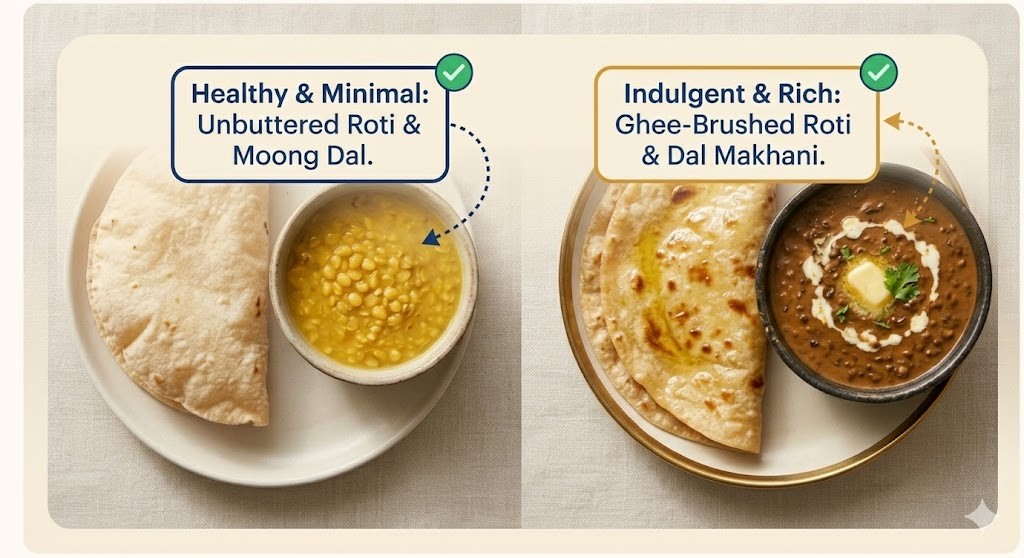
The Bottom Line: If you're looking to cut back, stick to the plain phulka. Using a non-stick pan or a quick spray of oil instead of a heavy pour of ghee can save you nearly 100 kcal across a single meal.
Rice and Grains: The Comfort Zone
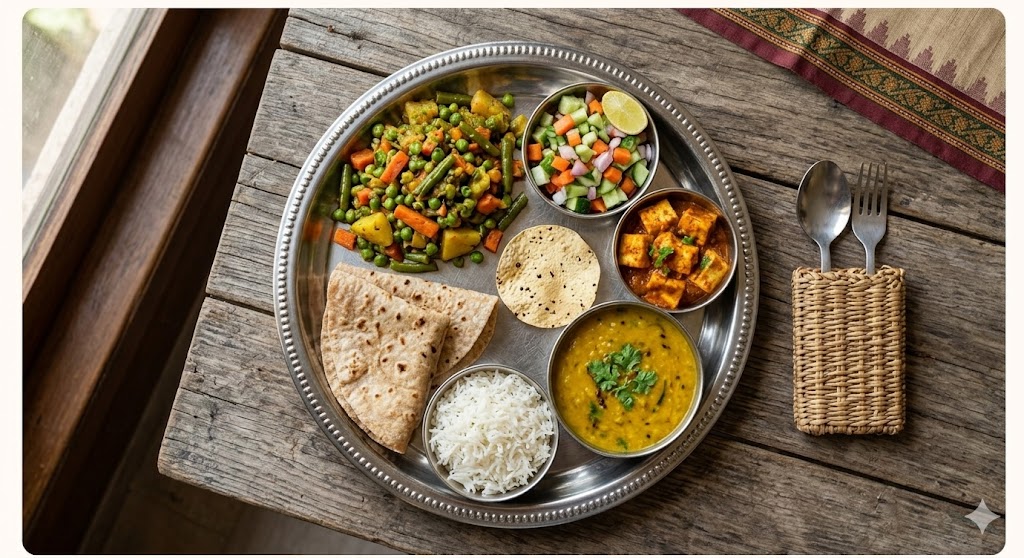
Whether it's a fluffy pile of white rice or a spicy plate of poha, grains provide the energy we need for the day. The 2024 ICMR guidelines suggest that millets (like ragi or jowar) are the "superheroes" here because they keep you full longer thanks to their high fiber content.
Rice/Grain Dish | Serving Size | Energy (Kcal) |
Cooked White Rice | 1 Cup | 170-205 |
Cooked Brown Rice | 1 Cup | 215-216 |
Poha (Flattened Rice) | 1 Cup | 180-270 |
Upma (Semolina) | 1 Cup | 210-270 |
Veg Khichdi | 1 Cup | 200 |
Pro Tip: Try the "My Plate" method! Fill half your plate with colorful vegetables and keep the rice or roti to just a quarter of the space.
Dals and Curries: The Protein Powerhouse
In an Indian vegetarian diet, dal is the primary source of protein. However, the way you "temper" or cook your dal makes a massive difference. A plain boiled dal is a lean 100 kcal but a butter-heavy Dal Makhani is a different story entirely!
Pulse Preparation | Serving Size | Energy (Kcal) | Protein (g) |
Plain Dal | 1/2 Cup | 100-150 | 4.4 |
Sambar | 1 Cup | 110-150 | 3.6 |
Rajma Curry | 1 Cup | 210 | 7.0 |
Paneer Curry | 1 Cup | 300 | 15.0 |
Dal Makhani | 1 Cup | 350 | 17.0 |
Did you know? Paneer is delicious, but it’s very calorie-dense. Just 100 g of paneer can pack up to 300 kcal. If you're watching your weight, try substituting it with tofu or sprouted moong.
The "Snack Attack": Street Food & Treats
We all love a good samosa or a plate of pav bhaji, but these are often the "caloric traps" of our diet. Most of these are deep-fried or loaded with butter, which means high calories and low satiety (meaning you'll be hungry again soon!).
Snack Item | Serving Size | Energy (Kcal) |
Samosa | 1 No. | 150-210 |
Dhokla | 1 Piece | 50-75 |
Pav Bhaji | 1 Plate | 450-600 |
Pani Puri | 6 Pcs | 180 |
Gulab Jamun | 1 No. | 150 |
Healthier Hack: Opt for Dhokla or Idli 40 kcal per piece when you're craving a snack. They are steamed, fermented, and much easier on your waistline!
More Than Just Food: The Science of Six Tastes
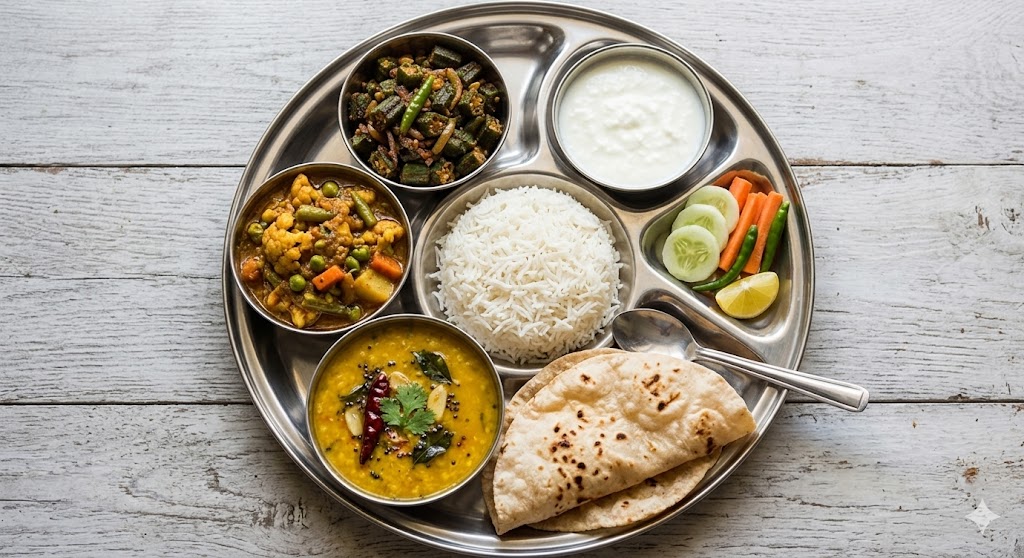
Did you know your thali is actually an ancient health hack? According to Ayurveda, a truly satisfying meal needs to hit six specific tastes, known as Rasas. When you have all six, your body feels nourished and those pesky 4 PM sugar cravings actually stay away.
Sweet (Madhura): Grains and dairy for energy.
Sour (Amla): Lemons or yogurt to kickstart digestion.
Salty (Lavana): To balance electrolytes.
Pungent (Katu): Spices like chilies to boost metabolism.
Bitter (Tikta): Leafy greens for detoxing.
Astringent (Kashaya): Beans and lentils to keep things firm.
Master Your Plate: The 50-25-25 Rule
Want to enjoy your thali and still fit into your favorite jeans? Use the "Plate Rule" :
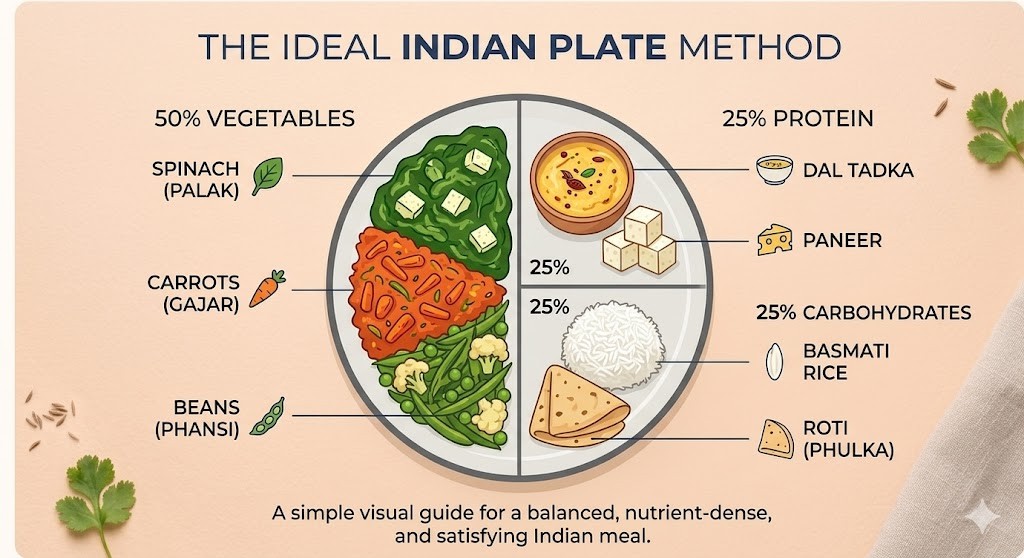
50% Vegetables: Fill half your plate with colorful sabzis and salads.
25% Protein: One-fourth goes to your dal, sprouts, or paneer.
25% Carbs: The last quarter is for your rice or roti.
This simple trick naturally cuts calories while keeping you full. Pro tip: Swap white rice for millets like Ragi or Bajra to get a massive fiber boost.
Tracking Made Easy with VoCal
Let’s face it—trying to find "half a bowl of bhindi masala" in a standard calorie app is a headache. Most apps are built for western diets (hello, avocado toast!) and don't understand the complexity of Indian home-cooked meals.
That’s where VoCal comes in. Instead of typing and searching, you just speak to the app.
11 Indian Languages: Whether you say it in Hindi, Tamil, Telugu, or English, Vo-cal understands you.
15-Second Logging: You can log an entire meal (like "two rotis, a bowl of dal, and some salad") in seconds.
98% Accuracy: Our AI is trained specifically on Indian portion sizes and cooking methods, ensuring you get accurate data for every tadka and masala.
Stop guessing and start speaking! Calorie tracking shouldn't feel like a chore. With Vo-cal, it’s just a conversation.
FAQs
How many calories are in one medium chapati?
A standard 6-inch plain whole-wheat chapati has about 80-110 kcal . If you add a teaspoon of ghee, it jumps to about 125-155 kcal.
Is white rice worse than brown rice for weight loss?
White rice (170-205 kcal/cup and brown rice (215 kcal/cup) are similar in calories. However, brown rice has more fiber, which helps you feel full longer and prevents overeating.
What is the lowest calorie Indian breakfast?
Steamed Idli (approx. 40-60kcal per piece) and Moong Dal Chila (approx. 125 kcal) are excellent low-calorie options compared to parathas or vadas.
Can I track Indian meals accurately by voice?
Yes! Apps like Vo-cal use AI to recognize complex Indian dishes like "baingan bharta" or "mixed veg" and estimate calories with up to 98% accuracy based on your verbal description.
Disclaimer: This content is for informational purposes only and does not constitute medical advice. Please consult a healthcare professional before starting any new diet.