
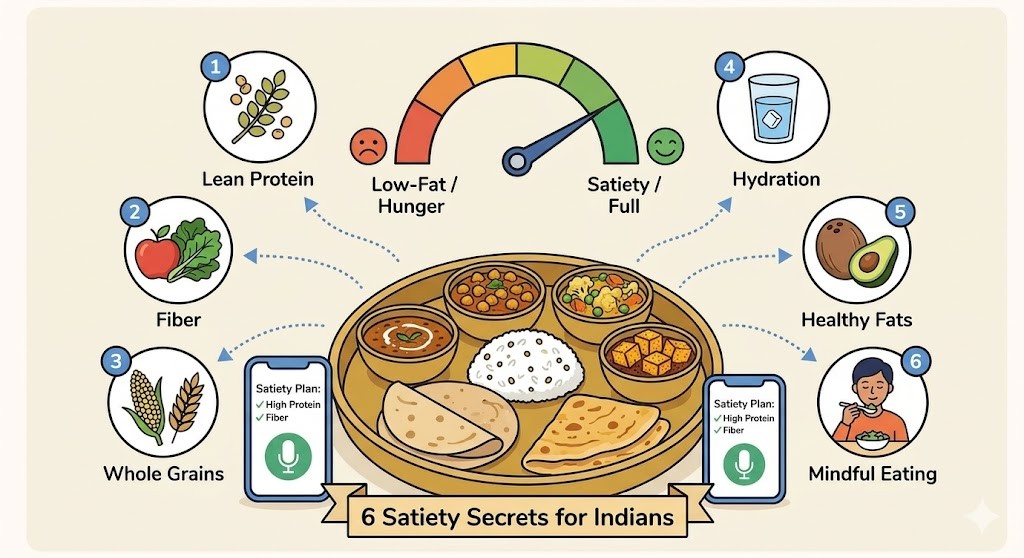
You’ve swapped the ghee for steamed veggies, picked up the "low-fat" yogurt, and said a temporary goodbye to pakoras. You’re doing everything "right" for your calorie deficit, but there’s one problem: your stomach is acting like a bottomless pit.
If you feel like you're constantly "hangry" (hungry + angry) while on a low-fat regimen, you aren't alone. Hunger is your body’s natural way of saying it needs energy, but on a low-fat diet, those signals can get a bit haywire.
In the Indian context, where our meals are often heavy on refined grains like white rice and maida, cutting out fat can lead to a "hunger trap." Here is the science-backed reason why you’re always hungry and how to fix it using the latest 2024 dietary guidelines.
1. You’ve Lost Your "Gastric Brake"
Fat isn't just about calories; it’s a powerful signaling molecule. When you eat healthy fats, your body releases a hormone called Cholecystokinin (CCK).
CCK acts as a "gastric brake", slowing down the rate at which food leaves your stomach. On a low-fat diet, this brake is often missing. Without enough fat to trigger CCK, food moves through your digestive tract much faster, leaving your stomach empty and growling sooner than expected.
The Fix: You don't need to deep-fry your food, but the National Institutes of Health (NIH) suggests including healthy fats from nuts, seeds, and moderate amounts of vegetable oils to keep that "brake" working.
2. Refined Carbs are Causing a Sugar Rollercoaster
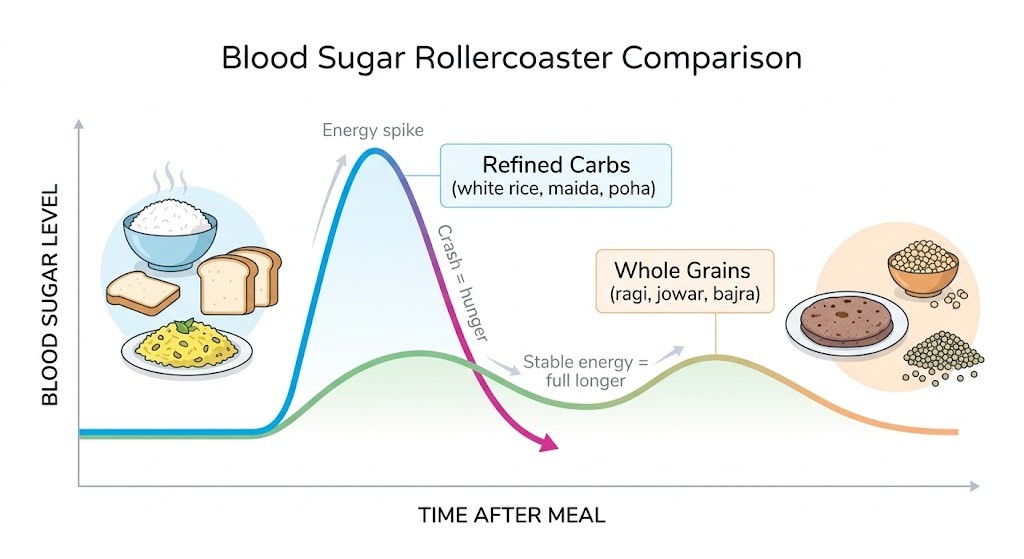
When people go low-fat, they often replace those calories with refined carbohydrates like white rice, poha, or white bread.
These simple carbs are digested quickly, causing a sharp spike in your blood sugar, followed by a rapid crash. When your blood sugar drops, your brain sends out an emergency signal: "I need energy NOW!" This manifests as intense hunger pangs shortly after you’ve eaten.
The Fix: Swap refined grains for high-fiber millets like Ragi, Jowar, or Bajra. These "Nutri-cereals" release energy slowly, keeping your blood sugar—and your appetite—stable.
3. You’re Not Hitting Your Protein Target
Protein is the undisputed king of satiety. It reduces your "hunger hormone" (ghrelin) and boosts "fullness hormones" like GLP-1 and PYY.
In many Indian households, meals are cereal-dominant (lots of rice/roti) and protein-light. If you are in a calorie deficit and not eating enough protein, your body will constantly nudge you to eat more in an attempt to meet its structural needs.
High-Protein Indian Staples:
Moong Dal Chilla: 15g protein per serving.
Paneer (Low Fat): Excellent for tikkas or salads.
Boiled Eggs: High biological value protein.
Sattu (Roasted Chana): A traditional, fiber-rich protein powerhouse.
4. Your Plate Lacks "Volume"
If your meals look tiny, your brain might not believe you’re full. This is where "Volume Eating" comes in. The 2024 ICMR-NIN guidelines have increased the recommended vegetable intake to 400g per day.
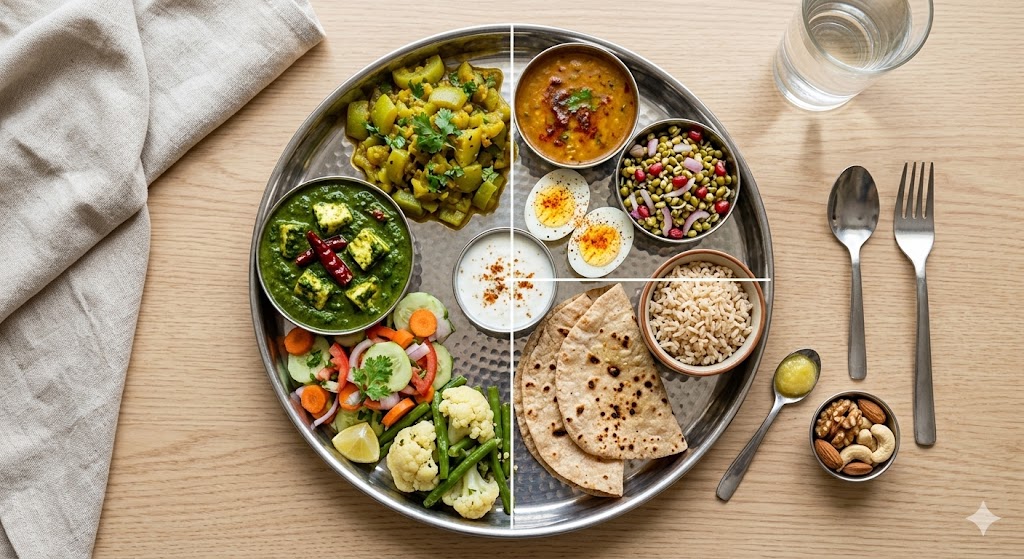
Vegetables are high in water and fiber but low in calories. Filling half your plate with Sabzi or salad provides physical "bulk" that stretches the stomach wall, signaling to your brain that you are full.
High-Volume Indian Foods | Why They Work |
Lauki / Torai (Gourds) | High water content, very low calorie. |
Sprouts Salad | High fiber and protein crunch. |
Dal Palak | Combines protein with voluminous greens. |
5. Fiber is Missing from the Equation
Fiber is the "secret sauce" of satiety. It absorbs water and forms a gel-like substance in your gut, slowing down digestion and making you feel full for longer.
The 2024 guidelines recommend 25–30g of fiber daily. Most Indians fall short because of an over-reliance on refined flours. Fiber also helps improve insulin sensitivity, which prevents the "irrational eating" caused by blood sugar slumps.
The Fix: Don't peel all your veggies, choose whole fruits over juices, and include at least one serving of pulses or legumes (Rajma, Chana, Dal) in your major meals.
6. You’re Tracking "Guesses" Instead of Reality
One of the biggest stressors in a calorie deficit is the "manual logging burnout." Trying to guess the calories in a katori of Bhindi Masala or Dal Tadka is frustrating and often inaccurate.
Research shows that consistent tracking is a powerful tool for weight loss, but only if it’s sustainable. When logging feels like a chore, you’re more likely to experience "decision fatigue," which leads to mindless snacking.
The Voice-Based Advantage: New technology like VoCal allows you to log meals using just your voice. Instead of scrolling through databases, you can simply say, "I had two phulkas with a bowl of Moong dal and cucumber raita." This is significantly faster and encourages the consistency needed to stay in a safe deficit.
Vo-Cal is designed to understand complex Indian recipes and cooking styles , making your tracking up to 98% more accurate than manual guessing.
The Summary (Takeaway)
Being hungry on a low-fat diet isn't a lack of willpower; it’s biology. To tame the "hanger":
Prioritize Protein: Ensure every meal has a source like dal, eggs, or paneer.
Add Fiber: Swap white rice for millets or brown rice.
Volume Up: Fill half your plate with local vegetables.
Use Tech: Simplify your journey with Vo-Cal voice-based tracking to avoid "logging stress".
Frequently Asked Questions
Is roti better than rice for staying full?
Generally, yes. Whole wheat roti has more fiber and a lower Glycemic Index (GI) than white rice, meaning it keeps you full for longer. However, if you prefer rice, choose brown or red varieties and pair them with plenty of fiber-rich dal.
Can I eat ghee while trying to lose weight?
Yes! In moderation. A small amount of ghee (about 1 teaspoon) can actually increase satiety and help your body absorb fat-soluble vitamins. Just remember that 1 tablespoon of ghee approx 120 calories , so portion control is key.
Why am I hungry even after eating a big Indian meal?
If the meal was mostly "white" carbs (rice, maida), your blood sugar may have spiked and crashed. Ensure your meal follows the ICMR "My Plate" model: 50% veg/fruits, 25% protein, and 25% grains.
How do I track home-cooked Indian meals accurately?
Indian cooking varies by household. Using a voice-based app like Vo-cal allows you to describe exactly what went into your dish (e.g., "low oil dal"), which is more accurate than selecting a generic "yellow dal" entry.
Disclaimer: Always consult a healthcare professional before starting a new diet, especially if you have underlying conditions like diabetes or PCOS.