

Few appetizers hit the spot quite like a basket of freshly fried, golden-brown onion rings. That shattering outer crunch paired with sweet, tender onion inside is pure comfort food magic. Whether you are grabbing a side at the drive-thru, sharing an appetizer tower at your favorite sports bar, or popping a batch into your air fryer for movie night, onion rings are an undisputed American favorite.
There is just one catch: onions may be vegetables, but once they take a dip in batter and hit the deep fryer, their nutrition profile undergoes a massive transformation.
If you are tracking your daily macros or simply wondering how that side basket fits into your health goals, we have got you covered. In this comprehensive guide, we will break down onion rings calories by piece count, explore how cooking methods slash or stack calories, compare popular fast-food chains, and look into sneaky dipping sauces.
Table of Contents
The 100-Gram Baseline: The Science of the Crunch
Piece-by-Piece: Calories in 5, 10, and 15 Onion Rings
Deep-Fried vs. Air-Fried: How Cooking Changes the Game
Frozen Grocery Favorites: Alexia, Ore-Ida, and Store Brands
The Fast-Food & Restaurant Showdown
The Dipping Sauce Trap: Mayo Nutrition Facts & Creamy Dips
The Burn-Off Reality: What It Takes to Burn a Basket
Track Every Ring Hands-Free with VoCal
Frequently Asked Questions
The 100-Gram Baseline: The Science of the Crunch
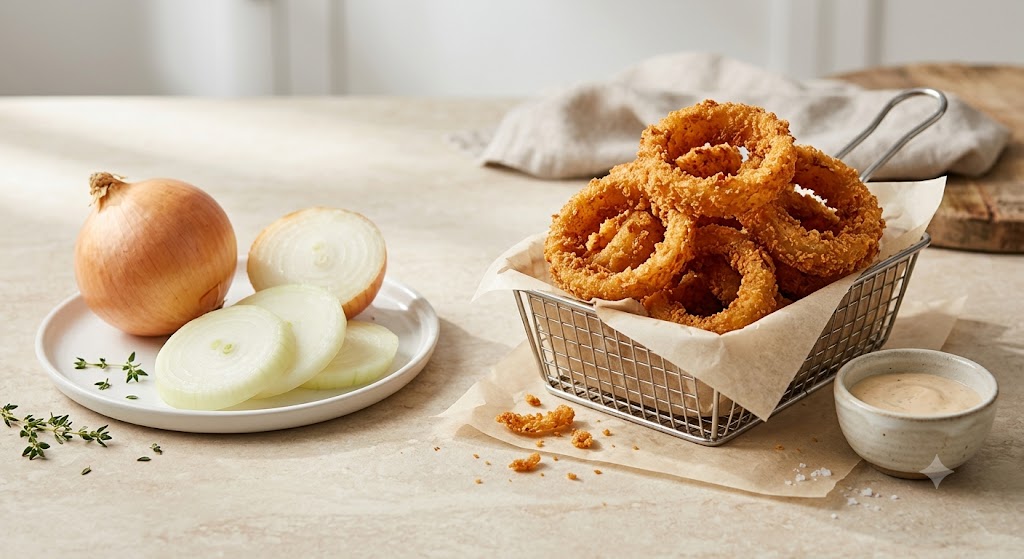
Before diving into portion sizes, let’s look at onion rings under the microscope using an objective 100-gram baseline (about 3.5 ounces).
In its natural state, raw onion is an absolute lightweight: around 40 calories per 100 grams, practically zero fat, and packed with vitamin C and prebiotic fiber.
When rings are dredged in flour or cornmeal and dunked into boiling oil, physics takes over. The natural moisture inside the onion rapidly turns to steam and escapes. That escaping steam creates tiny porous channels in the batter, which immediately soak up hot cooking oil.
According to USDA FoodData Central, commercial restaurant onion rings clock in at roughly 356 calories per 100 grams, while extra-crispy fast-food versions climb to 411 calories per 100 grams.
Nutritional Parameter | Raw Onion (USDA Reference) | Oven-Baked Frozen Rings | Full-Service Restaurant Rings | Fast-Food Fried Rings |
Calories (kcal) | 40 | 276 | 356 | 411 |
Protein (g) | 1.10 | 4.10 | 4.89 | 3.86 |
Total Fat (g) | 0.10 | 14.30 | 19.28 | 25.20 |
Saturated Fat (g) | 0.04 | 2.10 | 3.80 | 4.20 |
Carbohydrates (g) | 9.34 | 33.80 | 40.72 | 43.60 |
Dietary Fiber (g) | 1.70 | 2.20 | 2.60 | 2.70 |
Total Sugars (g) | 4.24 | 5.10 | 5.00 | 5.40 |
Sodium (mg) | 4 | 370 | 692 | 776 |
Bottom Line: Deep-frying raw onions multiplies their calorie count by nearly 900%. Over half of those calories come directly from absorbed frying oil.
Piece-by-Piece: Calories in 5, 10, and 15 Onion Rings
Counting onion rings by the piece can be tricky because sizes vary dramatically.
A small, machine-formed frozen ring weighs around 6 grams.
A typical fast-food ring weighs between 6.5 and 8 grams.
A hand-breaded, beer-battered restaurant monster can easily weigh 15 to 22 grams.
How does that translate when you are grabbing a handful? Here is how the numbers stack up across 5, 10, and 15 pieces:
Portion Count | Small Frozen / Oven-Baked | Standard Fast-Food Rings | Hand-Battered Casual Dining |
1 Single Ring | 6.0 g / 17 kcal | 6.5 g / 27 kcal | 15.0 g / 53 kcal |
5 Rings (Snack) | 30.0 g / 83 kcal | 32.5 g / 134 kcal | 75.0 g / 267 kcal |
10 Rings (Side Order) | 60.0 g / 166 kcal | 65.0 g / 267 kcal | 150.0 g / 534 kcal |
15 Rings (Appetizer Portion) | 90.0 g / 248 kcal | 97.5 g / 401 kcal | 225.0 g / 801 kcal |
Notice the dramatic difference? Nibbling on 10 small baked rings at home is a modest 166-calorie treat. But splitting a 10-piece basket of giant beer-battered rings at a pub dishes out over 530 calories—before a single dip of sauce!
Deep-Fried vs. Air-Fried: How Cooking Changes the Game

The cooking medium makes all the difference when it comes to fat and calorie totals.
When you submerge rings into a commercial deep fryer, they act like little sponges. But when you pop them in an air fryer or a convection oven, superheated circulating air crisps the exterior crust without requiring additional oil.
If you are cooking store-bought frozen rings, they are already lightly flash-fried at the plant, so baking or air-frying them keeps them right around 276 calories per 100 grams.
If you make them from scratch at home using fresh onion slices, a splash of egg wash, panko breadcrumbs, and a light mist of avocado or olive oil spray, you can drop the calories down to about 165 calories per 100 grams!
Cooking Method & Preparation | Calories (per 100g) | Total Fat (per 100g) | Saturated Fat (per 100g) | Net Carbs (per 100g) |
Commercial Deep-Fried | 411 kcal | 25.2 g | 4.2 g | 40.9 g |
Store Frozen (Air-Fried, No Added Oil) | 276 kcal | 14.3 g | 2.1 g | 31.6 g |
Store Frozen (Oven-Baked) | 276 kcal | 14.3 g | 2.1 g | 31.6 g |
Scratch-Made Air-Fried (Light Oil Spray) | 165 kcal | 5.2 g | 0.7 g | 26.5 g |
Pro Tip: When air-frying frozen rings at home, skip the extra oil spray entirely. They already have enough surface oil from the factory to turn golden and crunchy.
Frozen Grocery Favorites: Alexia, Ore-Ida, and Store Brands
Next time you are walking down the frozen food aisle, you will notice two main types of rings:
Whole-Cut Rings: Real onion slices coated in batter or panko crumbs (like Alexia and Ore-Ida Gourmet).
Extruded Rings: Diced or minced onions shaped into uniform circles with starch binders (like Ore-Ida Onion Ringers).
Here is how popular store brands compare per serving:
Frozen Brand & Variety | Serving Size | Calories | Total Fat | Total Carbs | Sodium | Protein |
Alexia Crispy Onion Rings (Panko) | 5 rings (80g) | 230 kcal | 11.0 g | 29.0 g | 360 mg | 4.0 g |
Ore-Ida Gourmet Sliced Rings | 3 rings (76–85g) | 200 kcal | 10.0 g | 26.0 g | 390 mg | 3.0 g |
Ore-Ida Onion Ringers (Minced) | 5 rings (81g) | 180 kcal | 9.0 g | 23.0 g | 150 mg | 3.0 g |
McCain Craft Beer Battered | 6 rings (91g) | 190 kcal | 8.0 g | 27.0 g | 410 mg | 3.0 g |
Great Value (Walmart) Frozen Rings | 1 serving (84g) | 220 kcal | 11.0 g | 28.0 g | 380 mg | 3.0 g |
Alexia uses a light Japanese panko breading that stays crisp while keeping saturated fats low (just 1 gram per serving). Meanwhile, Ore-Ida's extruded "Ringers" offer a lower sodium option at just 150 milligrams per 5 pieces.
The Fast-Food & Restaurant Showdown
Grabbing takeout or sitting down at a diner? Restaurant onion rings can range from a sensible side to a full day's worth of calories on a single plate.
Quick-Service Fast Food
Burger King: BK serves classic diced-onion rings. Their sizes run from a modest Value size (200 calories) and Small (280 to 379 calories) up to a Large (520 to 592 calories).
Sonic Drive-In: Sonic hand-slices sweet onions and dips them in a unique sweet batter made with melted vanilla ice cream. That signature recipe makes them delicious, but calorie-dense: a Small has 440 calories, while a Large jumps to 800 calories.
Carl's Jr.: Famous for thick, heavily breaded rings that supply 530 to 560 calories per single order.
The Casual Dining Titan: Red Robin
If you have ever ordered Red Robin's famous Towering Onion Rings®, you know it is an impressive centerpiece: 13 giant beer-battered rings served upright on a tall spindle alongside ranch and Campfire Mayo.
According to Red Robin's nutritional disclosures, that entire tower packs between 1,280 and 1,892 calories, 121 grams of fat, and over 3,300 milligrams of sodium. Even their smaller "O-Ring Shorty®" delivers roughly 910 to 920 calories.
Restaurant Brand & Order | Portioned Weight | Calories | Total Fat | Carbs | Sodium |
Burger King (Small) | 91 g | 280–379 kcal | 13–23 g | 39–40 g | 706 mg |
Burger King (Medium) | 117 g | 360–488 kcal | 16–29 g | 49–54 g | 850 mg |
Burger King (Large) | 142 g | 520–592 kcal | 24–30 g | 57–61 g | 1,020 mg |
Sonic Drive-In (Small) | ~140 g | 440 kcal | 21 g | 58 g | 580 mg |
Sonic Drive-In (Medium) | 201 g | 580 kcal | 29 g | 73 g | 770 mg |
Sonic Drive-In (Large) | ~280 g | 800 kcal | 39 g | 100 g | 1,060 mg |
Carl's Jr. (Regular Side) | 116–128 g | 530–560 kcal | 28–30 g | 61–66 g | 590–630 mg |
Culver's (Regular Order) | ~120 g | 400 kcal | 20 g | 50 g | 510 mg |
Dairy Queen (Regular Order) | ~115 g | 360 kcal | 18 g | 45 g | 520 mg |
Red Robin The O-Ring Shorty® | ~220 g | 910–920 kcal | 56–60 g | 89–94 g | 2,130 mg |
Red Robin Towering Onion Rings® | Full Tower (13 Rings) | 1,280–1,892 kcal | 121 g | 171–175 g | 3,340 mg |
The Dipping Sauce Trap: Mayo Nutrition Facts & Creamy Dips

Here is the secret trap that catches most dieters off guard: the sauce.
Because onion rings have a savory, salty crust, restaurants almost always pair them with rich, mayonnaise-based dipping sauces (think spicy zesty rings sauce, campfire dip, or garlic remoulade).
Understanding mayo nutrition facts reveals how quickly sauces add up. Mayonnaise is an emulsion of pure oil, egg yolks, and vinegar or lemon juice. Just one level tablespoon (14 grams) of standard mayonnaise provides 94 calories and over 10 grams of pure fat.
When dining out, dipping sauces are rarely served in single-tablespoon portions. A typical restaurant dipping cup or ramekin holds 2 ounces (4 tablespoons). That means dunking your rings into a ramekin of Campfire Mayo or southwest ranch quietly tacks on 250 to 300 extra calories and 25+ grams of fat!
Dipping Sauce / Condiment | Serving Size | Calories | Total Fat | Total Carbs | Sodium |
Traditional Real Mayo | 1 tbsp (14g) | 94 kcal | 10.3 g | 0.1 g | 88 mg |
Traditional Real Mayo | 2 tbsp (28g) | 188 kcal | 20.6 g | 0.2 g | 176 mg |
Light CommercialMayonnaise | 2 tbsp (30g) | 70 kcal | 6.0 g | 4.0 g | 240 mg |
Burger King Zesty Onion Ring Sauce | 1 tub (28g) | 150 kcal | 15.0 g | 3.0 g | 240 mg |
Campfire Mayo / Creamy Specialty Dip | 2 fl oz (59ml) | 260 kcal | 26.0 g | 6.0 g | 480 mg |
Classic Buttermilk Ranch | 2 tbsp (30ml) | 140 kcal | 14.0 g | 2.0 g | 260 mg |
Standard Tomato Ketchup | 2 tbsp (34g) | 35 kcal | 0.1 g | 8.5 g | 320 mg |
Smoky Barbecue Sauce | 2 tbsp (36g) | 70 kcal | 0.2 g | 17.0 g | 340 mg |
Smart Swap: If you want that creamy mayo kick without the calorie surplus, ask for sauce on the side and dip lightly, or swap to ketchup, barbecue sauce, or hot sauce to save up to 200 calories per order.
The Burn-Off Reality: What It Takes to Burn a Basket
To put restaurant onion rings into real-world perspective, let’s look at what it takes to burn off an average 450-calorie fast-food side order for a typical 150-pound adult:
Brisk Walking (3.5–4.0 mph): ~85 to 95 minutes
Moderate Jogging (5.0 mph): ~45 to 50 minutes
Outdoor Cycling (12–14 mph): ~40 minutes
Lap Swimming (Freestyle): ~35 minutes
No food needs to be "earned" or punished with exercise, but keeping these physical activity benchmarks in mind helps make portion sizes feel real!
Track Every Ring Hands-Free with VoCal
Logging mixed, fried appetizers can feel like a frustrating chore.
You are at a busy table with friends, sharing a plate of onion rings and dipping sauces. Are you really going to pull out your phone, open a clunky tracker, search through 30 identical database entries, guess the gram weights, and then separately log three dips of zesty sauce? Probably not. That tracking friction is why so many food logs get skipped.
That is where VoCal changes the game. VoCal is an AI-powered, voice-first calorie tracking app built for real life.
Instead of typing and searching, just speak naturally:
"VoCal, log 6 restaurant onion rings with two tablespoons of campfire mayo."
VoCal’s natural language engine instantly gets to work:
Understands Natural Portions: It identifies the food ("onion rings"), recognizes preparation style ("restaurant-style"), and breaks down the exact portion count ("6 rings").
Accounts for Sneaky Dips: It automatically pairs the calorie and fat breakdown of the mayonnaise dip alongside your side.
Logs Instantly Without Stress: You get an accurate, instant macro log in two seconds flat—no searching, no barcode scanning, and no camera fatigue.
Whether you are enjoying a casual Friday dinner or meal prepping healthy air-fried alternatives at home, VoCal keeps your nutrition tracking effortless and sustainable.
The Takeaway
Onion rings don't have to be off-limits. If you want to enjoy that crispy, golden crunch while staying on track with your wellness goals:
Choose air-fried or oven-baked rings at home to save over 100 calories and half the fat.
When eating out, share a basket with friends and aim for a mindful portion of 4 to 6 rings.
Be mindful of mayo-based dips, which can quietly double your calorie count.
Use VoCal to log your food in seconds using just your voice, keeping your tracking habit consistent, accurate, and stress-free!
Frequently Asked Questions
Are onion rings healthier than french fries?
Surprisingly, onion rings are often slightly higher in calories and fat than french fries. Because onion rings have a much larger exterior surface area covered in batter, they absorb more cooking oil than solid-cut potato fries. A medium order of fast-food fries typically delivers 320 to 365 calories, whereas a medium order of onion rings from the same restaurant ranges from 360 to 480 calories.
How many calories are in 10 onion rings?
It depends heavily on where they are from:
10 Small Oven-Baked / Air-Fried Frozen Rings: ~166 calories
10 Fast-Food Onion Rings: ~260 to 320 calories
10 Hand-Battered Pub Rings: ~530 to 550 calories
Can I eat onion rings on a low-carb or keto diet?
Standard onion rings are not keto-friendly. The thick wheat flour, breadcrumbs, and cornmeal batter contribute between 40 and 65 grams of carbohydrates per serving. However, you can make delicious keto-friendly onion rings at home by dipping fresh onion rings in an egg wash and coating them in crushed pork rinds (pork panko) and parmesan cheese before air-frying!
What is the lowest calorie dipping sauce for onion rings?
Standard yellow mustard (0 calories), hot sauce (0–5 calories), and regular ketchup (35 calories per 2 tbsp) are your lowest calorie options. If you love creamy dips, opt for light mayo mixed with hot sauce or choose a light yogurt-based ranch dressing.
Disclaimer: This article is for informational purposes only and does not constitute medical, dietary, or nutritional advice. Always consult a qualified healthcare professional or registered dietitian before making significant changes to your dietary routine.