

Picture this: you are sitting at your favorite burger joint or sports bar, and a steaming, golden basket of onion rings hits the table. That intoxicating aroma fills the air, the batter is crisp to perfection, and in your mind, a little voice whispers: "Hey, it’s an onion. It’s basically a salad, right?"
Well, not quite! While raw onions are practically guilt-free, low-calorie garden all-stars, a dunk in rich batter and a plunge into bubbling hot oil gives them an entirely different nutritional personality.
Whether you are tracking macros, watching your waistline, or just curious about how that weekend side order fits into your daily budget, knowing the real numbers behind is a game changer. Let's break down exactly what you are eating when you grab 5, 10, or 15 rings, explore how cooking styles shake up the math, and look at how modern tools like make logging them as simple as speaking a single sentence.
Table of Contents
The Fryer Magic: How an Innocent Veggie Gets Heavy
The Master Breakdown: Calories in 5, 10, and 15 Onion Rings
Portion Deep Dive: 5 vs. 10 vs. 15 Rings
Cooking Styles Face-Off: Air-Fried, Baked, Fast Food, and Beer-Battered
The Dip Trap: Condiments That Double Your Calorie Count
What Happens Inside: Carbs, Fats, and Sodium
How to Burn It Off: Real-World Workout Equivalents
Pro Tips to Enjoy Rings Without the Food Coma
Track Your Rings Without Typing: The VoCal Advantage
Frequently Asked Questions (FAQs)
The Fryer Magic: How an Innocent Veggie Gets Heavy
To understand why onion rings pack such a punch, look at the humble raw onion. A standard 100-gram serving of raw onion is about 89% water and contains just 40 calories, virtually zero fat, and a healthy dash of plant antioxidants like quercetin.
So, what happens when it heads to the kitchen?
The Breading Blanket: The onion is sliced and dredged in refined flour, cornstarch, eggs, or milk, and coated in breadcrumbs or liquid batter.
The Steam Outrush: When dropped into oil at 350°F to 375°F, moisture inside the onion rapidly boils into steam. As steam bubbles out, it leaves behind thousands of microscopic pores.
The Oil Vacuum: As soon as the ring is lifted out of the fryer and begins to cool, the internal steam condenses, creating a tiny vacuum that pulls surface oil straight into the breading crust.
Because an onion ring is shaped like a hoop, it has a massive surface area relative to its weight. In fact, the crispy outer coating often makes up 40% to 50% of the entire ring's weight! That is how a 40-calorie vegetable transforms into a treat delivering between 276 and 411 calories per 100 grams.
The Master Breakdown: Calories in 5, 10, and 15 Onion Rings

Serving sizes on menus can be notoriously vague. Some places count by weight, while others just heap a handful into a paper carton. To keep things clear, here is how the numbers stack up for 5, 10, and 15 rings across four popular preparation methods, based on official USDA FoodData Central benchmarks.
Portion Size (Number of Rings) | Preparation Style | Estimated Weight | Energy (kcal) | Total Fat (g) | Saturated Fat (g) | Total Carbs (g) | Sodium (mg) |
5 Onion Rings | Air-Fryer / Homemade | 80 g | 148 | 4.4 | 0.6 | 23.2 | 176 |
5 Onion Rings | Oven-Baked Par-Fried | 80 g | 221 | 11.4 | 1.7 | 27.0 | 296 |
5 Onion Rings | Fast Food Deep-Fried | 70 g | 288 | 17.6 | 2.9 | 30.5 | 543 |
5 Onion Rings | Restaurant Beer-Battered | 160 g | 544 | 32.0 | 5.6 | 57.6 | 832 |
10 Onion Rings | Air-Fryer / Homemade | 160 g | 296 | 8.8 | 1.3 | 46.4 | 352 |
10 Onion Rings | Oven-Baked Par-Fried | 160 g | 442 | 22.9 | 3.4 | 54.1 | 592 |
10 Onion Rings | Fast Food Deep-Fried | 140 g | 575 | 35.3 | 5.9 | 61.0 | 1,086 |
10 Onion Rings | Restaurant Beer-Battered | 320 g | 1,088 | 64.0 | 11.2 | 115.2 | 1,664 |
15 Onion Rings | Air-Fryer / Homemade | 240 g | 444 | 13.2 | 1.9 | 69.6 | 528 |
15 Onion Rings | Oven-Baked Par-Fried | 240 g | 662 | 34.3 | 5.0 | 81.1 | 888 |
15 Onion Rings | Fast Food Deep-Fried | 210 g | 863 | 52.9 | 8.8 | 91.6 | 1,630 |
15 Onion Rings | Restaurant Beer-Battered | 480 g | 1,632 | 96.0 | 16.8 | 172.8 | 2,496 |
(Data calculated from USDA FoodData Central SR Legacy items 11296 and 21238, adjusted for standard commercial portion weights).
Portion Deep Dive: 5 vs. 10 vs. 15 Rings
5 Onion Rings: "The Taster"
Grabbing just 5 rings off a friend’s plate or choosing a small side keeps things relatively manageable.
Fast Food: At 288 calories and 17.6 grams of fat, a 5-ring snack takes up roughly 14% of a standard 2,000-calorie daily intake.
Restaurant-Style: Because casual dining rings are huge and heavily battered, just 5 rings hit 544 calories—as much as an entire sandwich or burger!
Air-Fried: Homemade air-fried versions slide in at an easy 148 calories, making 5 rings a guilt-free side snack.
10 Onion Rings: "The Standard Side"
Ten rings is the classic serving size for a medium-to-large fast-food order or an appetizer basket meant to share.
Fast Food: You are looking at 575 calories, 35.3 grams of fat, and 1,086 milligrams of sodium. That single side takes care of almost half your recommended daily sodium allowance in just a few bites!
Restaurant-Style: A full 10-ring order of beer-battered rings reaches 1,088 calories and 64 grams of fat. That is over half an entire day's energy budget before your main entrée even arrives.
15 Onion Rings: "The Game-Day Feast"
Polishing off a large basket solo during game night or dinner out adds up fast.
Fast Food: 15 drive-thru rings deliver 863 calories and 52.9 grams of fat.
Restaurant-Style: A hearty 15-ring appetizer platter reaches 1,632 calories, 96 grams of fat, and a staggering 2,496 milligrams of sodium. That surpasses the American Heart Association's entire daily recommended sodium limit (2,300 mg) in one sitting!
Cooking Styles Face-Off: Air-Fried, Baked, Fast Food, and Beer-Battered

How your rings are made makes all the difference in their caloric density. Check out how they compare gram-for-gram (per 100g serving):
Preparation Style | Energy Density (kcal/100g) | Total Fat (g/100g) | Saturated Fat (g/100g) | Total Carbs (g/100g) | Dietary Fiber (g/100g) | Sodium (mg/100g) |
Convection Air-Fried | 185 | 5.5 | 0.8 | 29.0 | 2.5 | 220 |
Oven-Baked Par-Fried | 276 | 14.3 | 2.1 | 33.8 | 2.2 | 370 |
Fast Food Immersion Fried | 411 | 25.2 | 4.2 | 43.6 | 2.7 | 776 |
Restaurant Beer-Battered | 340 | 20.0 | 3.5 | 36.0 | 2.0 | 520 |
(Data derived from USDA FoodData Central entries for prepared onion rings).
Fast Food (The Densest): Fast-food chains often use minced onion paste shaped into uniform circles and coated with fine breading. This creates an enormous surface area that soaks up frying fat like a sponge, driving calories to 411 kcal per 100 grams.
Restaurant Beer-Battered (The Heaviest): Beer carbonation creates a fluffy, bubbly crust with large air pockets that trap oil. Combined with jumbo-sized onion slices, each individual ring can weigh 30 to 35 grams, leading to giant overall calorie counts.
Oven-Baked Par-Fried (The Middle Ground): Frozen grocery store rings are flash-fried at the factory to set the crust. Baking them at home avoids extra cooking oil, keeping calories at 276 kcal per 100 grams—about 33% lower than fast food.
Convection Air-Fried (The Lean Champion): Using fresh sweet onion slices, egg wash, panko breadcrumbs, and a light mist of avocado or olive oil spray drops the fat content by over 75% compared to commercial frying while keeping that craveable crunch!
Watch Out for the Dip Trap: Condiments That Double Your Calorie Count
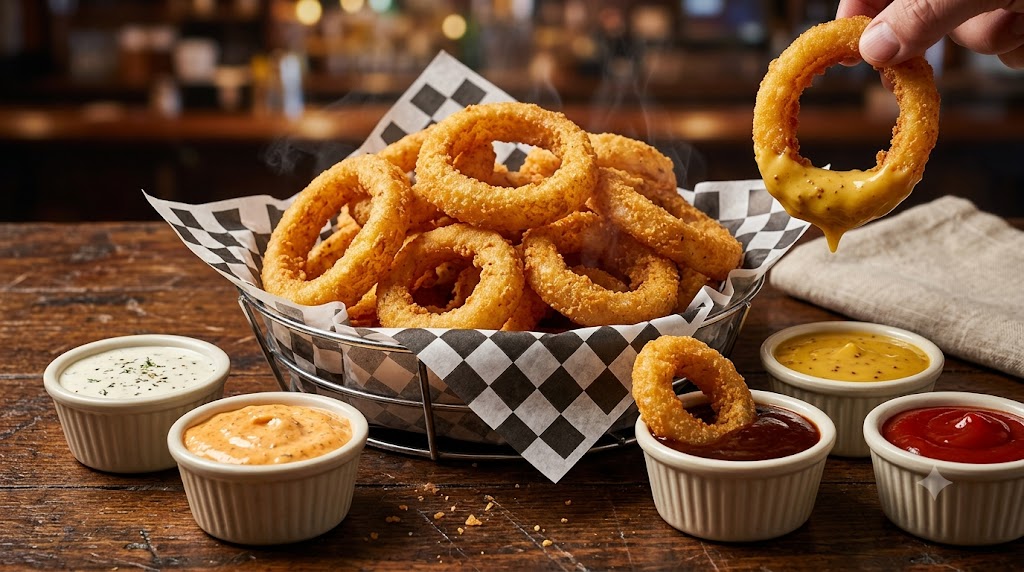
Nobody eats dry onion rings! But that little side cup of dipping sauce can silently hijack your nutritional goals.
Dipping Sauce Variety | Primary Base | Energy (kcal/30g) | Total Fat (g) | Saturated Fat (g) | Total Carbs (g) | Sodium (mg) |
Buttermilk Ranch | Soybean Oil & Buttermilk | 145 | 15.0 | 2.5 | 2.0 | 260 |
Restaurant "Zesty" Sauce | Mayonnaise & Horseradish | 160 | 16.5 | 2.8 | 3.0 | 280 |
Sweet Barbecue Sauce | High-Fructose Corn Syrup | 70 | 0.3 | 0.0 | 17.5 | 340 |
Honey Mustard | Mayonnaise & Honey | 130 | 10.0 | 1.5 | 9.0 | 210 |
Traditional Ketchup | Tomato Paste & Sugars | 35 | 0.1 | 0.0 | 9.0 | 300 |
(Standard 2-tablespoon / 30-gram serving sizes from USDA FoodData Central).
The Dip Reality Check: Restaurant sauce ramekins usually hold 2 to 3 fluid ounces (45 to 90 grams). If you dip generously into two cups of zesty onion ring sauce, you have just added 320 calories and 33 grams of pure fat to your meal—before counting a single ring!
What Happens Inside: Carbs, Fats, and Sodium
Enjoying onion rings every once in a while is one of life’s great pleasures, but understanding what happens physiologically helps you balance the rest of your day:
A Quick Glucose Surge: The outer coating is made of refined white flour, giving onion rings an estimated glycemic index of around 75 (high GI). Digestion breaks these refined starches down into simple sugars rapidly, triggering a spike in blood sugar and prompting insulin release.
Saturated Fat Overload: The American Heart Association recommends limiting saturated fats to under 6% of total daily calories—roughly 13 grams per day for a 2,000-calorie diet. A large order of 15 fast-food rings delivers 8.8 grams (68% of your daily limit), while 15 restaurant beer-battered rings deliver 16.8 grams, blowing past your daily allowance in one sitting.
Water Retention and Bloat: A 10-ring serving of fast-food rings carries over 1,000 mg of sodium. Your body holds onto extra fluid to balance this sudden salt intake, which can lead to temporary bloating and a temporary bump on the bathroom scale the next morning.
How to Burn It Off: Real-World Workout Equivalents
Curious about how much activity it takes to burn off those golden rings? Here is what it takes for an average 155-pound adult to burn through 5 fast-food rings (~288 kcal) versus 10 fast-food rings (~575 kcal):
Brisk Walking (3.5 mph):
5 Rings: ~65 minutes
10 Rings: ~130 minutes
Jogging / Running (5 mph):
5 Rings: ~30 minutes
10 Rings: ~60 minutes
Moderate Cycling (12–14 mph):
5 Rings: ~35 minutes
10 Rings: ~70 minutes
Lap Swimming (Freestyle, moderate):
5 Rings: ~25 minutes
10 Rings: ~50 minutes
You do not need to "punish" yourself with exercise after eating onion rings! These numbers simply offer a helpful frame of reference for how energy-dense fried foods can be.
Pro Tips to Enjoy Rings Without the Food Coma
You do not have to banish onion rings forever to stay fit and healthy. Use these simple culinary hacks to enjoy the crunch without the calorie hangover:
Adopt the "Rule of 5": When eating out, share the basket and limit yourself to 5 rings. You get all the flavor satisfaction while keeping your calorie intake under 300 kcal.
Pair with Protein and Greens: Instead of combining onion rings with a double bacon cheeseburger and a soda, pair them with a grilled chicken breast and a leafy green salad. Protein and fiber slow down digestion and blunt blood sugar spikes.
Upgrade Your Dip: Swap heavy mayo-based sauces for a dip made with nonfat plain Greek yogurt, lemon juice, garlic powder, and fresh herbs. You will save over 100 calories per serving while adding a bonus boost of protein!
Air-Fry at Home: Cut thick slices of Vidalia sweet onion, coat in seasoned panko crumbs, give them a quick spray of heart-healthy avocado oil, and air-fry at 400°F for 7 minutes. You get restaurant-grade crunch with a fraction of the oil!
Track Your Rings Without Typing: The VoCal Advantage
Let’s be honest: manually searching through calorie tracking apps after dining out is annoying. Scrolling through dozens of confusing database entries, trying to guess whether your onion ring was 14 grams or 28 grams, and typing in sauce brands usually leads to tracking fatigue.
That is where changes the game.
VoCal is a smart, voice-first calorie and macronutrient tracking app designed to fit real life. Instead of tapping menus or typing numbers, you just speak naturally:
"Hey VoCal, I had six onion rings with two tablespoons of ranch dressing."
That is literally all it takes. VoCal’s AI breaks down your speech, detects the food items, calculates portion estimates, and instantly logs your calories, protein, carbs, fats, and sodium.
Out at a restaurant? You can even snap a quick photo and add a quick voice note: "Shared half this appetizer basket of beer-battered onion rings with a friend". VoCal figures out the rest, keeping your health journey consistent, stress-free, and effortless.
Frequently Asked Questions (FAQs)
Are onion rings healthier than french fries?
Surprisingly, onion rings are often higher in calories and fat than regular french fries! Because an onion ring is thin and circular, it has more surface area exposed to batter and cooking oil than a solid potato fry. A small order of fast-food onion rings typically packs about 20% to 30% more fat than an equivalent serving of fries.
Can I eat onion rings on a keto or low-carb diet?
Traditional onion rings are not keto-friendly. Between the flour batter, breadcrumbs, and natural onion sugars, an order of 10 fast-food rings delivers over 60 grams of total carbohydrates and 41 grams of net carbs. For a low-carb alternative, make homemade rings coated with crushed pork rinds, parmesan cheese, or almond flour.
Why do restaurant onion rings have so many more calories than fast food?
Casual dining and sit-down restaurants typically make giant, hand-dipped beer-battered rings using colossal whole onions. A single restaurant ring can weigh more than double a fast-food ring, and the aerated beer batter absorbs significant amounts of cooking oil during frying.
What is the best way to reheat leftover onion rings so they stay crispy?
Skip the microwave, which turns the batter soggy! Instead, pop leftover rings into an air fryer or toaster oven at 375°F for 3 to 4 minutes. This crisps up the exterior crumb without needing extra oil.
Disclaimer: This article is for informational and educational purposes only and does not constitute individual medical or dietary advice. Nutritional values are based on standard USDA averages and may vary depending on restaurant preparation, portion sizes, and specific ingredients. For personalized nutrition guidance, consult a registered dietitian or healthcare provider.