

Whether you are spreading it on a toasted turkey club, mixing up a fresh batch of tuna salad, or using it as a dip for crispy fries, mayonnaise is easily one of America’s favorite condiments. It’s rich, tangy, ultra-creamy, and elevates almost any lunch dish. But if you’ve ever stopped mid-sandwich and wondered about mayo calories, you aren't alone!
Because mayonnaise is built around vegetable oil, it’s one of the most energy-dense spreads in your kitchen. An extra dollop here and an unmeasured scoop there can quietly add hundreds of unexpected calories to your day.
In this easy-to-read guide, we’re breaking down everything you need to know about mayo nutrition facts. We'll look at regular versus light mayo, discover how much energy mayo adds to your favorite sandwich, explore plant-based alternatives, and share smart hacks to manage your intake. Plus, we'll introduce you to VoCal—the voice-activated calorie counter that makes tracking condiments completely hands-free!
Calories in 1 Tbsp Mayo: Nutrition Facts
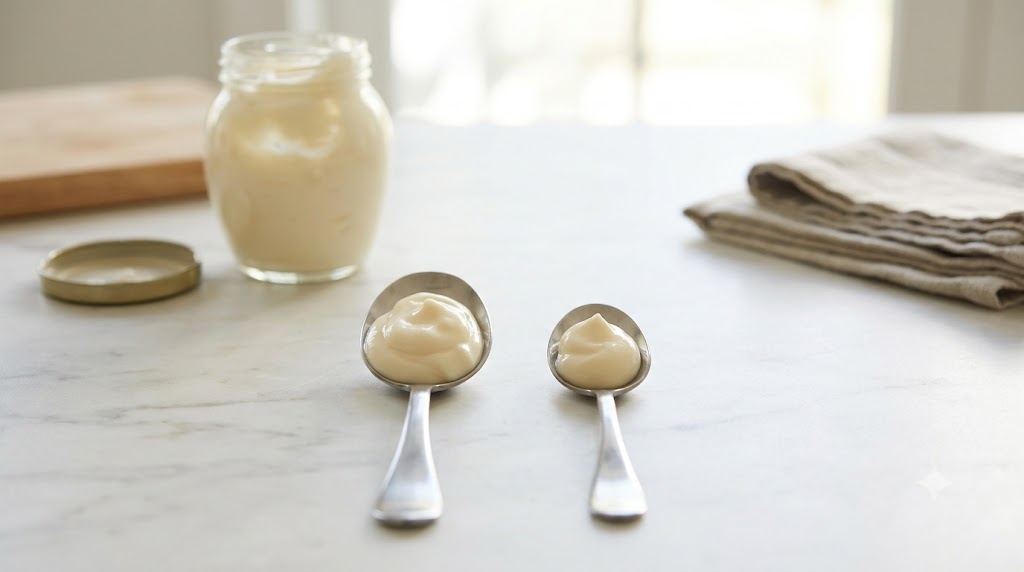
When you grab a butter knife and dip into a jar of mayo, you probably aren't weighing your serving on a laboratory scale. But when checking standard mayo nutrition facts, the official baseline serving size on nutrition labels is 1 tablespoon (1 Tbsp), which equals roughly 14 grams.
For classic, commercial full-fat mayonnaise—made from soybean, canola, or safflower oil blended with egg yolks and vinegar—a single tablespoon delivers 94 to 100 calories.
Virtually all of those calories come straight from fat. One tablespoon packs about 10 grams of total fat (including 1.6 grams of saturated fat), with under half a gram of carbohydrates and barely any protein. Because oil is pure lipid, mayonnaise has a very high energy density, meaning a small spoonful packs a lot of energy into a tiny volume!
Mayonnaise Variety | Serving Size | Energy (kcal) | Total Fat (g) | Saturated Fat (g) | Carbohydrates (g) | Sodium (mg) |
Regular Commercial | 1 Tbsp (14g) | 94–100 | 10.0 | 1.6 | 0.1 | 90–105 |
Light / Reduced-Fat | 1 Tbsp (15g) | 35–50 | 3.5–5.0 | 0.5–0.8 | 1.0–3.0 | 120–140 |
Fat-Free | 1 Tbsp (15g) | 10–15 | 0.0 | 0.0 | 2.0–3.0 | 120–150 |
Olive Oil Base | 1 Tbsp (14g) | 60–90 | 6.0–10.0 | 1.0 | 0.5 | 95–110 |
Avocado Oil Base | 1 Tbsp (14g) | 90–100 | 10.0 | 1.5 | 0.0 | 90–100 |
Key Takeaway: A standard 1-tablespoon serving of regular mayo contains roughly 100 calories and 10 grams of fat. Because it is oil-based, calories add up quickly if you don't measure your portion!
Calories in 1 Tsp Mayo: Nutrition Facts
If 100 calories for a single tablespoon feels a bit steep for your calorie budget, you don't have to cut mayo out of your life entirely. The secret lies in micro-dosing your spread!
A standard teaspoon (1 tsp) is one-third of a tablespoon, weighing in at about 4.7 grams. When you scale down to a measured teaspoon, you bring the energy count down to just 31 to 33 calories and 3.3 to 3.5 grams of fat. In standard dietary exchange guides, two teaspoons of regular mayo count as one single fat serving (around 45 calories).
Using a teaspoon to lightly coat your bread instead of slathering it on with a big spoon cuts your condiment calories by two-thirds while keeping that rich, savory taste you love!
Measurement Unit | Volume (mL) | Approx. Mass (g) | Regular Mayo (kcal) | Light Mayo (kcal) | Fat-Free Mayo (kcal) |
1 Teaspoon (tsp) | 4.93 | 4.7 | 31–33 | 12–16 | 4–5 |
2 Teaspoons (tsp) | 9.86 | 9.4 | 62–66 | 24–32 | 8–10 |
1 Tablespoon (Tbsp) | 14.79 | 14.0 | 94–100 | 35–50 | 10–15 |
Key Takeaway: Shrinking your serving down to 1 teaspoon brings mayo calories down to roughly 32 per dish, making it easy to enjoy great flavor while staying on track with your goals!
How Many Calories Does Mayo Add to a Sandwich?
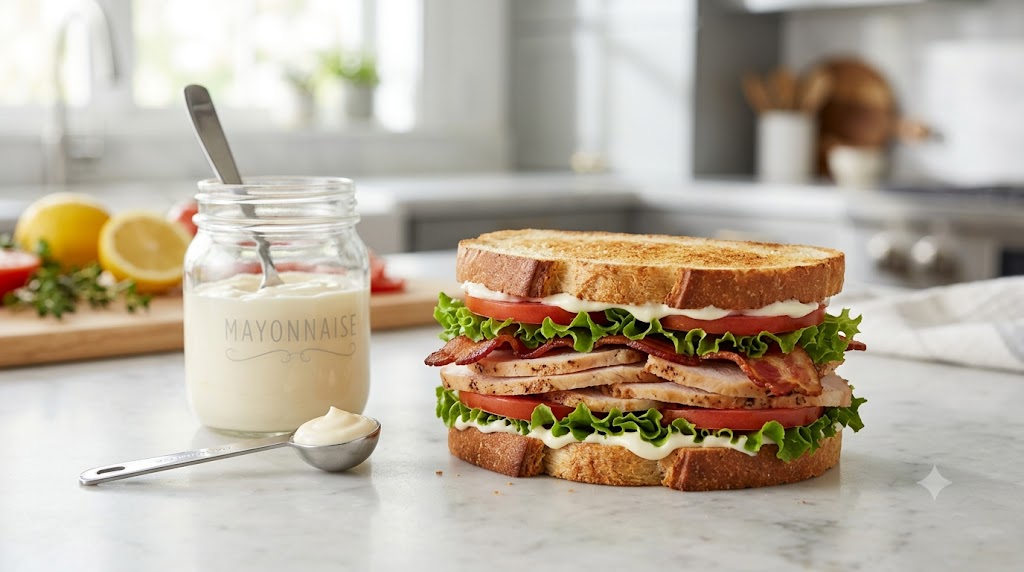
Here is a common scenario: you order a healthy turkey sub or assemble a tuna wrap at home, assuming it’s a light meal. But unless you explicitly ask for light spread or measure it yourself, deli workers and restaurant chefs often use 1.5 to 3 tablespoons of mayonnaise per sandwich.
That quick squeeze adds 140 to 300 extra calories and 15 to 30 grams of fat to your meal!
The hidden calorie jump is even larger in pre-mixed deli salads like chicken salad, egg salad, or tuna salad. Because mayo serves as the main continuous binder that gives deli salads their creamy texture, a single salad wrap can contain up to 2 full tablespoons of mayonnaise. In many classic lunch wraps, mayo accounts for 35% to 65% of the total meal’s energy load!
Sandwich / Wrap Type | Baseline Energy (Without Mayo) | Mayo Addition Volume | Mayo Energy Added | Final Meal Energy | Energy Increase (%) |
Deli Turkey Sub | 350 kcal | 1.5 Tbsp | +150 kcal | 500 kcal | +42.8% |
Classic BLT | 320 kcal | 2.0 Tbsp | +200 kcal | 520 kcal | +62.5% |
Tuna Salad Wrap | 280 kcal | 1.9 Tbsp | +190 kcal | 470 kcal | +67.8% |
Grilled Chicken Breast | 380 kcal | 1.0 Tbsp | +100 kcal | 480 kcal | +26.3% |
Key Takeaway: Unmeasured mayo can add 150 to 200+ calories to a sandwich, turning a lightweight lunch into a heavy calorie meal without you realizing it!
Light Mayo vs Regular Mayo: Calories Compared

Strolling down the grocery store aisle, you’ve probably noticed plenty of options labeled "Light," "Reduced-Fat," or "Fat-Free." But how does light mayo manage to slash calories, and does it taste just as good?
The secret comes down to simple food science. Traditional mayo relies on a high concentration of vegetable oil (70% to 80%) suspended in liquid. To create light mayo, food manufacturers replace a large portion of that oil with water.
Because water isn't naturally thick or creamy, food makers add natural hydrocolloids and starches—such as xanthan gum, guar gum, and modified food starch—to lock in moisture and keep the spread thick. Some formulas even use micro-sized whey proteins or plant fibers to replicate the velvety mouthfeel of traditional fat.
Thanks to these clever adjustments, light mayo slashes calorie density by 50% to 60%, bringing your intake down to just 35 to 50 calories per tablespoon. The only minor trade-off is that light and fat-free versions often contain slightly more sodium and carbohydrates than full-fat options to maintain flavor balance.
Formulated Property | Regular Mayonnaise | Light / Reduced-Fat Mayonnaise | Fat-Free Mayonnaise |
Lipid Phase Content | 70%–80% Vegetable Oil | 15%–50% Vegetable Oil | <3% Vegetable Oil |
Primary Stabilizers | Egg Yolk Lecithin | Egg Yolk, Guar Gum, Starches | Modified Starch, Xanthan Gum |
Caloric Density | ~6.7 kcal/g | ~2.5–3.3 kcal/g | ~0.7–1.0 kcal/g |
Carbohydrate Density | <0.5g per Tbsp | 1.0g–3.0g per Tbsp | 2.0g–3.0g per Tbsp |
Emulsion Stability | Baseline (Oil-Dependent) | High (Hydrocolloid Network) | High (Starch Matrix) |
Key Takeaway: Light mayo cuts calories in half by replacing oil with water and natural plant gums, giving you the same creamy texture for around 35 to 50 calories per tablespoon!
What About Avocado Oil, Olive Oil, and Vegan Mayo?
Specialty condiments are more popular than ever, but how do alternative oils and plant-based recipes compare when it comes to mayo calories?
Avocado Oil & Olive Oil Mayo: These varieties swap standard soybean oil for heart-healthy monounsaturated fats (like oleic acid). While they offer great fat quality, full-fat versions still pack 90 to 100 calories per tablespoon because oil is still pure fat. However, some reduced-fat olive oil spreads blend oil with water to deliver around 60 calories per tablespoon.
Vegan Mayo (Eggless): Plant-based spreads replace egg yolks with soy or pea protein to keep the emulsion stable. Since oil remains the primary ingredient, regular vegan mayo contains 80 to 90 calories per tablespoon. They are 100% cholesterol-free, but their calorie load is practically identical to classic mayo!
Key Takeaway: Specialty and plant-based mayos offer fantastic dietary benefits like heart-healthy fats and zero cholesterol, but full-fat versions carry the same energy load as standard mayo.
Smart Mayo Swaps
Looking to cut calories without giving up your favorite lunch spreads? Try these simple, delicious kitchen tricks:
The Greek Yogurt Hybrid: Mix equal parts light mayo with plain non-fat Greek yogurt. You’ll cut fat in half, boost your protein intake, and keep that rich, tangy creaminess!
Zesty Mustard Swap: Trade mayo for Dijon or spicy brown mustard. At just 5 to 10 calories per tablespoon, mustard delivers bold flavor for a fraction of the calories.
Drizzle Instead of Spreading: Thin out your mayo with a splash of fresh lemon juice or pickle juice. You get a pourable dressing that coats every bite using half the amount.
Track Sneaky Condiment Calories Hands-Free with VoCal
Let’s be honest: scraping mayonnaise off a knife to weigh it on a digital scale is messy, and typing fractional tablespoons into complex tracking apps takes too much time. That’s why VoCal makes logging your food completely effortless!
With VoCal, you can track your meals using simple voice commands. Just speak naturally into your phone: "I had a turkey sandwich with two teaspoons of light mayo." VoCal's smart voice assistant immediately calculates your intake and updates your daily journal in seconds. No searching through huge databases, no typing—just fast, accurate, voice-powered tracking!
Frequently Asked Questions (FAQs)
Is mayonnaise bad for weight loss?
Not at all! No food is inherently "bad" for weight loss. However, because regular mayo contains around 100 calories per tablespoon, unmeasured portions can easily cause you to exceed your daily calorie goal. Swapping to light mayo or controlling your portion sizes with a teaspoon allows you to enjoy mayo while losing weight.
Is light mayo healthier than regular mayo?
If your primary goal is reducing overall calorie and fat intake, light mayo is a great choice because it cuts calories by 50% or more. However, if you prefer minimal ingredients without added starches or gums, regular mayo made with avocado or olive oil may better fit your diet.
How many calories are in keto-friendly mayo?
Keto-friendly mayonnaises are typically made with high-fat oils like avocado oil or coconut oil and contain zero added sugars. They usually contain 90 to 100 calories and 10 grams of fat per tablespoon, making them ideal for high-fat keto targets but calorie-dense for standard diets.
Does mayonnaise contain cholesterol?
Traditional mayonnaise made with egg yolks contains a small amount of cholesterol (about 5 to 10 mg per tablespoon). If you are looking for a cholesterol-free option, plant-based (vegan) mayo contains zero egg products and zero cholesterol.
Disclaimer: This article is intended solely for general informational and educational purposes. It should not be used as a substitute for individual medical, nutritional, or dietary advice, diagnosis, or treatment. Always seek the advice of a qualified healthcare provider or registered dietitian with any questions you may have regarding your personal health, nutritional needs, or dietary regimen.