

Picture this: You are sitting at a classic American diner, catching a weekend football game at a sports bar, or pulling through the drive-thru after a long workday. The server sets down a golden, steaming basket of thick-cut onion rings. That initial crunch, followed by sweet, tender onion, is pure comfort food heaven.
Onions themselves are humble, vitamin-packed root vegetables. However, once they take a swim in seasoned batter and boiling vegetable oil, their nutritional profile shifts dramatically.
If you are keeping an eye on your daily intake, you have probably found yourself asking: Just how many onion rings calories am I actually eating? And does tossing them into an air fryer make a genuine difference?
Let’s unpack the science, crunch the numbers, and see how you can enjoy your favorite crispy snack without throwing your health goals off course.
Table of Contents
What Makes an Onion Ring So Irresistible?
The Big Showdown: Onion Rings Calories Breakdown
The Oil Sponge Effect: Why Deep Frying Adds So Many Calories
Health Perks and Pitfalls: What Happens Inside Your Body?
How to Burn It Off: Deep-Fried vs. Air-Fried
Effortless Tracking with VoCal
Frequently Asked Questions
What Makes an Onion Ring So Irresistible?
At its core, a raw yellow or sweet Vidalia onion is remarkably light. A 100-gram portion of raw onion contains only about 40 calories and is packed with natural plant antioxidants like quercetin.
The calorie spike occurs when we prepare the rings. Traditional onion rings are dredged in refined white flour, dunked in buttermilk or beer batter, coated in breadcrumbs, and submerged into a vat of sizzling oil heated to nearly 375°F.
The batter absorbs the hot oil, transforming an otherwise light vegetable into a calorie-dense treat.
Enter the countertop air fryer. By using high-speed convection fans to circulate superheated air, air fryers dehydrate the outer batter layer and trigger the Maillard reaction—that mouthwatering browning process—using only a whisper of cooking oil.
The result? You get that satisfying, shatteringly crisp crust while leaving the excess oil behind.
The Big Showdown: Onion Rings Calories Breakdown

How wide is the caloric divide between traditional deep frying and air frying?
Here is how the numbers stack up across a standard 100-gram serving (roughly 6 to 8 medium onion rings) across different cooking methods:
Nutritional Metric (per 100g) | Deep-Fried Commercial Onion Rings | Frozen Par-Fried (Oven/Air Heated) | Homemade Air-Fried (Panko Coated) | Homemade Air-Fried (Low-Carb Parmesan) |
Total Energy (kcal) | 417 | 276 | 175 | 212 |
Total Fat (g) | 25.0 | 14.0 | 4.5 | 16.0 |
Saturated Fat (g) | 4.2 | 2.1 | 0.8 | 5.0 |
Carbohydrates (g) | 44.0 | 34.0 | 30.0 | 9.0 |
Dietary Fiber (g) | 2.7 | 2.2 | 2.4 | 1.8 |
Sugars (g) | 5.4 | 5.1 | 4.8 | 3.5 |
Protein (g) | 3.9 | 4.1 | 4.2 | 9.0 |
Sodium (mg) | 776 | 370 | 280 | 410 |
(Data gathered from USDA FoodData Central and comparative food science analyses.)
What the Numbers Reveal:
The Restaurant Heavyweight: A standard restaurant order of deep-fried onion rings packs a massive 417 calories and 25 grams of fat per 100 grams. Over half of those calories come straight from absorbed cooking oil.
The Frozen Food Compromise: Bagged frozen onion rings from the supermarket sit at roughly 276 calories per 100 grams. Even if you pop them in an air fryer at home, remember that manufacturers "par-fry" them in oil at the factory before freezing, meaning a portion of that fat is already baked in.
The Scratch-Made Air-Fried Champ: Making onion rings from scratch at home with raw onions, an egg wash, whole-wheat panko, and an olive oil spray slashes the calorie count to just 175 kcal—cutting the calories by more than half and the fat by over 80 percent!
The Low-Carb Alternative: Swapping the breadcrumbs for grated parmesan creates a crunchy snack with only 9 grams of carbs and 9 grams of protein, offering steady energy without a post-meal sugar spike.
The Oil Sponge Effect: Why Deep Frying Adds So Many Calories
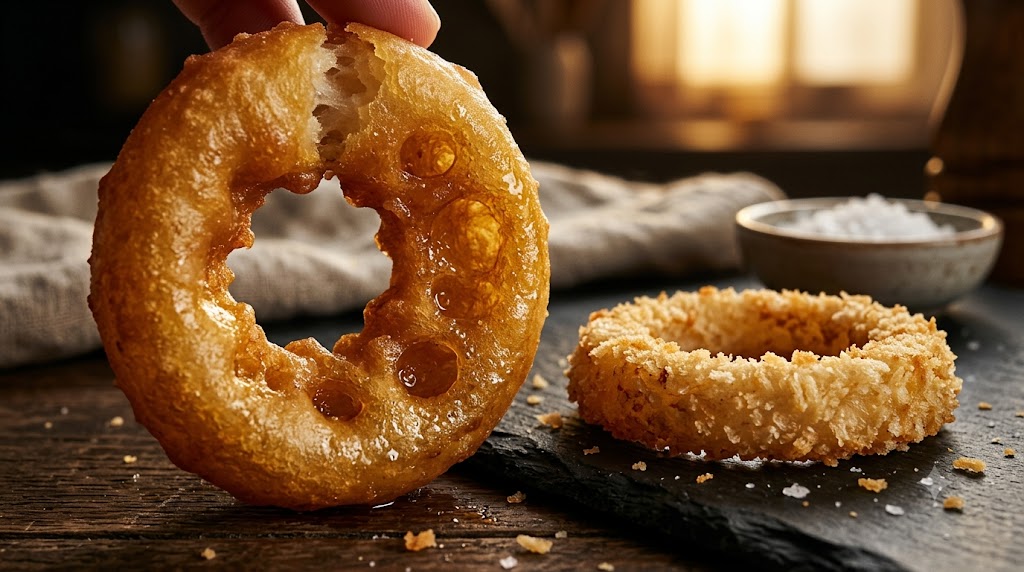
To understand where all those extra onion rings calories come from, consider the physics of cooking.
When battered onions hit a commercial deep fryer, the boiling oil instantly vaporizes the water on the surface of the food. That rapid steam escape creates tiny microscopic tunnels throughout the crust.
As the onion ring cooks and the steam subsides, those empty tunnels act like miniature straws. The moment the ring is lifted out of the fryer and begins to cool, the internal pressure drops, and the crust vacuums up the surface oil.
Because pure fat contains 9 calories per gram—more than double the 4 calories per gram found in protein or carbohydrates—every gram of oil absorbed adds up quickly.
Air fryers avoid this entirely. By blasting superheated air across the food, they evaporate moisture from the surface while circulating just a fine mist of oil. Research demonstrates that air frying reduces overall oil uptake by 70 to 90 percent compared to deep-fat frying.
You get the signature crispiness without the hidden fat reservoir.
Health Perks and Pitfalls: What Happens Inside Your Body?
Choosing air-fried onion rings over deep-fried versions influences your body in several key ways:
1. Vascular & Heart Health
Commercial kitchens reuse large fryers throughout a shift. When cooking oils are repeatedly heated to extreme temperatures, they break down into oxidized fatty acids and trans fat compounds.
A landmark 25-year study by the Harvard T.H. Chan School of Public Health found that individuals who ate fried foods four to six times a week had a 39 percent higher risk of developing type 2 diabetes, with the risk rising to 55 percent for those eating them daily.
When you make air-fried onion rings at home, you control the quality of the oil. Using heart-healthy, monounsaturated fats like avocado oil or extra-virgin olive oil delivers protective polyphenols without the harmful compounds produced by degraded fryer grease.
2. Lowering Neo-Formed Dietary Contaminants
When high-carbohydrate coatings meet sizzling temperatures, a chemical byproduct called acrylamide can form. International health agencies classify acrylamide as a probable human carcinogen. Studies show that air frying can reduce acrylamide formation by up to 90 percent compared to traditional deep frying.
Just keep an eye on your air fryer timer: you want a vibrant golden brown rather than dark, charred edges, as excessive browning can produce unwanted compounds like 5-HMF.
3. Taming the Sodium Bomb
The 2020–2025 Dietary Guidelines for Americans recommend keeping daily sodium intake under 2,300 milligrams.
A single serving of restaurant-fried onion rings can easily contain 776 milligrams of sodium—over a third of your entire daily budget!
Air frying at home lets you season thoughtfully with sea salt, smoked paprika, garlic powder, and herbs, keeping the sodium around a modest 280 milligrams.
How to Burn It Off: Deep-Fried vs. Air-Fried
To put these calorie counts into perspective, here is the approximate physical activity required for an average adult to burn off a standard serving:
Deep-Fried Restaurant Rings (~420 kcal)
Brisk Walking (3.5 mph): ~95 minutes
Jogging (5 mph): ~45 minutes
Stationary Biking: ~40 minutes
High-Intensity Interval Training (HIIT): ~35 minutes
Homemade Air-Fried Onion Rings (~175 kcal)
Brisk Walking (3.5 mph): ~35 minutes
Jogging (5 mph): ~18 minutes
Casual Bike Ride: ~18 minutes
Dancing Around the Living Room: ~25 minutes
Choosing the air-fried version saves you about an hour of walking, giving you the same crispy satisfaction with far less effort required to maintain your daily balance!
Effortless Tracking with VoCal
Nutrition tracking often falls apart when dealing with fried foods. If you search a typical food database for "onion rings," you might get dozens of conflicting results.
Log a restaurant-fried portion as a homemade baked ring, and you could unintentionally miss 200 to 250 calories. On the flip side, logging your air-fried snack as a deep-fried item might leave you feeling unnecessarily stressed about your numbers.
This is where VoCal comes in.
Instead of typing through endless database lists or trying to guess portions, you simply tap the mic and speak naturally:
"Logged six homemade air-fried onion rings made with panko and a spray of olive oil."
VoCal’s AI-powered voice engine processes your cooking method, portion size, and ingredients in seconds. It logs your exact macros and calories accurately without the guesswork, helping you stay on track with your fitness goals.
Frequently Asked Questions
1. How many calories are in a small order of fast-food onion rings?
A typical small fast-food serving (around 90 to 100 grams) contains between 380 and 420 calories, with roughly 23 to 25 grams of fat. Larger restaurant baskets can easily climb past 600 calories.
2. Does cooking store-bought frozen onion rings in an air fryer make them low-calorie?
Air frying frozen rings will prevent you from adding extra oil, but it does not remove the oil already present. Most commercial frozen brands are par-fried before packaging, so a 100-gram serving still provides roughly 276 calories. For the lowest calorie count, make them from scratch using fresh onions and whole-grain breadcrumbs.
3. Can I eat onion rings on a low-carb or keto diet?
Traditional flour-battered onion rings are relatively high in carbohydrates (about 44 grams per 100 grams). However, you can make keto-friendly air-fried onion rings by coating raw onion slices in a whisked egg and dipping them in finely grated parmesan cheese or crushed pork rinds. This cuts digestible carbohydrates to just 9 grams while providing 9 grams of protein.
4. What temperature and time work best for air-fried onion rings?
For the ideal balance of crunch without burning, set your air fryer to 375°F (190°C) and cook for 5 to 7 minutes. Give the basket a gentle shake halfway through cooking to ensure even browning across all sides.
Disclaimer: This article is for informational purposes only and does not constitute medical, dietary, or nutritional advice. Always consult a qualified healthcare professional or registered dietitian before making significant changes to your dietary routine.