
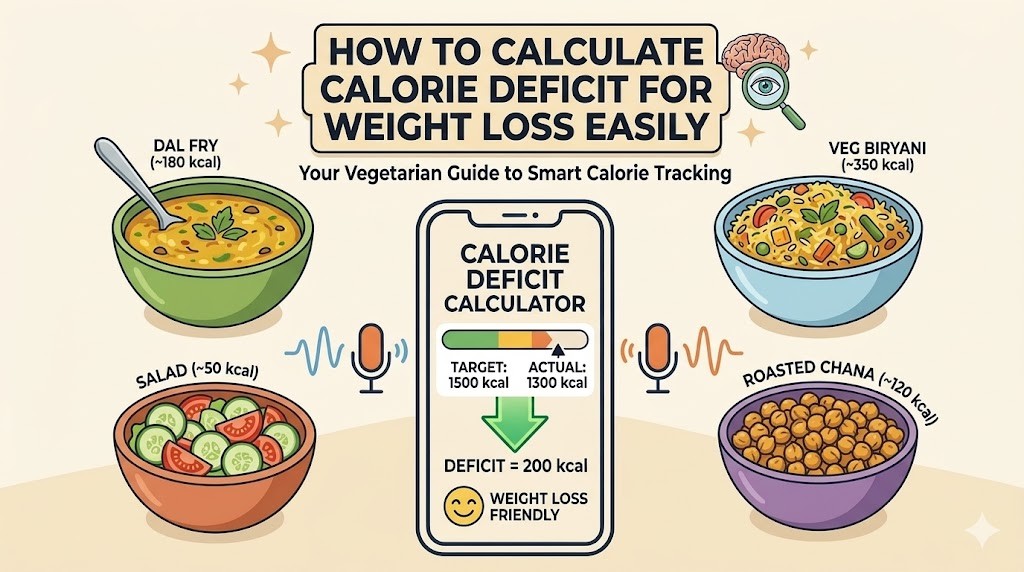
If you’ve ever felt like weight loss is a giant math puzzle that you just can't solve, you aren’t alone. Between "miracle" diets and complex gym routines, it’s easy to get lost. However, weight loss essentially boils down to one simple concept: the calorie deficit.
Think of your body like a battery. To lose weight, you need to use more energy than you’re plugging in. But how do you find that "sweet spot" without feeling like you're starving or living in a spreadsheet?
In this guide, we’ll break down exactly how to calculate your deficit, keep your energy high with tasty vegetarian foods, and use new tech like voice-tracking to make the whole process effortless.
Quick Summary
What is it? A calorie deficit is when you eat fewer calories than your body burns.
The Goal: Most experts suggest a modest deficit of 500 calories per day for steady, healthy weight loss.
Vegetarian Edge: High-fiber plant foods make you feel fuller for longer, making a deficit much easier to maintain.
Pro Tip: Use voice-based apps like VoCal to log meals in seconds—no more tedious typing!
Step 1: Find Your "Keep-the-Lights-On" Number (BMR)
Before you can cut calories, you need to know how many your body needs just to function. This is called your Basal Metabolic Rate (BMR). It’s the energy your body uses to breathe, keep your heart beating, and repair cells while you’re binge-watching your favorite show.
Scientists use the Mifflin-St Jeor equation to estimate this number.
If you are... | Use this formula |
Male | (10 *{weight in kg}) + (6.25 *{height in cm}) - (5 *{age}) + 5 |
Female | (10 *{weight in kg}) + (6.25 *{height in cm}) - (5 *{age}) - 161 |
The Bottom Line: This is your metabolic "floor." You generally shouldn't eat below this number without medical supervision.
Step 2: Calculate Your Daily Burn (TDEE)
Now, let’s add in your movement. Your Total Daily Energy Expenditure (TDEE) is your BMR plus the energy you use walking, working, and exercising.
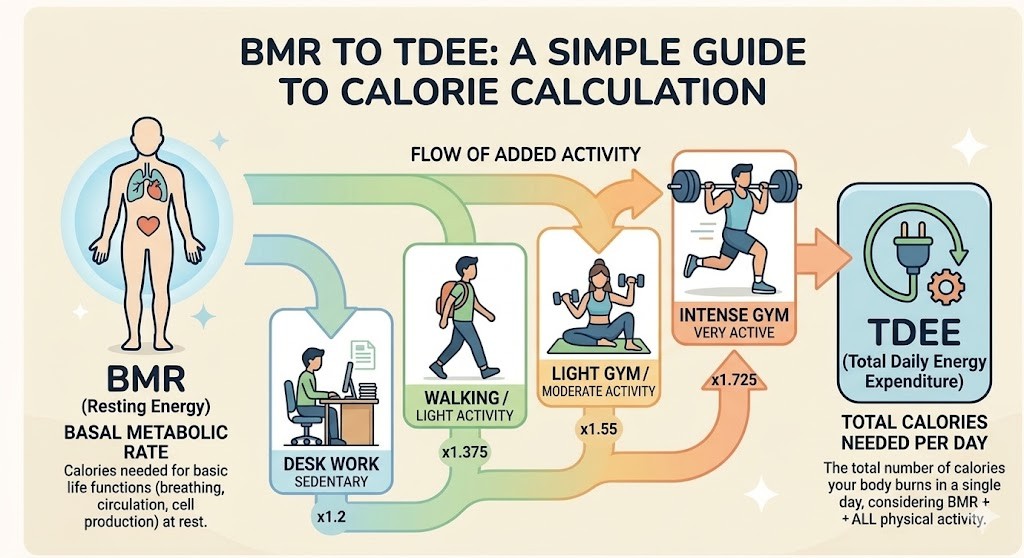
To find yours, multiply your BMR by the "Activity Factor" that matches your lifestyle:
Activity Level | Lifestyle Description | TDEE Calculation |
Sedentary | Little to no exercise; desk job. | BMR * 1.2 |
Lightly Active | Light exercise 1–3 days/week. | BMR * 1.375 |
Moderately Active | Moderate sports 3–5 days/week. | BMR * 1.55 |
Very Active | Hard exercise 6–7 days/week. | BMR * 1.725 |
Step 3: Pick Your Deficit Tier
How fast do you want to go? For most people, losing 1–2 pounds per week is the gold standard for staying healthy and keeping the weight off for good.
Small Deficit (10-15%): Great for building habits and keeping muscle.
Moderate Deficit (20-25%): The "sweet spot" for noticeable progress. Usually about 500 calories less than your TDEE.
Aggressive Deficit (30%+): Faster results, but harder to stick to. Watch out for "hanger"!
Vegetarian Power: High-Protein, Low-Calorie Favorites

One myth about vegetarian weight loss is that it’s all "carbs." Actually, plant-based proteins are your secret weapon. They are often lower in calories than meat but packed with fiber to keep you satisfied.
Vegetarian Protein Source | Serving Size | Calories (Approx.) | Protein (g) |
Non-fat Greek Yogurt | 1 cup | 130 | 24g |
Seitan | 3 oz | 120 | 21g |
Tempeh | 100g | 192 | 20g |
Cooked Lentils | 1 cup | 230 | 18g |
Firm Tofu | 1/2 cup | 90 | 10g |
Cottage Cheese (2%) | 1/2 cup | 90 | 12g |
Safety & Plateaus
Weight loss isn't a straight line. Sometimes your body adapts to your new habits, and progress stalls—this is called a plateau.
Don't panic: Plateaus are normal survival mechanisms.
Move more: Try adding 15 minutes of walking to your day to rev up your burn.
Stay safe: Women should generally avoid going below 1,200 calories and men below 1,500 calories per day to avoid nutrient gaps.
Making It Easy: The Tech Advantage
The biggest reason people quit? Tracking is a chore. Digging through databases to find how many calories are in a "homemade kale salad" takes too long.
This is where voice-based tracking (like the tech at VoCal) changes everything. Instead of typing, you simply say: "I had a cup of Greek yogurt with a handful of blueberries."
Speed: Log a meal in 5 seconds instead of 5 minutes.
Consistency: Research shows people are 1.7 times more likely to stick to their goals when using voice input.
Less Stress: It feels like talking to a friend rather than doing homework.
Summary
Calculating a calorie deficit is the most reliable way to lose weight. By finding your BMR, adjusting for your activity, and fueling with high-protein vegetarian foods, you can reach your goals without the headache. And with tools like VoCal, the "math" part of weight loss finally becomes easy.
FAQs
1. Can I build muscle while in a calorie deficit?
Yes! If you eat enough protein and do some resistance training (like weights or yoga), you can definitely tone up while losing fat.
2. Is a 1,200-calorie diet safe?
It can be, but it’s the lower limit for most adults. It’s best to speak with a doctor to make sure you're still getting the vitamins you need.
3. What happens if I miss a day of tracking?
Nothing! Consistency beats perfection. Just get back to your routine the next day. A single day won't ruin your progress.
Disclaimer: This information is for educational purposes only and is not a substitute for professional medical advice, diagnosis, or treatment. Always consult with a physician or registered dietitian before starting a new diet or weight loss program.