
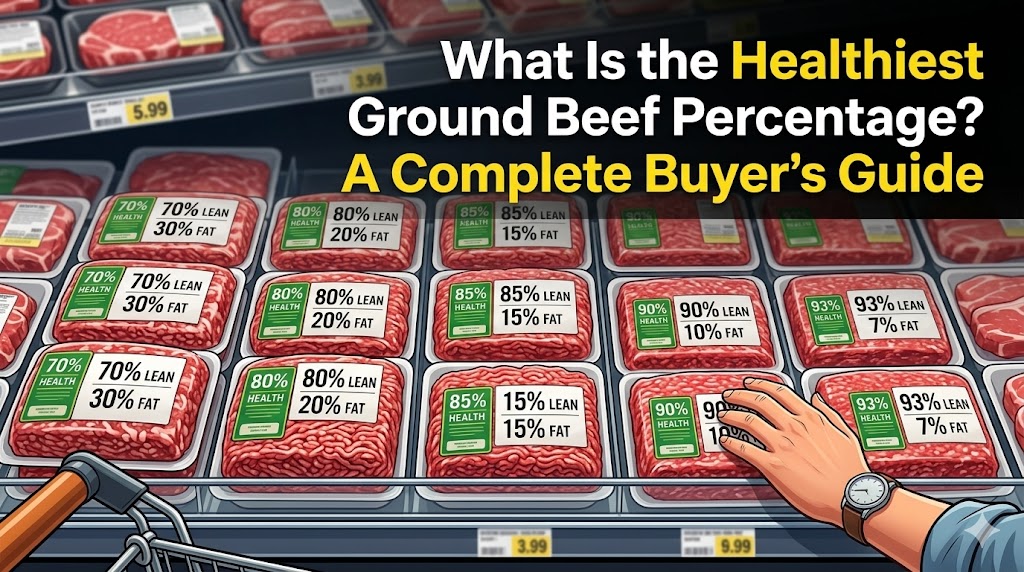
Imagine you are standing in the grocery store meat aisle on a busy Sunday afternoon. You are surrounded by a sea of bright red packages, and all you want to do is make a quick batch of taco meat. But instead, you are staring at a wall of confusing numbers: 80/20, 93/7, 85/15, and 70/30. Suddenly, buying dinner feels like taking a high-pressure college math exam.
Finding the healthiest ground beef percentage does not have to be a headache. Understanding what these numbers mean is the ultimate secret weapon for crushing your weight loss goals, building lean muscle, and keeping your cardiovascular health in peak condition.
But let’s be honest: tracking all of these specific numbers and trying to guess how much fat renders out during cooking can be incredibly tedious. If you are tired of typing detailed nutritional descriptions into search bars, voice-based calorie tracking apps like VoCal are an absolute game-changer. Instead of typing, you can simply speak your meal prep methods aloud—"Log four ounces of cooked, rinsed eighty-twenty ground beef"—and let the app handle the complex nutritional math for you.
Let’s dive into the juicy details behind ground beef ratios so you can confidently choose the perfect pack for your health goals.
Decoding the Numbers: What Ground Beef Percentages Actually Mean
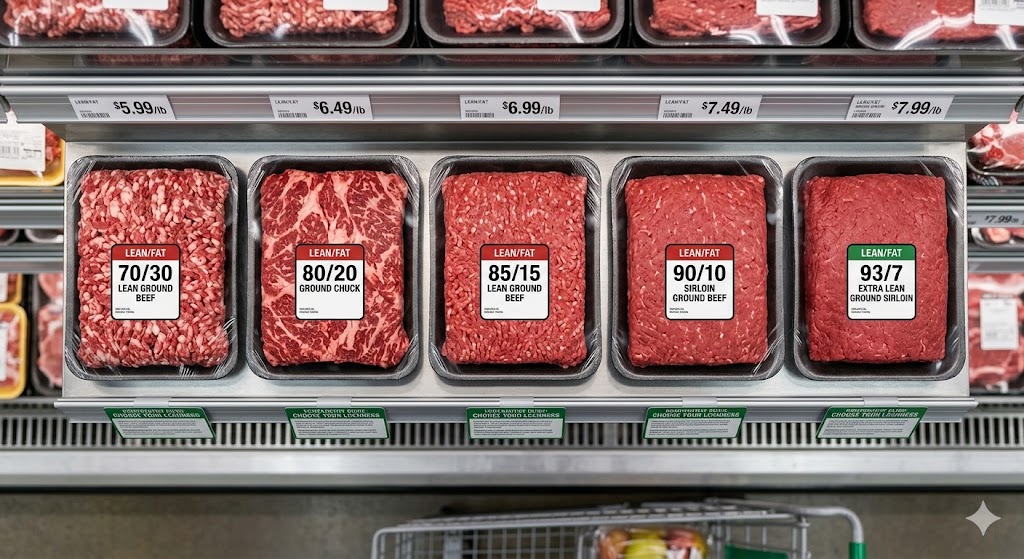
Those mystery numbers printed on ground beef packaging are actually very simple: they represent the lean-to-fat ratio by weight.
The first number represents the percentage of lean muscle meat, while the second number tells you the percentage of fat. For instance, a package of 85/15 ground beef is composed of 85% lean muscle tissue and 15% fat.
The specific cuts of beef used during the grinding process naturally dictate these percentages:
Ground Chuck: Sourced from the shoulder and neck regions of the cow, chuck is naturally marbled and typically averages an 80/20 ratio. It is the ultimate crowd-pleaser for burgers because the fat keeps the meat incredibly juicy.
Ground Round: Sourced from the hindquarters and leg, this cut is naturally leaner, usually landing around 85/15. It is an excellent, versatile middle-ground option for everyday family meals.
Ground Sirloin: Sourced from the mid-back subprimal, sirloin is a premium, naturally lean cut that generally falls between 90/10 and 95/5.
Generic "Ground Beef" or "Hamburger": If the package does not specify a primal cut like chuck or sirloin, it is a blend of leftover trimmings from various parts of the animal, regulated by the USDA to contain no more than 30% fat.
To help you navigate the meat counter, here is a quick breakdown of how these primal sources align with raw fat percentages and culinary uses:
Ground Beef Type | Source Primal | Raw Fat % | Raw Lean % | Satiety Factor | Primary Culinary Utility |
Ground Chuck | Shoulder & Neck | 20% | 80% | Moderate | Smash Burgers, Meatballs, Meatloaf |
Ground Round | Hindquarter / Leg | 15% | 85% | Moderately High | Tacos, Sheet Pan Dinners, Casseroles |
Ground Sirloin | Mid-Back / Loin | 10% | 90% | High | Meat Sauces, Chili, Lasagna, Skillet Meals |
Extra Lean Grinds | Sirloin / Trimmings | 3% to 7% | 93% to 97% | Very High | Soups, Stews, Stuffed Peppers, Stir-Fries |
Bottom Line: The numbers on the label represent the weight-based ratio of lean muscle meat to fat, which directly dictates how much the meat shrinks during cooking, how juicy it remains, and its total caloric value.
The Weight Loss Winner: Calorie Density and Satiety
When you are aiming for weight loss, you want to get the most bang for your caloric buck. This is where the concept of calorie density becomes your best friend.
Protein is the absolute champion of weight loss because it is the most satiating macronutrient. It takes your body more energy to digest protein than fats or carbs, and it keeps you feeling full for hours, preventing those late-night kitchen raids. Fat, on the other hand, packs a whopping 9 calories per gram, compared to just 4 calories per gram for protein.
Ultra-lean grinds like 93/7 or 95/5 ground beef are absolute gold mines for weight loss because they deliver highly concentrated protein with minimal fat calories.
To see exactly how many calories you can save, take a look at the raw nutritional values for a standard 4-ounce (113-gram) raw serving across the most common ratios:
Ground Beef Ratio (Raw, 4 oz) | Calories (kcal) | Total Fat (g) | Saturated Fat (g) | Protein (g) |
70/30 Ground Beef | 375 | 33.9 | 13.3 | 16.2 |
80/20 Ground Beef | 290 | 23.0 | 9.0 | 19.0 |
85/15 Ground Beef | 240 | 17.0 | 3.0 | 21.0 |
93/7 Ground Beef | 170 | 8.0 | 3.0 | 24.0 |
Notice the massive leap between the ends of the spectrum. A 4-ounce serving of raw 70/30 ground beef packs an astonishing 375 calories, with a massive 83% of those calories coming purely from fat! Swap that out for a 93/7 blend, and you get more protein while saving 205 calories per serving.
Over the course of a week, making simple swaps like this can easily add up to a significant calorie deficit without forcing you to eat tiny, unsatisfying portions.
If you are tracking your macros, trying to guess how much fat cooked out of your meat can make you want to throw your cooking utensils in frustration. With the voice-logging platform on VoCal, tracking these differences is incredibly easy. Simply tell the app, "Log four ounces of ninety-three-seven ground beef," and your food diary is instantly and accurately updated.
Bottom Line: Extra-lean ratios like 93/7 or 95/5 are the ultimate choices for weight loss, minimizing calorie density while providing high-quality, filling protein that supports muscle retention.
The Ultimate Showdown: 90/10 vs. 93/7 Ground Beef
If you want to eat healthily but refuse to chew on dry, flavorless meat, you will likely find yourself choosing between 90/10 (Ground Sirloin) and 93/7 (Extra-Lean Ground Beef). Both are exceptional, nutrient-dense choices, but they perform quite differently in the kitchen.
The Nutritional Breakdown
Once cooked, these two grinds are neck-and-neck. A 3-ounce cooked portion of 93/7 ground beef crumbles provides approximately 178 calories, 8 grams of total fat, and 25 grams of protein. A matching cooked portion of 90/10 ground beef yields roughly 169 to 173 calories, 9 grams of total fat, and 22 grams of protein.
The Cost and Taste Factor
Because of the precision and extra labor required to trim fat down to single-digit percentages, 93/7 ground beef is often the most expensive option at the meat counter. Ground sirloin (90/10) is also a premium cut, but it can sometimes be more budget-friendly depending on supermarket sales.
When it comes to flavor, fat acts as a natural shield against dry heat. It prevents the muscle fibers from tightening up and squeezing out moisture.
90/10 Ground Sirloin: Retains just enough fat to stay moist in dry-heat preparations. It is highly versatile and works beautifully in meatballs, tacos, and light skillet meals where you want the beef to hold its shape without swimming in grease.
93/7 Ground Beef: Because it is so lean, it can dry out and become crumbly very quickly if pan-seared. It is best suited for "wet" cooking methods—like chilis, bolognese, pasta sauces, and hearty soups—where the surrounding liquids keep the lean protein tender and juicy.
Comparison Metric | 90/10 Ground Sirloin (Cooked) | 93/7 Extra-Lean Beef (Cooked) |
Calorie Content | ~169 kcal per 3 oz | ~178 kcal per 3 oz |
Protein Content | ~22 g per 3 oz | ~25 g per 3 oz |
Saturated Fat | ~3.7 g per 3 oz | ~3.0 g per 3 oz |
Average Retail Cost | Moderate to High | High |
Best Cooking Methods | Meatballs, Tacos, Skillets | Chili, Bolognese, Soups |
Bottom Line: While 93/7 offers slightly more protein, 90/10 ground beef is often a more versatile kitchen champion, holding onto its moisture and flavor much better across dry-heat recipes.
Protein Density: Which Percentage Maximizes Muscle Growth?
A very common grocery store misconception is that all ground beef contains the exact same amount of protein. In reality, protein density is inversely related to fat content. Because protein lives in the lean muscle tissue of the cow, the higher the lean percentage on the package, the more raw protein you get per ounce.
During cooking, this relationship shifts slightly as water and fat render out of the meat, concentrating the remaining protein. To see how this concentrations look on your plate, here is the cooked protein density of a 3-ounce (85-gram) portion across different grinds:
Cooked Ground Beef Ratio (3 oz Patty) | Protein Content (g) | Total Fat Content (g) | Caloric Load (kcal) |
95% Lean Ground Beef | 26.0 g | 5.0 g | 164 kcal |
93% Lean Ground Beef | 25.0 g | 8.0 g | 178 kcal |
90% Lean Ground Beef | 22.0 g | 13.1 g | 213 kcal |
85% Lean Ground Beef | 21.0 g | 12.0 g | 204 kcal |
80% Lean Ground Beef | 20.0 g | 15.0 g | 228 kcal |
70% Lean Ground Beef | 21.6 g | 15.9 g | 235 kcal |
Note: Sourced from USDA FoodData Central and standard nutritional database comparisons.
Swapping out 80% lean ground beef for 95% lean ground beef gives you an extra 6 grams of pure, high-quality protein per 3-ounce cooked serving while saving you 64 calories and 10 grams of total fat. For athletes, bodybuilders, or anyone in a fat-loss phase, this is an incredibly efficient way to hit daily protein targets without blowing past calorie limits.
Bottom Line: The lower the fat percentage, the more protein you get per bite. Extra-lean grinds (93% to 95% lean) are the most efficient choices for maximizing amino acid intake.
USDA Labeling Standards: "Lean" vs. "Extra-Lean"
To protect consumers from misleading marketing, the USDA Food Safety and Inspection Service (FSIS) enforces strict legal definitions for nutrient content claims on meat packaging. These classifications are evaluated based on a reference portion size of 100 grams (about 3.5 ounces) of raw beef :
"Lean" Beef: 100 grams of raw beef must contain less than 10 grams of total fat, 4.5 grams or less of saturated fat, and less than 95 milligrams of cholesterol.
"Extra-Lean" Beef: 100 grams of raw beef must contain less than 5 grams of total fat, less than 2 grams of saturated fat, and less than 95 milligrams of cholesterol.
These nutritional definitions are entirely different from voluntary beef quality grades like Prime, Choice, and Select, which measure marbling (the white flecks of intramuscular fat) to determine tenderness and flavor. Prime has the most marbling, Choice has less, and Select has the least.
You might also spot labels like "Organic" or "Natural". The USDA defines "Natural" simply as minimally processed with no artificial ingredients. "Organic" beef must carry the official green-and-white USDA Organic seal, verifying that the animals were fed certified organic feed and raised without antibiotics or synthetic growth hormones. However, neither label indicates fat content; always look for the lean-to-fat percentage to verify leanness.
Bottom Line: "Lean" and "Extra-Lean" are legally protected USDA terms that guarantee strict upper limits on total fat, saturated fat, and cholesterol per 100 grams of raw product.
The Ultimate Kitchen Hack: Browning, Blotting, and Rinsing
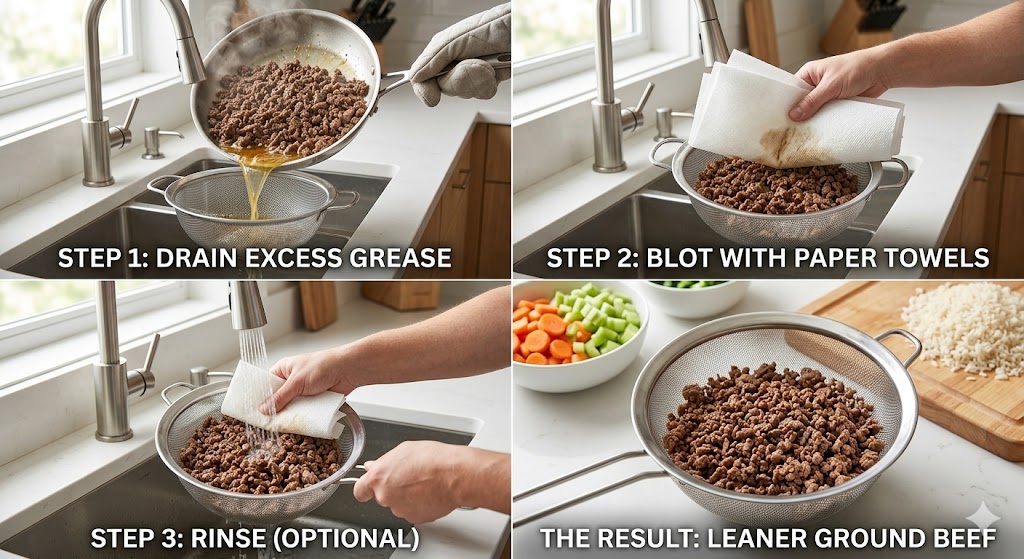
If you are on a tight budget, buying premium extra-lean ground beef can quickly add up. But what if you could buy affordable, high-fat ground beef (like 80/20) and turn it into a lean, healthy protein right in your own kitchen?
According to research from Iowa State University and the USDA, you can! A simple browning, blotting, and hot-water rinsing technique can slash the fat and calorie content of ground beef crumbles by up to 50%.
The 5-Step Fat Reduction Method:
Brown the Meat: Cook your ground beef crumbles in a large non-stick skillet over medium heat for 8 to 10 minutes, breaking them into small pieces until the internal temperature reaches 160°F.
Blot with Paper Towels: Using a slotted spoon, transfer the cooked crumbles to a large plate lined with three layers of paper towels, letting it sit for one minute while blotting the top.
Heat the Water: Microwave 4 cups of water in a bowl for 5 to 6 minutes until very hot but not boiling.
Rinse the Fat: Place the blotted beef into a fine-mesh strainer or colander and gently pour the hot water over the crumbles, letting the fat drain away for 5 minutes.
Proceed with Recipe: Season the beef after rinsing to prevent any herbs, spices, or salt from washing away.
Take a look at how this kitchen hack transforms the nutritional profile of different grinds:
Ground Beef Type (Raw) | Cooked Preparation | Cooked Calories (Per 3 oz) | Cooked Fat (Per 3 oz) |
80/20 Ground Beef | Cooked, Undrained | 228 kcal | 15.0 g |
80/20 Ground Beef | Cooked & Blotted | 191 kcal | 11.0 g |
80/20 Ground Beef | Cooked, Blotted, & Rinsed | 130 kcal | 5.0 g |
73/27 Ground Beef | Cooked, Undrained | 248 kcal | 18.0 g |
73/27 Ground Beef | Cooked & Blotted | 195 kcal | 12.0 g |
73/27 Ground Beef | Cooked, Blotted, & Rinsed | 135 kcal | 6.0 g |
By hot-water rinsing budget-friendly 80/20 ground beef, you reduce its fat content to just 5 grams, making it nutritionally comparable to expensive, undrained 95% lean beef. Best of all, scientific analysis confirms that rinsing does not wash away the essential protein, iron, zinc, or vitamin B12 in the meat.
With VoCal, logging this preparation is incredibly simple. Just say, "Log three ounces of rinsed eighty-twenty beef," and the app will accurately track the lighter fat profile instead of the raw values, keeping your food diary accurate.
Bottom Line: Cooking, blotting, and hot-water rinsing can remove up to 50% of the fat from ground beef crumbles, transforming budget-friendly, high-fat grinds into lean, high-protein options.
Heart Health: Saturated Fat and LDL Cholesterol
While beef is an excellent source of essential micronutrients like iron and vitamin B12, it is also a major source of saturated fat. Consuming high levels of saturated fat is linked to elevated levels of low-density lipoprotein (LDL) cholesterol, which is a key biomarker for heart disease.
To protect heart health, major public health organizations recommend strict daily limits on saturated fat intake:
The Dietary Guidelines for Americans: Recommend limiting saturated fat to no more than 10% of total daily calories (about 22 grams per day on a 2,000-calorie diet).
The Mayo Clinic and American Heart Association (AHA): Recommend a stricter limit of less than 6% of total daily calories (approximately 11 to 13 grams per day) for individuals managing cardiovascular risk.
To see how ground beef stacks up against other ground proteins, look at the saturated fat content in a cooked 3-ounce portion:
Cooked Ground Protein (3 oz Portion) | Total Saturated Fat (g) | Saturated Fat % DV (Based on AHA <6% Limit) |
Ground Chicken (99% Lean) | 0.00 g | 0% |
Vegan Ground Substitute | 1.00 g | 8% |
Ground Chicken (93% Lean) | 1.50 g | 12% |
95% Lean Ground Beef | 2.20 g | 18% |
93% Lean Ground Beef | 3.00 g | 25% |
Ground Turkey (85% Lean) | 3.75 g | 31% |
90% Lean Ground Beef | 3.70 g | 31% |
85% Lean Ground Beef | 4.70 g | 39% |
80% Lean Ground Beef | 5.75 g | 48% |
Ground Pork (80% Lean) | 6.00 g | 50% |
Ground Lamb (85% Lean) | 6.00 g | 50% |
Note: Percent Daily Value is calculated against the American Heart Association's strict daily recommendation of 12 grams of saturated fat.
To keep your cardiovascular system in peak condition, the AHA recommends choosing ground beef that is 90% lean or higher. Many health-conscious consumers also choose grass-fed beef. Grass-fed beef comes from cattle raised on pasture, offering a favorable lipid profile with lower total fat, more omega-3 fatty acids, and higher levels of antioxidants like vitamin E. However, grass-fed beef still contains saturated fat, so selecting a lean percentage remains the most critical factor for heart health.
Bottom Line: To maintain heart health, the American Heart Association and Mayo Clinic suggest choosing ground beef that is at least 90% lean and limiting overall saturated fat to less than 6% of daily calories.
Kitchen Safety: Storage, Thawing, and Cooking Temperatures
Ground beef carries a higher risk of bacterial contamination (such as Escherichia coli) than whole-muscle cuts like steaks. During the grinding process, surface bacteria are distributed throughout the meat, making safe storage and preparation essential.
To protect your family from foodborne illness, follow these USDA food safety guidelines :
Refrigeration: Store raw ground beef at 40°F (4.4°C) or below immediately after returning from the store, and use it within 1 to 2 days.
Freezing: You can freeze ground beef at 0°F (-17.7°C) indefinitely. For long-term freezing, wrap the original packaging in heavy-duty aluminum foil or freezer paper to prevent freezer burn.
Safe Thawing: There are only three safe ways to defrost ground beef: in the refrigerator, in cold water (in airtight packaging, changing the water every 30 minutes), or in the microwave (cooking it immediately afterward). Never thaw ground beef on the kitchen counter, as bacteria multiply rapidly at room temperature.
Cooking Temperature: Raw ground beef must always be cooked to a minimum internal temperature of 160°F (71.1°C), as measured by a food thermometer, to ensure all foodborne pathogens are destroyed.
Bottom Line: Keep your refrigerator at 40°F or below, cook or freeze raw ground beef within 1 to 2 days, and always cook it to an internal temperature of 160°F to ensure food safety.
Frequently Asked Questions
What is the healthiest ground beef percentage?
From a heart-health and weight-loss perspective, the healthiest ground beef percentage is 93/7 or 95/5, which are classified as extra-lean. These grinds contain minimal saturated fat while maximizing protein density per serving. If you want a balance of juicy flavor and health, 90/10 ground sirloin is a highly versatile option.
How many calories are saved by draining and rinsing ground beef?
Draining and blotting cooked 80/20 ground beef crumbles drops a cooked portion from 228 calories to approximately 191 calories. Adding a hot-water rinse reduces the fat content even further, yielding approximately 130 calories and 5 grams of fat. This browning, blotting, and rinsing process removes up to 50% of the fat, making budget-friendly beef as lean as premium 95% lean beef.
Is ground turkey always healthier than ground beef?
No, ground turkey is not automatically healthier than ground beef. The nutritional profile depends entirely on the lean-to-fat ratio. For example, 93/7 ground beef and 93/7 ground turkey have nearly identical nutritional profiles. Ground beef actually provides slightly more protein, zinc, and iron per serving, while ground turkey is only significantly leaner if it is made from 99% lean ground breast meat.
Why is 80/20 ground beef so popular if it has more fat?
The 80/20 ratio is popular because of its culinary performance and flavor. Fat carries fat-soluble flavor compounds and coats the protein strands during cooking, preventing the meat from drying out. This makes 80/20 the industry standard for juicy burger patties, meatballs, and meatloaf.
Disclaimer: The information in this article is for educational purposes only and should not be taken as personalized medical diagnosis, prognosis, treatment, or dietary advice. Always consult a qualified healthcare professional or a registered dietitian before starting any new diet or making major changes to your eating habits.