
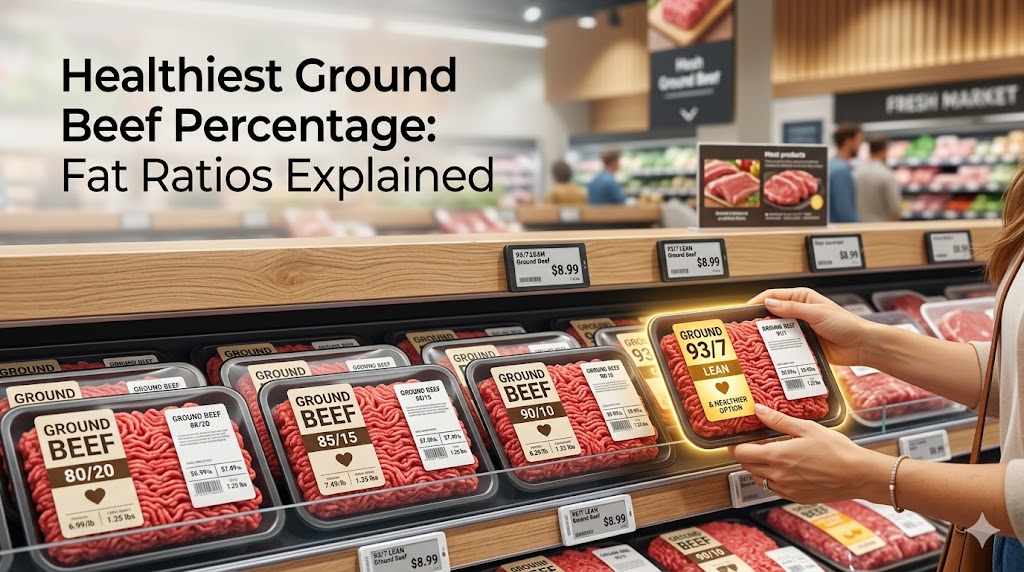
Let's be real: ground beef is the undisputed champion of the American kitchen. It is the superstar behind cozy meatloaves, Tuesday night tacos, and backyard burger cookouts.
But standing in the supermarket meat aisle looking at those dual-number labels can feel like trying to crack a secret government code. Should you grab the 80/20 package, or is 93/7 better?
Understanding these numbers is about more than just food trivia. It has major implications for your daily calories, heart health, and how juicy your dinner turns out.
This guide breaks down what those ground beef percentages actually mean, how to find the healthiest ground beef percentage, and a genius kitchen hack to save your budget and your diet.
Ground Beef Numbers Decoded
Those fraction-like numbers on the package (such as 80/20 or 90/10) represent the lean-to-fat ratio of the meat by weight.
The first number tells you the percentage of lean muscle tissue, while the second indicates the percentage of fat. For example, a package labeled 80/20 is made of 80% lean meat and 20% fat by weight.
These grinds are usually sourced from specific areas of the cow, known as "primal cuts". The cut determines the meat’s natural fat content, texture, and how it behaves in your skillet.
Bottom Line: The numbers on your ground beef package are a simple lean-to-fat weight ratio. The first number is muscle; the second is fat.
The Math Plot Twist: Weight vs. Calories
If you have ever looked at a package of 80/20 ground beef and thought, "Cool, only 20% of my calories are coming from fat!" we have some math-flavored news for you.
Packaging labels reflect weight, not caloric contribution. In reality, the percentage of calories derived from fat is vastly higher than the number on the sticker.
This happens because of a major energy gap between macronutrients. Protein provides approximately 4 calories per gram of energy, while fat provides a whopping 9 calories per gram.
Let’s look at a raw 4-ounce (113-gram) serving of 80/20 ground beef. It contains roughly 22.6 grams of fat and 19.4 grams of protein (with water making up the rest of the weight).
When we plug in the numbers, we get:
Caloric Fat Contribution={(22.6*9)/287} *100 = 70.9% (approx)
Your 80/20 beef actually derives nearly 71% of its raw calories from fat!
The table below shows the raw nutritional breakdowns across the most common ground beef percentages, highlighting this weight-to-calorie gap.
Ratio (Lean/Fat) | Typical Source Cut | Calories per 4 oz Raw | Total Fat (g) | Saturated Fat (g) | Protein (g) | Caloric Fat % |
73/27 | Primal Trimmings | 350 | 30.0 | 12.0 | 19.0 | 77.1% |
80/20 | Ground Chuck | 287 | 22.6 | 8.6 | 19.4 | 70.9% |
85/15 | Ground Round | 243 | 17.0 | 6.6 | 21.0 | 63.0% |
90/10 | Ground Sirloin | 199 | 11.3 | 4.4 | 22.6 | 51.1% |
93/7 | Premium Loin Trimmings | 172 | 7.9 | 3.3 | 23.6 | 41.3% |
96/4 | Select Sirloin | 140 | 3.0 | 1.0 | 24.0 | 19.3% |
Bottom Line: Because fat is highly calorie-dense, a beef ratio labeled 80/20 by weight actually derives nearly 71% of its raw calories from fat.
Ground Beef Percentages: A Cut-by-Cut Guide
Different ratios come from different areas of the animal, meaning they cook up uniquely and shine in different recipes.
70/30 and 73/27 (Regular Ground Beef)
Usually labeled as "regular ground beef," these high-fat grinds are processed from fatty beef trimmings. They are incredibly budget-friendly but will leave quite a bit of grease in your pan. Chefs love 70/30 for smash burgers, where the high fat content renders quickly, creating a deeply caramelized, crispy crust.
80/20 (Ground Chuck)
Sourced from the shoulder area, ground chuck is widely considered the ultimate culinary "sweet spot". The 20% fat content provides the perfect structural bind and moisture for classic grilled burgers, meatballs, and meatloaves, keeping them tender and juicy.
85/15 (Ground Round)
Taken from the hindquarters of the cow, ground round is a fantastic middle-of-the-road choice. It delivers excellent beef flavor with significantly less grease than chuck, making it perfect for tacos, casseroles, and family skillet dinners.
90/10 (Ground Sirloin)
Sourced from the mid-back loin, ground sirloin is officially classified as a "lean" cut. It has a milder flavor and works brilliantly in recipes where you can't easily drain the grease, such as stuffed bell peppers or cabbage rolls. Keep an eye on your cooking times, as sirloin can dry out if overcooked.
93/7 and 96/4 (Extra Lean Ground Beef)
These represent the leanest commercial grinds available. Sourced from premium loin and round cuts, these are highly popular among health-conscious individuals and athletes looking for maximum protein with minimal fat. Because they lack fat, cooked extra lean grinds can feel a bit dense and dry, so adding a splash of olive oil, broth, or pureed vegetables can help restore moisture.
The way cattle are raised also influences nutrition. Grass-fed beef is generally leaner than grain-fed conventional beef and contains slightly higher levels of heart-healthy omega-3 fatty acids.
Bottom Line: Different ground beef ratios come from different parts of the cow, which determines their texture, juiciness, and optimal cooking method.
What Is the Healthiest Ground Beef Percentage?
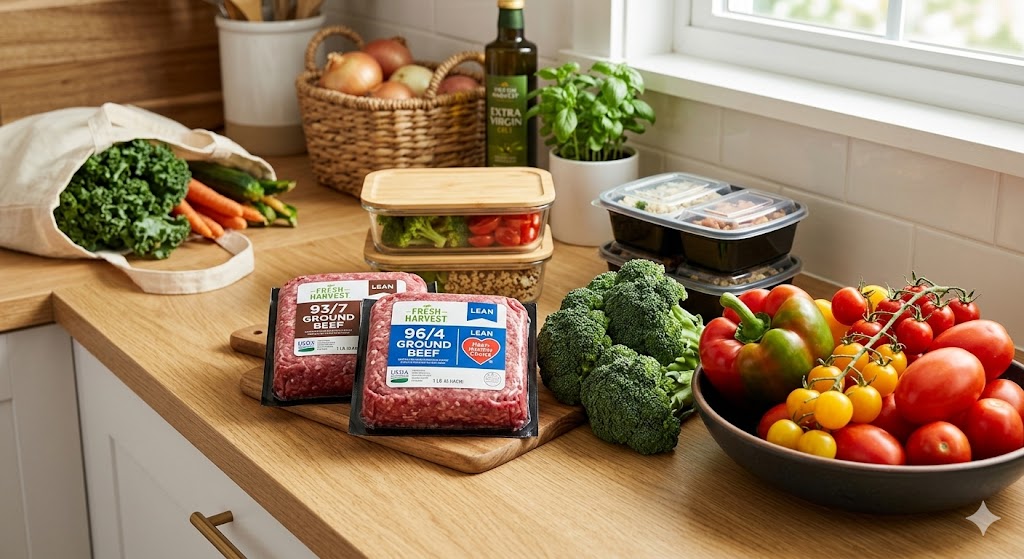
To crown the absolute healthiest ground beef percentage, we look to dietary guidelines set by the USDA and the American Heart Association (AHA).
USDA Classifications for Lean Beef
The USDA strictly regulates terms like "lean" and "extra lean" based on a cooked 3.5-ounce (100-gram) serving :
Lean Beef: Must have less than 10 grams of total fat, 4.5 grams or less of saturated fat, and under 95 milligrams of cholesterol. 90/10 ground beef fits nicely into this category.
Extra Lean Beef: Must contain less than 5 grams of total fat, less than 2 grams of saturated fat, and under 95 milligrams of cholesterol. 93/7 ground beef meets these criteria.
The American Heart Association Stamp of Approval
The AHA awards its respected Heart-Check Mark to help shoppers identify heart-healthy foods. To earn this red-and-white seal, ground beef must be at least 96% lean and 4% fat (96/4). Displaying the Heart-Check mark shows that the product meets strict, science-based limits on saturated fat and cholesterol.
Saturated Fat and Heart Wellness
Diets high in saturated fat are clinically linked to elevated low-density lipoprotein (LDL) cholesterol, which is a major risk factor for cardiovascular disease. Choosing extra lean ground beef (93/7 or 96/4) allows you to enjoy the nutritional benefits of red meat—like complete protein, highly bioavailable heme iron, zinc, and B-complex vitamins—while protecting your cardiovascular system.
Clinical studies, like the landmark DIRECT and OmniHeart trials, have shown that replacing simple carbohydrates or high-fat meats with lean proteins can lower blood pressure, improve fasting triglycerides, and support healthy weight management.
Bottom Line: The absolute healthiest ground beef percentage on paper is 96/4, followed closely by 93/7. These satisfy USDA "extra lean" guidelines and are certified by the American Heart Association.
The Magic Trick: How to Turn Cheap Beef into Lean Beef
While extra lean ground beef is fantastic for your health, it can be tough on your wallet. Premium extra lean grinds are often significantly more expensive than standard grinds.
Luckily, food scientists at Iowa State University and the Wisconsin Department of Agriculture developed a clever, budget-friendly kitchen hack. By cooking your beef as crumbles and applying a simple "defatting" protocol, you can dramatically reduce the fat content of cheaper grinds.
How to Rinse Your Beef (Step-by-Step)
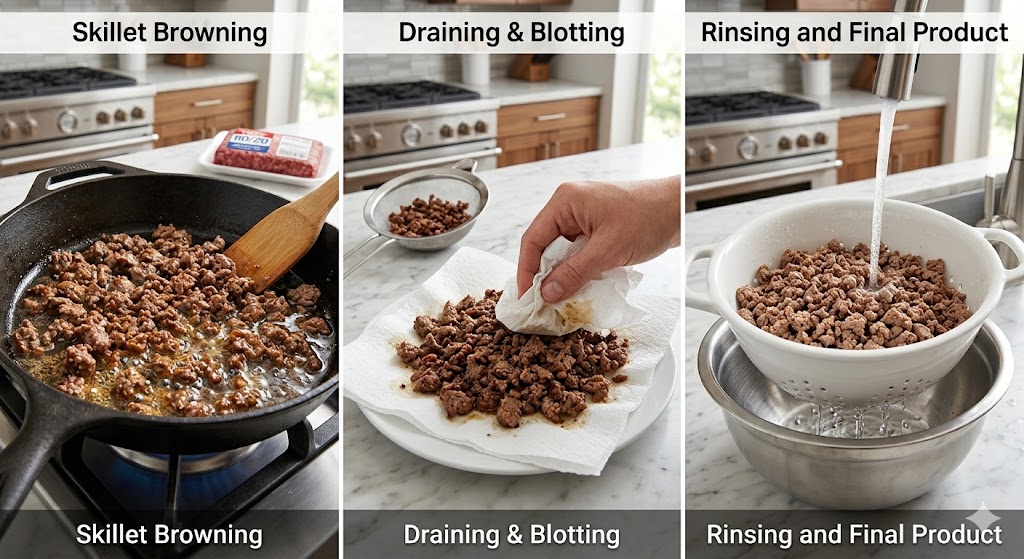
You can apply this two-step defatting process right at home :
Brown: Heat a non-stick skillet over medium heat. Add your ground beef and cook for 8 to 10 minutes, breaking it into small crumbles to release the trapped fat.
Blot: Use a slotted spoon to transfer the beef crumbles to a plate lined with paper towels. Let them sit for 30 to 60 seconds, and gently blot the top with another paper towel.
Rinse: Put the blotted beef crumbles into a fine-mesh strainer or colander. Pour very hot, but not boiling, water over the beef to rinse away the remaining surface grease. Let it drain for 5 minutes.
The Nutritious Results
Chemical analyses show that browning and blotting high-fat ground beef crumbles reduces its total fat content by about 30%. Adding the hot-water rinse slashes another 25% to 30% of the remaining fat!
The table below illustrates how different raw blends change after cooking, blotting, and rinsing per 100-gram (3.5-ounce) serving.
Raw Beef Ratio | Raw Fat Content (per 100g) | Cooked & Blotted Fat | Cooked, Blotted, & Rinsed Fat | Total Fat Saved % |
90/10 (Lean) | 10.0g | 7.0g | 3.0g | 70.0% |
80/20 (Chuck) | 20.0g | 9.0g | 4.0g | 80.0% |
70/30 (Regular) | 30.0g | 9.0g | 4.0g | 86.7% |
By rinsing and draining cheap 73/27 or 80/20 ground beef, you bring its final fat content down to a mere 4 grams per serving. That is practically identical to buying premium, unrinsed extra lean beef, at a fraction of the price!
Are There Any Trade-offs?
Testing shows that rinsing ground beef does not significantly reduce its high-quality protein, iron, zinc, or vitamin B12. However, you will lose some water-soluble vitamins—niacin content drops by about 28%.
Additionally, because fat carries flavor, rinsed beef crumbles will be dryer and less intensely beefy. To make up for this, rinsed beef is best used in saucy, highly seasoned dishes like taco fillings, spaghetti sauce, lasagna, or chili. Just be sure to add your spices and herbs after rinsing so you don't wash away your flavor!
Bottom Line: Browning, blotting, and rinsing high-fat ground beef crumbles can slash their fat content by up to 50%, transforming budget-friendly beef into a lean product.
Take Home Message
Ground beef is an incredibly versatile, nutrient-dense source of complete protein, zinc, iron, and B vitamins.
If your goal is cardiovascular health and general weight management, the healthiest ground beef percentage is 96/4 or 93/7, as these cuts keep saturated fat to a minimum.
But don't let premium price tags stop you. By using the browning, blotting, and warm-water rinsing trick, you can easily turn affordable, high-fat grinds into lean, high-quality protein for your favorite sauces, tacos, and chilis.
No matter which blend you choose, using VoCal's specific voice-logging features ensures your calorie tracker matches your plate perfectly!
How to Voice-Log Your Beef on VoCal (Without Ruining Your Deficit!)
For users of the VoCal app, ground beef can be a tricky ingredient to track. Standard calorie databases often default to raw weights, which can introduce massive tracking errors if you cook, drain, or rinse your meat.
Remember: 4 ounces of raw ground beef yields approximately 3 ounces of cooked meat due to moisture and fat loss.
If you cook a raw 4-ounce portion of 80/20 ground beef and drain the fat, the actual calories you consume drop dramatically. The table below shows how different preparation states affect a standard raw 4-ounce portion of 80/20 ground beef.
Preparation State (From 4 oz Raw 80/20) | Cooked Weight Yield | Calories (kcal) | Total Fat (g) | Protein (g) | Tracking Discrepancy vs. Raw Label |
Raw (Uncooked) | 113g (Raw) | 287 | 22.6 | 19.4 | Baseline |
Pan-Browned (Undrained) | ~85g (Cooked) | 307 | 19.6 | 30.5 | +20 kcal (Moisture loss increases nutrient density) |
Pan-Browned (Drained & Blotted) | ~85g (Cooked) | 230 | 15.0 | 24.0 | -57 kcal (Lipid loss) |
Pan-Browned (Drained & Rinsed) | ~85g (Cooked) | 195 | 10.0–12.0 | 25.0 | -92 kcal (Maximal lipid loss) |
If you rinse your 80/20 beef but log it as standard raw 80/20, you are overestimating your calorie intake by nearly 100 calories! Over a week of meal prep, this kind of discrepancy can stall your calculated progress.
To keep your logs perfectly precise, use descriptive voice commands in the VoCal app.
Recommended Voice Commands for VoCal:
For raw logging (great for burgers or meatloaf):
"Log four ounces of raw eighty-twenty ground beef."
For standard pan-browned crumbles where grease was discarded:
"Log three ounces of cooked, drained eighty-twenty ground beef."
For budget meal preps using the rinsing trick:
"Log three ounces of cooked, rinsed, and drained eighty-twenty ground beef crumbles."
For premium heart-healthy options:
"Log four ounces of raw ninety-three seven ground beef."
By specifying the fat ratio, raw vs. cooked weight, and whether you drained or rinsed, VoCal can accurately match your meal to the proper USDA nutritional profile, keeping your fitness goals on track.
Bottom Line: Cooking and draining ground beef can save you up to 100 calories per serving. To keep your nutrition log accurate, specify whether your beef is raw, cooked, drained, or rinsed when using VoCal's voice logging.
Frequently Asked Questions
Is 80/20 or 93/7 better for a weight loss diet?
For weight loss and maintaining a calorie deficit, 93/7 is generally the better choice. A 4-ounce serving of raw 93/7 ground beef contains only 172 calories and 8 grams of fat, while raw 80/20 has 287 calories and 22.6 grams of fat. However, if you are on a budget, you can buy 80/20 and apply the rinsing method to get a highly comparable lean beef profile!
Does draining ground beef remove its protein?
Nope! Scientific studies show that browning, blotting, and rinsing cooked ground beef crumbles does not substantially reduce its high-quality protein, iron, zinc, or vitamin B12. It primarily removes the rendered liquid fats.
Can I eat ground beef on a low-carb or keto diet?
Absolutely. Unprocessed ground beef is entirely carb-free and packed with protein and essential fats. If you are following a very low-carb ketogenic diet, higher-fat grinds like 80/20 chuck or 70/30 regular beef can help you meet your daily fat macros. If you prefer a lean low-carb diet, stick to sirloin or extra lean grinds.
Disclaimer: The information provided in this article is for educational and general wellness purposes only and is not intended to be a substitute for professional medical advice, diagnosis, or treatment. Always seek the advice of your physician or another qualified healthcare provider with any questions you may have regarding a medical condition or dietary changes.