
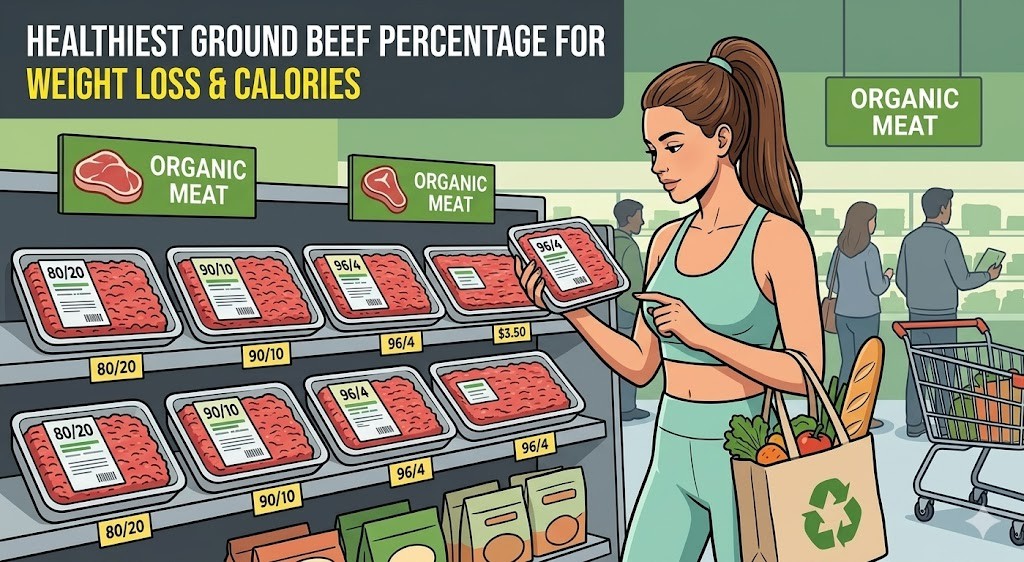
Picture this: You are standing in the supermarket meat aisle, staring at a wall of red meat. You want to stay on track with your fat-loss goals, but you are suddenly confronted by a confusing sea of numbers. 80/20? 90/10? 96/4? It feels like trying to crack a secret code.
But don't panic! Choosing the healthiest ground beef percentage for weight loss does not require a degree in food science. With a few simple tricks, you can enjoy juicy, satisfying meals without accidentally sinking your calorie budget.
Let’s break down the science of beef percentages, look at some budget-saving kitchen hacks, and see how easy it is to track your macros without losing your mind.
Decoding the Numbers: What Do Those Ratios Actually Mean?
The math on a ground beef package is actually pretty straightforward. Those numbers represent the lean-to-fat ratio by weight.
The first number tells you the percentage of lean, finely trimmed muscle tissue. This is where the muscle-building protein, water, and essential nutrients (like iron and B vitamins) live. The second number represents the percentage of pure fat. So, a package of 90/10 ground beef is 90% lean meat and 10% fat.
Where the meat comes from on the cow determines how fatty it is:
80/20 (Ground Chuck): Comes from the shoulder area, which is naturally well-marbled and juicy.
85/15 (Ground Round): Sourced from the rear, which is a leaner, more active muscle group.
90/10 (Ground Sirloin): Sourced from the premium, naturally lean sirloin region.
93/7 and Leaner (Extra Lean): Highly trimmed muscle tissue designed to keep fat to an absolute minimum.
The Government Definition of "Lean"
To keep food companies honest, the United States Department of Agriculture (USDA) has strict rules about who gets to use the "lean" label on a 3.5-ounce (100-gram) cooked serving:
USDA Lean: Must contain less than 10 grams of total fat, 4.5 grams or less of saturated fat, and less than 95 milligrams of cholesterol.
USDA Extra-Lean: Must contain less than 5 grams of total fat, less than 2 grams of saturated fat, and less than 95 milligrams of cholesterol.
The Ground Beef Lineup: Which Ratio Fits Your Goals?
How do these different blends behave in the kitchen, and which one is the healthiest ground beef percentage for your weight-loss journey? Let's take a look.
1. 95/5 or 96/4: The Lean Machines (Extra Lean)
This is the ultimate champion for pure calorie restriction. Because it is packed with protein and has almost no fat, it keeps you incredibly full for very few calories.
Best for: Meal prep, macro-counting, and quick stir-fries.
Cooking Tip: Since there is very little fat, it can dry out quickly. Keep your cooking time short, or add low-calorie moisture like Worcestershire sauce, diced onions, or pureed tomatoes.
Bottom Line: Choosing an extra-lean 95/5 blend over standard 80/20 cuts your raw fat intake by about 75% and saves you nearly 130 calories per serving!
2. 90/10: The Balanced Hustler (Lean)
If you want to save calories but cannot stand dry meat, 90/10 is your sweet spot. Sourced from sirloin, it offers a great balance of flavor and leanness.
Best for: Stuffed peppers, tacos, and lean patties.
Bottom Line: A fantastic everyday option that keeps your meals juicy without derailing your diet.
3. 85/15: The Happy Medium
This is a very popular, versatile blend. It is noticeably leaner than 80/20, but it still packs enough fat to stay juicy in meatballs, meatloaves, and skillet meals.
Best for: Spaghetti sauces, tacos, and family dinners where everyone wants great flavor.
Bottom Line: Good for general cooking, but you will need to keep a closer eye on your portion sizes if you are strictly tracking calories.
4. 80/20: The Juicy King
The gold standard for professional chefs and burger purists. The generous fat content keeps the meat incredibly tender and flavorful under high heat.
Best for: Classic smash burgers, meatloaves, and backyard grilling.
Bottom Line: While it is delicious, 80/20 is highly calorie-dense. If you are trying to maintain a consistent calorie deficit, this blend is best saved for occasional treats.
Let's Talk Numbers: Macronutrient and Caloric Comparison
To make your next grocery trip easier, here is a simple breakdown of standard ground beef ratios per 4-ounce (113-gram) raw serving, using official data from the USDA FoodData Central database.
Ground Beef Ratio | Caloric Density (per 4 oz Raw) | Protein Content | Total Fat | Saturated Fat | USDA Classification |
96% Lean / 4% Fat | 142 kcal | 24.0 g | 4.6 g | 2.0 g | Extra Lean |
95% Lean / 5% Fat | 155 kcal | 24.2 g | 5.6 g | 2.5 g | Extra Lean |
90% Lean / 10% Fat | 199 kcal | 22.6 g | 11.3 g | 4.4 g | Lean |
85% Lean / 15% Fat | 240 kcal | 21.0 g | 17.0 g | 6.0 g | Regular |
80% Lean / 20% Fat | 287 kcal | 19.4 g | 22.6 g | 8.6 g | Regular |
Notice a pattern? As the fat percentage goes down, the protein density goes up. That is because water and high-quality protein fill the space where the fat used to be.
Saturated Fat and Your Cardiometabolic Goals
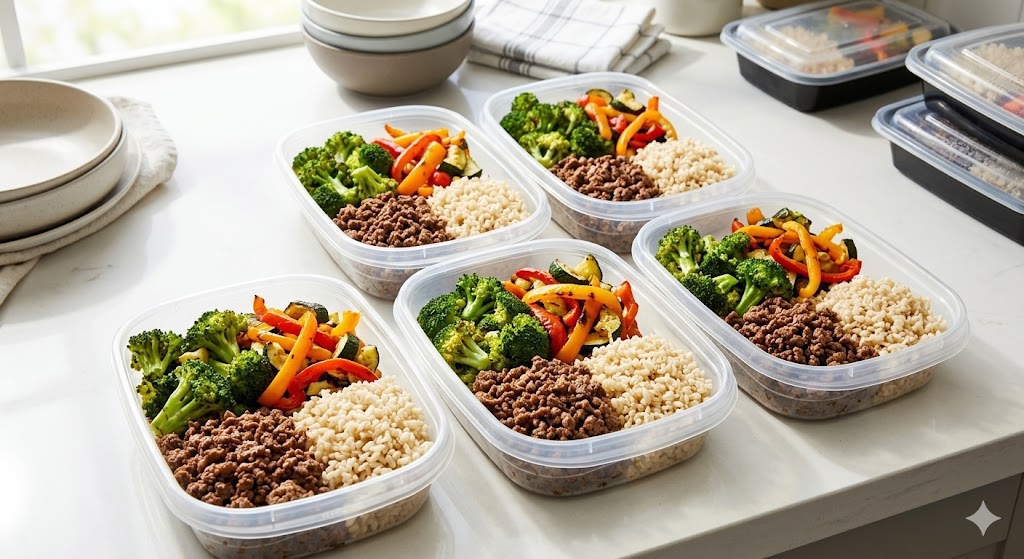
When managing your weight, you also want to keep your heart happy. Red meat naturally contains saturated fat, which can raise low-density lipoprotein (LDL) "bad" cholesterol if eaten in excess.
The Dietary Guidelines for Americans recommend keeping saturated fat under 10% of your daily calories (about 20 grams on a 2,000-calorie diet). The American Heart Association (AHA) goes a step further for heart health, recommending a limit of 6% (around 13 grams per day).
To see how ground beef compares to other ground proteins, check out this saturated fat breakdown per 3-ounce (85-gram) cooked serving:
Protein Type (3 oz Cooked Serving) | Saturated Fat Content | Cardiovascular Health Profile |
Ground Beef, 95% Lean | 2.20 g | Highly compatible with strict saturated fat limits |
Ground Beef, 90% Lean | 3.94 g | Moderate profile; requires careful daily lipid tracking |
Ground Beef, 85% Lean | 5.02 g | Elevated saturated fat; requires portion monitoring |
Ground Beef, 80% Lean | 5.75 g | High saturated fat; less ideal for cardiovascular restriction |
Ground Chicken, 99% Lean | 0.00 g | Minimal cardiovascular impact |
Ground Chicken, 93% Lean | 1.50 g | Low saturated fat; excellent lean alternative |
Ground Turkey, 85% Lean | 3.75 g | Moderate saturated fat; comparable to 90% lean beef |
Ground Pork, 80% Lean | 6.00 g | High saturated fat; requires careful moderation |
Ground Lamb, 85% Lean | 6.00 g | High saturated fat; less suitable for lipid control |
Vegan Ground "Beef" Substitute | 1.00 g | Low saturated fat; vegetable-based alternative |
Watch Out for the Pre-Seasoned Trap!
A quick warning: try to avoid pre-seasoned commercial ground beef. While convenient, these packages are often loaded with excess sodium. Too much sodium can cause fluid retention (hello, temporary scale weight jump!) and raise your blood pressure. It is always better to buy unseasoned meat and add your own salt and herbs.
Clinical Proof: Red Meat is Not the Weight-Loss Villain
Some old-school diet advice says you must completely cut out red meat to lose weight. Fortunately, modern clinical research has thoroughly busted this myth:
The BOLD Study (Beef in an Optimal Lean Diet): Published in the American Journal of Clinical Nutrition, this trial showed that people could eat 4.0 to 5.4 ounces of lean beef daily as part of a heart-healthy diet and actually reduce their LDL cholesterol.
The Beef WISE Study: Researchers at the University of Colorado Anschutz Health and Wellness Center tracked adults on a weight-loss plan. One group ate lean beef 4 or more times a week, while the other group avoided all red meat. Both groups lost the exact same amount of weight, and 90% to 95% of that lost weight was pure body fat, not muscle!
Lean beef is a massive asset during a diet because protein is highly satiating. It triggers the release of fullness hormones like GLP-1 and peptide YY, helping you fight off late-night cravings. Plus, protein has a high Thermic Effect of Food (TEF), meaning your body actually burns extra calories just trying to digest it.
Budget Hack: Turn Cheap Beef Into Weight-Loss Gold
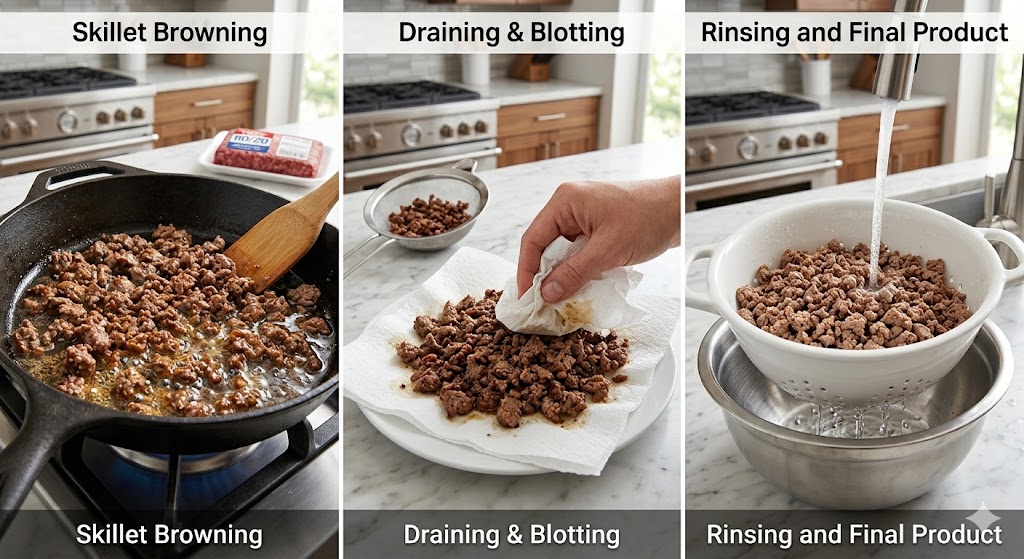
Let's face it: extra-lean ground beef (like 95/5) can be tough on your wallet. If you are on a budget, you can use a simple culinary science trick to turn inexpensive 80/20 ground beef into a lean, diet-friendly protein.
A landmark study from Iowa State University proved that pan-frying, draining, blotting, and rinsing 80% lean ground beef with hot water slashes its fat and calories.
By rinsing the meat, you reduce a 4-ounce cooked serving of 80/20 down to just 121 calories and 5 grams of fat—making it nutritionally identical to expensive, raw 95/5 beef! Best of all, you do not wash away the essential iron, zinc, and vitamin B12 locked inside the muscle tissue.
The Step-by-Step Rinsing Protocol
Pan-Broil: Cook your ground beef in a non-stick skillet for 8 to 10 minutes, breaking it into small crumbles, until it reaches a safe internal temperature of 160°F.
Drain: Use a slotted spoon to scoop the beef out of the pan, leaving the pooled grease behind.
Blot: Put the crumbles on a plate lined with paper towels. Let it sit for 30 seconds, then firmly blot the top with another paper towel to soak up surface grease.
Rinse: Place the blotted beef in a fine-mesh strainer or colander over a bowl. Slowly pour 4 cups of very hot (but not boiling) water over the beef to wash away residual fat.
Rest: Let it drain for 5 minutes, discard the drained fat, and proceed with your recipe.
Track It Without the Headache: Voice Log Your Beef in Seconds
Consistency is the secret sauce of weight loss, but typing every single ingredient into a calorie tracking app can feel like a part-time job. Spending up to 11 minutes a day manually searching databases and entering portion sizes often leads to "tracking fatigue" and giving up entirely.
That is where voice-activated calorie tracking comes in. Modern apps like VoCal let you log your entire meal in under 4 seconds just by speaking naturally.
Instead of typing, you simply tap the microphone and say: "I had three ounces of cooked, rinsed eighty-twenty ground beef, half a cup of brown rice, and a cup of steamed broccoli." The AI instantly parses your description, calculates the macros, and logs it to your daily dashboard. It even makes it easy to log custom prep methods—like the hot-water rinsing trick—so your calorie records remain highly accurate and your weight-loss journey stays effortlessly on track.
Frequently Asked Questions
What is the absolute healthiest ground beef percentage for weight loss?
For cutting calories while keeping your protein high, 95/5 or 96/4 extra-lean ground beef is your best bet. It gives you a massive 24 grams of muscle-preserving protein for only 142 to 155 calories per 4-ounce raw serving.
Does draining and rinsing ground beef make it taste dry?
Fat is a major flavor carrier, so removing it can make the meat feel a bit drier. To keep it delicious, simply mix in low-calorie, moisture-rich ingredients like tomato paste, garlic, onions, peppers, or a splash of beef stock after you rinse it.
Can I eat lean ground beef every day while dieting?
You absolutely can! Rigorous clinical trials like the BOLD study prove that eating 4.0 to 5.4 ounces of lean beef daily can be easily incorporated into a heart-healthy diet without negatively affecting your blood pressure or cholesterol.
Is ground turkey always healthier than ground beef?
Not necessarily! Standard 85/15 ground turkey has about the same saturated fat content as 90/10 lean ground beef. If you want a turkey option that is truly lower in fat than extra-lean beef, you have to choose 93% or 99% lean ground turkey breast.
Disclaimer: This article is for informational and educational purposes only and does not replace professional medical advice, diagnosis, or treatment. Always consult a healthcare professional or registered dietitian before starting any new diet or weight-loss program.