
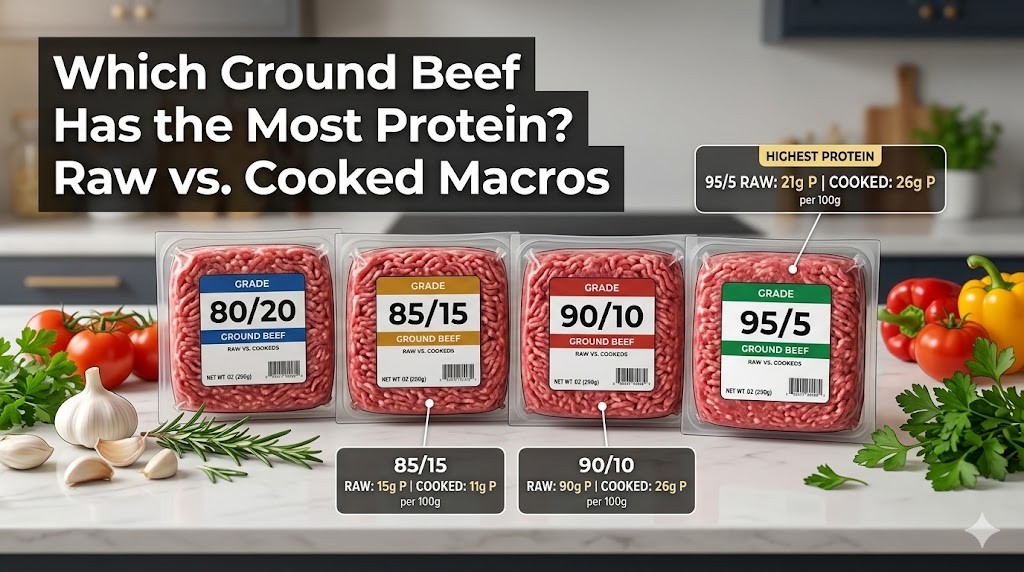
Ah, ground beef. It is the undisputed MVP of weeknight dinners, backyard barbecues, and lazy taco nights. It is packed with high-quality, complete protein, highly bioavailable iron, energy-boosting zinc, and vitamin B12.
But when you are standing in the supermarket meat aisle, staring at a giant wall of red packages, trying to figure out the healthiest ground beef percentage can feel like solving a high school algebra problem.
Should you grab the 80/20 chuck for taco night, or is the ultra-lean 95/5 the only way to save your macros? Let’s break down the juicy science of ground beef so you can shop like a pro.
Deciphering the Meat Label: What Do Those Numbers Actually Mean?
When you look at a package of ground beef, those big bold numbers (like 80/20 or 90/10) represent the lean-to-fat ratio of the raw meat by weight. For example, 80/20 means the package is 80% lean muscle tissue and 20% fat. By federal law, the absolute maximum fat content allowed in any ground beef sold in the US is 30%.
To make things easier for health-conscious shoppers, the U.S. Department of Agriculture (USDA) regulates specific terms on packaging :
Lean: Contains less than 10 grams of total fat, 4.5 grams or less of saturated fat, and less than 95 milligrams of cholesterol per 100 grams (about 3.5 ounces) cooked.
Extra Lean: Contains less than 5 grams of total fat, less than 2 grams of saturated fat, and less than 95 milligrams of cholesterol per 100 grams cooked.
Don’t confuse these terms with quality grades like Prime, Choice, and Select. Grading is a voluntary program where the USDA judges tenderness, juiciness, and flavor. Prime is the most marbled (aka the fattiest), Choice is moderate, and Select is the leanest.
If you are looking at overall nutrient density, raw ground beef scores significantly higher as the fat percentage drops.
Raw Ground Beef Ratio | Nutrivore Score | Density Classification |
97% Lean / 3% Fat | 360 | High |
95% Lean / 5% Fat | 316 | High |
90% Lean / 10% Fat | 244 | Medium-High |
85% Lean / 15% Fat | 197 | Medium |
80% Lean / 20% Fat | 165 | Medium-Low |
70% Lean / 30% Fat | 125 | Low |
Bottom Line: The raw ratio on the package tells you exactly how much lean meat you are buying compared to fat. If you are looking for the most nutrient-dense bang for your buck, higher lean percentages are your best bet.
Raw vs. Cooked: The Great Protein Disappearing Act
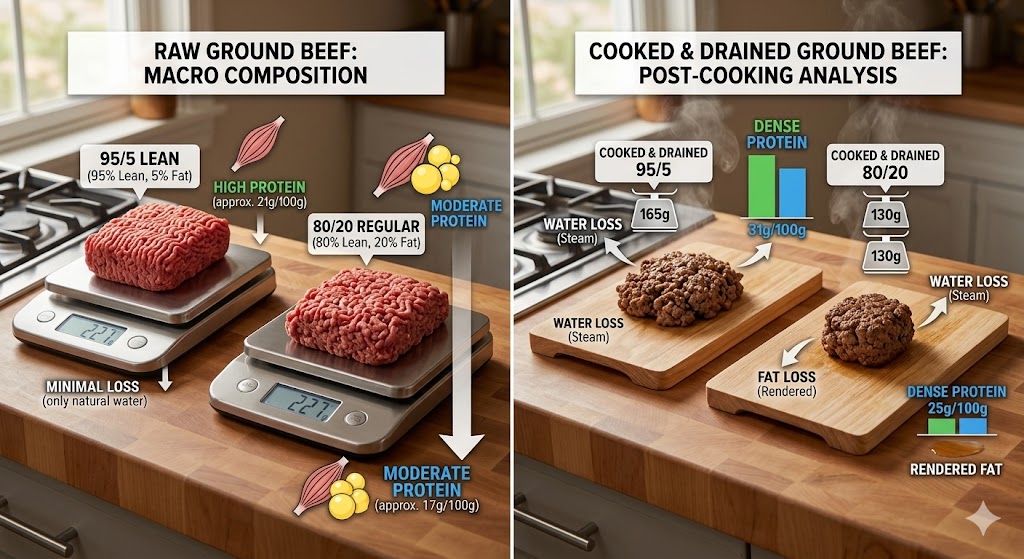
There is a simple zero-sum relationship in raw beef: the more fat in the grind, the less room there is for lean muscle tissue. Because of this, raw 95/5 extra-lean ground beef starts with a clear protein advantage over its fattier cousins, delivering 23 grams of protein per 4-ounce serving compared to just 19 grams in raw 80/20.
But here is where kitchen chemistry steps in. When you cook ground beef, heat causes water to evaporate and fat to melt and drain away.
Because fattier blends lose a lot more total weight during cooking, the protein left behind becomes highly concentrated. Once cooked and drained, the protein difference between 80/20 and 95/5 narrows significantly.
Raw Ground Beef Nutrition (Per 4 oz / 112g Serving)
Raw Lean-to-Fat Ratio | Calories | Total Fat (g) | Saturated Fat (g) | Protein (g) |
95% Lean / 5% Fat | 164 | 8.0 | 2.6 | 24.0 |
90% Lean / 10% Fat | 195 | 10.0 | 3.9 | 23.0 |
85% Lean / 15% Fat | 217 | 13.0 | 5.0 | 22.0 |
80% Lean / 20% Fat | 231 | 15.0 | 5.8 | 19.0 |
Cooked, Pan-Broiled Ground Beef Nutrition (Per 100g Cooked Portion)
Note: These values assume you have drained away the excess pan grease!
Cooked Lean-to-Fat Ratio | Calories | Total Fat (g) | Saturated Fat (g) | Protein (g) |
95% Lean / 5% Fat | 174 | 6.4 | 2.5 | 27.3 |
85% Lean / 15% Fat | 240 | 14.4 | 6.2 | 25.9 |
80% Lean / 20% Fat | 270 | 17.8 | 6.8 | 25.8 |
How does cooked beef stack up against other ground proteins on the market? Let's look at the numbers.
Cooked Ground Protein Comparison (Per 100g Cooked Portion)
Protein Source | Calories | Total Fat (g) | Saturated Fat (g) | Protein (g) |
Ground Beef (95/5) | 174 | 6.4 | 2.5 | 27.3 |
Ground Turkey (93/7) | 176 | 8.5 | 2.1 | 28.5 |
Ground Chicken (92/8) | 143 | 7.5 | 1.8 | 19.8 |
230 | 14.0 | 2.0 | 21.0 | |
190 | 11.0 | 5.0 | 17.0 |
Bottom Line: Raw 95/5 ground beef has the most protein because it contains less fat. However, once you toss them in a pan and let the fat render out, cooked 80/20 and 85/15 beef concentrate their protein, making them surprisingly comparable per cooked ounce.
Beefed-Up Nutrition: Essential Amino Acids and Micronutrient Goodies
Beef is a "complete" protein, which means it serves up all nine essential amino acids your body needs to build muscle and repair tissue. Think of it as a complete toolkit for your muscles.
An analysis of cooked 80/20 ground beef highlights an abundance of key amino acids :
Lysine (2,131 mg per 100g): Essential for hormone production and bone health.
Leucine (2,007 mg per 100g): The superstar branched-chain amino acid (BCAA) that triggers muscle growth.
Valine and Isoleucine (1,264 mg and 1,138 mg): BCAAs that promote muscle recovery and energy.
But beef is way more than just protein. It is also packed with crucial vitamins, minerals, and bioactive compounds:
Vitamin B12: Essential for brain function and red blood cell formation. One 100-gram serving of ground beef gives you over 100% of your daily needs.
Zinc: Crucial for keeping your immune system firing on all cylinders.
Coenzyme Q10 (CoQ10): A vital spark plug for cellular energy, particularly in heart tissue.
Taurine: Supports cardiovascular health and muscle contraction.
What about the fat quality? Interestingly, about 60% of the fatty acids in beef are actually unsaturated—primarily monounsaturated oleic acid, the same heart-healthy fat found in olive oil!
If you choose 100% grass-fed or grass-finished ground beef, you will get even more benefits: less total fat, up to six times more anti-inflammatory omega-3 fatty acids, and three times more conjugated linoleic acid (CLA).
Bottom Line: Ground beef is a nutrient goldmine. It supplies a stellar amino acid profile for muscle growth alongside hard-to-get micronutrients like B12, bioactive CoQ10, and zinc.
Kitchen Alchemy: How Cooking Methods and Draining Alter Your Macros
In the kitchen, fat behaves like a culinary shield. As beef cooks, melting fat coats the protein strands, acting as a physical barrier against heat. This prevents the muscle fibers from tightening up, drying out, and turning into shoe leather.
This is why professional chefs love 80/20 for juicy burgers, meatballs, and meatloaf—it keeps things incredibly moist and delicious.
On the other hand, extra-lean grinds like 95/5 have almost no fat barrier, meaning they cook incredibly fast and can easily turn dry and crumbly if you overcook them.
But what if you are on a tight budget and cannot afford premium extra-lean beef? You can easily buy cheaper 80/20 or 75/25 ground beef and "engineer" your own lean product at home!
Research from Iowa State University shows that browning ground beef crumbles, blotting them with paper towels, and rinsing them with hot water can slash the fat content of cooked crumbles by more than 70%. Rinsing 4 cups of hot water over your blotted beef in a colander washes away surface fat without losing the essential protein, B12, or iron locked inside the meat.
The only catch? Fat carries flavor-soluble compounds, so rinsed beef will taste much milder and have a slightly chewier texture.
Draining and Rinsing Impact on 80/20 Ground Beef (Per 100g Cooked)
Preparation Step | Calories | Total Fat (g) | Saturated Fat (g) | Protein (g) |
Pan-Fried Patty (Drained) | 270 | 17.8 | 6.8 | 25.8 |
Pan-Fried Crumbles (Blotted) | 191 | 11.0 | 4.4 | 25.0 |
Pan-Fried Crumbles (Rinsed & Blotted) | 130 | 5.0 | 2.0 | 25.0 |
Bottom Line: While 80/20 provides the juiciest burgers , browning and warm-water rinsing can turn a cheaper, high-fat pack of beef into an ultra-lean protein source.
Saturated Fat vs. Satiety: How to Choose Your Perfect Match
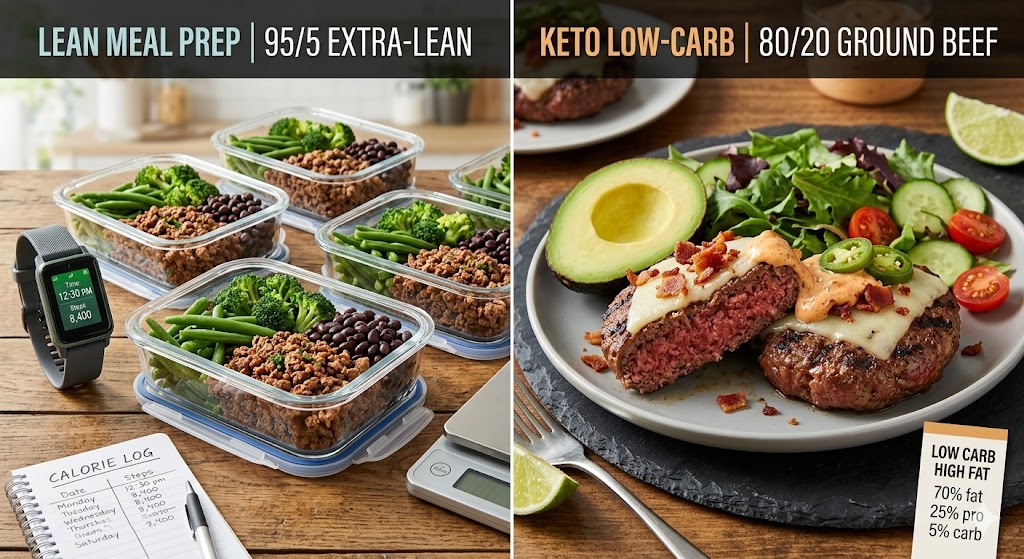
Finding the healthiest ground beef percentage for your goals doesn't have to be a headache. It all comes down to your personal health targets.
For Heart Health and Calorie Counting
If your doctor is monitoring your cholesterol or you are actively counting calories, the American Heart Association (AHA) and the USDA recommend sticking to ground beef that is at least 90% lean.
In fact, 96% extra-lean ground beef carries the AHA's Heart-Check mark because it keeps saturated fat under 2 grams per serving.
The Dietary Guidelines for Americans recommend keeping saturated fat below 10% of your total daily calories. If you want to calculate your personal maximum daily saturated fat allowance (Smax) in grams based on your daily calories (C), you can use this simple equation:
Smax = (0.10 *C)/9
For a standard 2,000-calorie diet, that works out to about 22.2 grams of saturated fat per day. A single 3-ounce serving of cooked 80/20 ground beef has 5.8 grams of saturated fat, taking up a quarter of your entire daily limit in one go! Switching to 95% lean ground beef slashes that to just 2.2 grams.
For Keto, Carnivore, or Low-Carb Diets
If you are on a ketogenic or carnivore diet, fat is your primary fuel source. Fattier blends like 80/20 or 85/15 are highly valued here because they keep you full for hours, provide stable energy, and don't require you to add extra cooking oils to the pan.
Track It Like a Pro with Vo-cal.com
No matter which ratio you choose, logging your food accurately is key to hitting your goals. But manual tracking can be a nightmare—do you log raw weight, cooked weight, or drained crumbles?
That is where VoCal steps in. VoCal is a conversational, voice-based calorie tracker. Instead of searching through endless databases, you can simply say: "I had four ounces of cooked, rinsed eighty-twenty beef crumbles."
The app automatically adjusts for the fat-rendering, calculates the exact macro shift, and logs it instantly, keeping your diet perfectly on track.
Bottom Line: If cardiovascular health and low calories are your priority, opt for 95% or 96% extra-lean ground beef. If you are on a low-carb diet, stick to fattier grinds like 80/20 to boost satiety and energy.
Frequently Asked Questions
What is the healthiest ground beef percentage?
For heart health and fat loss, 95% or 96% lean ground beef is ideal because it meets USDA "extra lean" standards and keeps saturated fat low. If you are on a low-carb or ketogenic diet, 80/20 or 85/15 is often preferred to keep energy and satiety high.
Does rinsing ground beef wash away the protein?
Nope! The protein in beef is located inside the muscle fibers of the lean meat, not in the fat. Browning and rinsing ground beef crumbles with hot water washes away up to 50% or more of the fat, but keeps the high-quality protein, iron, and zinc completely intact.
Is grass-fed ground beef better than grain-fed?
Both provide excellent complete protein and minerals. However, grass-fed beef is naturally leaner, has more antioxidant vitamin E, and provides up to six times more heart-healthy omega-3 fatty acids and conjugated linoleic acid (CLA).
Why does the protein content change so much between raw and cooked beef?
Raw ground beef contains a lot of water. As it cooks, moisture evaporates and fat melts away. Losing this water and fat weight concentrates the remaining meat, which significantly increases the protein density by weight once cooked.
Is it safe to eat ground beef every day?
Yes, lean ground beef can easily fit into a healthy, balanced daily diet. However, for overall wellness, health experts recommend varying your protein sources to include poultry, fish, and plant-based proteins. Always consult a healthcare professional for personalized dietary advice.
Disclaimer: The information in this article is for educational purposes only and is not a substitute for professional medical advice, diagnosis, or treatment. Please consult a healthcare professional before making any significant changes to your diet.