
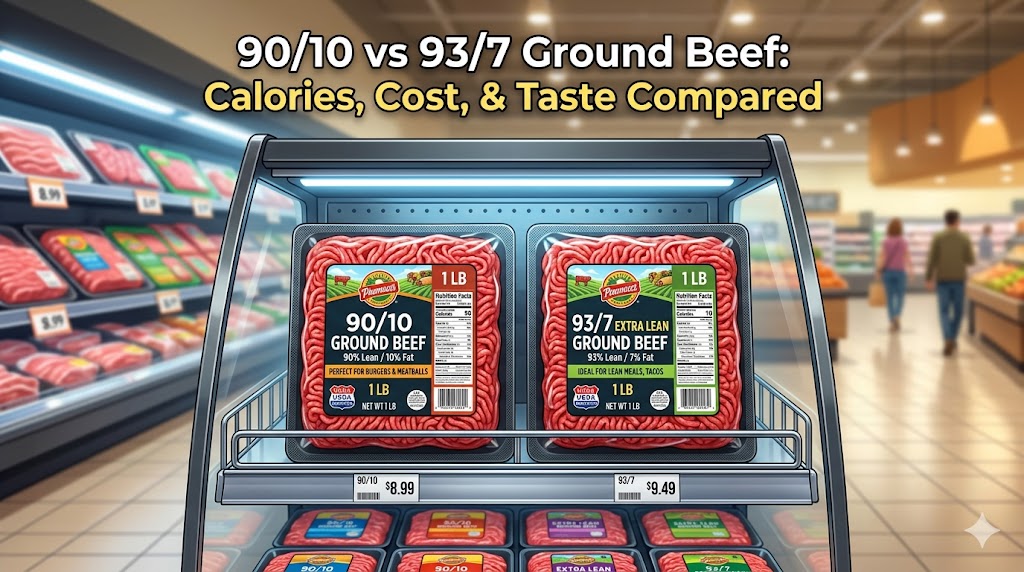
We’ve all been there: standing in front of the grocery store meat case, staring at a wall of red packages, trying to figure out if we want 90/10, 93/7, or something else entirely. Buying ground beef shouldn't feel like a high-stakes math test!
If you are searching for the healthiest ground beef percentage, you are likely choosing between 90% lean / 10% fat (90/10) and 93% lean / 7% fat (93/7).
Before making major changes to your daily eating habits, it is always a good idea to consult a healthcare professional to make sure these shifts align with your personal wellness goals.
Let’s dive into how these two crowd-pleasers stack up in terms of nutrition, cost, and taste—and how to track them like a pro.
Lean vs. Extra Lean: Decoding the USDA Label
First, let’s decode some of that official-sounding government jargon on the labels. The USDA (United States Department of Agriculture) has strict definitions for what gets to be called "lean" and "extra lean".
By law, the maximum fat content allowed in any ground beef package is 30%. To help you make sense of the rest, here is what the USDA looks for:
Lean: A 100-gram serving (about 3.5 ounces) must have less than 10 grams of total fat, 4.5 grams or less of saturated fat, and under 95 milligrams of cholesterol. Both raw 90/10 and 93/7 fit neatly into this club.
Extra Lean: To step up to this level, the meat must contain less than 5 grams of total fat, less than 2 grams of saturated fat, and under 95 milligrams of cholesterol per 100 grams. This means 93/7 misses the cut. Only ultra-lean cuts like 96/4 ground beef qualify, and they often carry the American Heart Association's (AHA) coveted Heart-Check mark.
Bottom Line: Both 90/10 and 93/7 ground beef are officially "lean" by USDA standards. However, if you want "extra lean" status, you’ll need to seek out 96/4 ground beef, which has earned the American Heart Association’s stamp of approval.
Raw vs. Cooked: The Ultimate Nutritional Showdown
Are you eating your beef raw? Hopefully not!
When comparing ground beef, it is important to look at both the raw and cooked states. That is because beef naturally loses water weight and renders out fat while cooking, making the final cooked product more nutritionally dense.
On average, a 4-ounce raw portion of lean ground beef shrinks down to about 3 ounces (85 grams) of cooked meat.
Here is a breakdown of the nutritional profiles for a raw 4-ounce (113-gram) serving and a cooked 3-ounce (85-gram) serving of pan-browned crumbles, based on standard USDA data:
Nutrient Component | Raw 90/10 (4 oz / 113g) | Raw 93/7 (4 oz / 113g) | Cooked 90/10 Crumbles (3 oz / 85g) | Cooked 93/7 Crumbles (3 oz / 85g) |
Calories (kcal) | 199 | 172 | 196 | 178 |
Total Fat (g) | 11.3 | 7.9 | 10.2 | 8.1 |
Saturated Fat (g) | 4.4 | 3.3 | 4.0 | 3.3 |
Protein (g) | 22.6 | 23.6 | 24.2 | 24.5 |
Cholesterol (mg) | 73.4 | 71.2 | 75.6 | 75.6 |
Sodium (mg) | 74.6 | 74.6 | 74.0 | 73.1 |
Iron (mg) | 2.5 | 2.6 | 2.6 | 2.7 |
Zinc (mg) | 5.4 | 5.6 | 5.8 | 5.9 |
As you can see, raw 93/7 ground beef gives you a slight head start if you are watching your calories, saving you about 27 calories and around 30% saturated fat per serving compared to 90/10.
Still, both options are micronutrient goldmines. They are packed with highly bioavailable heme iron, zinc, and B-complex vitamins.
In fact, one serving of 93/7 ground beef provides around 105% of your Daily Value (DV) for Vitamin B12 and over 50% for zinc, which are crucial for energy production and immune support.
Bottom Line: Raw 93/7 is slightly lower in calories and fat than 90/10. However, once cooked, both are incredibly high-protein options packed with essential vitamins like B12 and zinc.
Kitchen Science: How Cooking Renders the Fat
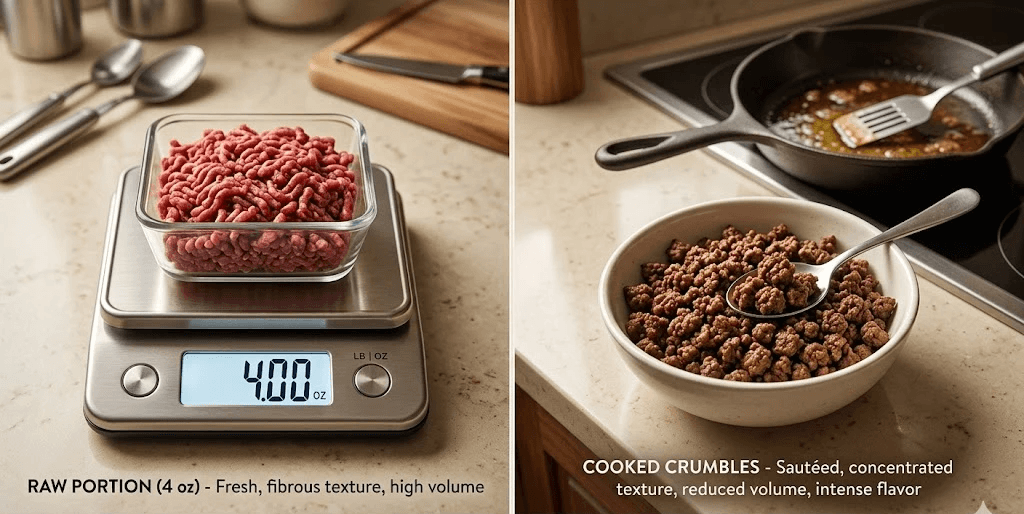
Here is a fun kitchen science fact: cooking actually acts like a mini fat-reduction session for your beef. When you brown ground beef, some of the fat melts and runs into the pan.
By pan-broiling your beef as crumbles and blotting it with a clean paper towel, you can slash the fat significantly. Want to go full kitchen scientist? Try rinsing your cooked crumbles with hot water. This simple trick can cut the fat content in half.
Here is how different preparation methods affect the fat content per 100-gram serving (about 3.5 ounces) of beef :
Raw Ground Beef Type | Raw Fat (per 100g) | Pan-Fried Crumbles Fat (per 100g) | Pan-Fried & Rinsed Fat (per 100g) |
90% Lean (90/10) | 10g | 7g | 3g |
80% Lean (80/20) | 20g | 9g | 4g |
70% Lean (70/30) | 30g | 9g | 4g |
And don't worry—rinsing away the fat doesn't rinse away the good stuff. Research shows that protein, iron, zinc, and Vitamin B12 stay locked safely inside the muscle tissue of the meat.
Just remember to practice good kitchen safety! Always defrost your meat in the fridge and wash any surfaces or utensils that touch raw beef. Most importantly, use a meat thermometer to ensure your beef reaches a safe internal temperature of 160°F to kill any sneaky bacteria.
Bottom Line: Cooking, draining, and blotting significantly reduces the fat and calories in ground beef. Rinsing cooked crumbles with warm water can lower the fat content even more without losing essential protein or vitamins.
Cost vs. Value: Trimming the Price, Not Just the Fat
Let’s talk dollars and cents. Because leaner meats require more hands-on trimming at the processing plant, they usually come with a higher price tag.
All-natural 93/7 ground beef is often treated as a premium item, typically retailing around $7.97 to $9.99 per pound in US supermarkets. On the other hand, 90/10 ground beef is a bit more wallet-friendly, often priced between $5.86 and $9.79 per pound, especially if you buy it in bulk vacuum packs or rolls.
This price gap opens up an awesome budget hack. If you buy the cheaper 90/10 and use the browning, blotting, and rinsing method at home, you can easily replicate the ultra-lean nutritional profile of 93/7 without paying the high retail markup!
Bottom Line: Leaner beef costs more because of the extra labor required to trim the fat. You can save money by purchasing slightly higher-fat options like 90/10 and draining the grease yourself.
Taste and Texture: Fat is Flavor!
In the culinary world, fat is a superpower. It acts as a heat conductor and carries the aromatic flavor compounds that make beef taste, well, beefy.
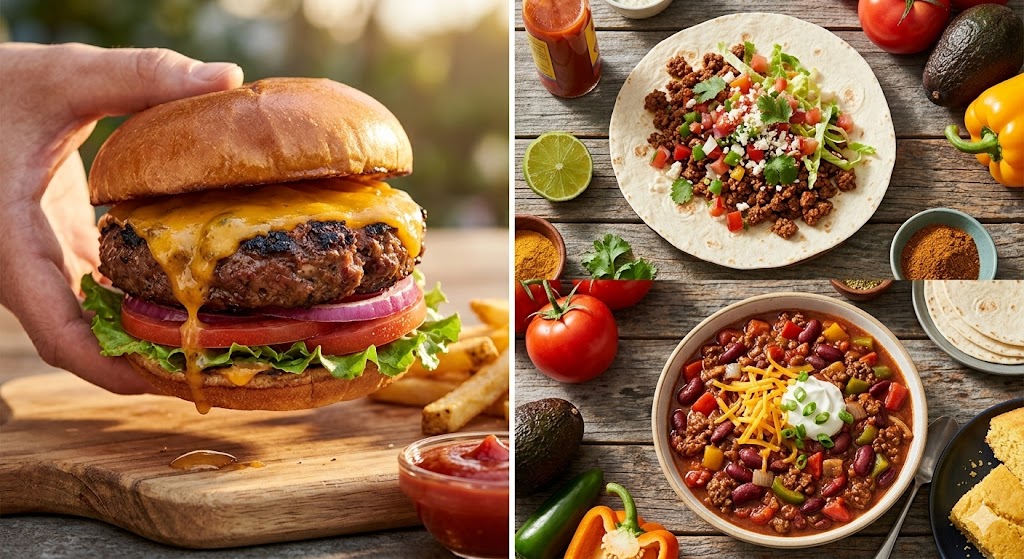
Because 90/10 ground beef holds onto a bit more fat, it is much better at keeping its moisture during dry-heat cooking. This makes it the absolute star for recipes where the meat needs to hold its shape, like juicy burgers, meatballs, or a classic meatloaf.
On the flip side, 93/7 has very little fat and higher water content, meaning it can easily dry out and turn into leather if you overcook it. It shines best in moist-heat dishes where it is broken up into crumbles and cooked in a sauce, such as taco fillings, chili, pasta sauces, or stuffed peppers.
Bottom Line: Choose 90/10 for burgers and meatballs to keep them juicy and intact. Go with 93/7 for saucy dishes like tacos, chili, and bolognese where extra moisture is provided by other ingredients.
Precision Calorie Tracking with VoCal
Tracking your macros shouldn't be a guessing game. Because the fat content of ground beef can drop by up to 50% depending on how you cook, drain, and rinse it, relying on standard "raw" food database entries can seriously throw off your numbers.
If you are using VoCal, logging your beef is incredibly easy and highly accurate. You don't need to perform complex mental math or calculate yield percentages.
Instead, just talk to the app! Our advanced voice-recognition system allows you to say phrases like:
"Log three ounces of cooked, drained ninety-ten ground beef crumbles."
"Log four ounces of pan-fried and rinsed eighty-twenty ground beef."
VoCal automatically calculates your true caloric intake based on cooked and rendered fat values.
By tracking your cooked weights and preparation methods with your voice, you can hit your protein targets and fat limits with absolute precision.
Frequently Asked Questions (FAQs)
Is 93/7 ground beef healthier than 90/10?
Yes, if you are strictly focused on reducing fat and calories. Raw 93/7 contains about 30% less fat than 90/10. However, you can make 90/10 just as lean by cooking, draining, and rinsing it with hot water.
Does rinsing ground beef wash away the protein?
Nope! Rinsing cooked beef crumbles with hot water removes melted fat, but it does not wash away the protein, iron, zinc, or B vitamins. These nutrients remain bound inside the muscle fibers.
What is the safe temperature to cook ground beef?
Always cook ground beef to a minimum internal temperature of 160°F. Use a digital meat thermometer to make sure it is cooked all the way through and safe to eat.
Why does lean beef dry out faster?
Fat acts as a moisture shield. Since lean beef like 93/7 has very little fat, the moisture evaporates quickly during cooking. Stick to low-and-slow or sauce-based cooking methods for extra-lean cuts.
Disclaimer: The information in this article is for educational purposes only and is not a substitute for professional medical advice, diagnosis, or treatment. Please consult a healthcare professional before making any significant changes to your diet.