

Picture this: You are relaxing at happy hour, catching a ballgame, or firing up the backyard grill on a Saturday afternoon with a frosty brew in hand. You turn the can around to see how it fits into your daily nutrition goals, and you find… nothing. No Nutrition Facts panel, no calorie count, and no macronutrient breakdown.
So, what is the deal?
Unlike packaged snacks or sodas, which are regulated by the Food and Drug Administration (FDA), most domestic beers fall under the jurisdiction of the Alcohol and Tobacco Tax and Trade Bureau (TTB). Because current federal regulations do not mandate standardized nutrition labels on alcoholic beverages unless a brand makes a specific dietary claim (like "light" or "low-carb"), figuring out beers calories often feels like a guessing game.
Yet those numbers add up quickly. According to data from the Centers for Disease Control and Prevention (CDC), American adults drink an average of nearly 100 calories per day from alcohol. For men aged 20 to 39, that number jumps to roughly 174 calories a day, with beer making up the lion's share.
Whether you are aiming for fat loss, tracking your macros, or simply curious about what is inside your favorite pint glass, this guide breaks down the numbers across popular US beers, unpacks how alcohol percentage shifts caloric density, and shows you how to track your drinks effortlessly.
Table of Contents
The Science of the Sip: What Makes Up Beer Calories?
Calories in 5% ABV Beer vs. How Many Calories in a 6% Beer
Calories per Beer by ABV: The Master Cheat Sheet
Popular US Beers Ranked: Light Lagers to Craft Brews
The Dark Beer Myth: Why Guinness Stuns Everyone
Pint Sizes Matter: Why Your 12 oz Count Is Probably Off
How to Burn It Off
Smart Tips for Enjoying Beer on a Calorie Budget
Effortless Tracking with VoCal
Frequently Asked Questions
The Science of the Sip: What Makes Up Beer Calories?
When you sip a cold beer, where do the calories actually come from? Unlike soda, which draws its energy almost entirely from refined sugars, beer gets its caloric punch from two main sources: pure alcohol (ethanol) and residual carbohydrates.
Pure Alcohol (7 Calories per Gram): Most people think of carbs first, but alcohol is actually the biggest caloric driver in your glass. Alcohol delivers 7 calories per gram—substantially more than carbs or protein (4 calories per gram) and just behind pure fat (9 calories per gram). Pure ethanol has a physical density of 0.789 grams per milliliter, meaning higher-alcohol beers pack far more energy into the exact same glass.
Residual Carbohydrates (4 Calories per Gram): When brewers make beer, grain starches from malted barley or wheat are converted into fermentable sugars. Yeast eats most of these sugars to create alcohol and carbon dioxide, but it leaves behind complex carbs called unfermentable dextrins. These leftover carbs give beer its body, head retention, and malty flavor, adding 4 calories per gram.
Protein (4 Calories per Gram): A trace amount of soluble plant protein from the grain makes it into the finished pour, contributing a minor fraction of energy.
According to the USDA FoodData Central database, a standard 12-ounce can of regular 5.0% ABV beer contains about 153 calories and roughly 12.6 to 13 grams of carbs.
Nutritional Parameter | Energy Conversion Factor | Mean Quantity in 12 oz Regular Beer (5.0% ABV) | Caloric Yield | Caloric Share (%) |
Ethanol (Pure Alcohol) | 7.0 kcal/g | 14.0 g | 98.0 kcal | 64.1% |
Residual Carbohydrates | 4.0 kcal/g | 12.8 g | 51.2 kcal | 33.5% |
Soluble Protein | 4.0 kcal/g | 1.6 g | 6.4 kcal | 4.2% |
Total Dietary Lipids (Fat) | 9.0 kcal/g | 0.0 g | 0.0 kcal | 0.0% |
Composite Nutritional Yield | — | 355.0 mL (356 g mass) | 153.0 kcal | 100.0% |
Bottom Line: Pure alcohol delivers 7 calories per gram, providing nearly two-thirds of the total energy in an ordinary lager, while residual grain carbohydrates supply the rest.
Calories in 5% ABV Beer vs. How Many Calories in a 6% Beer
Because alcohol carries 7 calories per gram, the beer calories alcohol percentage relationship is the primary factor determining how light or heavy your drink is.
Let's look at the numbers for two of the most common alcohol levels ordered at US bars:
Calories in 5% ABV Beer
A 5.0% ABV beverage is considered the baseline "standard drink" by the National Institute on Alcohol Abuse and Alcoholism (NIAAA). In a classic 12-ounce can of regular American adjunct lager (like Budweiser or Coors Banquet), 5% ABV yields exactly 14.0 grams of pure alcohol.
Alcohol energy: roughly 98 calories.
Carbohydrate energy: roughly 42 to 55 calories.
Total: A standard 12-ounce serving lands comfortably between 140 and 153 calories.
How Many Calories in a 6% Beer
Curious about how many calories in a 6% beer? When you bump the ABV from 5% to 6%—typical for many American pale ales, medium IPAs, and amber ales—the caloric profile jumps noticeably.
A 12-ounce pour of 6.0% beer carries approximately 16.8 grams of pure ethanol, delivering 118 calories from the alcohol alone.
To brew a beer that reaches 6% ABV while maintaining balance against hop bitterness, brewers use a heavier malt base, leaving behind 12 to 18 grams of residual carbs.
Total: A 12-ounce pour of 6.0% ABV beer typically clocks in between 170 and 195 calories.
That single percentage point jump in ABV adds an extra 30 to 45 calories per drink. If you have two or three pints over an evening, that difference quickly equals an entire extra snack!
Calories per Beer by ABV: The Master Cheat Sheet
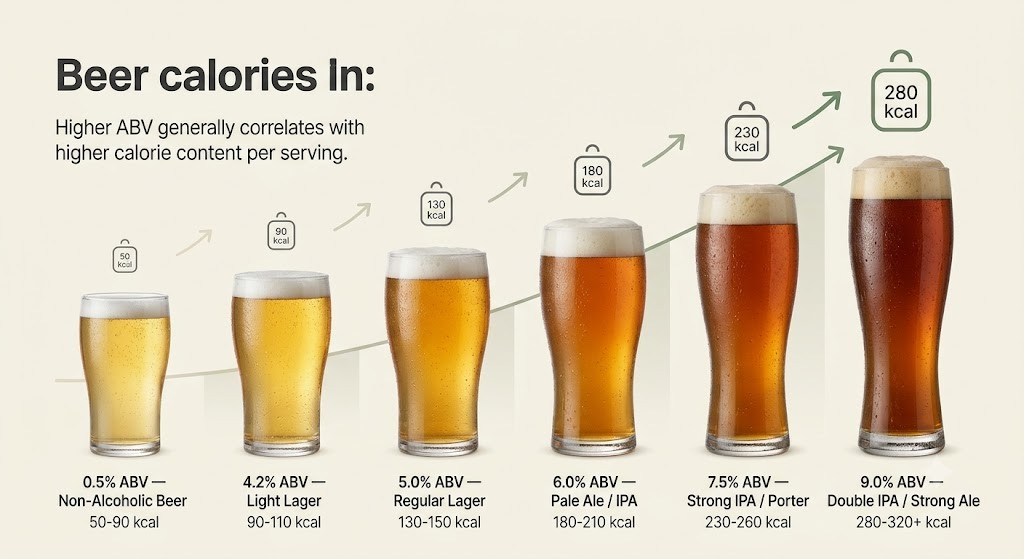
As you venture into bolder craft beers—such as hazy double IPAs, Belgian tripels, and bourbon-barrel stouts—the energy density accelerates. High-gravity brewing requires enormous amounts of grain, resulting in both high alcohol levels and high residual sugars that conventional brewing yeasts cannot fully ferment.
Here is how calories per beer by ABV scale across standard 12-fluid-ounce servings:
Alcohol by Volume (ABV) | Ethanol Mass (g per 12 oz) | Alcohol Energy Yield (kcal) | Typical Residual Carbohydrate Range (g) | Total Energy Profile (kcal per 12 oz) |
0.5% (Non-Alcoholic) | 1.4 g | 10 kcal | 5.0 g–14.0 g | 30 kcal–65 kcal |
4.0% (Ultra-Light Lager) | 11.2 g | 78 kcal | 2.6 g–5.0 g | 88 kcal–98 kcal |
4.2% (Standard Light Lager) | 11.8 g | 83 kcal | 3.2 g–6.6 g | 96 kcal–110 kcal |
5.0% (Standard American Lager) | 14.0 g | 98 kcal | 10.5 g–13.5 g | 140 kcal–155 kcal |
6.0% (Pale Ale / Standard IPA) | 16.8 g | 118 kcal | 12.0 g–18.0 g | 170 kcal–195 kcal |
7.5% (Robust IPA / Porter) | 21.0 g | 147 kcal | 16.0 g–22.0 g | 210 kcal–240 kcal |
9.0% (Double IPA / Strong Ale) | 25.2 g | 176 kcal | 22.0 g–32.0 g | 265 kcal–310 kcal |
11.0% (Imperial Stout / Barleywine) | 30.8 g | 216 kcal | 28.0 g–42.0 g | 330 kcal–385+ kcal |
Bottom Line: The higher the alcohol by volume, the steeper the calorie count. While an ultra-light lager sits under 100 calories, high-gravity craft offerings above 8% ABV routinely pass the 250- to 300-calorie mark for a single 12-ounce can.
Popular US Beers Ranked: Light Lagers to Craft Brews
Whether your go-to beverage is a low-carb light lager, an import, or an artisanal craft pour, having hard numbers removes the mystery.
Here is how popular beer brands distributed across the United States stack up per standard 12-ounce serving:
Commercial Brand | Commercial Category / Style | ABV (%) | Energy (kcal per 12 oz) | Carbohydrates (g per 12 oz) | Protein (g per 12 oz) |
Corona Premier | Low-Carbohydrate Mexican Lager | 4.0% | 90 | 2.6 | 0.7 |
Michelob Ultra | Low-Carbohydrate Light Lager | 4.2% | 95 | 2.6 | 0.6 |
American Light Pilsner | 4.2% | 96 | 3.2 | 0.7 | |
American Light Lager | 4.2% | 102 | 5.0 | 0.7 | |
American Light Lager | 4.2% | 110 | 6.6 | 0.9 | |
Irish Dry Stout | 4.2% | 125 | 10.0 | 1.0 | |
European Pale Lager | 5.0% | 142 | 11.0 | 1.5 | |
Budweiser | Standard American Adjunct Lager | 5.0% | 145 | 10.6 | 1.3 |
Coors Banquet | Standard American Adjunct Lager | 5.0% | 147 | 11.7 | 1.5 |
Corona Extra | Imported Adjunct Lager | 4.6% | 148 | 13.9 | 1.2 |
Stella Artois | European Pale Lager | 5.0% | 150 | 12.8 | 1.2 |
Blue Moon Belgian White | Belgian-Style Wheat Ale | 5.4% | 171 | 14.1 | 1.9 |
Sierra Nevada Pale Ale | American Pale Ale | 5.6% | 175 | 14.1 | 2.1 |
Lagunitas IPA | American India Pale Ale | 6.2% | 190 | 16.0 | 2.0 |
Athletic Brewing Run Wild | Non-Alcoholic IPA | <0.5% | 65 | 16.0 | 1.0 |
Athletic Brewing Lite | Non-Alcoholic Light Lager | <0.5% | 25 | 5.0 | 0.0 |
How Light Beers Cut the Calories
Ever wonder how beers like Miller Lite and Michelob Ultra achieve their sub-100-calorie counts? Brewers introduce specialized enzymes (such as amyloglucosidase) during the mashing phase. These enzymes snip unfermentable carbohydrate bonds into simple sugars that yeast can easily digest, resulting in lower leftover carbohydrates (often just 2.6 to 3.2 grams) and a lean caloric profile.
The Dark Beer Myth: Why Guinness Stuns Everyone

One of the biggest misconceptions in nutrition is that dark beer automatically means a heavy, calorie-loaded drink. People often stare at a glass of Guinness Draught—opaque, near-black, and crowned with a thick creamy head—and assume it carries more calories than a milkshake.
The reality? Guinness Draught contains only 125 calories and 10 grams of carbs per 12 ounces.
That makes it lighter in calories than a standard Budweiser (145 kcal), Corona Extra (148 kcal), or Sierra Nevada Pale Ale (175 kcal)!
How is this possible?
A Modest ABV: Guinness Draught is formulated at a sessionable 4.2% ABV, keeping its alcohol calorie load low.
Roasted Unmalted Barley: Its pitch-black color and rich roasty flavor come from a small addition of heavily roasted grain, which provides bold pigment without piling on excess sugar.
Nitrogen Gas Dispense: Guinness utilizes a blend of nitrogen and carbon dioxide. Nitrogen creates micro-bubbles that deliver a velvety mouthfeel without relying on dense residual unfermented starches.
Bottom Line: Don't judge a beer by its color! A pitch-black Irish dry stout often carries fewer calories than a golden, hazy craft IPA.
Pint Sizes Matter: Why Your 12 oz Count Is Probably Off
When health guidelines talk about a standard beer, they assume a 12-fluid-ounce serving. But when was the last time a bar or taproom served you a 12-ounce glass?
In the real world, glassware is considerably larger:
A standard US bar pint is 16 fluid ounces—a 33% increase in volume.
A British imperial pint reaches 20 fluid ounces—a 67% increase.
Stadium and ballpark souvenir cups often hold 21 to 24 fluid ounces.
If you order two 16-ounce pints of a craft IPA at your neighborhood brewery, you aren't drinking two standard beers; you are consuming the equivalent of nearly three standard drinks, totaling roughly 546 calories.
Serving Vessel | Fluid Volume (fl oz) | U.S. Standard Drink Equivalents (at 5% ABV) | Energy in Regular Lager (5.0% ABV, kcal) | Energy in American IPA (6.5% ABV, kcal) |
Standard Can / Bottle | 12 fl oz (355 mL) | 1.00 Standard Drink | 150 kcal | 205 kcal |
Standard US Bar Pint | 16 fl oz (473 mL) | 1.33 Standard Drinks | 200 kcal | 273 kcal |
British Imperial Pint | 20 fl oz (591 mL) | 1.67 Standard Drinks | 250 kcal | 342 kcal |
Ballpark Souvenir Cup | 21 fl oz (621 mL) | 1.75 Standard Drinks | 263 kcal | 359 kcal |
Tallboy Can | 24 fl oz (710 mL) | 2.00 Standard Drinks | 300 kcal | 410 kcal |
Craft Crowler Can | 32 fl oz (946 mL) | 2.67 Standard Drinks | 400 kcal | 546 kcal |
Bottom Line: Always account for the glass! Drinking a 16-ounce draft pint adds 33% more calories than the 12-ounce can listed on traditional nutritional charts.
How to Burn It Off
To burn off the approximately 150 calories found in a single 12-ounce can of regular 5% beer, an average adult would typically need to perform:
Brisk Walking (3.5 to 4 mph): ~35 to 40 minutes
Moderate Jogging (5 mph): ~15 to 20 minutes
Cycling (Moderate Effort): ~18 to 20 minutes
Casual Lap Swimming: ~15 minutes
Remember that alcohol temporarily pauses the liver's normal fat-burning processes while it clears acetate from your bloodstream, making regular physical activity and overall balance essential.
Smart Tips for Enjoying Beer on a Calorie Budget
You do not need to give up beer completely to reach your body composition goals. Simple, intentional habits make a meaningful difference:
Opt for Session and Light Beers: Reaching for a 4.0% to 4.2% light lager instead of a 7.5% double IPA saves you over 100 to 150 calories per can.
Watch the Glass Size: Remember that a craft bar pint is usually 16 ounces, not 12 ounces. Adjust your log accordingly so your numbers stay accurate.
Practice the 1:1 Water Rule: Drink a full glass of water between every alcoholic beverage. This keeps you hydrated, slows your drinking pace, and curbs the late-night hunger signals that alcohol often triggers.
Try Non-Alcoholic Craft Options: The non-alcoholic beer space has improved dramatically. Exceptional craft options from makers like Athletic Brewing deliver real hop flavors and crisp malt profiles for as little as 25 to 65 calories per can.
Effortless Tracking with VoCal
Logging nutrition is proven to help maintain a healthy energy balance, but let's be honest: tracking alcoholic drinks on traditional apps is a hassle.
You are sitting with friends at a noisy brewery, you pull out your phone, and you are forced to:
Open a tracker and type "IPA" into a search bar.
Scroll through dozens of conflicting, crowdsourced entries with wild variations in calorie counts.
Figure out how to calculate a 16-ounce draft pour when the database only gives you 12-ounce increments.
Give up entirely and create an untracked caloric blind spot.
This is where VoCal comes in.
Instead of typing, searching, and doing mental math while out with friends, you simply speak into your phone naturally:
"Logged two sixteen-ounce draft pale ales at five point six percent ABV."
In seconds, VoCal's voice-activated interface interprets the style, volume, and alcohol content, automatically logging the exact calories and carbohydrates. No barcode scanning, no manual fraction conversion, and zero awkward screen time during social dinners.
Frequently Asked Questions
1. Which popular US beer has the fewest calories?
Among widely available commercial brands, non-alcoholic light beers like Athletic Brewing Lite lead the pack at just 25 calories and 5 grams of carbs. For alcoholic options, low-carb light lagers such as Corona Premier (90 calories), Michelob Ultra (95 calories), and Miller Lite (96 calories) offer the lowest counts.
2. Does beer calories alcohol percentage really make that much difference?
Yes, it is the single most important factor. Pure alcohol provides 7 calories per gram—substantially more than the carbs in the beer. When alcohol percentage rises, caloric density scales up quickly, which is why an 8.5% double IPA can easily contain double or triple the calories of a 4.2% light lager.
3. Why do craft beers have so many more calories than commercial light lagers?
Craft beers generally have higher ABV percentages and retain more unfermented grain starches to balance pronounced hop bitterness. Light lagers, on the other hand, utilize specialized brewing enzymes to break down almost all residual carbohydrates into fermentable sugars, which yeast ferments completely, leaving minimal carbohydrates behind.
4. Can I drink beer while trying to lose weight?
Yes, weight loss ultimately depends on your overall energy balance. Choosing lower-calorie or light beers, accounting for true pour sizes, and logging your intake accurately ensures you can enjoy a drink without exceeding your daily caloric goals.
Disclaimer: This content is for informational purposes only and does not constitute medical, nutritional, or health advice. Always consult a qualified healthcare professional before making significant changes to your diet or alcohol consumption.