

Whether you are tailgating on a crisp football Sunday, chilling at a backyard barbecue, or grabbing a quick happy hour round with coworkers, Bud Light is practically an American staple. It is crisp, cold, easy to find, and famously marketed as a lighter pick for your waistline.
When you are watching your daily intake, keeping an eye on beer calories bud light fans drink is key to staying on track. Alcoholic beverages are among the easiest ways to accidentally sip through hundreds of hidden calories without feeling full.
The total energy in your glass changes quite a bit depending on whether you are cracking open a standard 12-ounce can, sipping a 16-ounce tallboy, or ordering a draft pint at the pub. If you happen to grab a Bud Light Platinum, the numbers shift even more.
Here is everything you need to know about the calories, carbs, and alcohol in Bud Light, broken down in plain English so you can enjoy your brew and still crush your health goals.
In this article:
What Is in a Bud Light?
Calories by Size: 12 oz, 16 oz, and Pints
Bud Light Platinum: What Extra Alcohol Does to Calories
The Science of Liquid Calories: Where Do They Go?
Does Bud Light Fit a Low-Carb or Keto Diet?
Multi-Drink Scenarios: How Quick Rounds Add Up
Log Drinks in Seconds Using Your Voice with VoCal
The Bottom Line
Frequently Asked Questions
What Is in a Bud Light?
Bud Light is brewed by Anheuser-Busch using four basic ingredients: water, barley malt, rice, and hops. The addition of rice gives the beer its signature crisp, clean profile and keeps the body light.
Brewers ferment the grain sugars so that the finished lager sits at 4.2% alcohol by volume (ABV). That fermentation also strips away most of the heavy carbohydrates you find in traditional beers.
According to official brewery data and the United States Department of Agriculture (USDA) FoodData Central database, a classic 12-ounce (355 ml) can of Bud Light provides:
Calories: 110 kcal
Carbohydrates: 6.6 grams
Protein: 0.9 grams
Fat: 0 grams
Sugars: 0 grams
Alcohol by Volume (ABV): 4.2%
Pure Alcohol (Ethanol): 11.8 grams
While earlier USDA testing batches recorded unrounded values of roughly 103 calories and 4.6 grams of carbohydrates per serving, standard commercial cans across the US state 110 calories and 6.6 grams of carbs.
Summary: A standard 12-ounce can of Bud Light delivers 110 calories, 6.6 grams of carbs, and 4.2% ABV with zero fat or added sugars.
Calories by Size: 12 oz, 16 oz, and Pints
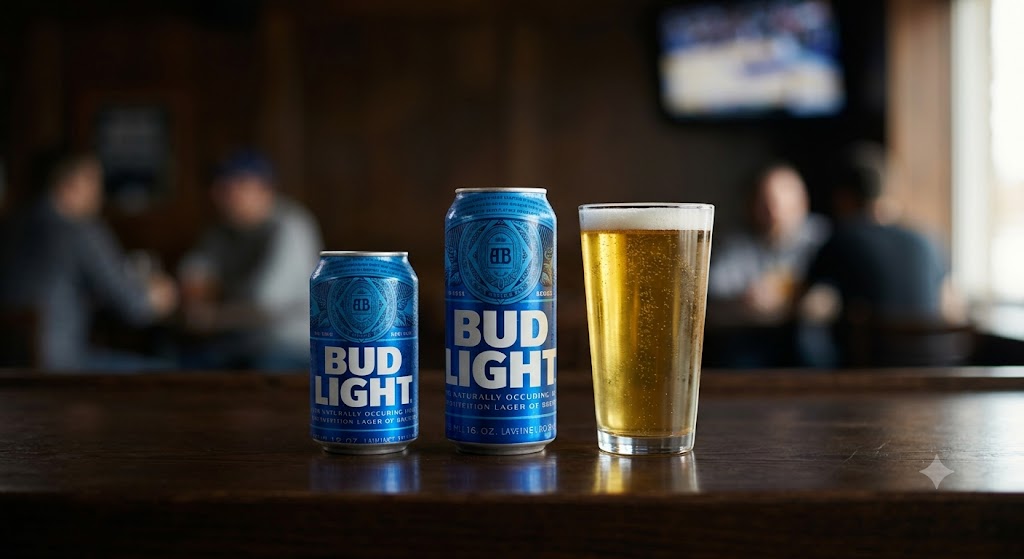
Portion sizes matter just as much with beer as they do with french fries. When you switch from a standard grocery store can to a draft pour at your local sports bar, your calorie and carbohydrate intake increases.
A standard US draft pint is 16 fluid ounces. That four-ounce bump adds roughly 34% more liquid, pushing your count from 110 calories up to 147 calories. Draft pours can also vary: a thick head of foam might leave you with 14 ounces of beer, while a heavy pub glass filled to the brim can easily top 16 ounces.
According to the National Institute on Alcohol Abuse and Alcoholism (NIAAA), one "standard drink" in the US contains 14 grams (0.6 fluid ounces) of pure alcohol. While a 12-ounce Bud Light equals about 0.84 of a standard drink, a 16-ounce draft pint delivers 1.12 standard drinks.
The table below breaks down the nutritional composition across common serving formats:
Bud Light Nutritional Values Across Serving Sizes (4.2% ABV)
Serving Format | Volume (fl oz / ml) | Calories | Carbohydrates (g) | Protein (g) | Fat (g) | Pure Alcohol (g) | Standard Drinks |
Standard Can / Bottle | 12 fl oz / 355 ml | 110 | 6.6 | 0.9 | 0.0 | 11.8 | 0.84 |
Tallboy Can | 16 fl oz / 473 ml | 147 | 8.8 | 1.2 | 0.0 | 15.7 | 1.12 |
US Draft Pint | 16 fl oz / 473 ml | 147 | 8.8 | 1.2 | 0.0 | 15.7 | 1.12 |
Imperial Pint (UK Draft) | 20 fl oz / 591 ml | 183 | 11.0 | 1.5 | 0.0 | 19.6 | 1.40 |
Tall Draft Mug | 22 fl oz / 650 ml | 202 | 12.1 | 1.6 | 0.0 | 21.6 | 1.54 |
Stovepipe Can | 25 fl oz / 739 ml | 229 | 13.8 | 1.9 | 0.0 | 24.5 | 1.75 |
Summary: Upgrading from a 12-ounce can to a 16-ounce draft pint bumps your intake from 110 calories and 6.6 grams of carbs to 147 calories and 8.8 grams of carbs.
Bud Light Platinum: What Extra Alcohol Does to Calories

It is easy to assume every blue-labeled bottle in the ice cooler has identical nutrition, but checking bud light platinum beer calories reveals a very different picture.
Bud Light Platinum is brewed as a higher-strength alternative to original Bud Light. It uses golden malts and cereal grains that undergo triple filtration, boosting the ABV to 6.0%—a 43% leap in alcohol strength over the original recipe.
Because the yeast ferments more of the grain sugars into ethanol, Platinum actually ends up with fewer carbohydrates (4.4 grams vs. 6.6 grams per 12 oz). However, alcohol contains 7 calories per gram, while carbs contain only 4 calories per gram.
As a result, a 12-ounce bottle of Bud Light Platinum delivers 139 calories—about 26% more energy than standard Bud Light.
Side-by-Side: Original Bud Light vs. Bud Light Platinum
Nutritional Metric | Bud Light (12 oz Can) | Bud Light Platinum (12 oz Can) | Bud Light (16 oz Pint) | Bud Light Platinum (16 oz Pint) |
Alcohol by Volume (ABV) | 4.2% | 6.0% | 4.2% | 6.0% |
Energy (Calories) | 110 kcal | 139 kcal | 147 kcal | 185 kcal |
Carbohydrates | 6.6 g | 4.4 g | 8.8 g | 5.9 g |
Sugars | 0.0 g | ~1.0–3.0 g | 0.0 g | ~1.3–4.0 g |
Protein | 0.9 g | 0.8 g | 1.2 g | 1.1 g |
Fat | 0.0 g | 0.0 g | 0.0 g | 0.0 g |
Pure Alcohol Weight | 11.8 g | 16.8 g | 15.7 g | 22.4 g |
Caloric Share from Alcohol | 73.5% | 84.7% | 73.5% | 84.7% |
Standard Drinks (NIAAA) | 0.84 | 1.20 | 1.12 | 1.60 |
If you drink a 16-ounce pint of Bud Light Platinum, you take in roughly 185 calories and 22.4 grams of pure alcohol. That single tall pour represents 1.60 US standard drinks.
Summary: While Bud Light Platinum has fewer carbs than regular Bud Light (4.4g vs. 6.6g), its higher 6.0% ABV pushes calories up to 139 kcal per 12 oz bottle and 185 kcal per 16 oz pint.
The Science of Liquid Calories: Where Do They Go?
Understanding the calories in a bud light beer means looking at what happens once that cold brew hits your stomach.
The total energy in an alcoholic beverage follows a clear mathematical formula:
Total Calories = (Pure Alcohol Grams* 7.0) + (Carbohydrate Grams* 4.0) + (Protein Grams* 4.0)
In a 12-ounce Bud Light, pure ethanol provides 82.3 calories (11.76 g * 7.0), while carbohydrates supply 26.4 calories (6.6g * 4.0), and protein adds about 3.6 calories.
That means over 73% of the total energy in a Bud Light comes directly from alcohol, not grain carbs. In Bud Light Platinum, alcohol accounts for nearly 85% of all calories.
Why Your Body Burns Beer Calories First
Your body can store extra carbs as glycogen in your muscles and liver, but it has no storage tank for alcohol. Your liver views alcohol as an immediate priority that must be cleared.
When you drink beer, liver enzymes convert the ethanol into acetate. Acetate enters your bloodstream, and your cells start burning it for immediate energy.
While your body is busy burning through acetate, it presses the "pause" button on your normal fat-burning engine. Research shows that fat burning can drop significantly after alcohol intake. If you are eating nachos, buffalo wings, or pizza while enjoying your beer, your body burns the alcohol first and redirects excess dietary fats straight into fat storage.
Alcohol also stimulates appetite-regulating nerve cells in the hypothalamus while lowering self-control, making that late-night pizza slice look twice as tempting.
Summary: Alcohol provides 7 calories per gram. Because the body prioritizes burning off alcohol immediately, normal fat oxidation slows down, making midnight snacking more likely to be stored as body fat.
Does Bud Light Fit a Low-Carb or Keto Diet?
If you are mindful of your macros, the total calories of bud light beer can fit into your routine, provided you budget for them.
Standard Low-Carb Diets (60–130g Carbs Daily)
On a moderate low-carbohydrate plan, Mayo Clinic guidelines note that dieters typically aim for 60 to 130 grams of carbs daily (roughly 240 to 520 calories from carbohydrates).
Within that window, drinking a 12-ounce Bud Light (6.6g carbs) or a Bud Light Platinum (4.4g carbs) is easy to fit alongside balanced meals of lean protein, healthy fats, and greens.
Strict Ketogenic Diets (20–50g Carbs Daily)
Strict keto requires keeping daily net carbs below 20 to 50 grams to stay in ketosis—a metabolic state where your body burns ketones from fat for fuel:
One 12-ounce Bud Light uses up 13% to 33% of your daily carb budget.
A single 16-ounce draft pint (8.8g carbs) uses up almost half of a strict 20-gram daily limit.
Two draft pints (17.6g carbs) can easily bump you out of ketosis, especially when combined with veggies, nuts, or sauces from your meal.
Even though Bud Light Platinum has fewer carbs (4.4 grams), its higher alcohol dose temporarily halts ketone production in the liver until the ethanol is processed.
Summary: Bud Light fits easily into general low-carb diets (60–130g carbs/day). On a strict keto plan (<50g/day), a single 16 oz pint takes up a major chunk of your daily carb allowance.
Multi-Drink Scenarios: How Quick Rounds Add Up

Because light beers are easy to drink, it is surprisingly easy to lose count during a game or an evening out. The NIAAA notes that creating a daily deficit of 500 calories is standard for losing 1 pound per week. A single fun night can wipe out that deficit if drinks go untracked.
Here is how common drinking scenarios translate to everyday food equivalents:
Cumulative Calories, Alcohol, and Snack Equivalents
What You Drink | Total Volume | Total Calories | Total Carbs | Pure Alcohol | US Standard Drinks | Everyday Food Equivalent |
1 Can Bud Light | 12 fl oz | 110 kcal | 6.6 g | 11.8 g | 0.84 | 1 medium apple |
2 Cans Bud Light | 24 fl oz | 220 kcal | 13.2 g | 23.5 g | 1.68 | 1 glazed donut |
3 Cans Bud Light | 36 fl oz | 330 kcal | 19.8 g | 35.3 g | 2.52 | 1 slice pepperoni pizza |
1 Draft Pint (Bud Light) | 16 fl oz | 147 kcal | 8.8 g | 15.7 g | 1.12 | 1 large banana |
2 Draft Pints (Bud Light) | 32 fl oz | 294 kcal | 17.6 g | 31.4 g | 2.24 | 1 fast-food cheeseburger |
3 Draft Pints (Bud Light) | 48 fl oz | 441 kcal | 26.4 g | 47.0 g | 3.36 | 1 large order of french fries |
2 Bottles Bud Light Platinum | 24 fl oz | 278 kcal | 8.8 g | 33.6 g | 2.40 | 1 bakery croissant |
2 Pints Bud Light Platinum | 32 fl oz | 370 kcal | 11.7 g | 44.8 g | 3.20 | 2 large flour tortillas |
Tossing back three draft pints of Bud Light adds 441 calories and 26.4 grams of carbs. That equals nearly an entire basket of fries before factoring in any food you actually ordered.
Summary: Three draft pints of Bud Light equal roughly 441 calories—the caloric equivalent of a large order of fries. Tracking multi-drink outings keeps those extra calories from sneaking past your goals.
Log Drinks in Seconds Using Your Voice with VoCal
The biggest challenge with tracking beer is not the math—it is the hassle.
Nobody wants to pull out their phone at a busy bar, open a clunky app, type into a search bar, scroll past twenty different varieties, and try to guess the ounce size while friends are talking. When logging is tedious, drinks go unrecorded, daily calorie totals go off track, and weight-loss goals stall.
That is where VoCal makes life easy.
VoCal is an AI-powered calorie tracker designed for voice logging. Instead of typing and searching menus, you just tap the microphone and speak naturally:
"I drank two twelve-ounce cans of Bud Light."
"Log a sixteen-ounce draft pint of Bud Light."
"Had one bottle of Bud Light Platinum with dinner."
VoCal automatically parses what you said, matches the exact container volume to verified nutritional data, and logs your calories, carbs, protein, and alcohol in under 5 seconds.
Whether you are enjoying a casual beer at home or out for wings on game day, VoCal lets you keep your streak alive and your nutrition on track without missing a second of the fun.
The Bottom Line
Bud Light remains one of America's favorite light lagers for good reason: it is refreshing, light on the palate, and significantly lower in energy than regular beers or heavy IPAs.
A standard 12-ounce can delivers an easy-to-manage 110 calories and 6.6 grams of carbohydrates. Moving up to a 16-ounce draft pint brings that to 147 calories, and switching to higher-gravity options like Bud Light Platinum raises the tally to 139 calories per bottle and 185 calories per pint.
Because alcohol temporarily halts fat burning and can trigger late-night food cravings, tracking your drinks is the key to enjoying social nights without derailing your fitness progress.
With voice-activated tools like VoCal, logging your favorite brew takes just a quick spoken sentence—so you can stay on target, hit your goals, and still enjoy happy hour.
Frequently Asked Questions
How many calories are in a 12 oz can of Bud Light?
A standard 12-fluid-ounce can of Bud Light has 110 calories, 6.6 grams of carbohydrates, 0.9 grams of protein, and zero fat at 4.2% ABV.
How many calories are in a 16 oz pint of Bud Light?
A standard 16-ounce draft pint contains 147 calories, 8.8 grams of carbs, and 1.2 grams of protein. It delivers approximately 1.12 US standard drinks.
Is Bud Light or Bud Light Platinum better for weight loss?
Standard Bud Light is generally better for pure weight management because it has fewer calories (110 kcal vs. 139 kcal per 12 oz). While Platinum has slightly fewer carbohydrates (4.4g vs. 6.6g), its higher 6.0% ABV adds extra calories from alcohol.
Can I drink Bud Light on a keto diet?
Yes, but with strict moderation. A 12-ounce can contains 6.6 grams of net carbs, which fits into a 20-to-50-gram daily keto budget. Having two or three pints, however, can easily exceed your daily carb allowance and kick you out of ketosis.
Does Bud Light contain any sugar or fat?
Bud Light has 0 grams of fat and 0 grams of added sugar. The calories come entirely from residual grain carbohydrates and alcohol.
Disclaimer: This article is for informational and educational purposes only and does not constitute individual medical or nutritional advice. If you have specific dietary needs, medical conditions, or questions about alcohol consumption, consult a qualified healthcare provider or registered dietitian.