
Whether you are building a deli turkey sandwich, whipping up a classic summer potato salad, or making a quick dip for dinner, mayonnaise is America's favorite creamy spread. But if you are watching your daily intake or trying to lose a few pounds, that delicious spread can pack a surprising caloric punch.
Just how big is the difference between standard mayo calories and lighter alternatives? Is switching to light mayo worth the swap, or does it come with hidden trade-offs? Let's break down the numbers, the science, and the math so you can make the best choice for your goals.
What Makes Mayo So Creamy (and Calorie-Dense)?
To understand where all those calories come from, it helps to look inside the jar. Traditional mayonnaise is a classic culinary trick called an emulsion—a smooth mix of oil, egg yolk, vinegar, and seasonings.
In fact, according to U.S. Food and Drug Administration (FDA) standards, official mayonnaise must contain at least 65% vegetable oil by weight. Because oil is pure fat, it carries 9 calories per gram. That high fat concentration is what gives classic mayo its signature rich taste, but it also makes it one of the most energy-dense condiments on the planet.
So, how do manufacturers make light mayo? To create reduced-fat spreads, food scientists swap out a large portion of the vegetable oil for water. Since oil and water do not naturally stay mixed, they add safe plant starches, xanthan gum, and food-grade thickeners to keep the texture thick and creamy. By replacing high-calorie fats (9 calories/g) with water (0 calories/g) and starches (4 calories/g), they slash mayo lite calories by half or more.
Key Takeaway: Regular mayo must be at least 65% oil, making it very high in fat. Light mayo replaces much of that oil with water and starches, drastically lowering total calories per spoonful.
Mayo Calories Breakdown: Regular vs. Light vs. Fat-Free
How do commercial mayonnaise options compare on the nutrition panel? Here is a direct breakdown based on standard portion data from the U.S. Department of Agriculture (USDA) FoodData Central database:
Mayonnaise Type & USDA Identification | Standard Serving Size | Energy (kcal) | Total Fat (g) | Saturated Fat (g) | Total Carbohydrates (g) | Sodium (mg) | Energy Density per 100g |
Regular Mayonnaise | 1 tbsp (14 g) | 94–100 | 10.3 | 1.6 | 0.1 | 88 | 680 kcal |
Light Mayonnaise / Mayo Lite | 1 tbsp (10 g) | 24–35 | 2.4–3.5 | 0.4 | 1.0–2.0 | 83–120 | 238 kcal |
Reduced-Fat with Olive Oil | 1 tbsp (9 g) | 32–45 | 3.5–4.5 | 0.5 | 1.0 | 72–110 | 361 kcal |
Fat-Free Mayonnaise Dressing | 1 tbsp (11 g) | 7–10 | 0.2 | 0.0 | 1.5–2.5 | 83–130 | 64 kcal |
Notable Highlights:
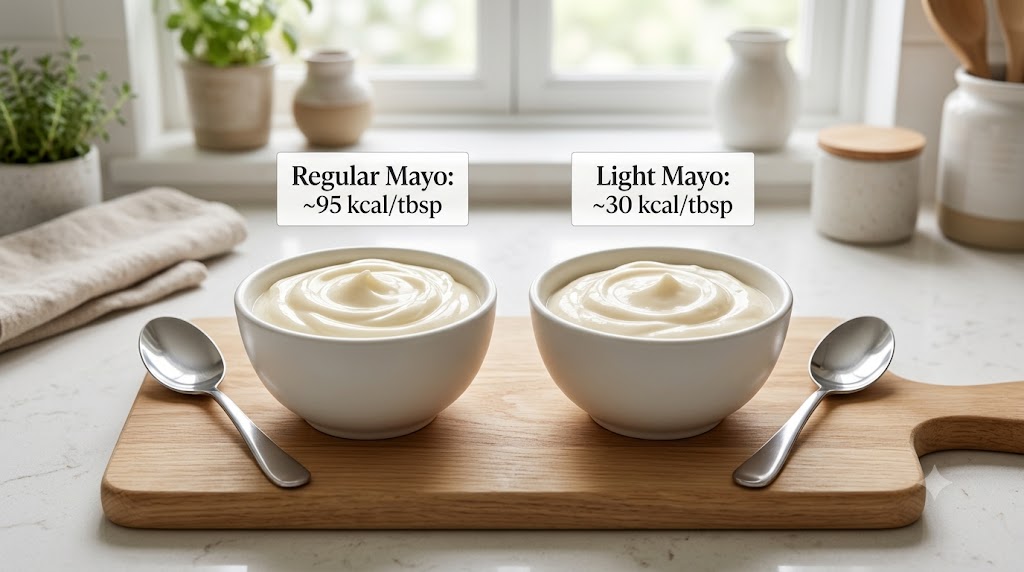
The Calorie Gap: Standard mayo calories average around 95–100 kcal per tablespoon, while mayo lite calories hover around 25–35 kcal. That is a 65% to 75% reduction per serving!
Fat vs. Carbs: Full-fat mayo contains virtually zero carbohydrates (<0.1 g) because it is almost entirely pure oil. Light and fat-free versions add 1 to 2.5 grams of carbohydrates per tablespoon due to added starches used for thickening.
Sodium Check: Lighter options often add a touch more salt (up to 120–130 mg/tbsp) to maintain flavor once fat is removed.
How Swapping Mayo Saves Major Calories Over Time
Because condiments are consumed in small amounts, it is easy to assume a spoonful does not matter. But small daily habits compound quickly.
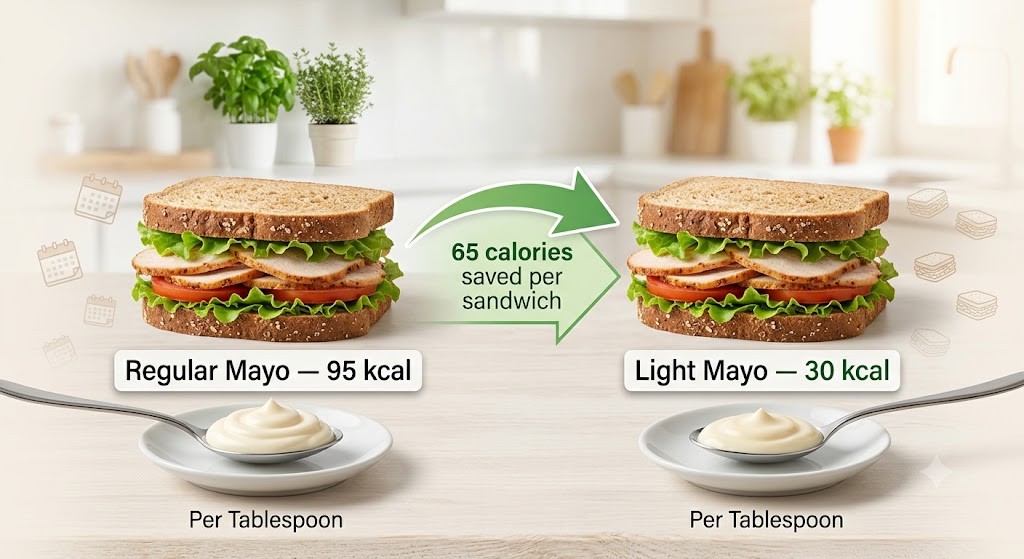
Swapping full-fat mayo for light mayo on a daily sandwich saves roughly 65 calories and nearly 8 grams of fat every single day. Here is how those savings add up over time:
Meal Application | Regular Mayo Formulation | Light Mayo Substitution | Net Calorie Reduction | Net Fat Reduction |
Daily Turkey Sandwich (1 tbsp / 14g spread) | 95 kcal / 10.3g fat | 30 kcal / 2.5g fat | 65 kcal saved | 7.8g fat saved |
Deli Tuna / Chicken Salad (3 tbsp per portion) | 285 kcal / 30.9g fat | 90 kcal / 7.5g fat | 195 kcal saved | 23.4g fat saved |
Family Potato / Egg Salad Batch (1/2 cup / 8 tbsp total) | 760 kcal / 82.4g fat | 240 kcal / 20.0g fat | 520 kcal saved | 62.4g fat saved |
Weekly Sandwich Cumulative (1 tbsp daily for 7 days) | 665 kcal / 72.1g fat | 210 kcal / 17.5g fat | 455 kcal saved | 54.6g fat saved |
Annual Cumulative Total (1 tbsp daily for 365 days) | 34,675 kcal / 3,759.5g fat | 10,950 kcal / 912.5g fat | 23,725 kcal saved | 2,847.0g fat saved |
A standard weight-management deficit of 3,500 calories roughly corresponds to 1 pound of fat mass equivalent. By making this single simple swap on one daily sandwich, you trim over 23,700 calories per year—which equals nearly 6.8 pounds of body fat mass equivalent saved annually without changing your main protein or bread choices!
3 Things to Keep in Mind Before Making the Switch

While light mayo is a great tool for trimming excess energy, keep these three quick tips in mind:
Watch Out for the "Health Halo": It is easy to think, "Since it's light mayo, I can use three times as much!" But using 3 tablespoons of light mayo (~90 kcal) equals the cost of 1 measured tablespoon of standard mayo (~95 kcal). Portion awareness still counts!
Keto & Low-Carb Diets: If you follow a strict ketogenic protocol (<20g net carbs per day), full-fat regular mayo is naturally zero-carb and fits low-carb fat targets better than light mayo, which contains added starches.
Flavor Satisfaction: If you really prefer the rich taste of regular mayo, you don't have to force yourself to eat light mayo. Simply measure out half a tablespoon of regular mayo (~47 kcal) to get the flavor you love while keeping calories manageable.
Track Hidden Condiment Calories Effortlessly with VoCal
Condiments are famous for being "invisible calories". Most people guess their serving sizes, but an unmeasured heaping spoonful of mayo off a butter knife can easily weigh 20 grams instead of 14 grams—silently turning 95 calories into 135+ calories without you realizing it!
Typing into traditional tracking apps, searching through endless brand databases, and guessing gram weights can feel like doing high school math homework at lunch.
That is why we built VoCal —the voice-activated calorie tracker designed to make food logging fast, simple, and hands-free.
Instead of typing, you simply speak naturally into your phone:
"I had a turkey club sandwich with a tablespoon of light mayo."
VoCal's smart speech engine instantly parses your meal:
Identifies the food: Turkey club sandwich.
Recognizes condiment type: Differentiates between standard mayo calories and mayo lite calories automatically.
Calculates exact macros: Logs your calories and fats in under 5 seconds.
No typing, no database searching, and no stress. Just speak, log, and keep your health goals moving forward!
Frequently Asked Questions (FAQs)
How many mayo calories are in a single tablespoon of regular mayo?
A standard tablespoon (14 grams) of regular full-fat mayonnaise contains approximately 94 to 100 calories and 10.3 grams of fat, based on USDA FoodData Central standards.
Is light mayo keto-friendly?
Light mayo contains 1 to 2 grams of carbohydrates per tablespoon from added modified food starches. While 1 to 2 grams can fit into a low-carb diet, individuals following strict ketogenic plans often prefer regular full-fat mayonnaise because it contains virtually zero carbohydrates (<0.1g).
How do mayo lite calories compare to regular mayo calories?
One tablespoon of light mayo contains about 24 to 35 calories, compared to 95 to 100 calories for regular mayo. Swapping regular mayo for light mayo cuts calories and total fat by roughly 65% to 75% per serving.
Why does light mayo have more carbohydrates than regular mayo?
Because light mayo removes a significant portion of vegetable oil, food manufacturers add water and modified food starches (or plant gums) to recreate a thick, creamy texture. These added starches contribute 1 to 2 grams of carbohydrates per serving.
How can I accurately log mayo calories when eating at local delis or restaurants?
When eating out, restaurants often use generous spreads of full-fat mayo. Using a voice tracker like VoCal allows you to speak plain sentences like "turkey deli wrap with extra mayo," and the app automatically estimates realistic restaurant preparation fat and calorie totals for you.
Disclaimer: This is for informational purposes only. For medical advice or diagnosis, consult a professional.