

Picture this: You are at a sunny backyard barbecue, catching the game with friends, or unwinding after a long work week. You reach into an ice-filled cooler and crack open a frosty "Silver Bullet". Crisp, cold, and easy to drink, Coors Light is an American classic.
If you are watching your daily macros, one question always comes up: how many beer calories Coors Light actually packs into that icy can?
Whether you are counting macros, cutting back for summer, or navigating a low-carb diet, knowing your Coors Light calories lets you enjoy social nights without sabotaging your fitness goals. Here is an easy-to-read breakdown of the calories, carbs, alcohol content, and simple tracking hacks for your next cold brew.
Table of Contents
What Is Coors Light?
Coors Light Calories by Serving Size
Where Do the Calories Come From? (Carbs vs. Alcohol)
How Coors Light Stacks Up Against Other Beers
Is Coors Light Keto and Low-Carb Friendly?
How to Burn It Off
Effortless Tracking with VoCal
Frequently Asked Questions
What Is Coors Light?
First brewed in Golden, Colorado, Coors Light is one of the most popular light lagers across the United States. It is brewed with Rocky Mountain water, Moravian barley malt, hop extract, lager yeast, and corn syrup.
Seeing "corn syrup" on the label might give you pause, but don't worry: your beer is not filled with high-fructose corn syrup. In brewing, corn syrup acts as a fermentation adjunct. The lager yeast metabolizes these sugars completely, converting them into alcohol and bubbles.
Because the yeast does its job thoroughly, the finished beer contains 0 grams of sugar. What is left is a clean, crisp beverage with a light body and low bitterness.
Coors Light Calories by Serving Size
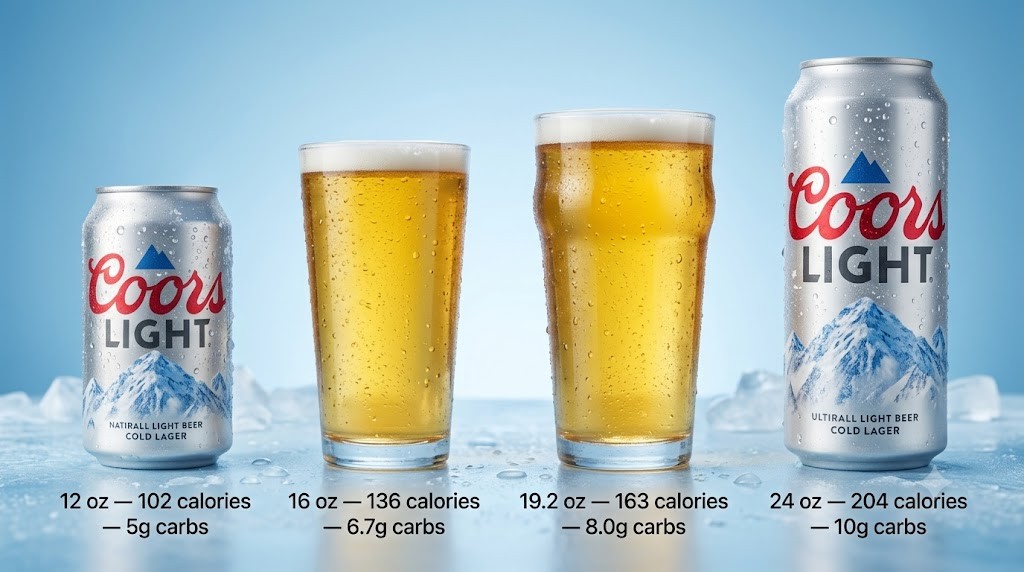
In a standard 12 fl oz can or bottle, a Coors Light contains 102 calories, 5.0 grams of carbs, less than 1.0 gram of protein, 0 grams of fat, and 4.2% alcohol by volume (ABV).
However, beer does not always come in neat 12-ounce cans. From 16-ounce draft pints at happy hour to 24-ounce tallboys at stadium games, portion sizes vary widely.
Here is how the numbers change based on your glass or can size:
Serving Container Type | Fluid Ounces (fl oz) | Metric Volume (mL) | Total Energy (kcal) | Carbohydrates (g) | Ethanol Content (g) | Standard Drink Equivalents |
Standard Can / Bottle | 12.0 | 355 | 102 | 5.0 | 11.8 | 0.84 |
Tallboy / British Pint | 16.0 | 473 | 136 | 6.7 | 15.7 | 1.12 |
Imperial Pint | 19.2 | 568 | 163 | 8.0 | 18.8 | 1.34 |
Large Single-Serve Can | 24.0 | 710 | 204 | 10.0 | 23.5 | 1.68 |
Note: Calculations assume an ethanol density of 0.789 g/mL. Standard drink equivalents are based on the National Institute on Alcohol Abuse and Alcoholism (NIAAA) standard of 14.0 grams of pure alcohol per drink.
Takeaway: Pour size matters! A single 24-ounce stadium can delivers 204 calories and 10.0 grams of carbs—the energetic equivalent of nearly two full alcoholic drinks.
Where Do the Calories Come From? (Carbs vs. Alcohol)
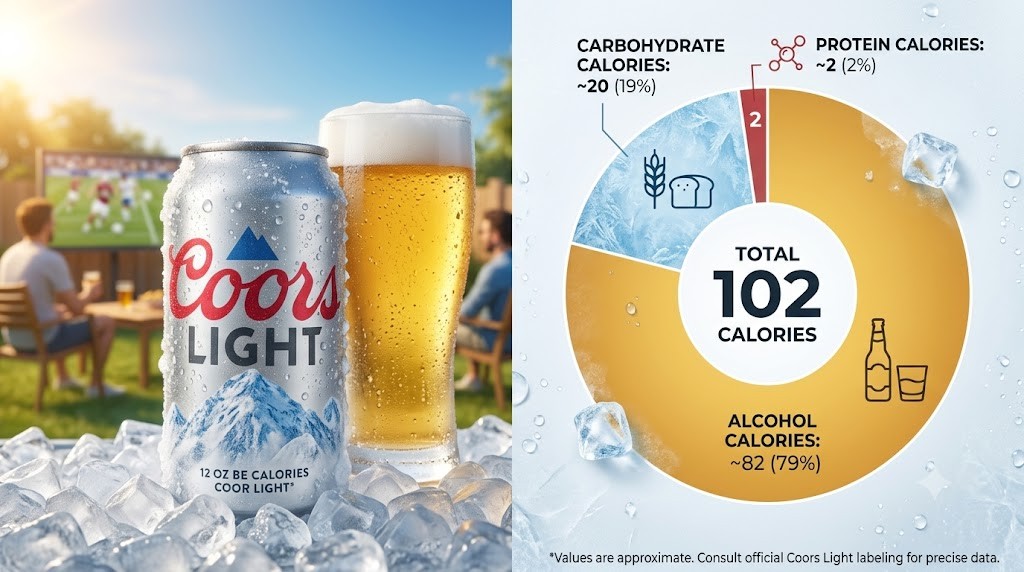
A common myth is that beer calories come purely from carbohydrates. In reality, alcohol itself is a calorie-dense macronutrient.
While carbohydrates and proteins supply 4 calories per gram, alcohol provides 7 calories per gram—almost as much as pure fat (9 calories per gram)!
In a single 12 fl oz can of Coors Light:
Alcohol: 11.8 grams of pure ethanol deliver approximately 82.3 calories, making up 79% of the total can.
Carbohydrates: 5.0 grams of complex carbohydrates (dextrins) contribute 20 calories, or roughly 19% of total energy.
Protein: Around 0.5 grams adds about 2 calories, or 2% of the total.
Because your body cannot store alcohol, your liver prioritizes clearing ethanol before metabolizing other nutrients. While your liver works on the beer, your body temporarily pauses burning dietary fat. If you are pairing your drinks with greasy appetizers, those food calories are more easily stored as body fat.
How Coors Light Stacks Up Against Other Beers
How does Coors Light compare to the rest of the beer aisle?
While standard domestic lagers and craft IPAs can easily range from 145 to well over 200 calories, light beers offer significant calorie savings.
Beverage Brand / Category | Serving Size (fl oz) | Calories (kcal) | Carbohydrates (g) | ABV (%) | Glycemic & Macro Profile |
Michelob Ultra | 12 | 95 | 2.6 | 4.2% | Ultra-low carbohydrate |
Miller Lite | 12 | 96 | 3.2 | 4.2% | Low carbohydrate |
Corona Light | 12 | 99 | 4.8 | 4.0% | Moderate-low carbohydrate |
Coors Light | 12 | 102 | 5.0 | 4.2% | Moderate-low carbohydrate |
Bud Light | 12 | 110 | 6.6 | 4.2% | Moderate carbohydrate |
Budweiser (Standard Lager) | 12 | 145 | 10.6 | 5.0% | Full-calorie domestic lager |
Coors Banquet (Full Strength) | 12 | 147 | 11.7 | 5.0% | Full-malt domestic profile |
Typical American IPA (Craft) | 12 | 200–240 | 15.0–20.0 | 6.5–7.5% | High energy, dense carbohydrate |
Takeaway: Coors Light sits in a well-balanced middle ground. It saves you 8 calories and 1.6 grams of carbs compared to Bud Light, while offering slightly more body than ultra-light options like Michelob Ultra.
Is Coors Light Keto and Low-Carb Friendly?
On a moderate low-carbohydrate diet—which public health guidelines and institutions like the Mayo Clinic define as 60 to 130 grams of carbs daily—a 12-ounce Coors Light fits comfortably, using up only 5.0 grams of your daily allowance.
For strict ketogenic protocols (usually capped at 20 to 50 grams of net carbs per day), you need to be more strategic:
Two cans take up 10 grams of carbs, which could represent up to half your daily limit.
Even if you stay within your carb budget, the alcohol will temporarily pause ketone production while your liver breaks it down. Once cleared, ketosis resumes.
How to Burn It Off
Curious about how much activity it takes to offset that cold beer?
For an average adult weighing approximately 155 pounds, burning off the 102 calories in a 12-ounce can takes:
Brisk Walking (17 min/mile pace): ~19 minutes
Weight Training: ~15 minutes
Jogging / Running (10 min/mile pace): ~8.5 minutes
Cycling (moderate pace): ~7 minutes
A casual walk around the neighborhood or a short gym session easily balances out your beverage.
Effortless Tracking with VoCal
We have all been there: you are out at a loud sports bar or hanging out with friends. The last thing you want to do is unlock your phone, open an app, search through fifty different beer entries, and scroll through serving sizes.
Because manual logging takes too much time in social settings, drinks often get skipped in food diaries. That omission can quietly derail your deficit.
That is where VoCal makes tracking simple.
Instead of typing, scanning barcodes, or taking photos of generic pint glasses, you speak naturally:
" I had two draft pints of Coors Light."
VoCal's speech-recognition engine instantly recognizes the drink, accounts for the 16-ounce draft pour, logs 272 calories and 13.3 grams of carbs, and updates your daily totals automatically.
Frequently Asked Questions
Q1: How many calories and carbs are in a regular 12 oz Coors Light?
A standard 12 fl oz can or bottle contains 102 calories, 5.0 grams of carbohydrates, less than 1.0 gram of protein, 0 grams of fat, and 4.2% ABV.
Q2: Does Coors Light contain added sugars or high-fructose corn syrup?
No. Although corn syrup is used as an adjunct during mashing, the yeast fully consumes it during fermentation, leaving 0 grams of sugar in the finished beer.
Q3: Which light beer has the fewest calories?
Among domestic light brews, Michelob Ultra has 95 calories and Miller Lite has 96 calories, placing them slightly lower than Coors Light at 102 calories per 12 oz serving.
Q4: Can I drink Coors Light while trying to lose weight?
Yes. Weight management depends on maintaining an appropriate overall energy balance. As long as the calories in Coors Light fit within your daily target, you can enjoy it in moderation.
Q5: How many standard drinks are in a 24 oz tallboy?
A 24 fl oz can of Coors Light contains roughly 23.5 grams of alcohol, which equals approximately 1.68 standard US drinks.
Disclaimer: This guide is intended for informational and educational purposes only. Always consume alcohol responsibly and in moderation in accordance with US Dietary Guidelines (up to one standard drink per day for women, up to two standard drinks per day for men). If you have underlying medical conditions or need a personalized nutrition plan, consult a qualified physician or registered dietitian.