
Building some serious "Desi" muscle while sticking to a vegetarian lifestyle used to be thought of as a challenge. But let’s be real: between protein-packed paneer, the "vegetarian meat" known as soya chunks, and a literal rainbow of lentils, the Indian kitchen is a secret weapon for bodybuilders.
To gain weight and build muscle, you need to eat more calories than you burn. For many active individuals, a 3500 calorie vegetarian indian diet plan is the "sweet spot" to fuel intense workouts and muscle repair without feeling like you're just eating "fluff."
Bottom Line
Hypertrophy (fancy talk for muscle growth) requires a consistent caloric surplus and plenty of protein to repair the tiny tears in your muscles after a heavy gym session.
Who Should Follow a 3500-Calorie Diet?

Not everyone needs 3,500 calories. If you’re sitting at a desk all day, this might be overkill. However, if you are a "hard gainer," an athlete, or someone with a physically demanding job, your body needs this extra fuel to maintain weight and build new tissue.
The 2024 ICMR-NIN (Indian Council of Medical Research - National Institute of Nutrition) guidelines actually highlight that heavy workers and active individuals need significantly more energy to stay healthy.
Bottom Line
A 3,500-calorie plan is ideal for active men, athletes, or those looking for an "aggressive bulk" to maximize lean mass gains.
Getting Your Macros Right
Calories are the energy, but macronutrients (carbs, protein, and fat) are the building blocks. For a solid muscle-building plan, you should aim for:
Protein: 10–35% of calories (around 1.6 to 2.2g per kg of body weight).
Carbs: 45–65% of calories for energy and glycogen replenishment.
Fats: 20–35% of calories for hormone health and easy calorie boosting.
In a 3,500-calorie world, that means you're looking at roughly 180–220g of protein daily.
The New Indian Standard
The latest 2024 ICMR-NIN guidelines have shifted how we look at the Indian plate, emphasizing more legumes and less refined grain.
Nutrient / Food Group | 2011 Recommendation | 2024 Recommendation | Significance for Hypertrophy |
Cereal-to-Legume Ratio | 11:1 | 3:1 | More amino acids for muscle |
Pulse/Legume Intake | Lower emphasis | Targeted increase | Primary plant protein |
Vegetable Intake | 300 g/day | 400 g/day | Micronutrient support |
Added Sugar | General restriction | <5% of total energy | Cleaner bulking |
Fiber | General advice | 25-30 g/day | Better digestion |
Bottom Line Mixing cereals (like rice/wheat) with pulses (like dal/rajma) creates a "complete protein" that rivals meat for muscle building.
Foods to Eat and Avoid
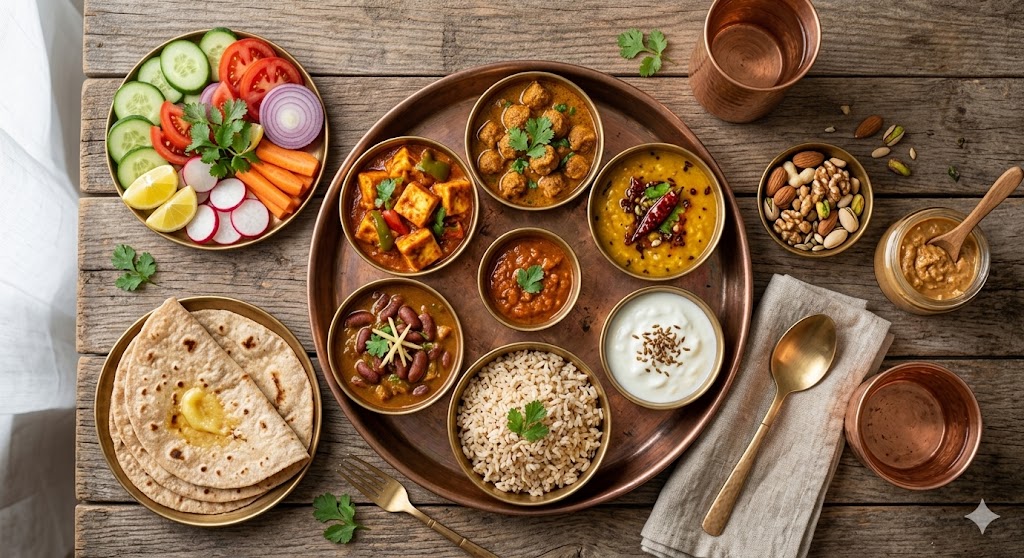
To hit 3,500 calories, you want to focus on "clean" sources. Sure, you could eat five pizzas, but that "dirty bulk" will mostly lead to fat gain rather than muscle pump.
What to Eat
Plant Proteins: Soya chunks (52g protein per 100g!), paneer, tofu, Greek yogurt, and seitan.
Complex Carbs: Millets (Ragi, Bajra), brown rice, oats, and sweet potatoes.
Healthy Fats: Ghee, nuts (almonds, walnuts), peanut butter, and avocado.
What to Avoid
Refined Sugars: Leads to insulin crashes and unwanted fat storage.
Ultra-Processed Foods: Refined flour (maida) and sugary drinks that offer "empty" calories.
Bottom Line Prioritize high-protein staples like soya and paneer while using healthy fats like ghee to bump up the calories without adding too much volume to your plate.
The 3500 Calorie Indian Vegetarian Meal Plan
Consistency is your best friend. This 6-meal structure ensures you’re in a constant "anabolic" (growth) state throughout the day.
Meal | Food Items | Approx. Calories | Protein (g) |
Breakfast (8:30 AM) | 2 Paneer Parathas with Ghee, 150g Curd, Banana & PB Smoothie | 850 kcal | 47g |
Mid-Morning Snack | 50g Roasted Soya Chunks, 30g Mixed Nuts, 1 Apple | 500 kcal | 32g |
Lunch (1:30 PM) | 1.5 cups Brown Rice, 1.5 cups Rajma, 100g Paneer Sabzi, Buttermilk | 950 kcal | 42g |
Pre-Workout (4:30 PM) | 2 Besan Chillas (stuffed with Paneer), 1 Sweet Potato, Black Coffee | 450 kcal | 20g |
Dinner (8:00 PM) | 3 Whole Wheat Rotis with Ghee, 1 cup Dal Makhani, 50g Soya Stir Fry | 550 kcal | 34g |
Bedtime (10:30 PM) | 250ml Turmeric Milk (Full-fat), 5-6 Soaked Almonds | 200 kcal | 10g |
Bottom Line
Spread your protein across 4–6 meals to maximize muscle protein synthesis and keep your energy levels steady.
Don't Forget the Micronutrients!
A high-calorie diet is great, but if you're low on Vitamin B12 or Iron, you’ll feel too tired to lift those heavy weights. Nearly 70% of Indian vegetarians are B12 deficient because it's mostly found in animal products.
Vitamin B12: Get it from milk, curd, and paneer, or consider a supplement.
Iron: Eat your leafy greens (palak) and squeeze some lemon (Vitamin C) on your dal to help absorption.
Vitamin D: Try to get some sun or take a supplement, as it's crucial for muscle function.
Tracking Made Easy with VoCal
Logging 3,500 calories of Indian food manually can be a nightmare. "How many calories are in a medium katori of dal makhani?" is a question that stops many in their tracks.
This is where the VoCal app changes the game. Instead of searching databases, you just tap a button and say, "Maine do paneer paratha aur ek bowl dahi khaya." The AI understands the dish, the portion, and the language, logging your macros in seconds . It’s 10x faster than traditional apps, letting you focus on the gym, not the spreadsheet .
Bottom Line
Consistency in tracking is the #1 predictor of success. Use voice-based tools like VoCal to stay on track with your 3500 calorie vegetarian indian diet plan without the stress .
Disclaimer: This article is for informational purposes only and does not constitute medical advice. Always consult with a qualified healthcare professional or a registered dietitian before starting a high-calorie diet or new exercise regimen, especially if you have underlying health conditions like diabetes, kidney disease, or heart issues.