

We’ve all been there: standing in the grocery store seafood section, staring blankly at cans of tuna and beautiful, pink fillets of salmon. You want to eat healthier, but a big question hits you: salmon vs tuna which is healthier?
While both of these swimming superstars deserve a spot in your shopping cart, they are actually totally different beasts when it comes to their macros, calories, and how they help you crush your health goals.
Whether you are counting calories to shed a few pounds, trying to stay in deep ketosis, or just trying to figure out which fish matches your lifestyle, we’ve got you covered. Let’s dive deep into the ultimate ocean showdown!
The Ultimate Nutrients Showdown (Macros and More)
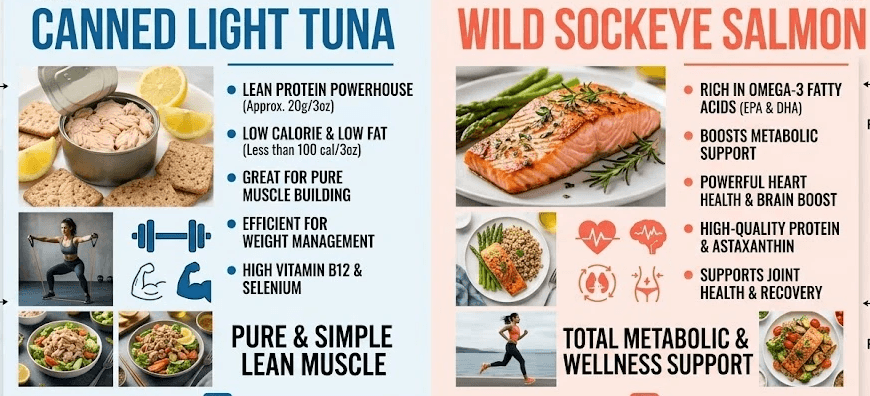
Before we talk about your fitness goals, let's look at the numbers. Tuna is famous for being incredibly lean and meaty, while salmon is loved for its buttery, rich texture.
To keep things fair, let’s compare a standard 100-gram (about 3.5-ounce) cooked portion of water-packed canned light tuna, wild sockeye salmon, and farmed Atlantic salmon:
Nutritional Parameter (per 100g) | Canned Light Tuna (Water-Packed) | Wild Sockeye Salmon | Farmed Atlantic Salmon |
Total Energy (Calories) | ~86 - 116 kcal | ~134 - 167 kcal | ~177 - 206 kcal |
Protein | ~19.7 - 29.1 g | ~22.4 - 26.3 g | ~17.0 - 22.0 g |
Total Lipids (Fat) | ~1.0 - 1.6 g | ~5.0 - 7.4 g | ~10.5 - 13.0 g |
Carbohydrates | 0.0 g | 0.0 g | 0.0 g |
Total Omega-3 Fatty Acids | ~0.1 - 0.2 g | ~1.1 - 1.5 g | ~1.5 - 2.0 g |
Total Omega-6 Fatty Acids | Trace | ~0.09 g | ~0.60 - 0.90 g |
Looking at this chart, you can see that salmon has more calories because it is a naturally fatty fish—but don't let those calories scare you! Those fats are primarily heart-healthy omega-3s. On the flip side, water-packed canned tuna is almost pure, high-quality protein with virtually zero fat.
But what about the pH balance of these proteins? If you track your Potential Renal Acid Load (PRAL) scores, sockeye salmon has a lower score of +11.85 mEq/100g compared to canned light tuna’s score of +16.61 mEq/100g. This means tuna has a slightly higher relative acid-forming potential due to its higher phosphorus-to-fat ratio. Additionally, while we don't have a formal insulin index score for salmon, tuna has a measured insulin index of just 22, which is considered very low and friendly for keeping blood sugar stable.
Tuna vs. Salmon for Weight Loss: Calorie Crusher vs. Metabolic Spark
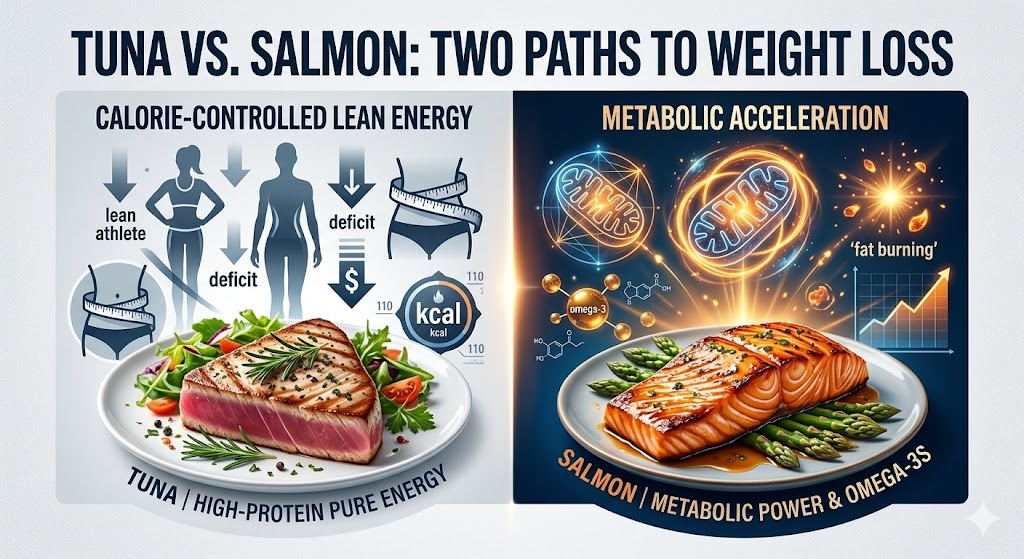
When looking at tuna vs salmon for weight loss, the right choice depends on your strategy. Are you cutting calories or trying to fire up your fat-burning engines?
Tuna: The Lean Calorie-Cutter
If your main goal is hitting a strict calorie deficit, water-packed canned light tuna is your best friend. It delivers a massive punch of muscle-building protein with almost no fats or carbs.
It is also incredibly filling! In fact, clinical trials show that eating fish protein can lead to an 11% reduction in how many calories you eat at your next meal compared to eating beef protein
Salmon: The Metabolic Spark Plug
But don't count salmon out just because it has more calories! The long-chain omega-3 fatty acids (specifically EPA and DHA) found in salmon act as natural triggers for key genes in your body. They bind to receptors called peroxisome proliferator-activated receptors and uncoupling proteins (UCP2).
This genetic team-up increases your resting energy expenditure (REE) and helps your mitochondria burn off fat as heat instead of storing it as body fat :
REE proportional to UCP2
Even better, activating these genes helps suppress ghrelin, the pesky hormone that tells your brain "I'm starving!". So, while tuna helps you cut calories today, salmon helps your metabolism burn fat more efficiently over time.
Salmon or Tuna for Keto: Staying in Ketosis
If you are on a ketogenic protocol, your main goal is to shift your liver into fat-burning mode to create ketones. To make this happen, you need plenty of healthy fats and a moderate amount of protein.
This is why deciding on salmon or tuna for keto diet is an easy win for salmon.
Salmon comes pre-packaged with the exact healthy triglycerides your liver needs to keep you in ketosis. If you try to do keto using only ultra-lean canned tuna, you might run into a metabolic roadblock called gluconeogenesis. This is when your body, starved of both carbs and fats, converts excess protein into glucose. This glucose can raise your insulin levels and knock you right out of ketosis.
The Keto Fix for Tuna
Does this mean you have to throw away your tuna cans? Absolutely not! If you want to enjoy tuna on keto, simply mix it with a high-fat, low-carb partner like extra virgin olive oil, avocado, or a generous scoop of high-fat avocado oil mayonnaise. Salmon, however, gives you those keto-friendly fats naturally.
Thyroid Support and Micronutrient Superpowers
Both fish are nutrient powerhouses, but they support your body in different ways.
Your thyroid acts as the master control center for your metabolic rate. To produce thyroid hormones like thyroxine (T4) and triiodothyronine (T3), your body needs iodine and selenium.
Direct clinical measurements show how much iodine these fish bring to the table per 100g :
Iodine in Canned Tuna=19.0 Ug
Iodine in Fresh Tuna=16.7 Ug
Iodine in Salmon=10.5 Ug
Tuna takes the crown for iodine and selenium—supplying up to 98% of your daily selenium value in just a small 50-gram serving.
But salmon completely dominates when it comes to fat-soluble vitamins. It is one of the absolute best food sources of Vitamin D3, with wild sockeye providing 91% of your Daily Value per 85g serving. Vitamin D3 is crucial for bone health, immune function, and keeping your insulin working properly. Salmon also contains 17 times more folate than tuna and small amounts of Vitamin C (which tuna lacks entirely).
The Mercury in the Room: Safety and Contaminants
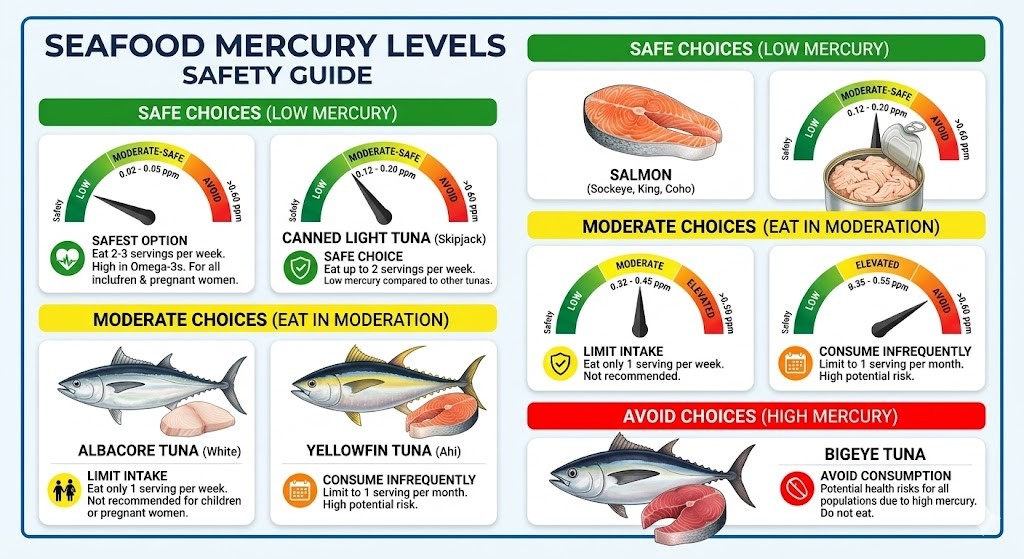
One of the biggest questions people have when adding more fish to their diet is mercury. Because tuna is a larger, predatory fish that lives longer, it bioaccumulates more methylmercury in its flesh than smaller fish like salmon.
To keep things safe and simple, the EPA recommends keeping mercury levels in seafood below 0.3 ppm. Here is how different options measure up :
Seafood Category | Average Mercury Concentration (ppm) | FDA/EPA Safety Status | Maximum Recommended Weekly Intake |
Salmon (Wild or Farmed) | ~0.014 - 0.022 ppm | Best Choice | 2 to 3 servings (~8 to 12 oz) |
Canned Light Tuna (Skipjack) | ~0.126 - 0.130 ppm | Best Choice | 2 to 3 servings (~8 to 12 oz) |
Albacore (White) Tuna | ~0.350 ppm | Good Choice | 1 serving (~4 oz) |
Yellowfin Tuna | ~0.354 ppm | Good Choice | 1 serving (~4 oz) |
Bigeye Tuna (Ahi) | ~0.689 ppm | Choice to Avoid | Avoid completely |
For general safety, salmon is an absolute superstar with virtually trace amounts of mercury. If you love canned tuna, stick to canned light (skipjack) tuna, which is made from smaller fish and has much less mercury than white albacore or yellowfin. Pregnant women, nursing mothers, and young children should completely avoid bigeye (ahi) tuna and limit albacore to once a week.
The Verdict: Which Fish Wins?
At the end of the day, salmon vs tuna which is healthier depends entirely on your personal goals:
Choose Canned Light Tuna if you want maximum protein with minimal calories, are trying to hit a tight calorie deficit, or need an affordable, pantry-stable lunch.
Choose Wild Sockeye Salmon if you are on a ketogenic diet, want to boost your heart-healthy omega-3s and Vitamin D3, or want a low-mercury option that you can eat regularly with peace of mind.
The Best Strategy? Alternate both! Rotating these two delicious fish throughout your week gives you the best of both worlds—lean protein power and rich, anti-inflammatory healthy fats.
Tracking Your Macros with VoCal
Because wild salmon, farmed salmon, and canned tuna have such wildly different macronutrient profiles, keeping an accurate food diary is crucial. Choosing oil-packed tuna over water-packed can quickly double your calories, while choosing farmed salmon over wild sockeye adds several grams of extra fats to your day.
This is where VoCal makes life incredibly easy. Instead of spending ten minutes searching databases and typing in food logs, you can track your meals using your voice. Simply speak to the app: "I just ate three ounces of drained canned light tuna in water," and Vo-cal.com instantly records your exact protein and lipid metrics. It takes the headache out of macro tracking so you can focus on enjoying your meals!
Frequently Asked Questions (FAQs)
Can I eat canned tuna every day?
It's best not to. Because of mercury concerns, the FDA and EPA recommend eating canned light tuna 2 to 3 times per week, and limiting white albacore tuna to once per week.
Why does wild salmon have a deeper color than farmed salmon?
Wild salmon eat a natural marine diet of krill and plankton, which contains astaxanthin, a powerful antioxidant that naturally dyes their flesh red. Farmed salmon would naturally be gray, so farmers add nutrients and pigments to their feed to give them their pink color.
Is canned salmon as healthy as fresh salmon?
Yes! Canned sockeye salmon is incredibly nutritious, offering amazing levels of calcium, selenium, and Vitamin D3, often with the convenience and lower price point of canned foods.
Disclaimer: Please consult a healthcare professional before starting any restrictive dietary regimen, especially if you are pregnant or managing metabolic conditions.