

Let’s face it: navigating the seafood aisle when you are pregnant, breastfeeding, or planning meals for a hungry toddler can feel like preparing for a chemistry final. You want those gold-star brain nutrients for your little one, but the word "mercury" is enough to make you put down the fish spatula and back away slowly.
The good news is that you don't have to skip the seafood counter! Eating the right fish can give your baby a massive developmental head start. It's all about knowing which fish are the safest, low-mercury superstars and how much to serve. Let's dive in and compare two of America’s absolute favorites: salmon and tuna.
Salmon vs. Tuna: The Nutritional Showdown
So, salmon and tuna for your weekly menu? It depends on your nutritional goals!
Salmon is a naturally fatty fish, which means it is absolutely swimming in those heart-healthy, brain-boosting omega-3 fats. Tuna, on the other hand, is a lean-protein champion.
If you are using a hands-free, voice-based calorie tracker like Vo-cal.com, tracking these meals is incredibly simple. Just say, "Hey VoCal, I ate three ounces of grilled salmon for lunch," and the app will instantly log your lean proteins and healthy fats.
While both fish offer exceptional high-quality protein, salmon delivers nearly 19 times the omega-3 fats found in canned light tuna. Salmon is also a great source of vitamin D and folate, while tuna brings essential minerals like magnesium and thyroid-supporting selenium to the table.
Fish Type (per 100g cooked) | Calories (kcal) | Protein (g) | Total Fat (g) | Omega-3 EPA+DHA (mg) | FDA Advice Category |
Atlantic Salmon (Fresh/Frozen) | 208 | 25.4 | 12.4 | 2260 | Best Choice |
Canned Light Tuna (Skipjack) | 116 | 25.5 | 0.8 | 120 | Best Choice |
Canned Albacore (White Tuna) | 128 | 23.6 | 3.0 | 860 | Good Choice |
Yellowfin Tuna (Fresh/Frozen) | 139 | 29.2 | 1.2 | 120 | Good Choice |
Bottom Line: Salmon is the clear winner for brain-building omega-3s and vitamin D, while canned light tuna is a fantastic, budget-friendly option for low-calorie, high-quality protein.
Why Seafood Is a Powerhouse for You and Your Baby
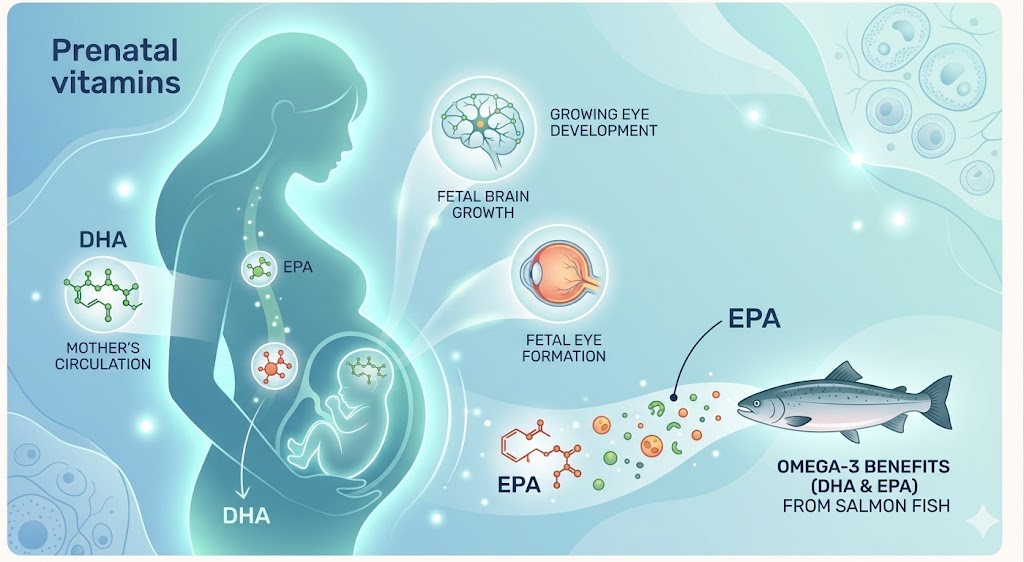
Seafood is packed with long-chain omega-3 fatty acids—specifically docosahexaenoic acid (DHA) and eicosapentaenoic acid (EPA). Think of DHA as the ultimate building block for your baby’s rapidly growing brain, eyes, and central nervous system.
In fact, getting enough omega-3s is a total game-changer for your pregnancy. A major Cochrane scientific review of nearly 20,000 pregnancies found that getting enough omega-3s reduced the risk of preterm birth (before 37 weeks) by 11% and cut the risk of early preterm birth (before 34 weeks) by a whopping 42%.
To get these incredible benefits, the U.S. Food and Drug Administration (FDA) and the Environmental Protection Agency (EPA) recommend that pregnant and breastfeeding individuals eat 8 to 12 ounces (about 2 to 3 servings) of low-mercury fish every single week.
Bottom Line: Eating 2 to 3 servings of low-mercury fish weekly during pregnancy isn't just safe—it's highly recommended by doctors to support your baby's brain and help prevent early labor.
The Mercury Mystery: Which Is Safer?
Let's address the elephant in the room: salmon vs tuna mercury levels safety.
Mercury is a natural element that can build up in oceans and rivers. Because it doesn't easily leave a fish's body, it accumulates as you go up the food chain. This means that larger, older predator fish (like sharks and swordfish) end up with much higher mercury levels than smaller, shorter-lived fish.
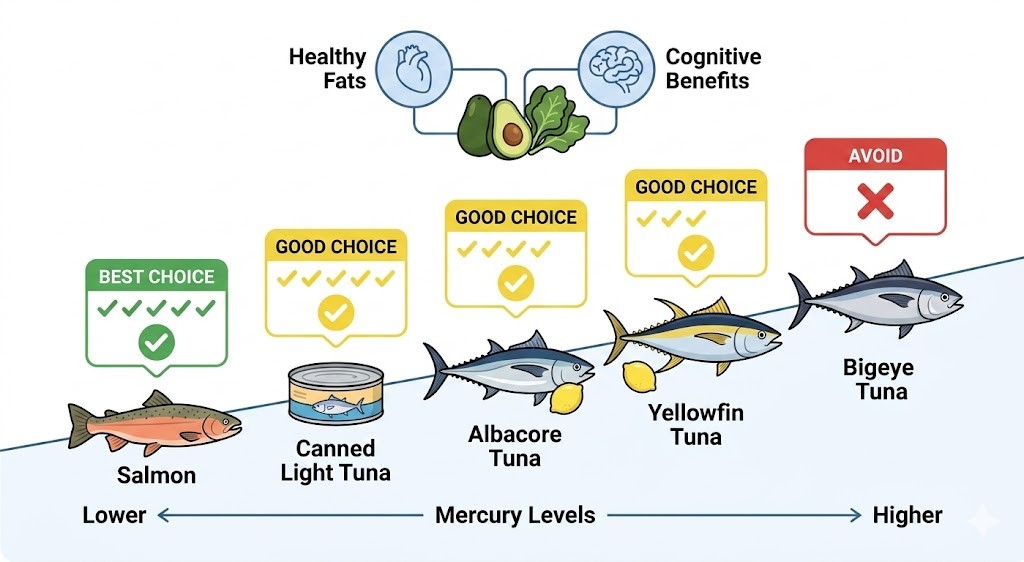
Salmon lives on a lower rung of the food chain, meaning it accumulates very little mercury. Fresh or frozen salmon averages a tiny 0.022 ppm (parts per million) of mercury, placing it safely in the FDA's premier "Best Choices" category.
Tuna is a predator, so its mercury levels are naturally higher and vary wildly depending on the species:
Canned Light Tuna (Skipjack): This is made from smaller tuna and has an average mercury level of 0.126 ppm, making it a safe "Best Choice".
Canned Albacore ("White" Tuna) & Yellowfin: These are larger fish and average around 0.350 ppm of mercury—earning them a "Good Choice" rating, but meaning they must be strictly limited.
Bigeye Tuna: This species averages a high 0.690 ppm of mercury and should be completely avoided by pregnant individuals and young kids.
Seafood Species | Average Mercury Concentration (ppm) | FDA Safety Classification | Maximum Recommended Weekly Servings |
Canned Salmon | 0.014 | Best Choice | 2 to 3 servings |
Fresh/Frozen Salmon | 0.022 | Best Choice | 2 to 3 servings |
Canned Light Tuna | 0.126 | Best Choice | 2 to 3 servings |
Canned Albacore Tuna | 0.350 | Good Choice | 1 serving |
Fresh/Frozen Yellowfin Tuna | 0.354 | Good Choice | 1 serving |
Bigeye Tuna | 0.690 | Choice to Avoid | 0 servings |
Independent testing by Consumer Reports has also shown that while canned light tuna is low in mercury on average, about 1 in 5 cans can show unpredictable, elevated mercury spikes. Because of this can-to-can fluctuation, many experts suggest making salmon your primary go-to seafood during pregnancy.
Bottom Line: Salmon is remarkably safe, with mercury levels nearly 10 times lower than canned light tuna and 15 times lower than albacore, making it the lower-risk choice.
Finding the Healthiest Fish for Pregnancy
If you're hunting for the absolute healthiest fish for pregnancy, you want a high-omega-3, low-mercury champion.
The American College of Obstetricians and Gynecologists (ACOG) and the National Institutes of Health (NIH) recommend that pregnant individuals get at least 200 to 300 mg of DHA daily.
A single 4-ounce serving of Atlantic salmon delivers over 2,500 mg of DHA and EPA—shattering your weekly pregnancy target in one delicious meal! To get that same dosage from canned light tuna, you would have to eat several cans, which would expose you to much more cumulative mercury.
This is why major medical trials, like the NIH-funded ADORE study, highlight the massive benefits of keeping healthy, fatty, low-mercury fish like salmon as a regular staple on your plate.
Bottom Line: Salmon takes the crown as the ultimate prenatal superfood because it delivers a massive dose of brain-boosting DHA with almost zero mercury worries.
Feeding Your Tiny Tot: Portion Rules for Toddlers
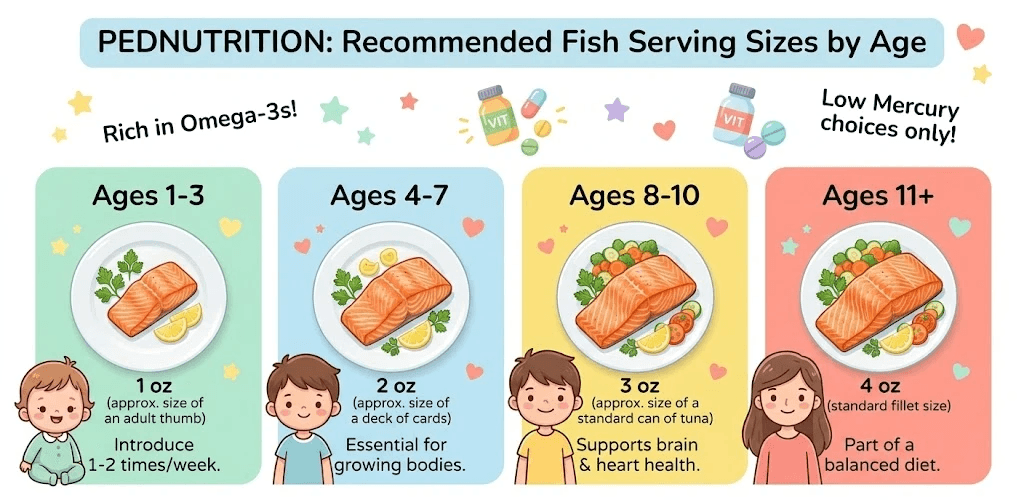
Your toddler's brain is growing at warp speed, making them highly receptive to healthy fats—but also extra sensitive to heavy metals like mercury. Because their bodies are small, their portion sizes should be too!
For toddlers aged 1 to 3, a single serving of fish is just 1 ounce. The FDA and pediatric associations recommend serving your toddler 2 portions of "Best Choices" seafood per week.
Pediatric Age Group | Target Serving Size | Weekly Serving Frequency | Recommended Species |
Ages 1 to 3 Years | 1 ounce | 2 servings | Salmon, Sardines, Atlantic Mackerel |
Ages 4 to 7 Years | 2 ounces | 2 servings | Salmon, Cod, Pollock, Tilapia |
Ages 8 to 10 Years | 3 ounces | 2 servings | Salmon, Trout, Canned Light Tuna |
Ages 11+ Years | 4 ounces | 2 servings | Broad variety of Best Choices |
While canned light tuna is approved for kids, those unpredictable can-to-can mercury spikes mean it's smart to moderate how much tuna your toddler eats. Stick to safe, reliable choices like salmon, cod, and pollock for their primary weekly meals.
Bottom Line: Toddlers only need a 1-ounce portion of fish twice a week. Stick to ultra-safe salmon to fuel their developing minds without the heavy metal worry.
Wild-Caught vs. Farmed Salmon: What’s the Catch?
When shopping for salmon, you'll likely run into the wild-caught vs. farmed debate. Both options are highly nutritious, delicious, and incredibly low in mercury, but there are a few differences in how they are raised and fed.
Farmed salmon are raised in pens and fed a calorie-dense diet, making them plumper and fattier. This means they actually have slightly more overall omega-3 fats, but they also carry more omega-6 fats and saturated fats.
Because industrial pollutants like PCBs accumulate in fatty tissue, studies have found that farmed salmon can carry higher chemical contaminant levels than wild salmon. While stricter modern regulations are closing this gap, wild-caught Pacific salmon remains the absolute gold standard for pure, clean nutrition.
Environmental & Nutritional Factor | Wild-Caught Salmon (per 3 oz) | Farmed Salmon (per 3 oz) | Clinical Implications |
Total Fat Content | 5 to 10 g | 10 to 14 g | Farmed has higher total and saturated lipids |
Omega-3 to Omega-6 Ratio | ~1:1 | 1:3 to 1:4 | Wild-caught provides superior lipid balance |
Vitamin D Concentration | 2 to 3 times more | Baseline levels | Wild-caught supports superior bone homeostasis |
Average PCB Concentration | ~4.8 ppb | ~36.6 ppb | Wild-caught exhibits lower chemical burden |
Antibiotic Exposure | Zero | Variable | Farmed salmon may carry therapeutic residues |
Bottom Line: Both farmed and wild salmon are fantastic, low-mercury choices. However, wild-caught salmon offers a cleaner nutritional profile with fewer environmental toxins, more vitamin D, and a better balance of fats.
Take These Steps: Safe Seafood Prep and Cooking
To keep your meals completely safe and healthy during pregnancy, make sure to follow these essential prep tips :
Steer clear of the big predators. Avoid shark, swordfish, king mackerel, and tilefish. They are at the very top of the ocean food chain and carry the highest levels of mercury.
Say goodbye to raw seafood. Skip the raw sushi, sashimi, oysters on the half shell, and cold-smoked fish (like lox) while you are expecting to protect yourself from harmful bacteria.
Cook it to perfection. Cook all fish to an internal temperature of 145°F. The fish should easily separate into flakes with a fork and look milky white throughout.
Understand local fish advisories. If friends or family catch fish from local lakes or streams, always check local state advisories first. If no advisory is active, limit your intake to a single 6-ounce serving for the week and don't eat any other fish.
Frequently Asked Questions
Is canned light tuna safe during pregnancy?
Yes, canned light tuna (made from skipjack) is safe to eat in moderate amounts of 8 to 12 ounces per week. However, because of occasional mercury spikes in individual cans, some pregnant individuals choose to rely primarily on salmon.
How much salmon can a pregnant woman eat weekly?
Pregnant individuals can safely eat 2 to 3 servings (8 to 12 ounces in total) of salmon per week. It is one of the absolute lowest-mercury and highest-nutrient fish available.
Can toddlers eat albacore tuna?
It is best to avoid feeding albacore (white) tuna to toddlers. Albacore is a larger species that contains about three times as much mercury as canned light tuna, which can be too much for their developing nervous systems.
What is the difference between light tuna and white tuna?
Light tuna is made from smaller skipjack tuna, which are younger and lower in mercury. White tuna is made from albacore, a larger predator fish that contains significantly more mercury.
Do prenatal vitamins replace the need for eating fish?
While prenatal vitamins are great and often contain DHA, they lack the high-quality protein, selenium, vitamin D, and choline that you get from whole seafood. Most medical experts recommend getting your nutrients from real food whenever possible.
Disclaimer: This article is for informational purposes only. Please consult your healthcare provider or pediatrician for personalized nutritional advice.