

Ah, buttered toast. Is there any breakfast comfort food quite like a warm, golden slice fresh out of the toaster, slathered in rich, melting butter? Whether you are grabbing a quick bite before heading out the door or lingering over a relaxed weekend brunch, toast is an absolute morning staple across American kitchens.
But if you are keeping an eye on your daily energy balance, you might find yourself wondering about toast with butter calories. When you stand in the bread aisle choosing between classic soft white, earthy whole wheat, or tangy artisanal sourdough, which option actually delivers the highest calorie punch?
The answer might surprise you! While we often blame the bread variety itself, slice size and butter thickness play massive roles. Let's break down the numbers, uncover the winner, and learn how to enjoy your morning toast without playing calorie guessing games.
The Quick Winner: Which Toast Has the Most Calories?
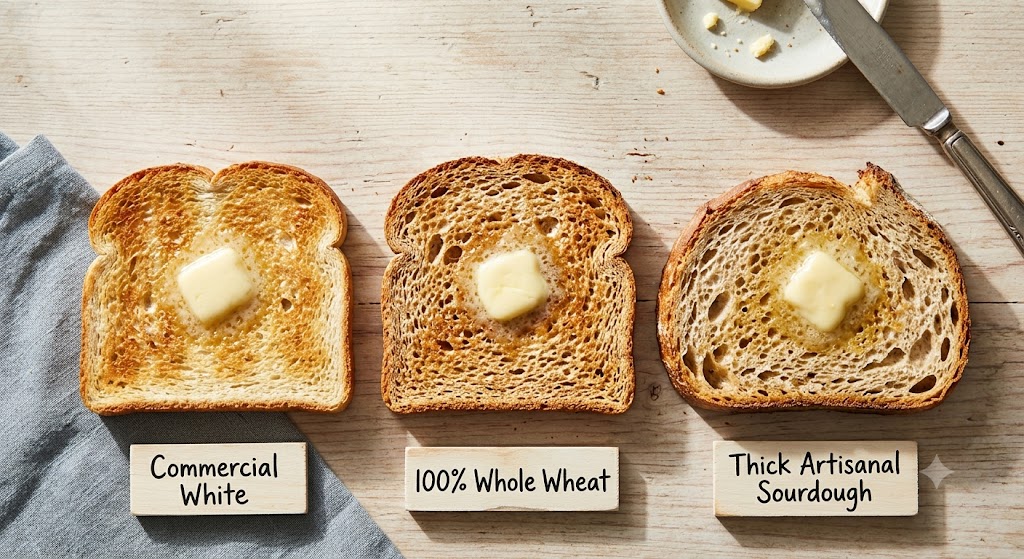
Spoiler Alert: On a slice-by-slice basis, artisanal sourdough buttered toast almost always takes the crown for the highest calorie count.
However, there is a fun catch! Gram for gram, white bread and sourdough bread have virtually the same baseline caloric density (~260 to 265 calories per 100 grams). Sourdough wins the high-calorie title simply because artisanal bakery slices are usually sliced much larger and thicker than standard packaged sandwich bread.
Here is how the main contenders stack up using official nutrient data from the USDA FoodData Central database:
Bread & Butter Variety | Average Slice Weight (g) | Base Bread Calories (kcal) | Total Carbohydrates (g) | Dietary Fiber (g) | Protein (g) | Total Fat with 1 tsp Butter (g) | Total Fat with 1 tbsp Butter (g) | Total Calories (1 tsp Butter) | Total Calories (1 tbsp Butter) |
Commercial White Bread | 28g (1 slice) | 75 kcal | 13.5g | 0.8g | 2.5g | 5.1g | 12.5g | 111 kcal | 177 kcal |
Commercial 100% Whole Wheat | 32g (1 slice) | 80 kcal | 13.0g | 2.1g | 4.0g | 5.0g | 12.4g | 116 kcal | 182 kcal |
Artisanal Sourdough Bread | 56g (1 thick slice) | 120 kcal | 25.0g | 1.0g | 5.0g | 4.6g | 12.0g | 156 kcal | 222 kcal |
Sweet Cream Butter (1 tsp) | 5g | 36 kcal | 0.0g | 0.0g | 0.0g | 4.1g | N/A | N/A | N/A |
Sweet Cream Butter (1 tbsp) | 14g | 102 kcal | 0.0g | 0.0g | 0.0g | 11.5g | N/A | N/A | N/A |
1. Classic White Toast + Butter: The Rapid Energy Boost
When you look at white bread calories, standard square sandwich loaves keep things light in slice weight. Because commercial white flour is milled to remove the grain's outer bran and germ, you are left with a light, fluffy starch that digests very quickly.
Bread Alone: One standard commercial slice (28g) comes in at around 75 calories.
With 1 tbsp Butter: Adding a standard tablespoon of butter (102 kcal) brings your total calories in a slice of white toast with butter to about 177 kcal.
Because white bread contains very little dietary fiber (under 1 gram per slice), your digestive system turns those starches into blood sugar rapidly. This causes a quick rise in insulin, giving you speedy morning energy, though you might find yourself reaching for a snack a bit sooner in the mid-morning.
Bottom Line: White buttered toast gives you quick, easy-to-digest energy, but its low fiber content means it won't keep you full as long as denser, fiber-rich options.
2. Whole Wheat Toast + Butter: The Fiber-Packed Powerhouse
When reviewing whole wheat toast calories, intact whole grains change the digestability picture. Whole wheat flour retains the nutrient-dense bran and germ, packing in natural dietary fiber and essential minerals.
Bread Alone: Whole wheat slices are usually a touch denser (around 32g per slice), giving you about 80 calories.
With 1 tbsp Butter: Combined with a tablespoon of butter, your total slice hits approximately 182 kcal.
While the total calorie count is almost identical to white toast, whole wheat brings 2 grams or more of dietary fiber and 4 grams of protein to the table. Fiber acts like a natural speed bump for digestion, slowing carbohydrate breakdown, steadying blood sugar levels, and helping you stay full longer.
Bottom Line: Whole wheat buttered toast has virtually the same calorie count as white toast, but its extra fiber and protein keep your appetite satisfied for longer.
3. Sourdough Toast + Butter: The Artisanal Heavyweight
Checking sourdough bread calories reveals why sourdough is often misjudged. Sourdough undergoes a slow fermentation process using wild yeast and lactic acid bacteria.
Biochemically, sourdough bread has a moderate energy density (~260 kcal per 100 grams). But when you buy an artisanal loaf, those rustic slices are thick! A single slice of bakery sourdough frequently weighs 56 grams or more—double the weight of a square white slice.
Bread Alone: One thick slice of artisanal sourdough contains about 120 calories.
With 1 tbsp Butter: Spread on a tablespoon of butter, and your single slice of sourdough calories with butter reaches 222 kcal.
Despite the higher slice calorie count, sourdough has fantastic gut-health perks! The natural fermentation process produces organic acids that lower the bread's Glycemic Index (GI ~48–53) and creates resistant starch, which helps nourish healthy gut bacteria and reduces post-meal blood sugar spikes.
Bread Type (1 Slice + 1 tbsp Butter) | Bread Mass (g) | Bread Calories (kcal) | Butter Calories (kcal) | Total Meal Calories (kcal) |
White Buttered Toast | 28g | 75 kcal | 102 kcal | 177 kcal |
Whole Wheat Buttered Toast | 32g | 80 kcal | 102 kcal | 182 kcal |
Sourdough Buttered Toast | 56g | 120 kcal | 102 kcal | 222 kcal |
Bottom Line: Artisanal sourdough toast usually yields the most calories in buttered toast per slice (over 220 kcal). This is due to slice thickness and loaf size, even though sourdough offers great digestion and glycemic benefits.
Don't Forget the Butter: Where the Real Calories Live

When asking how many calories in buttered toast, it is easy to focus on the bread—but the butter spread often carries more than half of the total meal's energy!
Pure butter is packed with dietary fats (9 calories per gram), meaning small differences in spread thickness add up fast:
Butter Application Level | Butter Weight (g) | Added Fat (g) | Added Saturated Fat (g) | Added Caloric Energy (kcal) |
Thin Layer (1/2 tsp) | 2.5g | 2.0g | 1.3g | 18 kcal |
Standard Light (1 tsp) | 5.0g | 4.1g | 2.6g | 36 kcal |
Full Serving (1 tbsp) | 14.0g | 11.5g | 7.3g | 102 kcal |
Generous Layer (1.5 tbsp) | 21.0g | 17.3g | 11.0g | 153 kcal |
A light scrape of butter (1 teaspoon) adds just 36 calories, whereas a generous spread (1.5 tablespoons) adds a whopping 153 calories! Overestimating or underestimating your spread by a butter-knife scoop can easily swing your morning total by 50 to 100 calories.
Track Your Toast Calories Effortlessly with VoCal
Trying to weigh irregular slices of sourdough or guess whether you used a teaspoon or a tablespoon of butter can feel like a chore. Searching through endless food databases for exact bread brands takes away the simple joy of breakfast!
That is where VoCal makes life effortless. Instead of typing, searching, and calculating portion sizes manually, VoCal lets you track your meals using your voice.
Just open the app and say:
"I had a thick slice of toasted sourdough with a tablespoon of butter for breakfast."
VoCal’s smart AI instantly understands slice thickness, estimates the butter spread, and logs your calories and macronutrients in seconds! It takes the friction out of calorie counting so you can enjoy your morning toast worry-free.
Frequently Asked Questions (FAQs)
How many calories are in a slice of white toast with butter?
A standard slice of commercial white toast with a tablespoon of butter contains approximately 177 calories (75 calories from the bread and 102 calories from the butter). If you use a lighter spread of butter (1 teaspoon), it drops to about 111 calories.
Is sourdough toast healthier than whole wheat toast?
Both have distinct health advantages! Whole wheat toast provides higher dietary fiber and protein, making it great for long-lasting satiety. Sourdough toast undergoes natural fermentation, which lowers its Glycemic Index, degrades phytic acid for better mineral absorption, and is often gentler on digestion.
Does toasting bread reduce its calories?
No, toasting bread does not change or burn off its calorie count! Toasting simply evaporates water weight from the bread slice, which slightly concentrates nutrients by weight, but the baseline calorie content remains identical whether the slice is soft or toasted
.
How can I lower the calories in buttered toast without giving up flavor?
To reduce overall energy intake while enjoying buttered toast:
Use Whipped Butter: Whipped butter contains incorporated air, giving you the same spreadable volume with about 30% fewer calories per tablespoon.
Opt for Thin-Sliced Bread: Choosing thin-sliced varieties keeps your base slice around 60 to 70 calories.
Try a Scrape Instead of a Scoop: Spread butter immediately while the toast is piping hot so a smaller amount (1 teaspoon, 36 kcal) melts across the entire surface easily.
Disclaimer: This content is for informational purposes only. For medical advice, diagnosis, or personalized dietary planning, please consult a qualified healthcare professional or registered dietitian.