

Ah, buttered toast. It is the undisputed champion of quick breakfasts, late-night snacks, and cozy comfort food. It sounds so simple: toast a slice of bread, spread some golden butter on top, and enjoy.
But if you are keeping an eye on your daily intake, you might wonder: How many calories are actually in toast with butter?
The short answer? A single slice of buttered toast usually lands anywhere between 114 and 250+ calories. Why such a huge gap? Because the slice size, the type of bread, and just how heavy-handed you are with the butter knife make a massive difference.
Let's break down the numbers, bust a few diner myths, and show you how to enjoy your toast without playing guessing games.
The Butter Breakdown: 1 Teaspoon vs. 1 Tablespoon
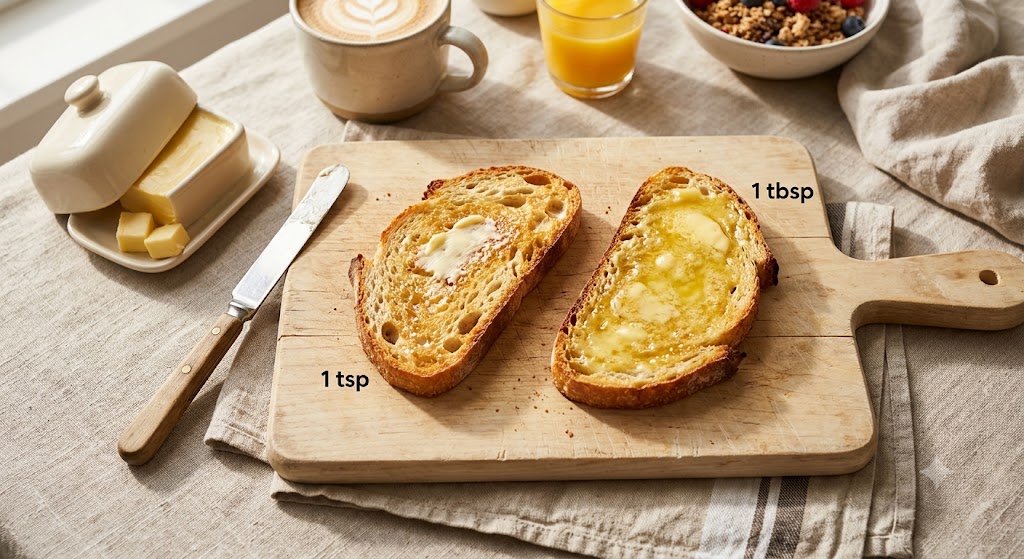
The biggest variable on your toast isn't the bread—it’s the fat spread. Butter is pure energy density, packing around 717 calories per 100 grams. Because fat delivers 9 calories per gram (compared to 4 calories per gram for carbs or protein), a "little extra spread" adds up fast.
Here is how standard butter portions stack up according to USDA data:
1 Teaspoon (4.7g): 34 calories, 4.0g fat, 2.0g saturated fat.
1 Tablespoon (14.2g): 102 calories, 11.5g fat, 7.0g saturated fat.
Upgrading from a modest scrape (one teaspoon) to a heavy spread (one tablespoon) triples your added fat calories, tossing an extra 68 calories onto a single slice!
How Different Fat Spreads Compare
Not all butter is created equal! Changing how butter is made or processed changes its weight per spoon:
Fat Type & Portion | Energy (kcal) | Total Fat (g) | Saturated Fat (g) |
|---|---|---|---|
Butter, Stick (1 tsp / 4.7g) | 34 | 4.0 | 2.0 |
Butter, Stick (1 tbsp / 14.2g) | 102 | 11.5 | 7.0 |
Butter, Whipped (1 tbsp / 9.4g) | 67 | 7.6 | 4.8 |
Ghee / Clarified (1 tsp / 5.0g) | 44 | 5.0 | 3.1 |
Ghee / Clarified (1 tbsp / 13.0g) | 114 | 12.9 | 8.1 |
Pro Tip: Whipped butter has air whipped right into it. That means a tablespoon weighs less, slashing calories by about 34% while giving you the exact same visual coverage! Ghee (clarified butter), on the other hand, has water and milk solids removed, making it slightly more calorie-dense.
White, Sourdough, or Wheat: Which Toast Has the Most Calories?
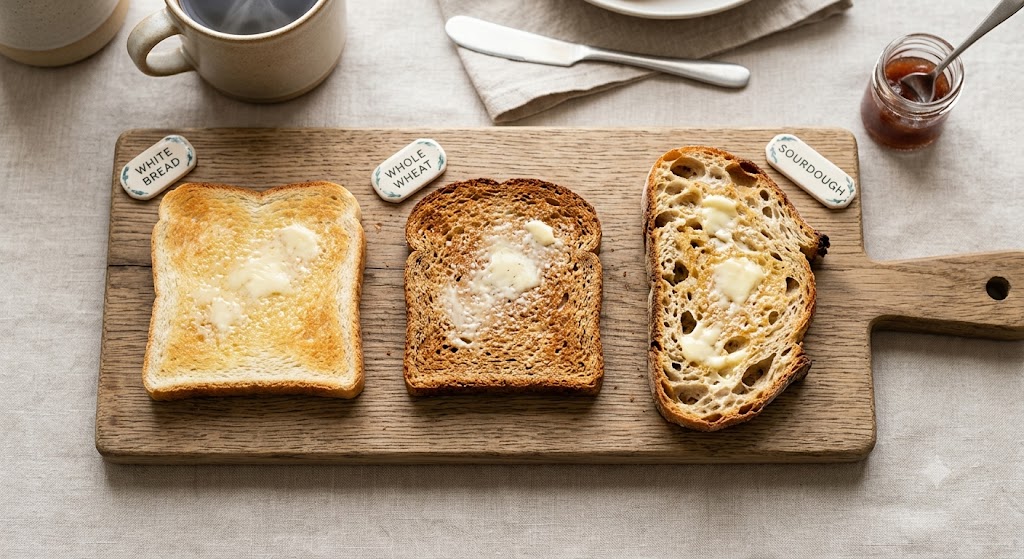
Now let's talk about the substrate: the bread. Milling techniques, grains, and fermentation all play a role in how a slice of bread behaves in your body.
Commercial White Bread: Made from refined wheat flour without the fibrous bran or nutrient-rich germ. A standard 30-gram slice is about 80 calories. It digests quickly and has a higher Glycemic Index (GI of 71).
100% Whole Wheat Bread: Keeps the whole grain intact. A standard 30-gram slice sits at about 80.6 calories and almost 2 grams of dietary fiber, helping you feel fuller for longer.
Artisanal Sourdough Bread: Made through natural fermentation. A 30-gram slice comes in around 90 calories. Even though it has slightly more carbs, its fermentation gives it a lower Glycemic Index (GI of 54), meaning smoother energy without a huge blood sugar spike.
Bread Variety Breakdown
Bread Base Variety | Slice Weight | Energy (kcal) | Carbohydrates (g) | Fiber (g) | Glycemic Index (GI) |
|---|---|---|---|---|---|
Commercial White | 30 g (Standard) | 80.0 | 14.7 | 0.80 | 71 |
Commercial White | 43 g (Thick Cut) | 114.0 | 21.1 | 1.15 | 71 |
Whole Wheat | 30 g (Standard) | 80.6 | 13.7 | 1.92 | 71 |
Artisanal Sourdough | 30 g (Standard) | 90.1 | 19.0 | 1.01 | 54 |
Whole Grain Sourdough | 100 g (Bulk) | 220.0–230.0 | 41.0 | 6.50 | 48–52 |
When you put it together with 1 teaspoon of stick butter (34 kcal):
White Toast with Butter: ~114 calories
Whole Wheat Toast with Butter: ~115 calories
Sourdough Toast with Butter: ~124 calories
Sweetening the Deal: Toast with Butter and Jam Calories
If you love a sweet-and-savory combo, adding jam or jelly is likely part of your morning ritual. But keep in mind that fruit preserves add concentrated simple sugars to your lipid-starch base.
A standard tablespoon of fruit jam adds roughly 50 calories and 12 grams of sugar.
Assembly Composition | Bread Base (kcal) | Butter Spread (kcal) | Jam Portion (kcal) | Total Energy (kcal) |
|---|---|---|---|---|
Light White Assembly | 80 (30g White) | 34 (1 tsp Butter) | 17 (1 tsp Jam) | 131 |
Standard Wheat Assembly | 81 (30g Wheat) | 34 (1 tsp Butter) | 50 (1 tbsp Jam) | 165 |
Classic Sourdough Assembly | 90 (30g Sourdough) | 102 (1 tbsp Butter) | 50 (1 tbsp Jam) | 242 |
Heavy Diner Assembly | 114 (43g Thick White) | 102 (1 tbsp Butter) | 75 (1.5 tbsp Jam) | 291 |
The Diner Secret: Why Restaurant Buttered Toast Hits Different
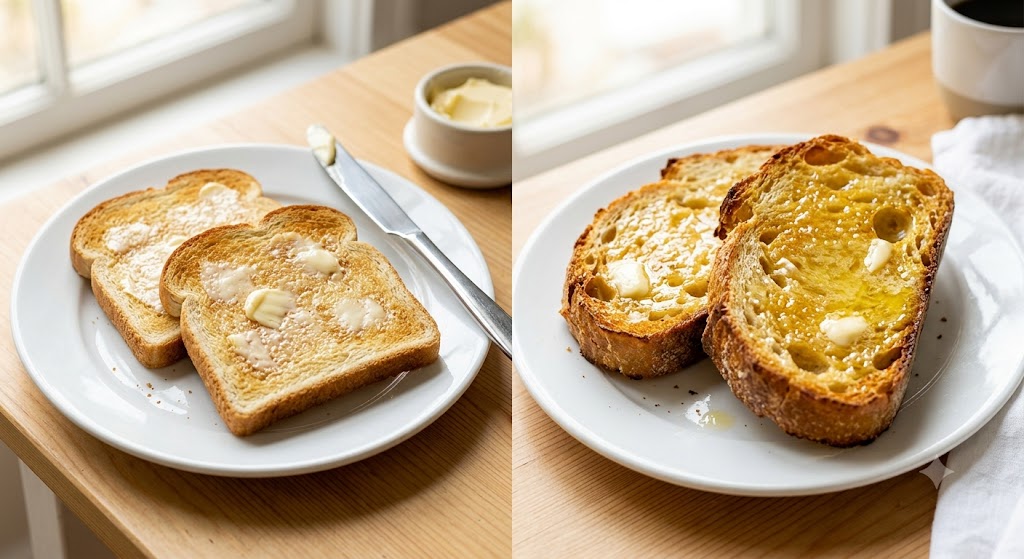
Have you ever noticed that diner toast tastes amazing, but seems to ruin your calorie budget? There is a culinary secret behind that!
Griddle Magic: Diners usually throw bread onto a hot flat-top griddle coated in liquid butter or oil, soaking both sides.
Thicker Slices: Restaurants often use thick-cut bread (like Texas Toast), which weighs 43–50g per slice instead of the standard 30g.
The Melt Trap: Warm melted butter sinks deep into bread pores. Because you can't see it, it's easy to add even more butter pats at the table!
Household vs. Restaurant Preparation
Culinary Parameter | Household Preparation | Restaurant / Diner Preparation |
|---|---|---|
Mean Slice Mass | 30 g (Standard slice) | 43–50 g (Thick-cut loaf profile) |
Application Method | Top-side scrape with cold butter | Dual-side griddle oil or melted brush coating |
Estimated Fat Volume | 1 tsp (4.7g) per slice | 1.5 to 2.0 tsp (7–10g) per slice |
Base Bread Energy | ~80 kcal | ~114–135 kcal |
Added Fat Energy | ~34–67 kcal | ~70–140 kcal |
Total Energy per Slice | 114–147 kcal | 184–275+ kcal |
Saturated Fat & Heart Health: What to Keep in Mind
Butter brings incredible flavor, but it is high in saturated fat (about 51g per 100g).
The Dietary Guidelines for Americans recommend keeping saturated fat to under 10% of your daily calories. On a standard 2,000-calorie diet, that limit is about 20 grams per day.
Since one tablespoon of butter contains 7 grams of saturated fat, a single heavy slice of toast covers 35% of your daily limit! If you are watching your heart health or cholesterol levels, consider swapping butter for extra virgin olive oil or mashed avocado on some days.
Track Toast in Seconds with VoCal
Let's be honest: melted butter is invisible fat. Trying to search database drop-downs for "toast, white, toasted, buttered, medium butter" can turn calorie logging into a chore.
That is where VoCal changes the game.
VoCal is an AI voice-based calorie tracker that lets you speak naturally instead of tapping through endless search menus.
Just tap the mic button and say:
"I had two slices of sourdough toast with two teaspoons of whipped butter and a tablespoon of strawberry jam."
VoCal’s natural language processing breaks down your sentence automatically:
Identifies your bread type and weight.
Adjusts for aerated spreads like whipped butter.
Calculates added toppings like jam.
No manual entry, no math, no stress. Just talk and keep moving with your day!
Frequently Asked Questions (FAQs)
How many calories are in 2 slices of white toast with butter?
Two standard slices of white bread (160 kcal total) with 1 teaspoon of butter on each slice (68 kcal total) equal roughly 228 calories. If each slice gets a full tablespoon of butter, the total rises to 364 calories.
Is sourdough toast with butter better for weight loss?
Sourdough has a lower Glycemic Index than refined white bread, meaning it digests slower and provides steady energy without dramatic blood sugar spikes. While calorie counts are similar, sourdough can help keep cravings at bay longer.
How can I lower the calories in my buttered toast?
You can easily shave off calories by:
Switching to whipped butter, which saves ~34% calories per tablespoon.
Using a measuring spoon to keep butter portions to 1 teaspoon per slice.
Asking for "dry toast" when dining out so you can control your own butter application.
Disclaimer: This article is for informational and educational purposes only and does not constitute medical, nutritional, or healthcare advice. Always consult with a qualified healthcare professional or registered dietitian before making significant changes to your diet or health regimen.